GROW
A book for plants, to encourage growth.
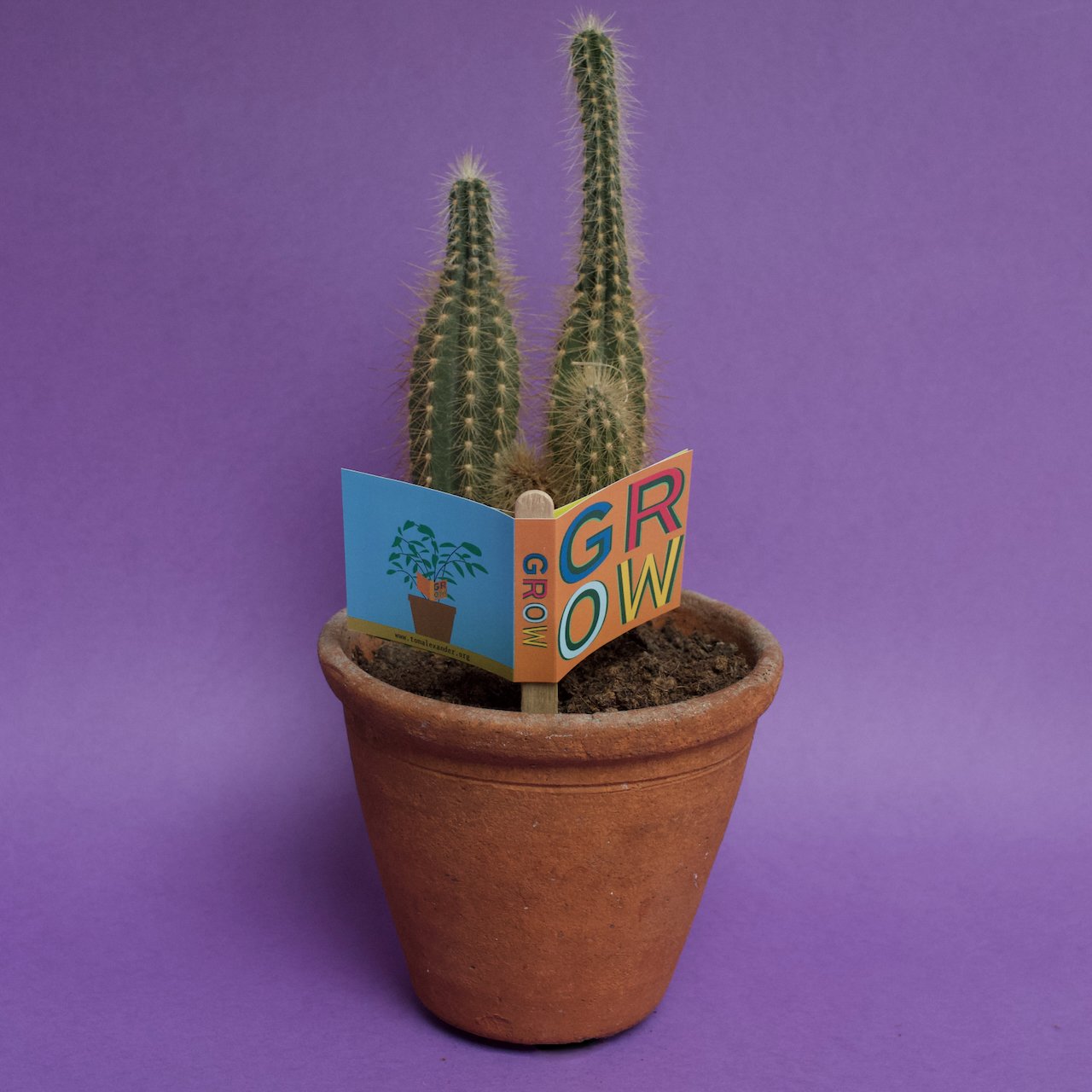
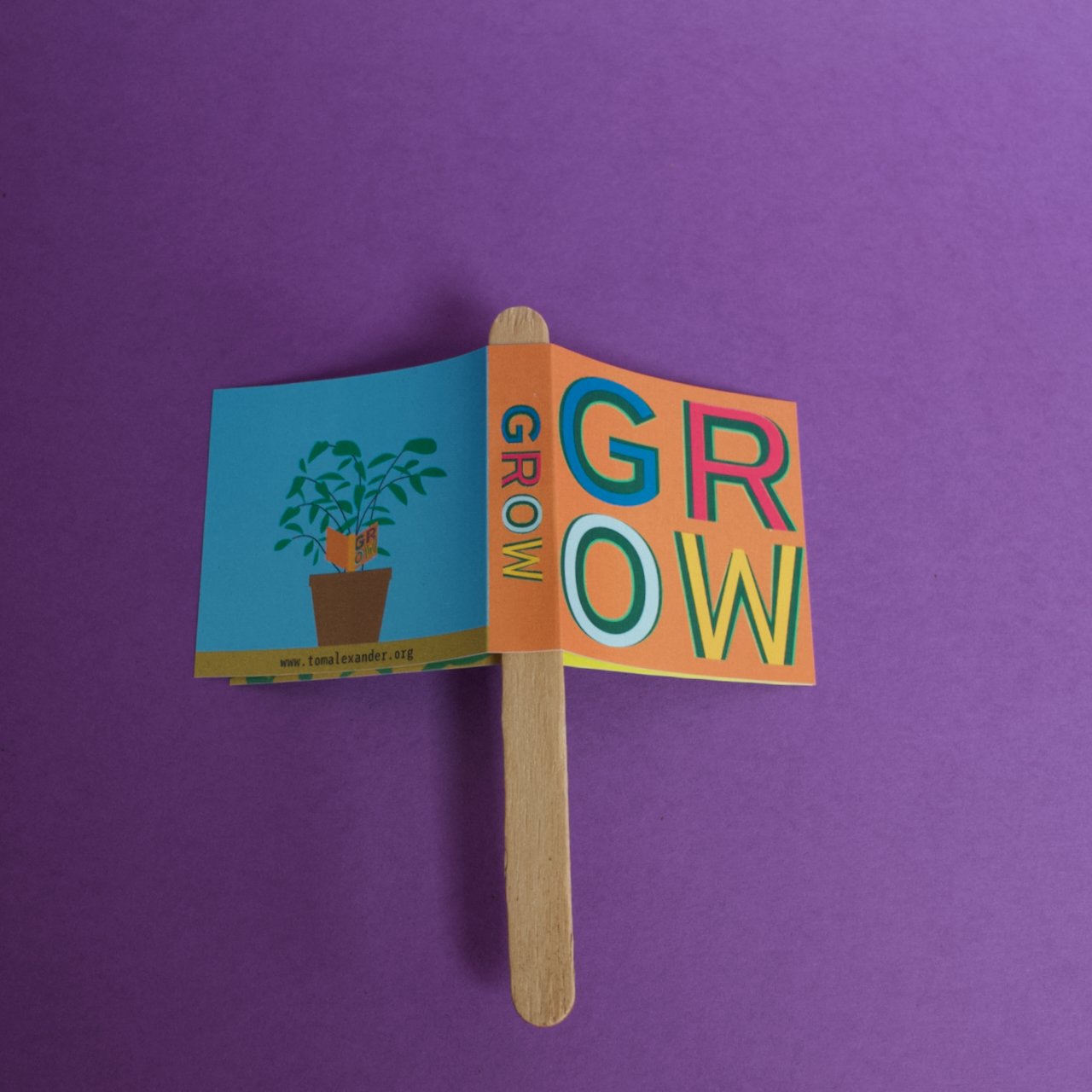
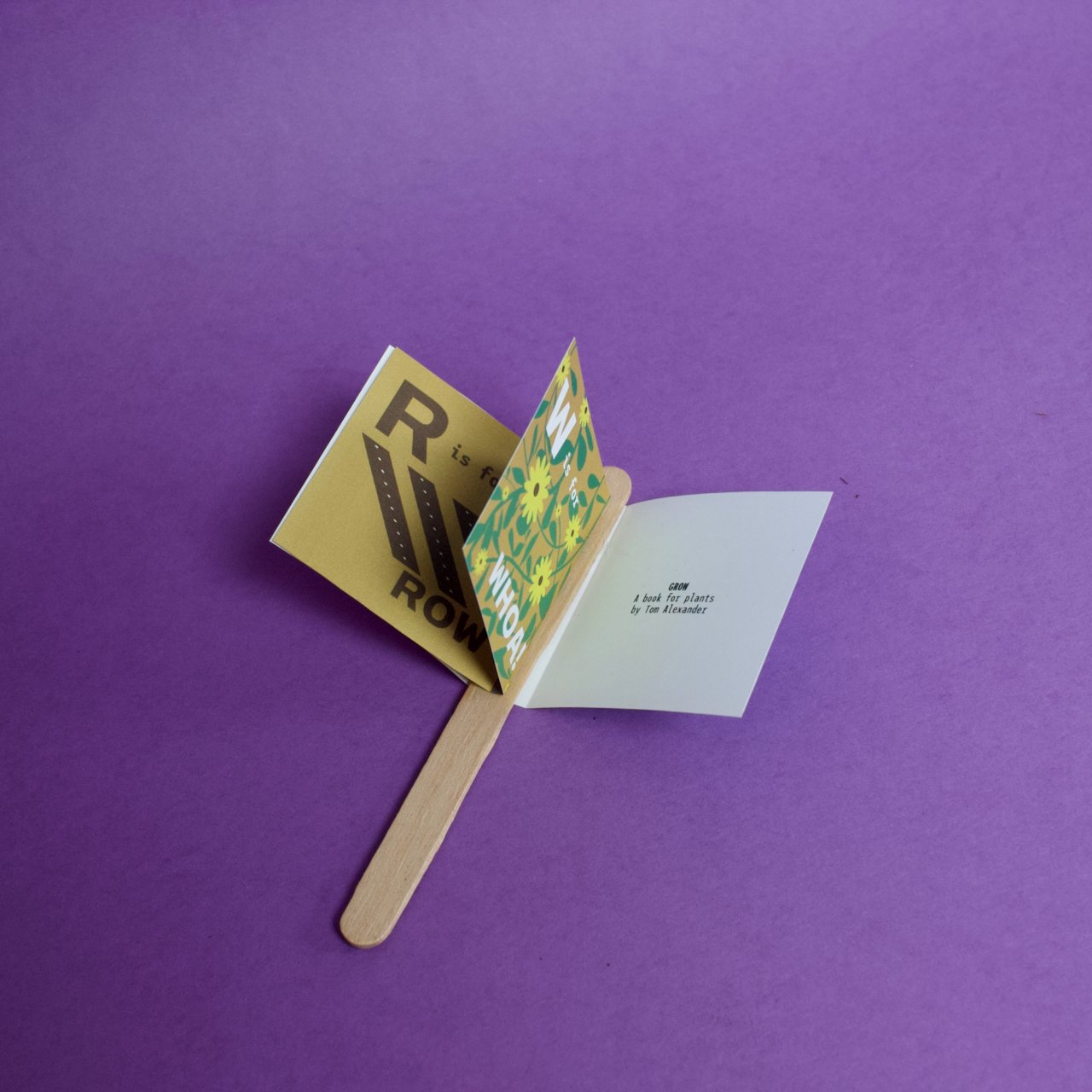
Paper and Wood, 115 x 10 x 50 mm
Overview
A book for plants, to encourage growth
Background
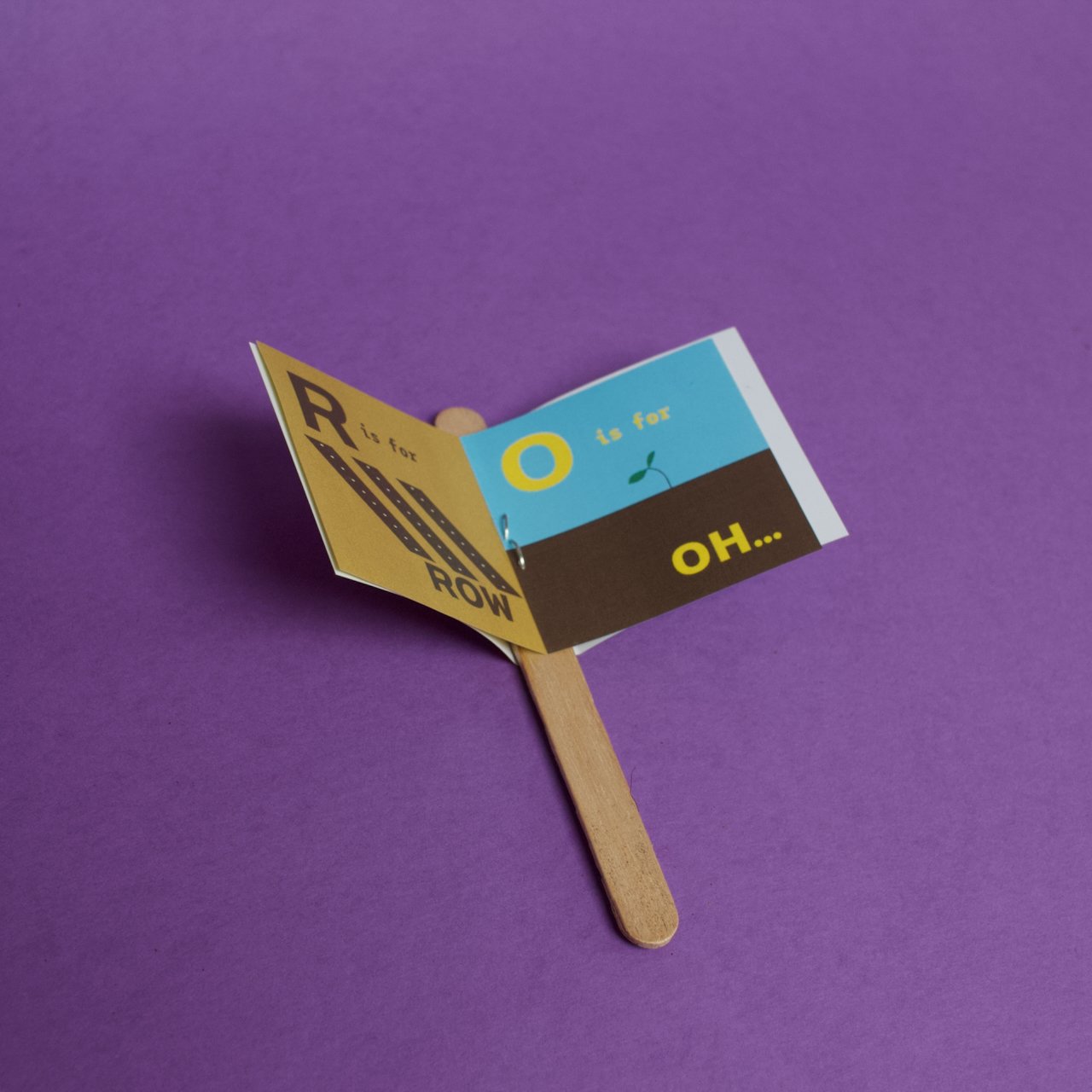
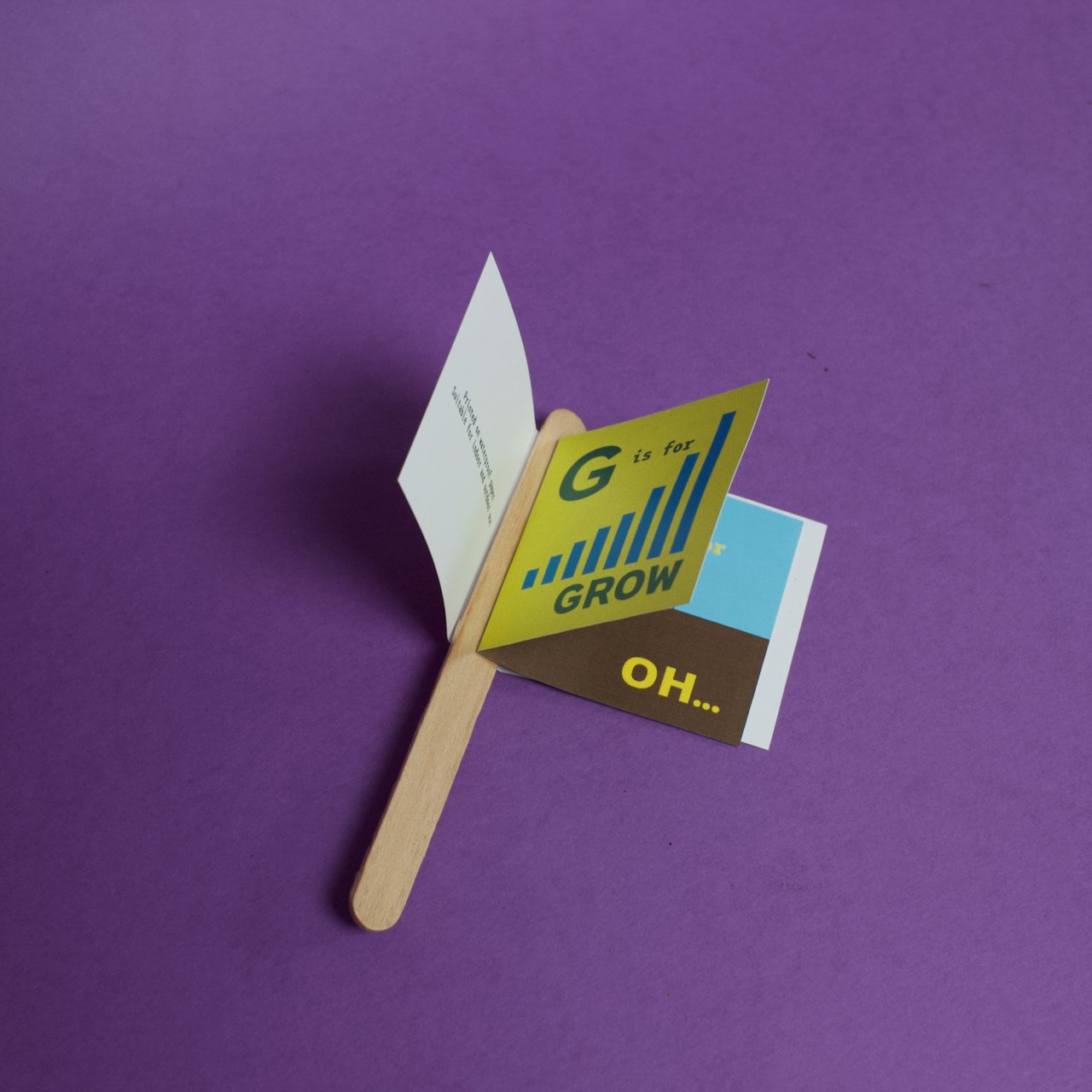
These little paperback pamphlets are printed on waterproof paper, which means they should survive outdoors or at least a watering or two. The simple story encourages even the most remedial plants to strive for more. There was originally going to be a more complex narrative and perhaps even a range of plant books for different species at different stages of their lives. Eventually, though, I hit upon the (fairly stupid) schema used in the book:
G is for Grow
R is Row
O is for Oh…
W is for Woah!
Which is pretty silly, but made me chuckle.
Construction was mostly about figuring out which way to put the staples and whether the book needed a ‘spine’ or not. In the end, I decided to cover the stick with the book title. I figured it was more aesthetically pleasing. A heavy duty staple binds it and hot glue is osed to cover that staple with the cover.
Six Six Six
One hundred and eleven six-word stories about hell, in three editions.


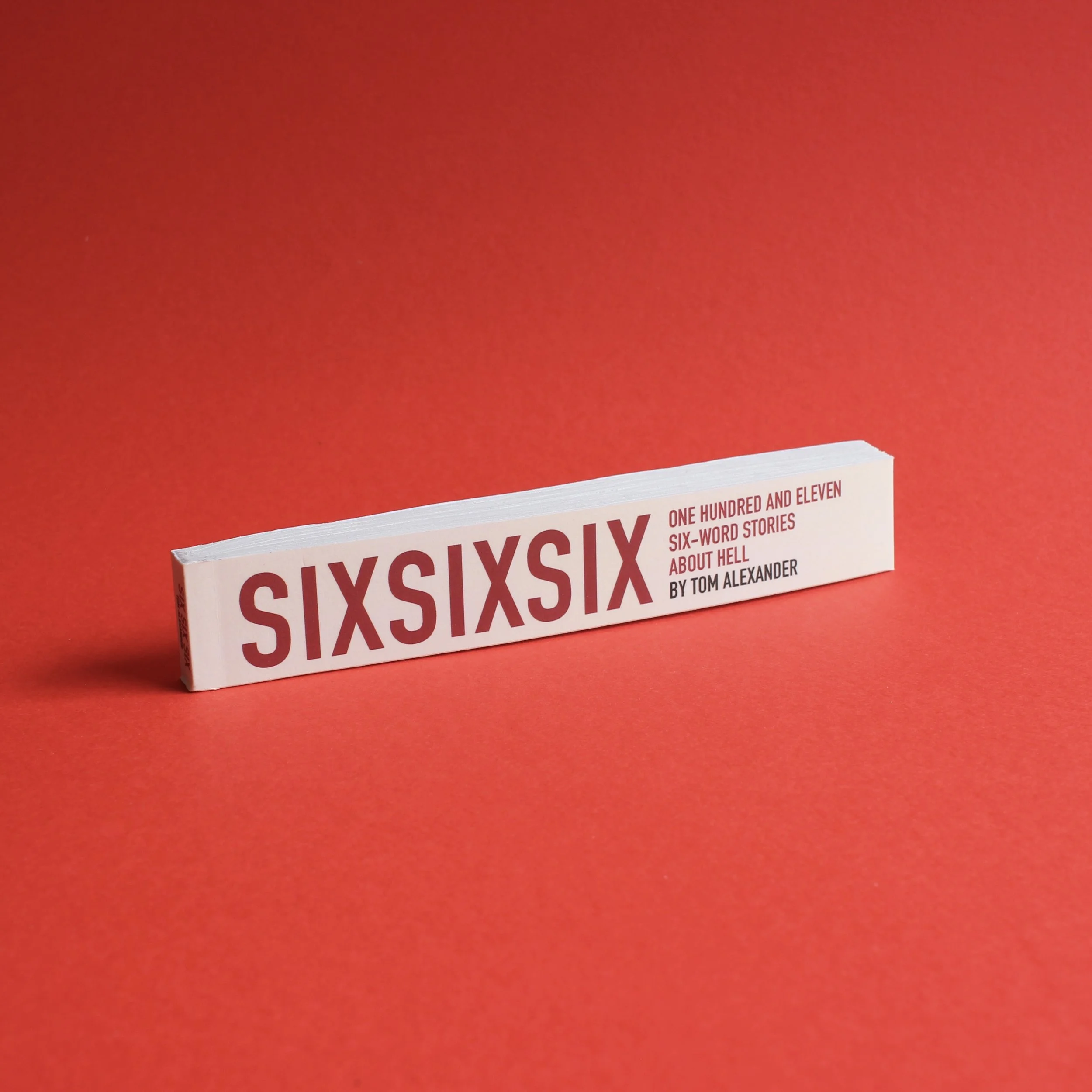


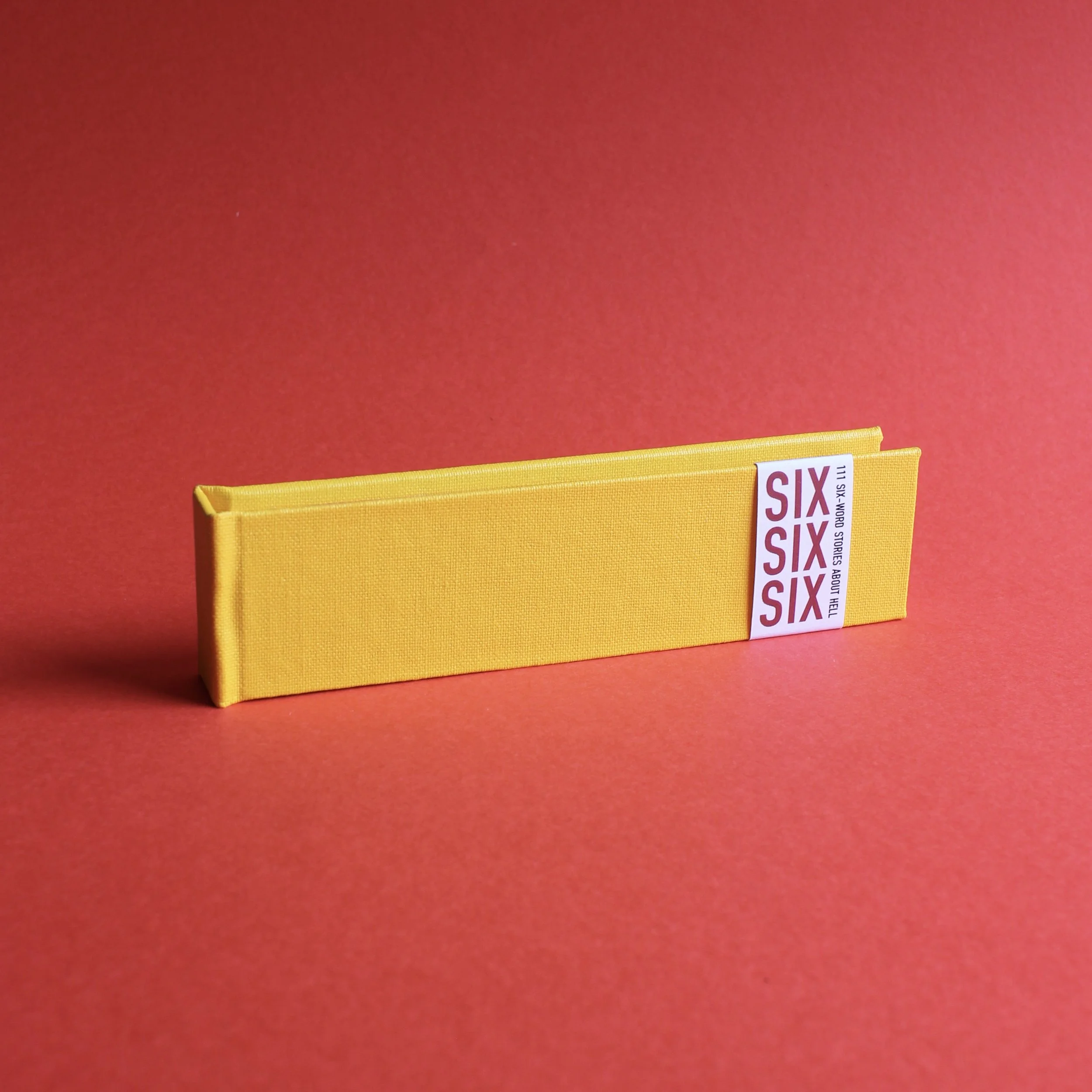
One hundred and eleven six-word stories about Hell. This is one of only 6 handmade limited edition hardbacks telling the story of Lucifer’s exile from heaven, his reinvention as Satan and his infernal revenge against those that wronged him. But, y’know, funny.
Hardback, 145 x 37 x 10mm
Paperback, 151 x 25.4 x 10mm
ebook, PDF format
Overview
One hundred and eleven six-word stories about Hell, in three editions.
Background
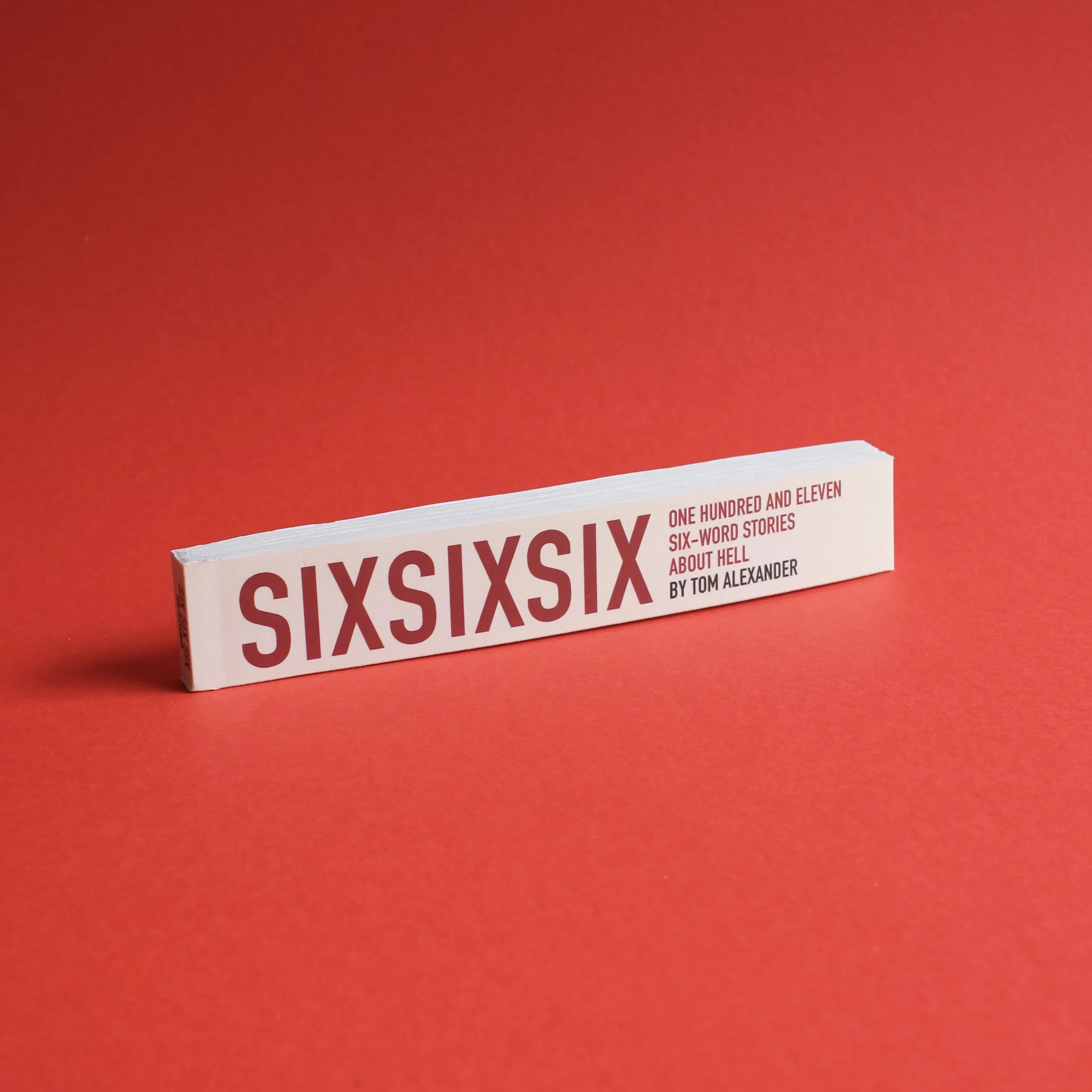
One hundred and eleven six-word stories about Hell. This is one of 60 limited edition paperbacks telling the story of Lucifer’s exile from heaven, his reinvention as Satan and his infernal revenge against those that wronged him. But, y’know, funny.
I really like projects with constraints. When I made films, some of the best work we did was in projects where we were given briefs with tight parameters, most notably shooting and editing within 48 hours. Those pieces were inventive and had a kind of manic energy to them which wouldn’t have been possible if they’d had more time or resources. I’ve often set myself guidelines to follow trying to chase that high, sometimes successfully and sometimes… not. Perhaps it’s getting older, but I’ve come to appreciate a bit of time to think, to ruminate and reflect on the work. Perhaps that means it doesn’t have the raw energy of more frenzied projects, but I think for the most part it does mean it comes out better. Maybe.
But there is something appealing about projects which fit within certain parameters. Those don’t have to be time based. In fact, I’ve found myself less able to work to those self-imposed deadlines for anything more than three days. (The last one was the 3 Day Novel Competition, which produced a novella I was pretty pleased with. It didn’t win, but did make the shortlist.) When it goes beyond that short intense burst, other things sort of get in the way and I can’t make it work. That said, sometimes you see something where the pieces fit together perfectly in your head. So it was with Six Six Six. I’ve been thinking about the six word story for a while now, mostly due to my friends at TYPE! magazine, who feature them in their brilliant bookmark literary journal. Obviously, I could have just written some six-worders and submitted them, but my grandiosity wouldn’t allow for it. Instead, this project came to mind, based first of all on the maths. One hundred and eleven six word stories equals six hundred and sixty six words total. That, obviously, is the Number of the Beast, so it made perfect sense to do a connected series of tiny stories about the Dark Lord himself. I’d make it into a book that would have 666 copies and sell them for £6.66 each.
And that’s what I’ve done. Almost. Some things have changed along the way. In the process of prototyping the physical books, it became clear that I had to make some hardback copies. I wasn’t about to do 666 of them though, so the idea of separate printings came to mind. There would be six hand-made hardbacks, sixty mass-produced paperbacks and then it seemed obvious to make six hundred ebooks. The pricing was obvious: £66.60 for the handmade books, £6.66 for the paperbacks and 66p for the ebooks.
Writing the stories was fun. I did it piecemeal over several months, jotting down any half-idea that came to mind and spending an hour or so twisting them into shape. Six words isn’t a lot, but it allows for a surprising amount of variation and experimentation. When I started amassing an amount of stories of what I thought was a decent quality, I started looking at the overall structure of the story. It’s basically Lucifer: My Fall and Rise of Lucifer, although I must say that my knowledge of the story comes more from popular culture than it does from scripture. Milton scholars should look elsewhere. I think it’s pretty entertaining, though, and I’m pleased with how it came out. The niceness of the hardbacks was a surprise and I’ve learned a lot about bookbinding through doing it. It’s another tiny fiddly project, though, and I’ve promised myself that next time I’m going to make something larger so I’m not dealing with teeny-tiny margins for error. I am almost certainly going to ignore my own advice, though.
Enormous thanks should go to the brilliant Jemima Kingsley, who created the system that allows me to sell individually numbered PDFs for next to nothing. Anyone looking for any sort of technical solution to a problem should hire her.
Context is Everything
A proposed financial awareness app that gives you insight into your spending.


Video, 2min, 2024
Overview
A proposed financial awareness app that gives you insight into your spending.
Background
I submitted a proposal for the 2024 Future of Money Design Awards about an idea that had been knocking around my head for some time. It’s an app called Context that would sit on top the contactless payment systems we all use every day, providing insights into where we spend our money. On a basic level this could include things like how the company treats its employees, its environmental record or whether they avoid tax. It would also make more philosophical comparisons about how that money might be used elsewhere in society or what it would mean to someone else in different economic circumstances.
The proposal was shortlisted and I was given a small budget to make it into a film. My initial idea was basically to read out the proposal with some demonstrative graphics, but my absolute horror at hearing my own voice recorded meant I went a different route. The final version uses stock footage and a mock up of the app and shows it at work. Nothing fancy, but gets the point across.
I attended an event at the Museum of London and was pleasantly surprised to be awarded first prize in a poll taken among the financial poobahs in attendance, meaning I got this nice shiny thing to put on my mantelpiece.
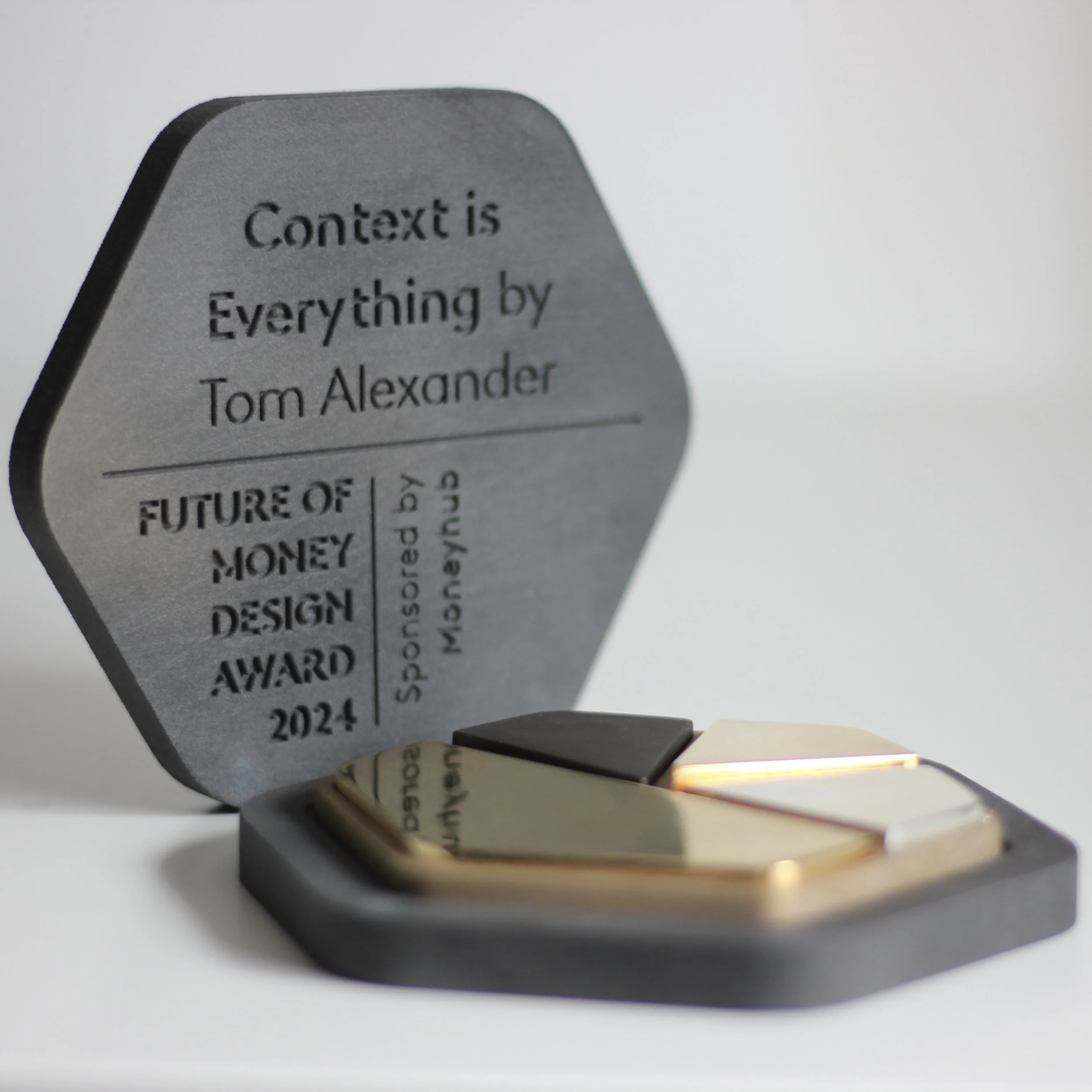
Details of the competition can be found at www.futuremoneyaward.com and the whole thing was sponsored by MoneyHub.
The Run
A story about good fortune and self-belief, told through coffee cups.
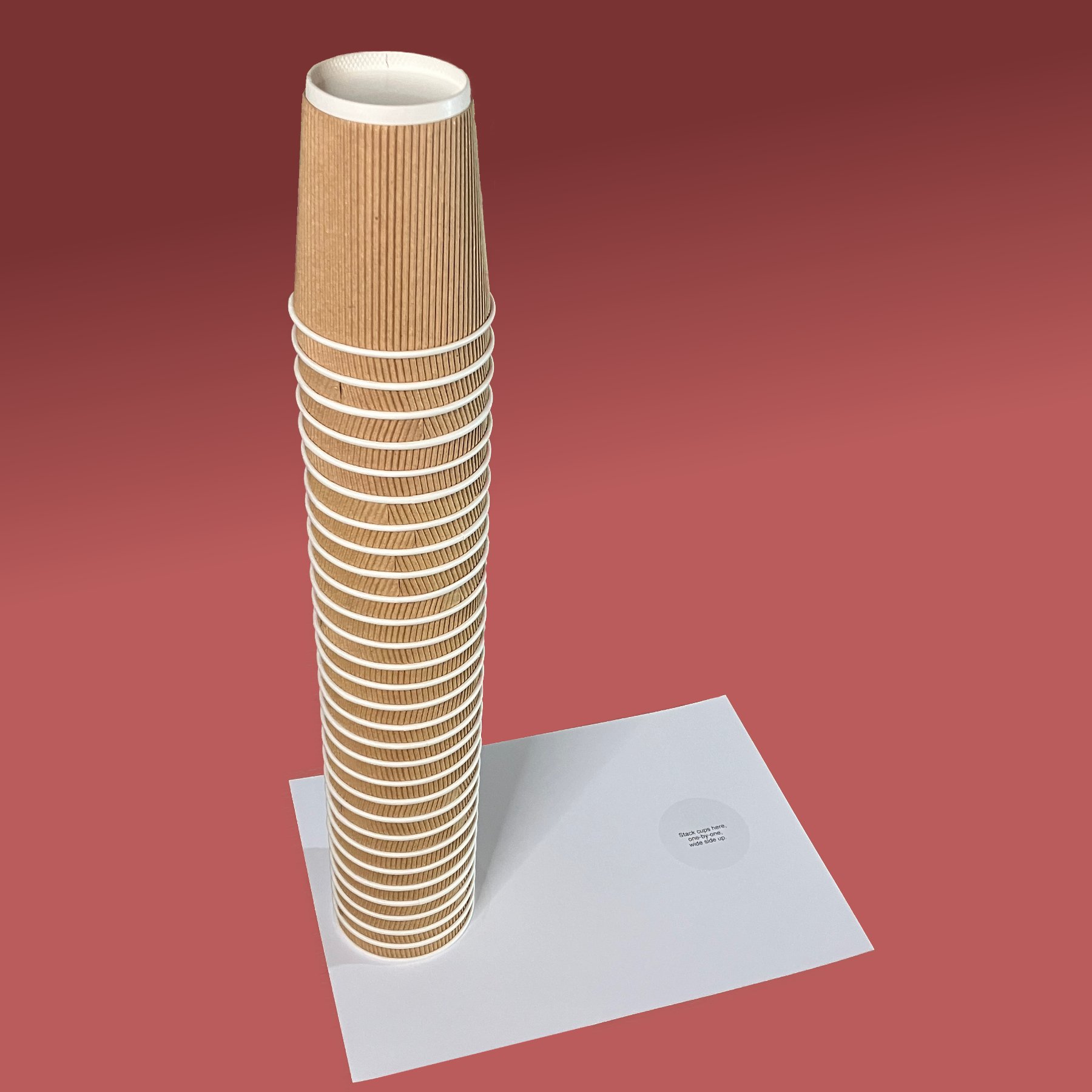
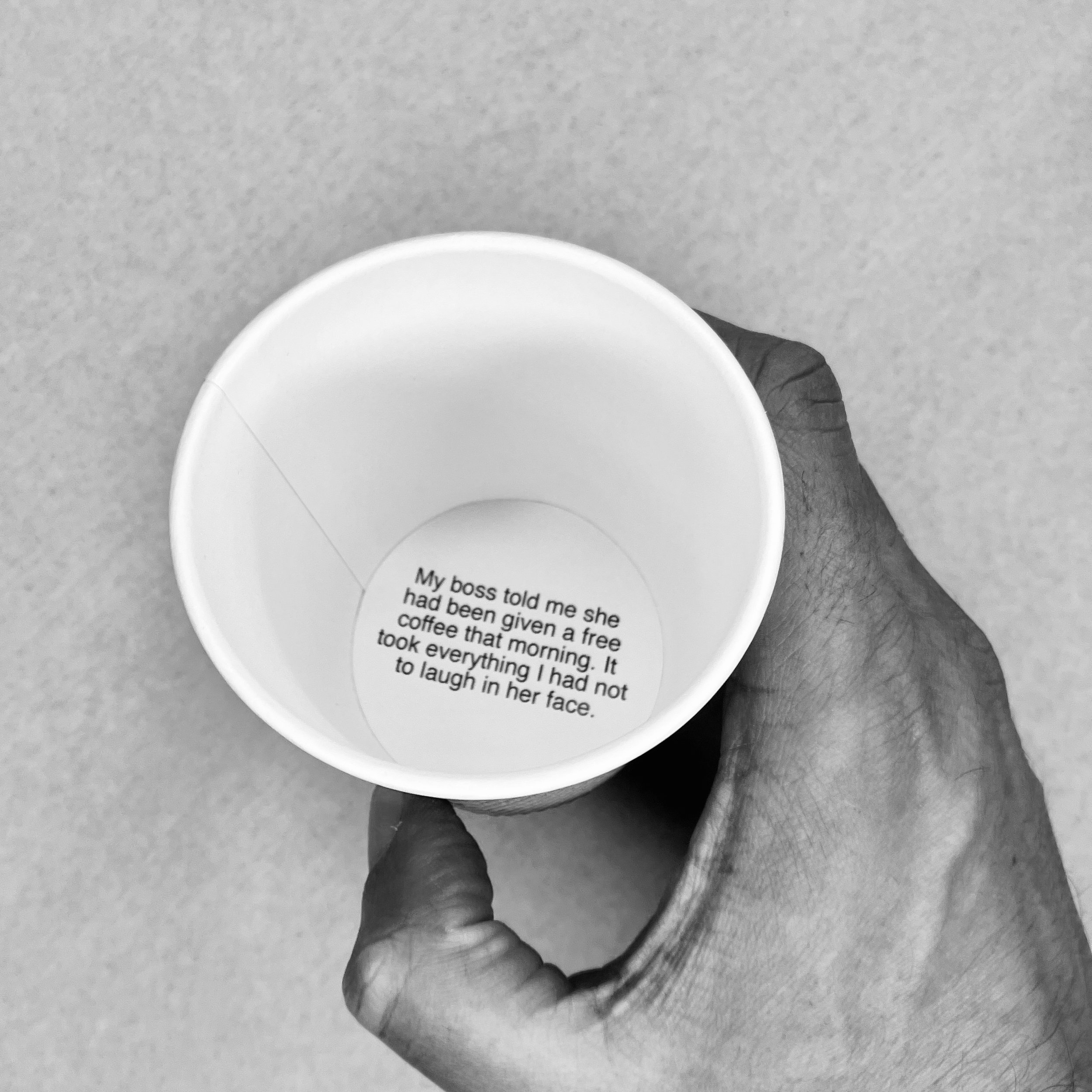
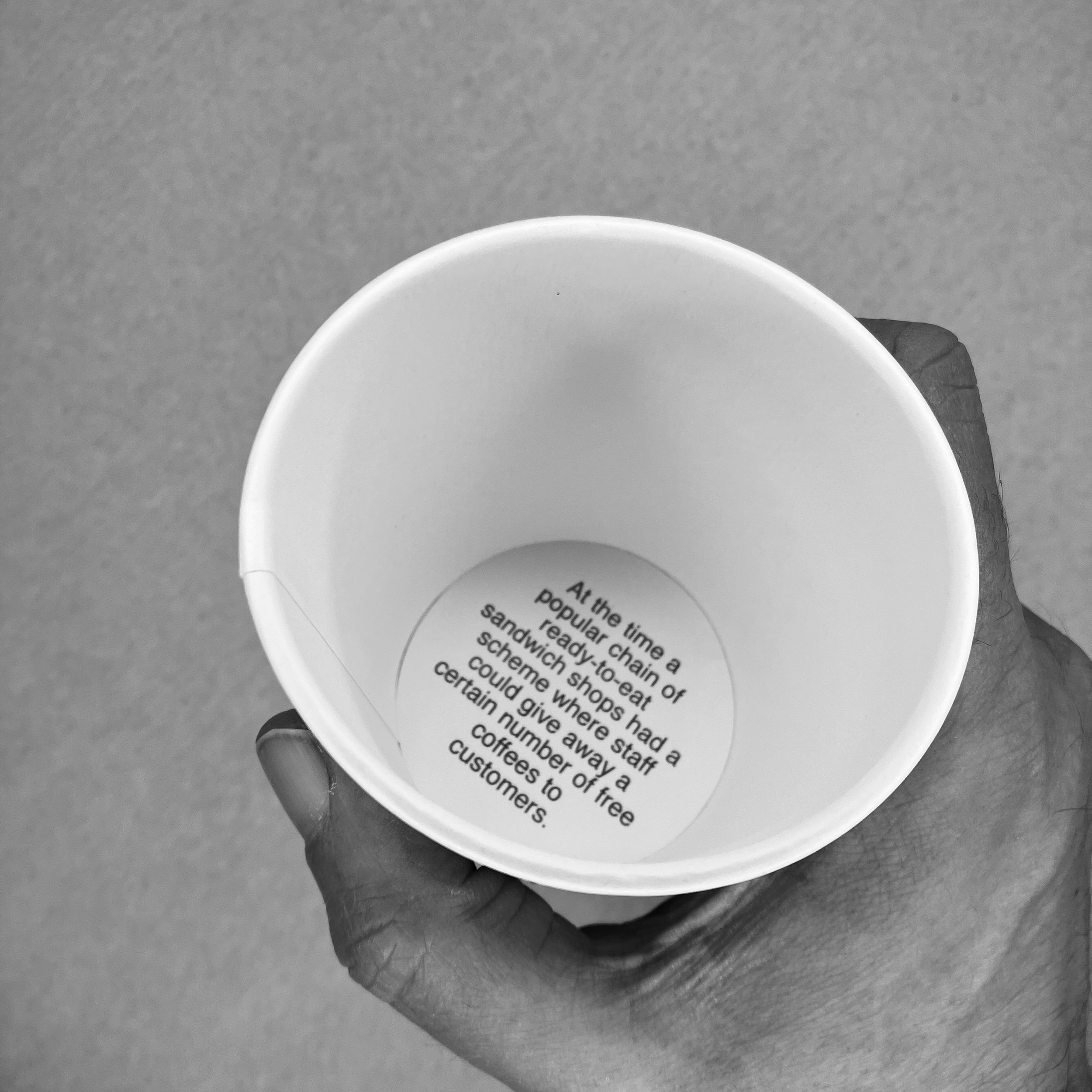
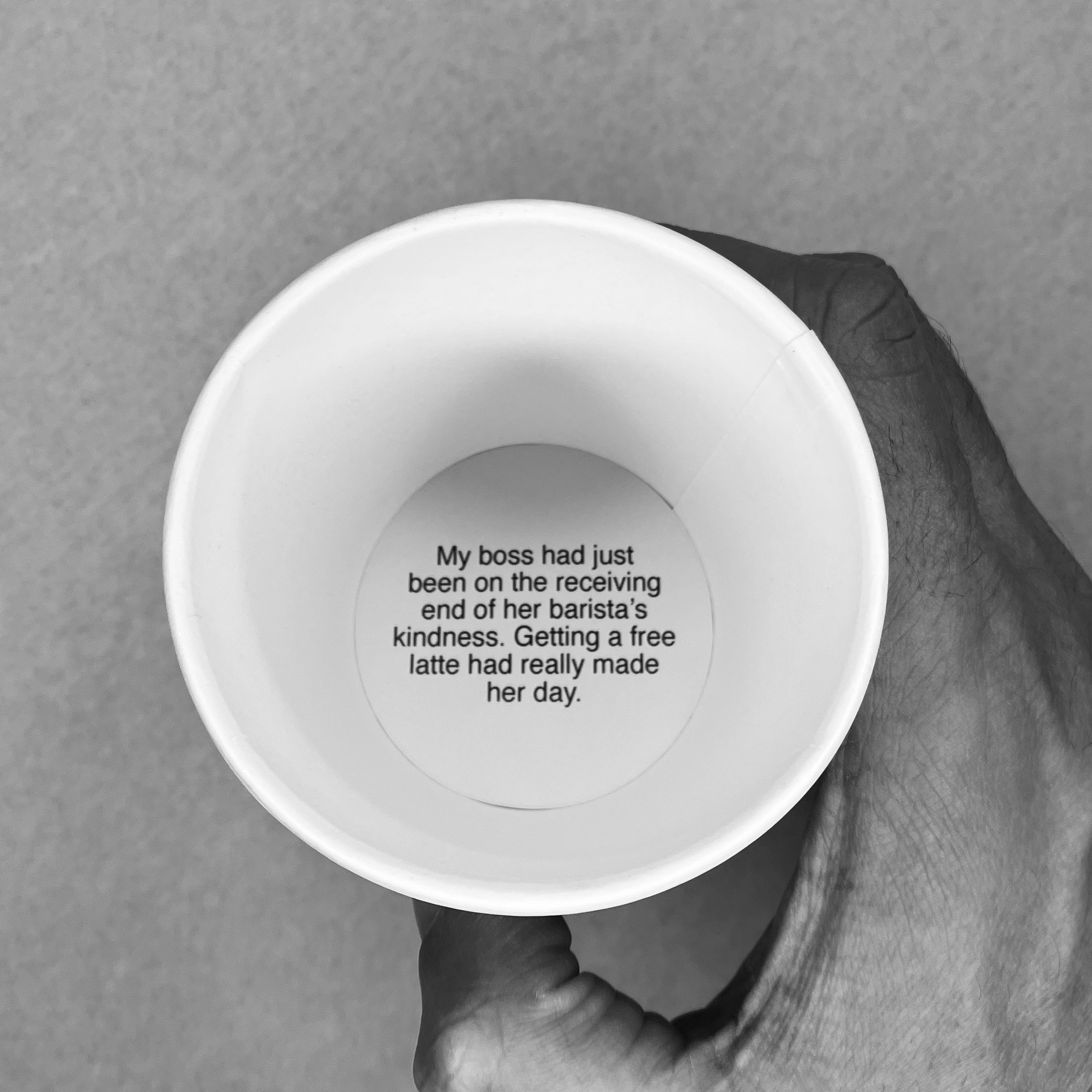
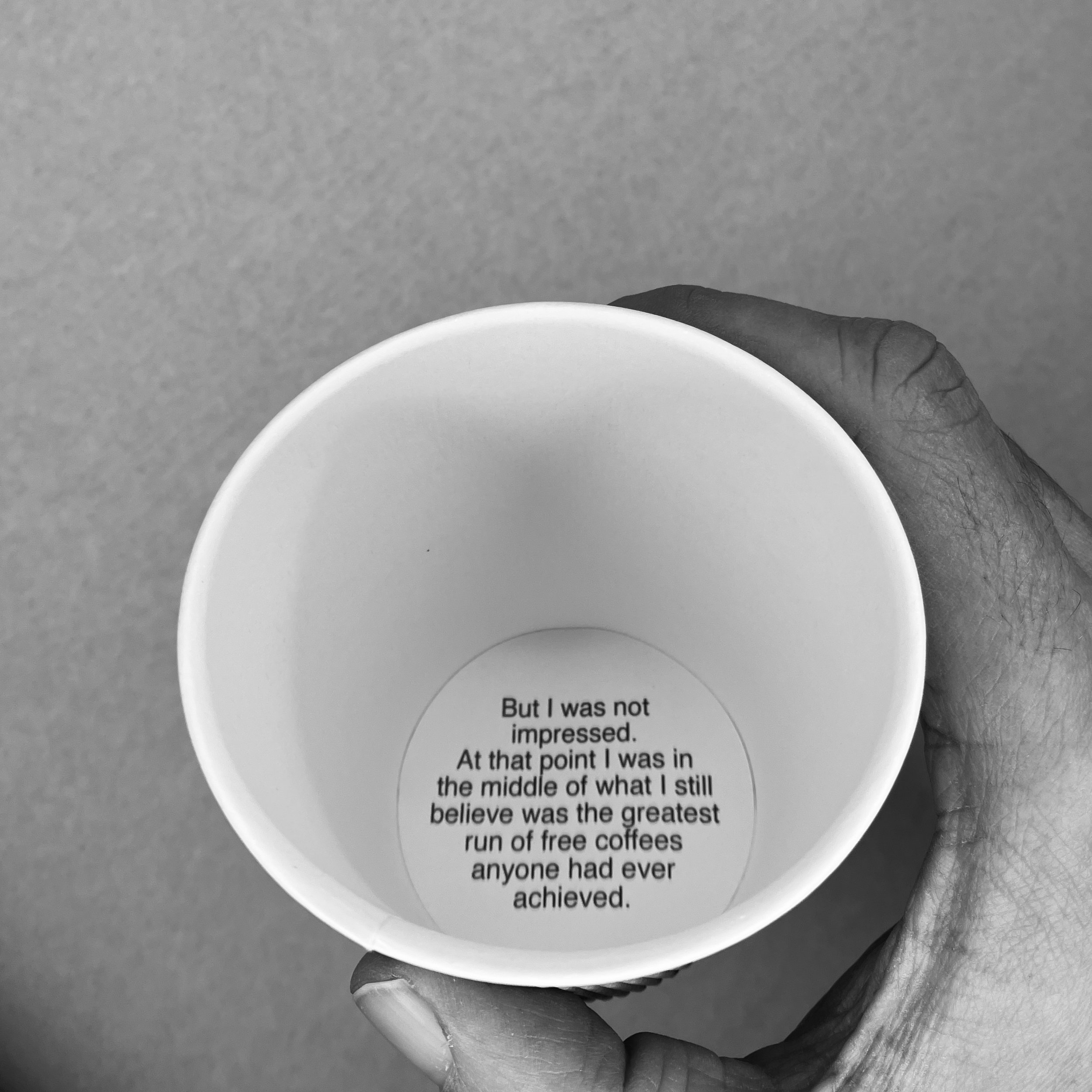
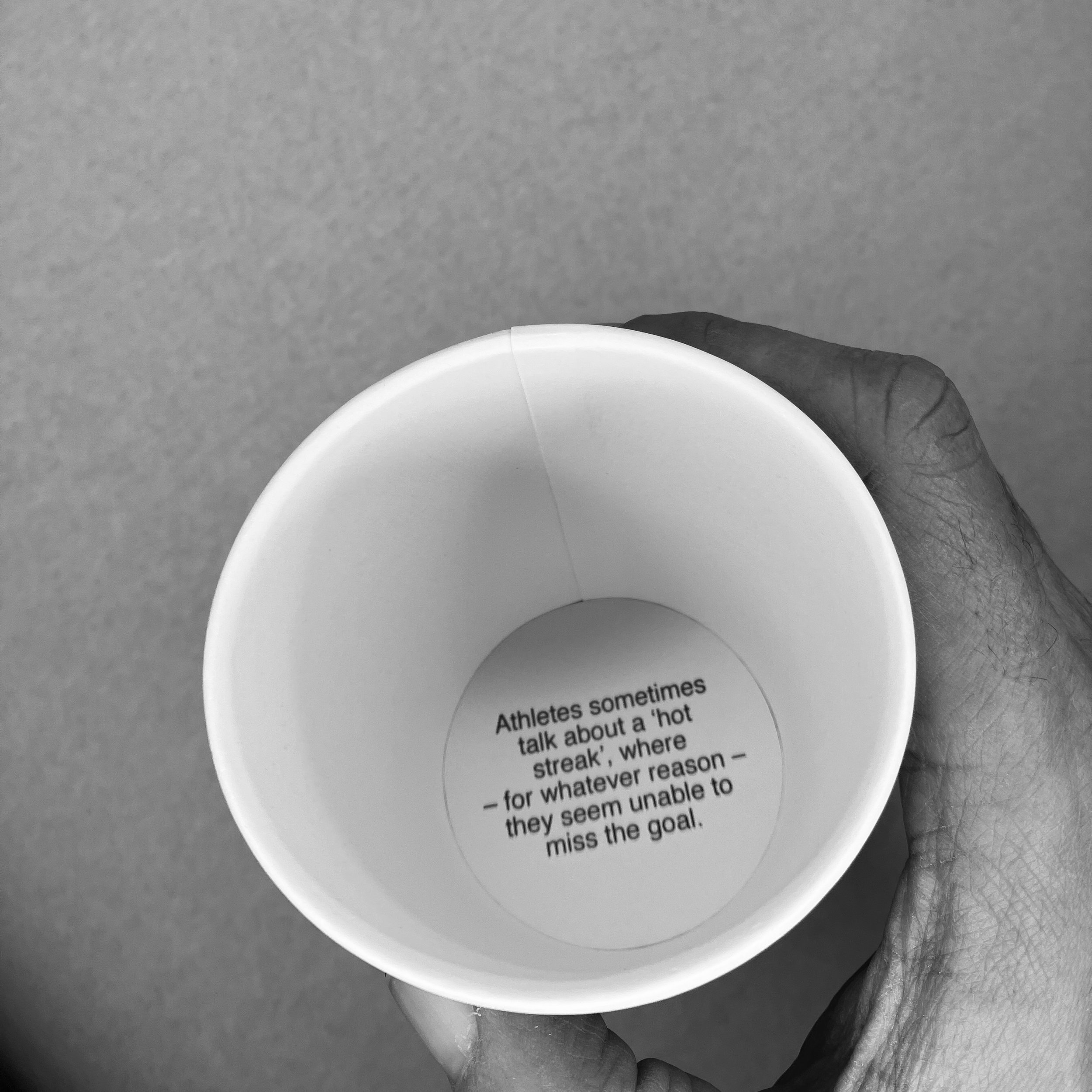
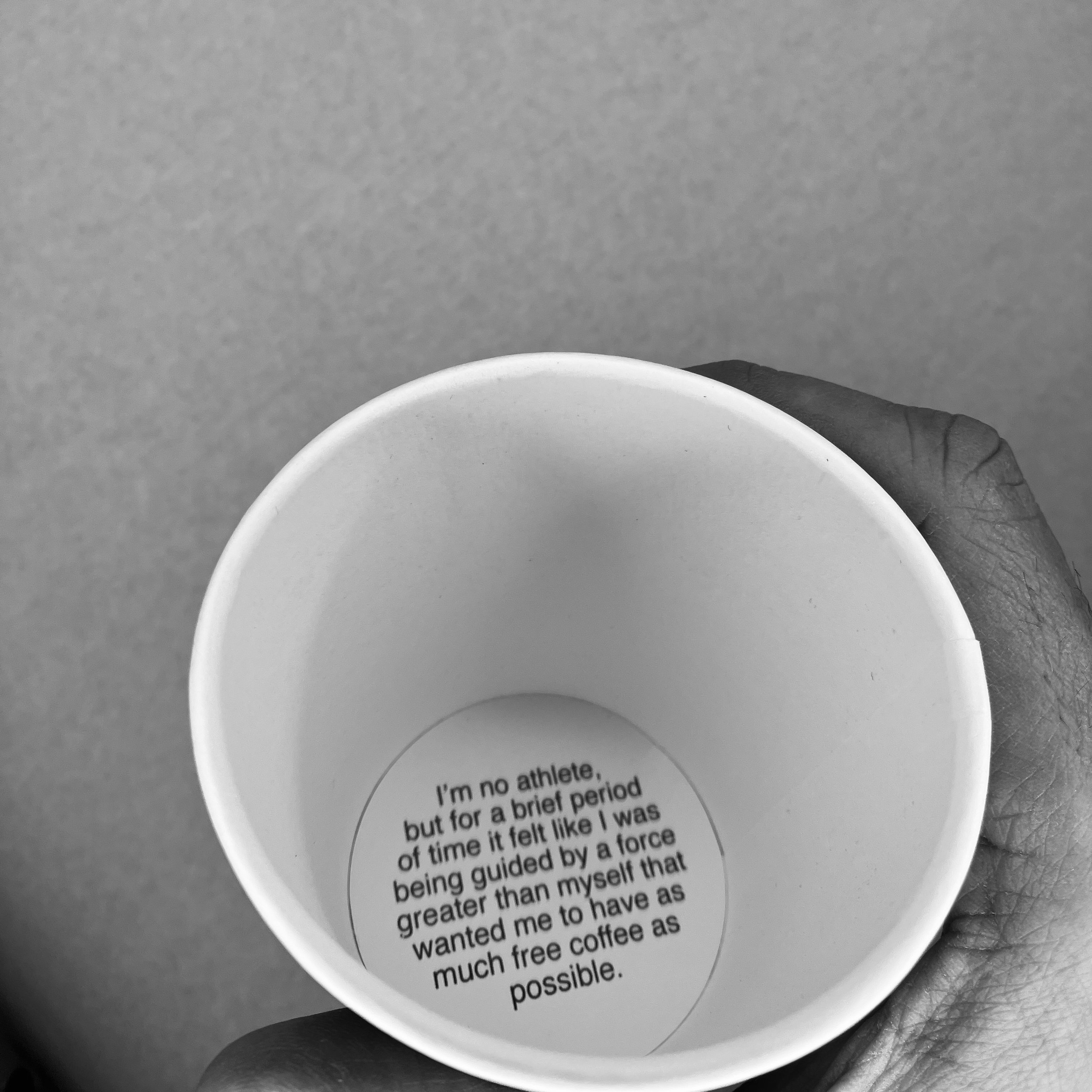
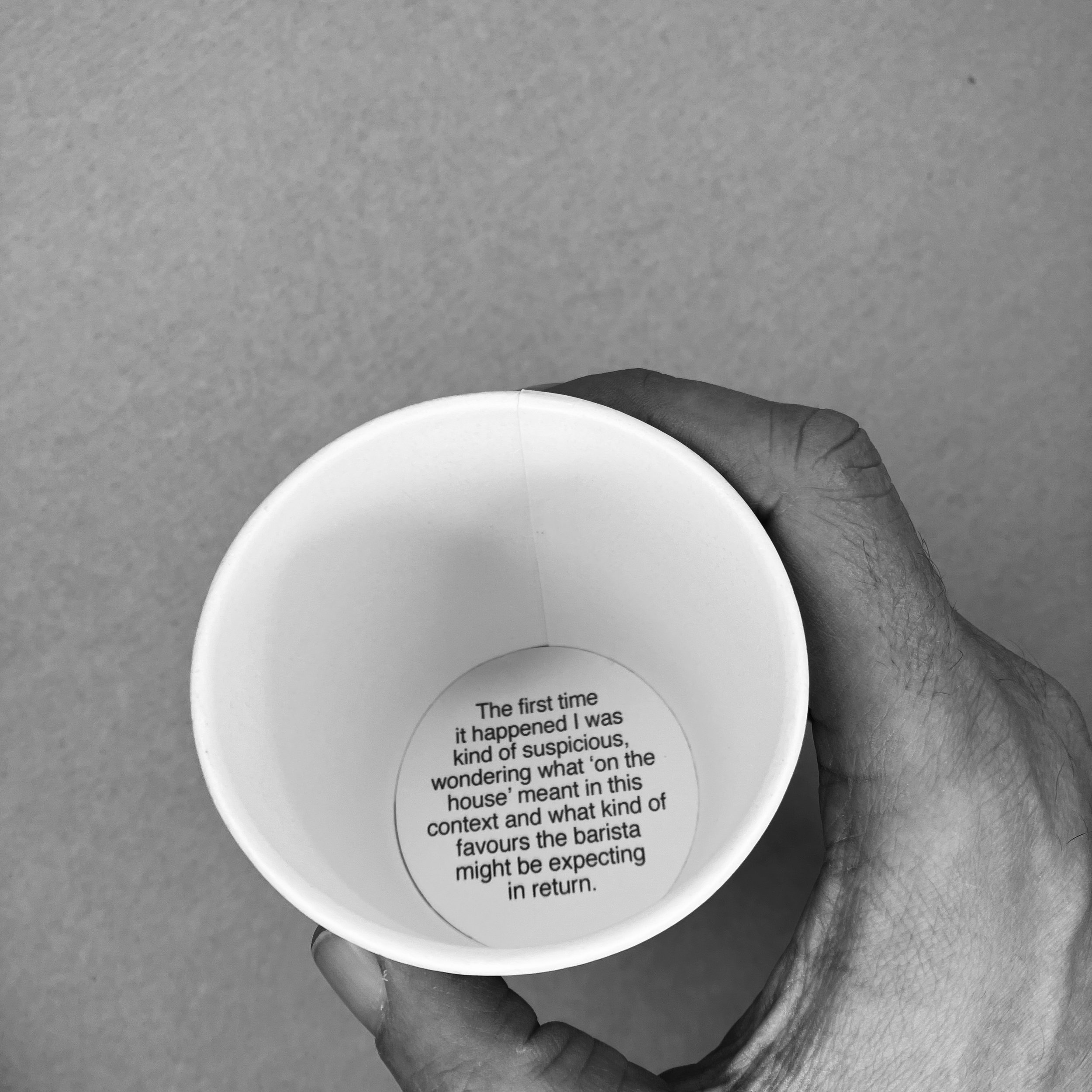
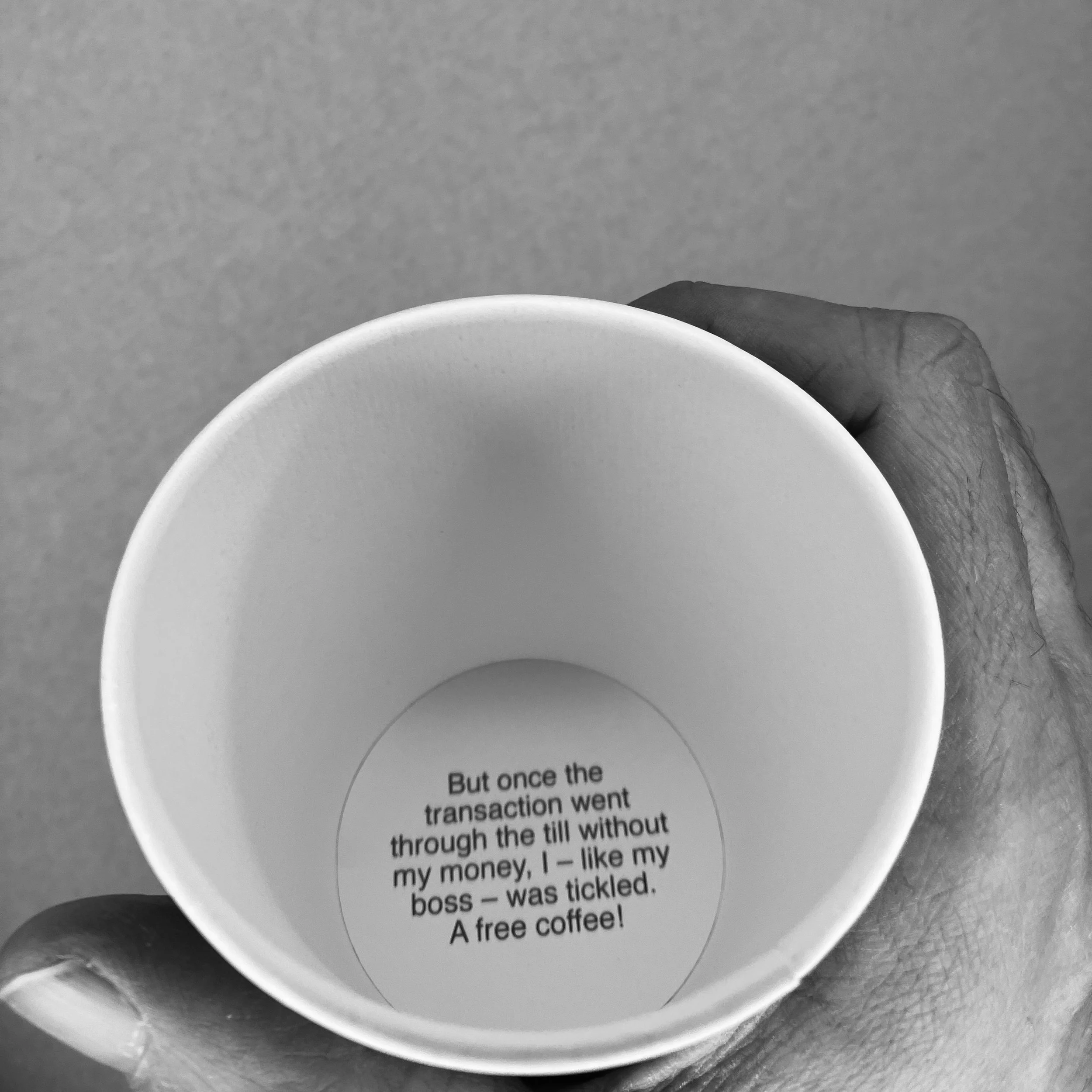
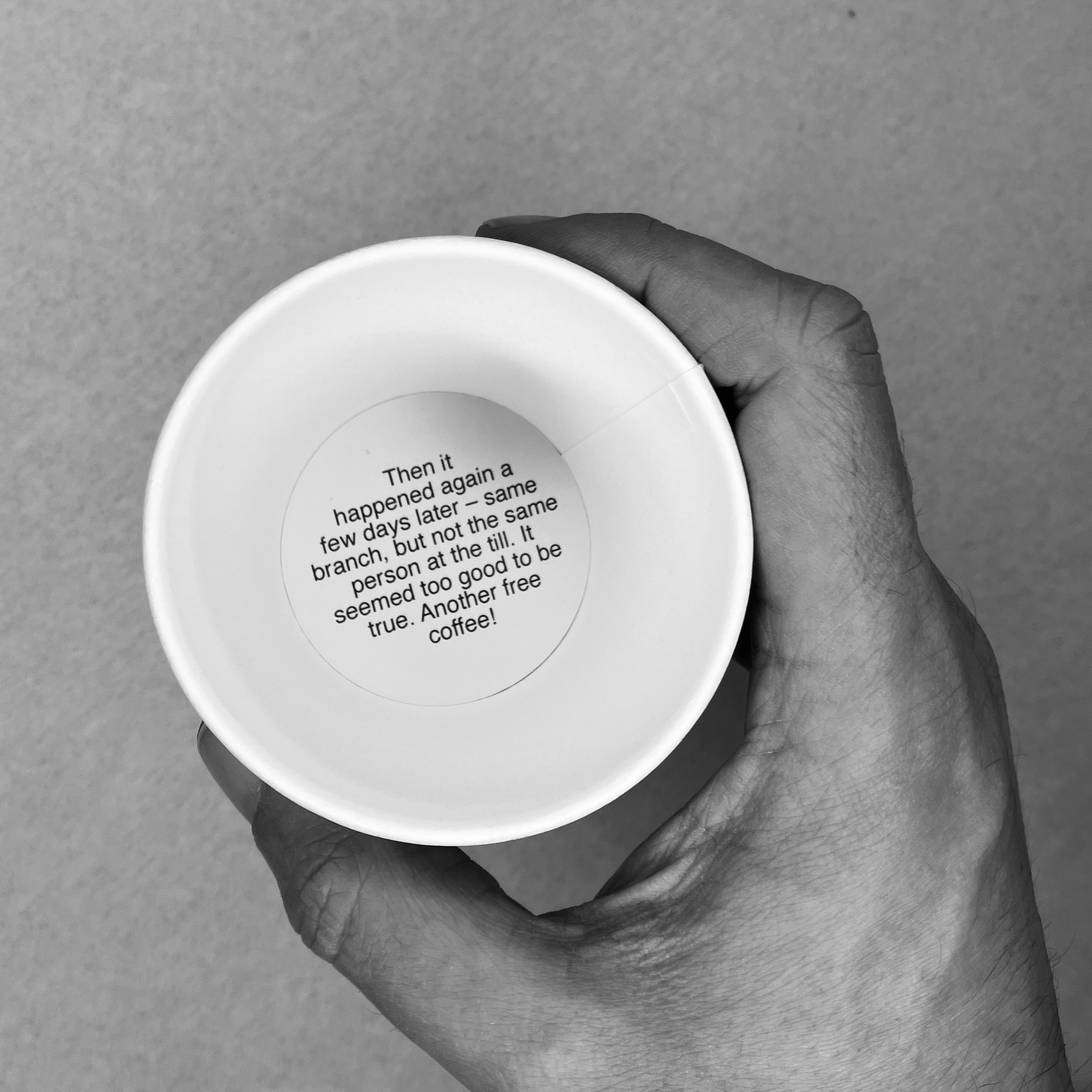

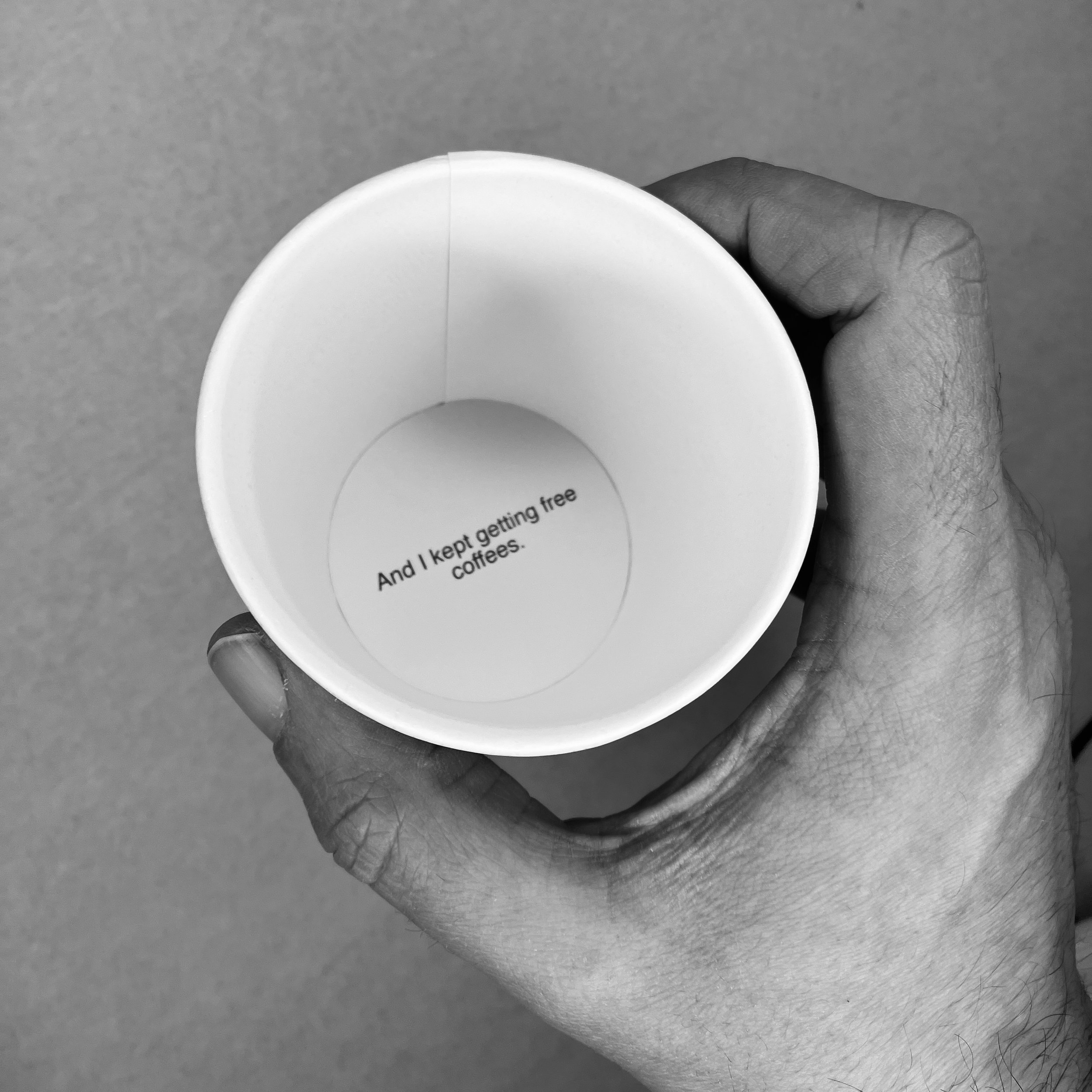
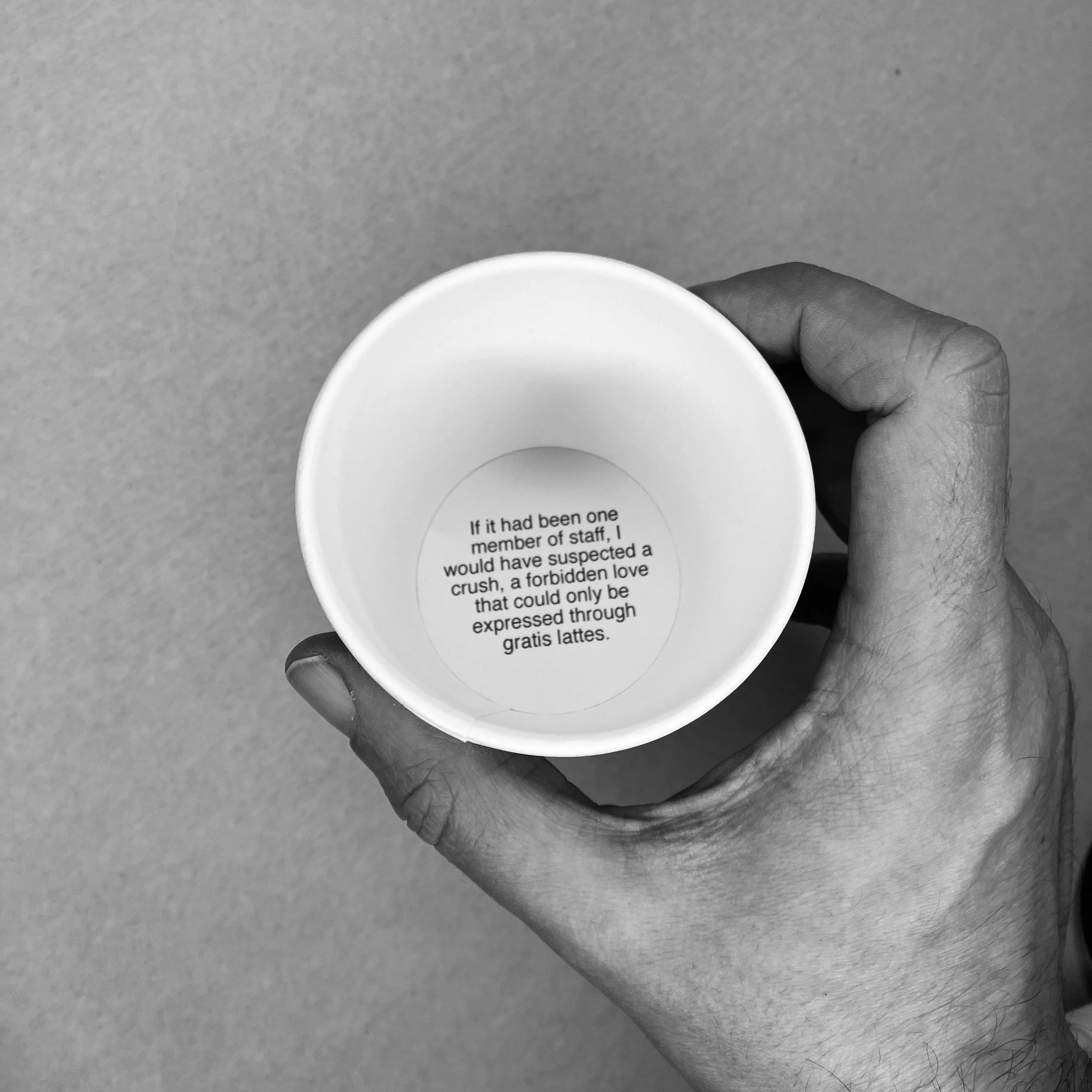

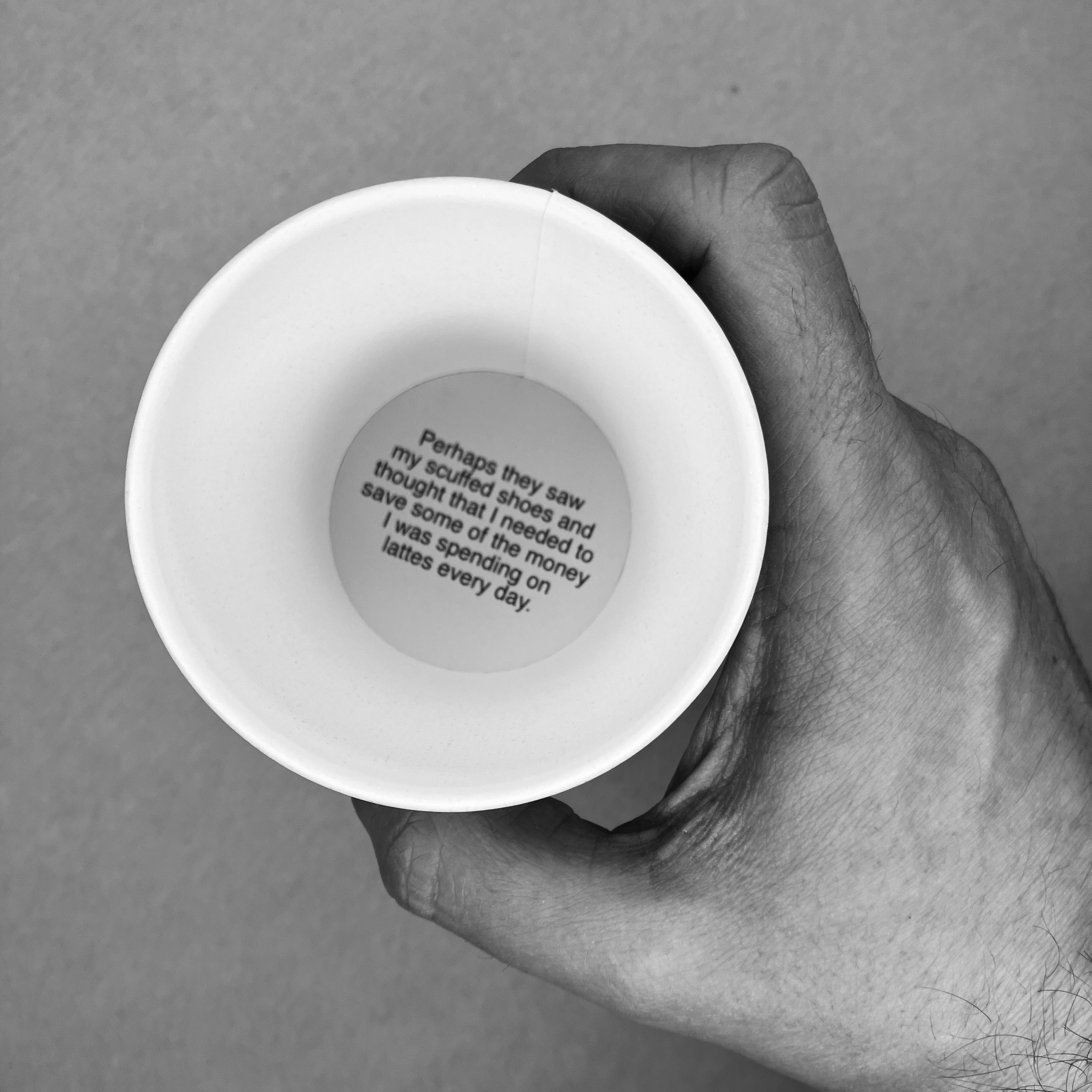

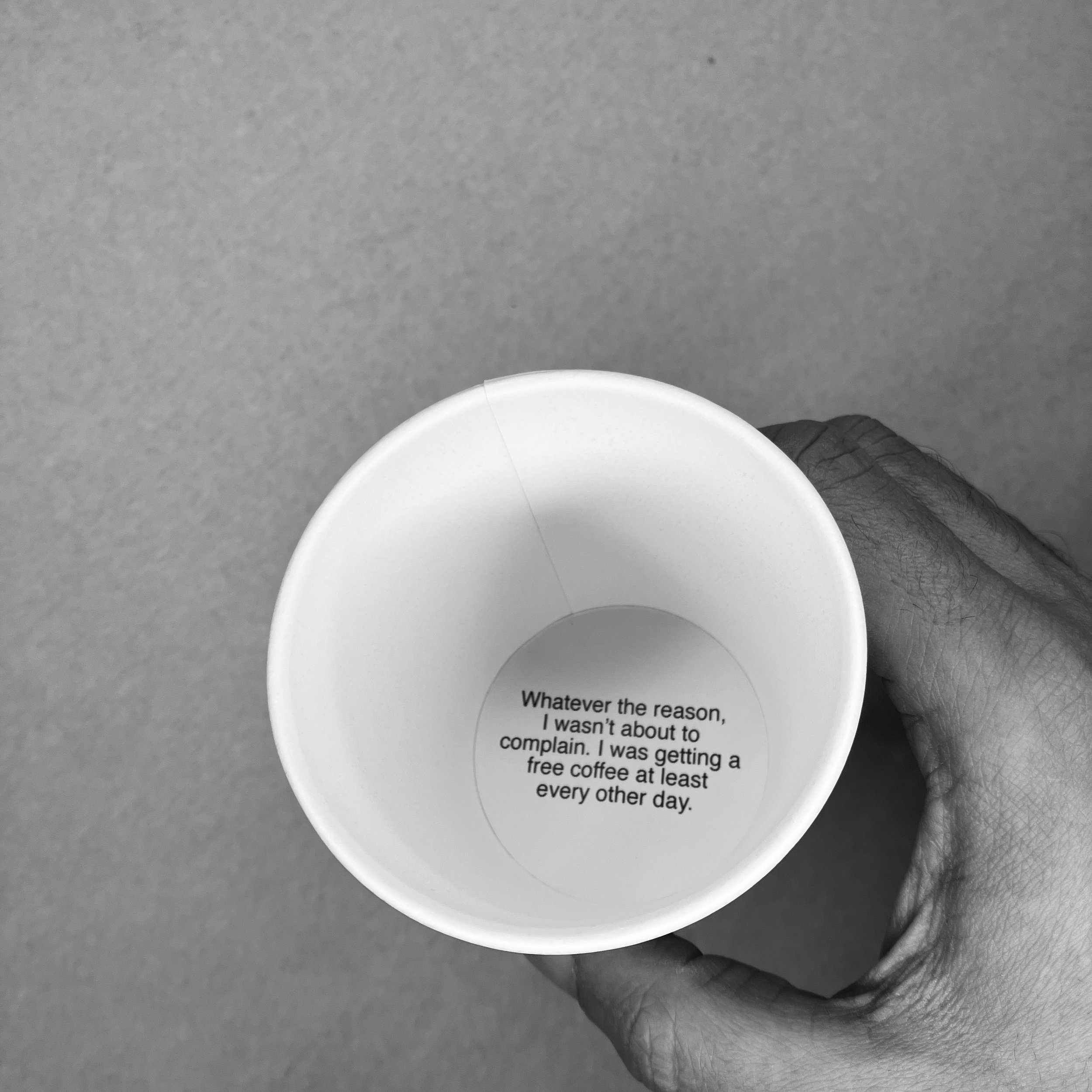
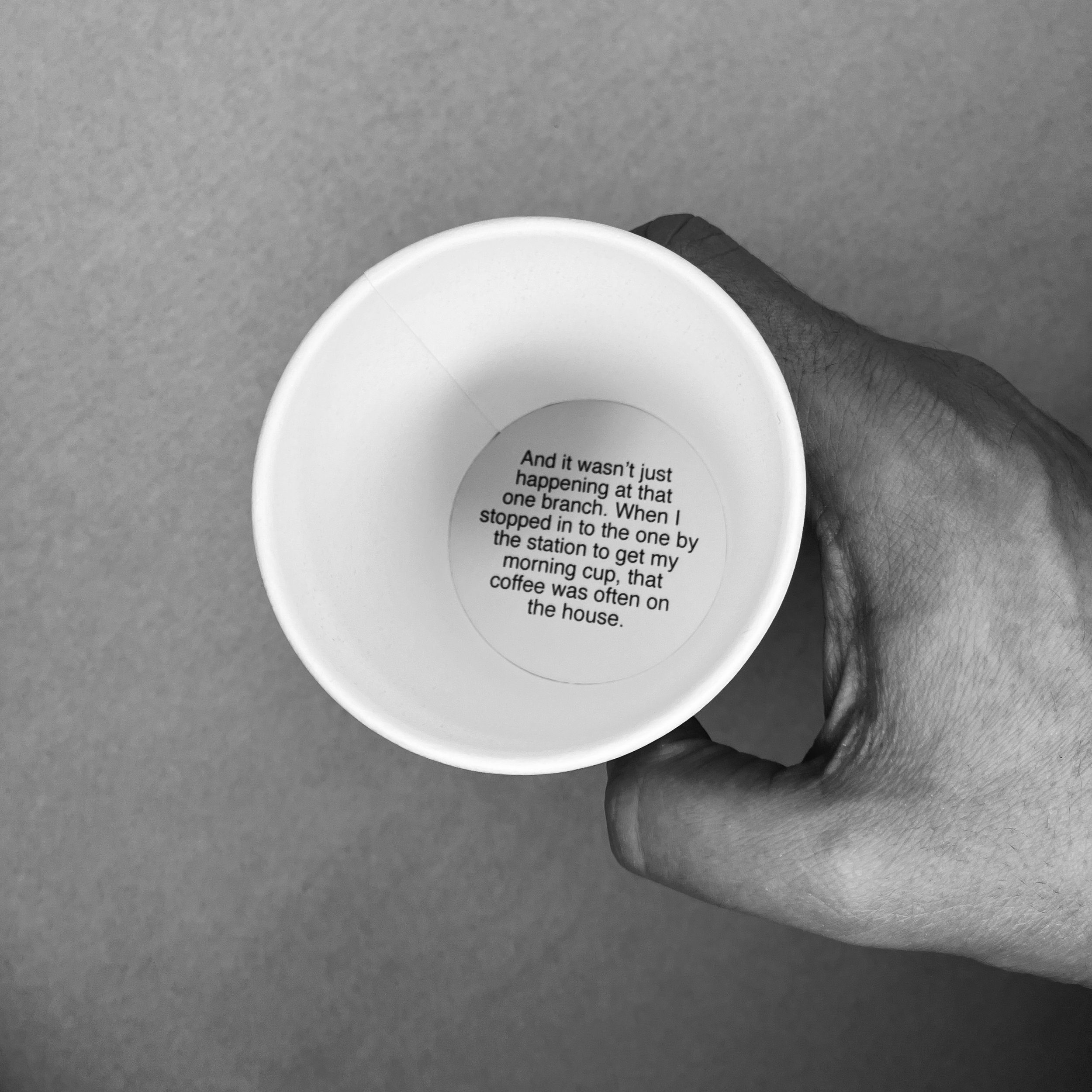

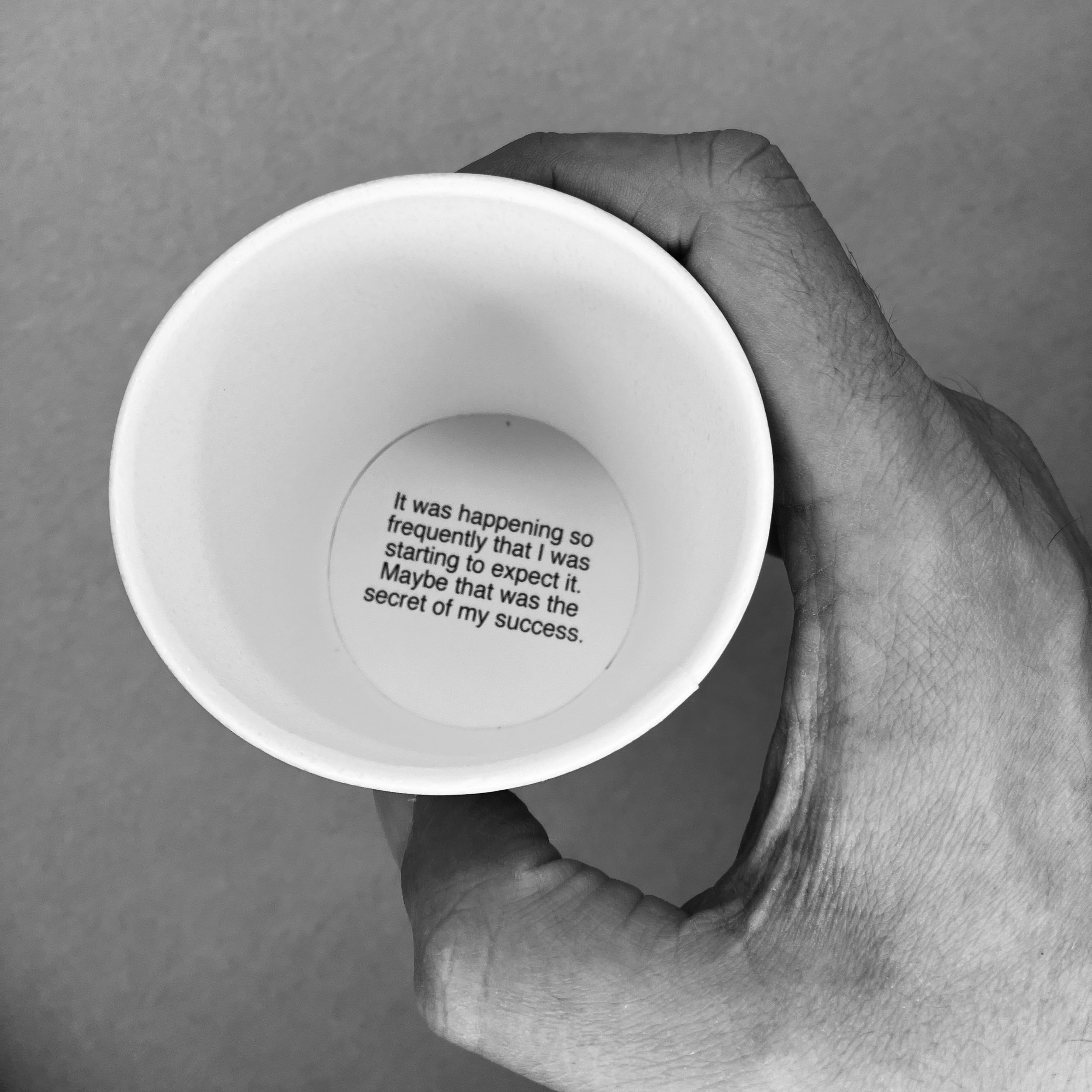


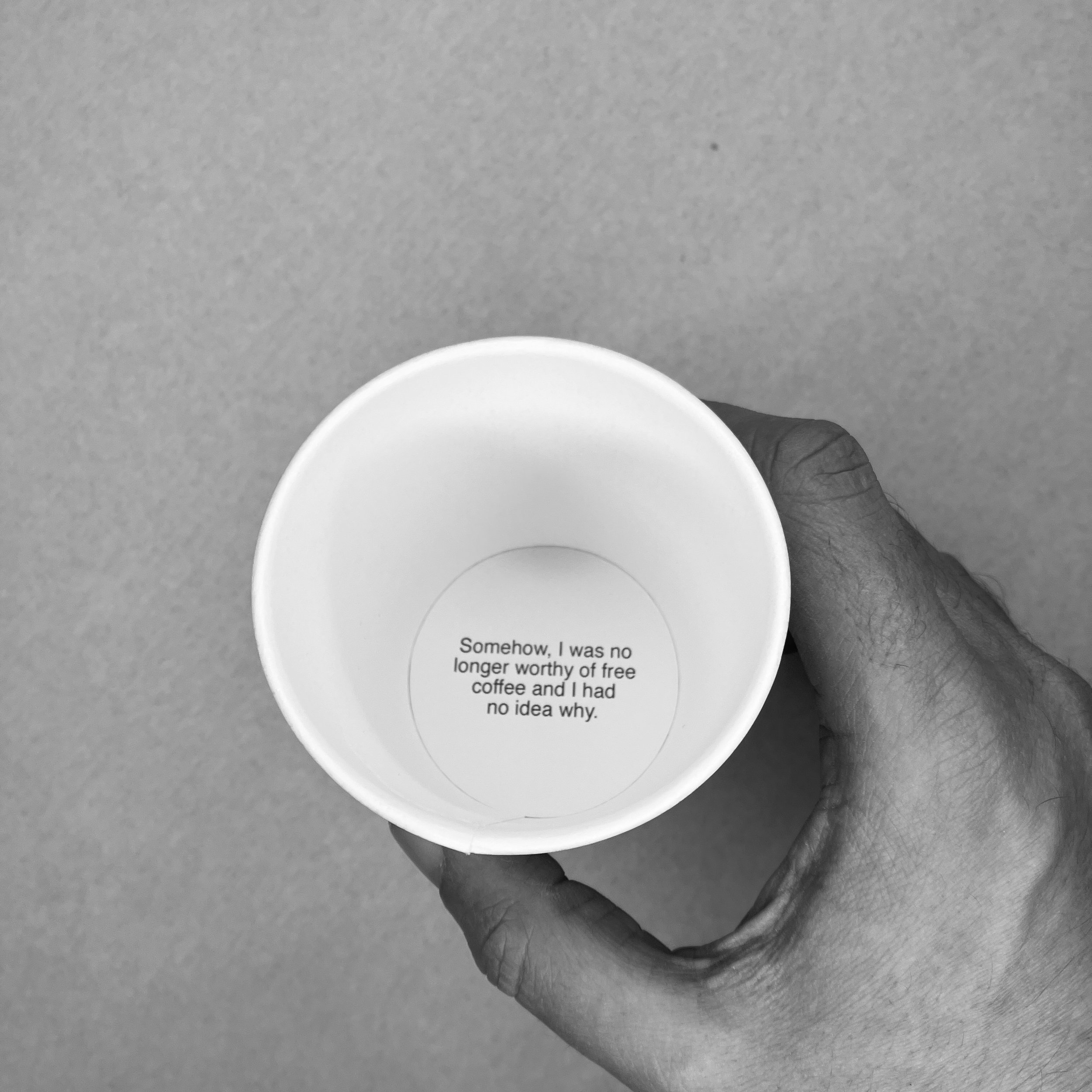
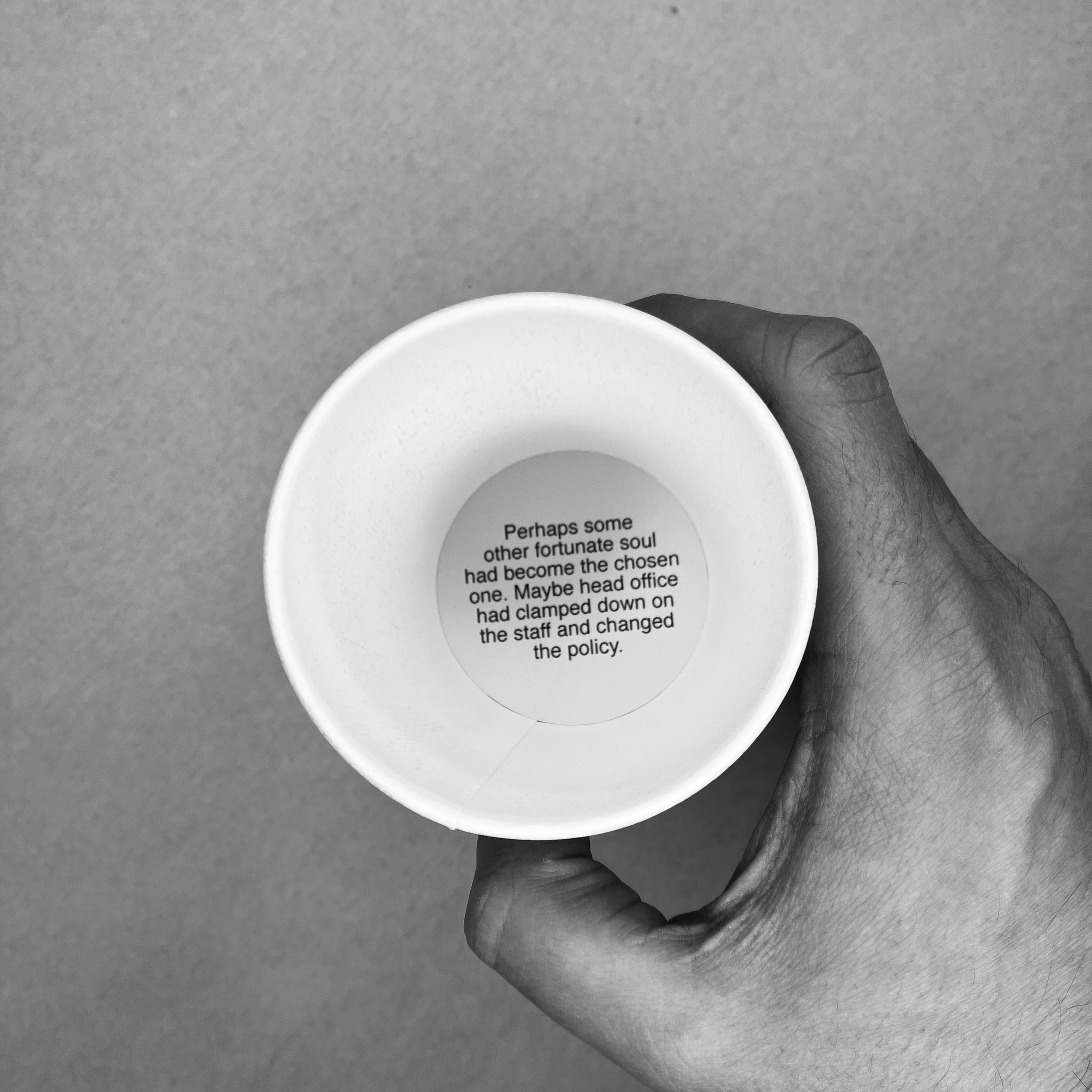
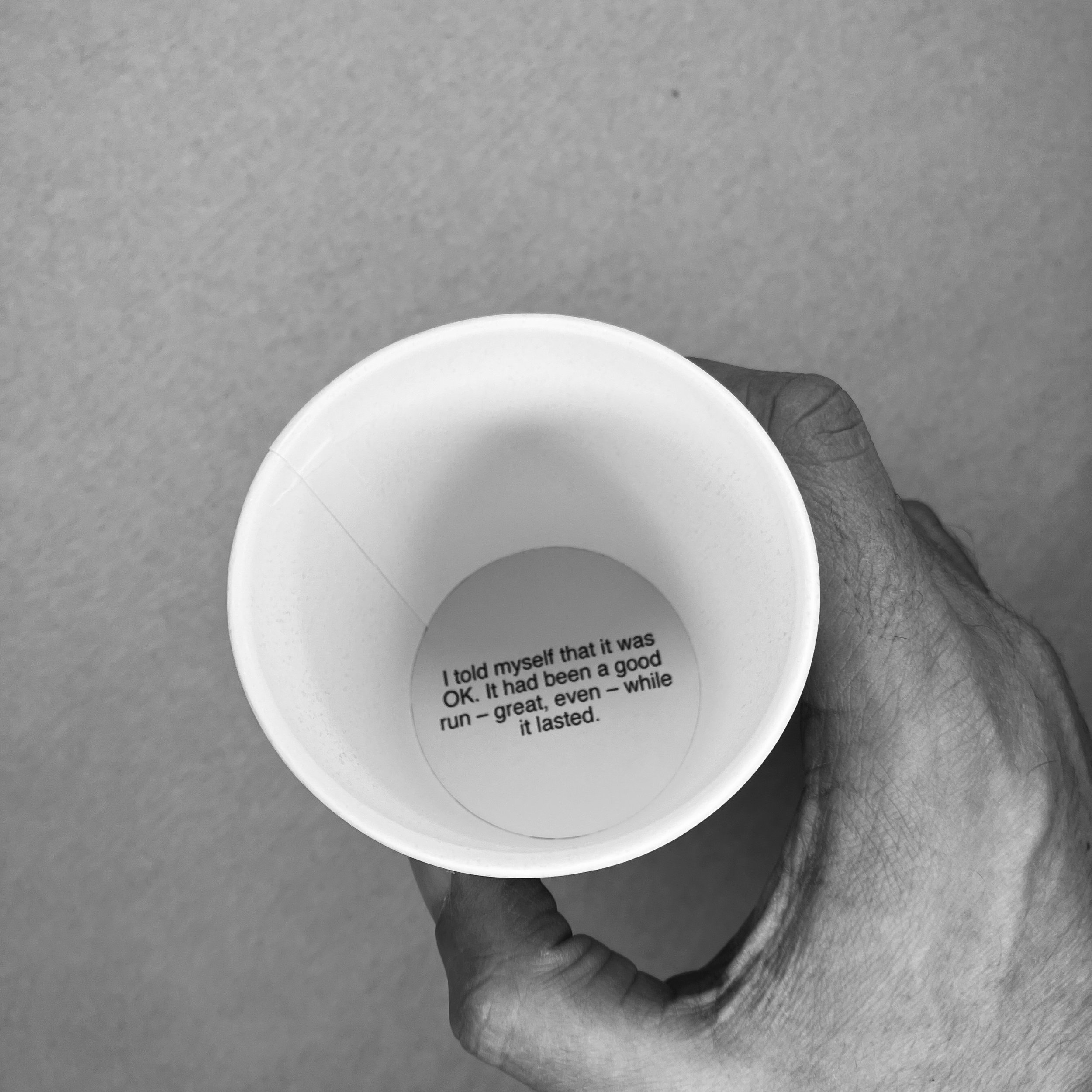

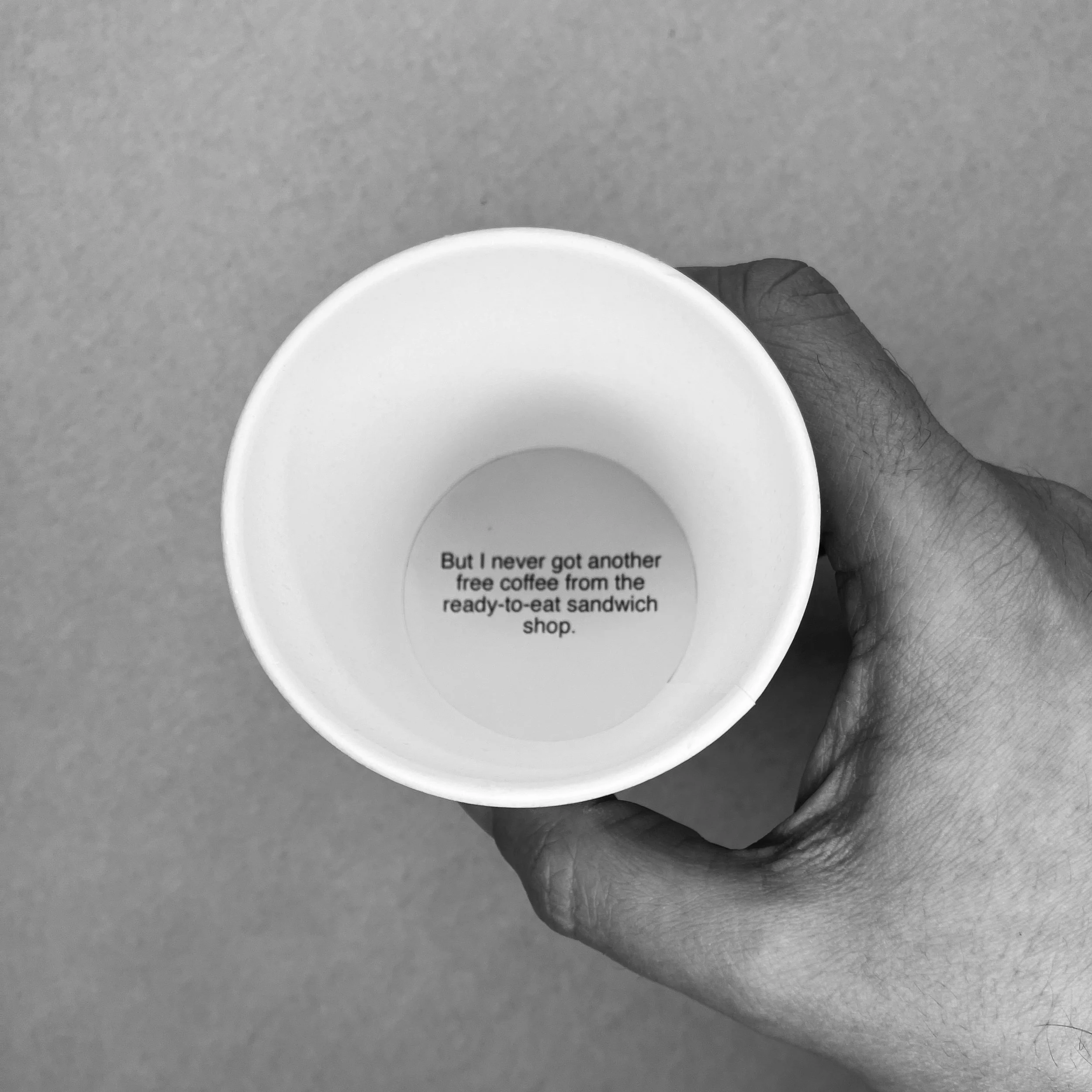
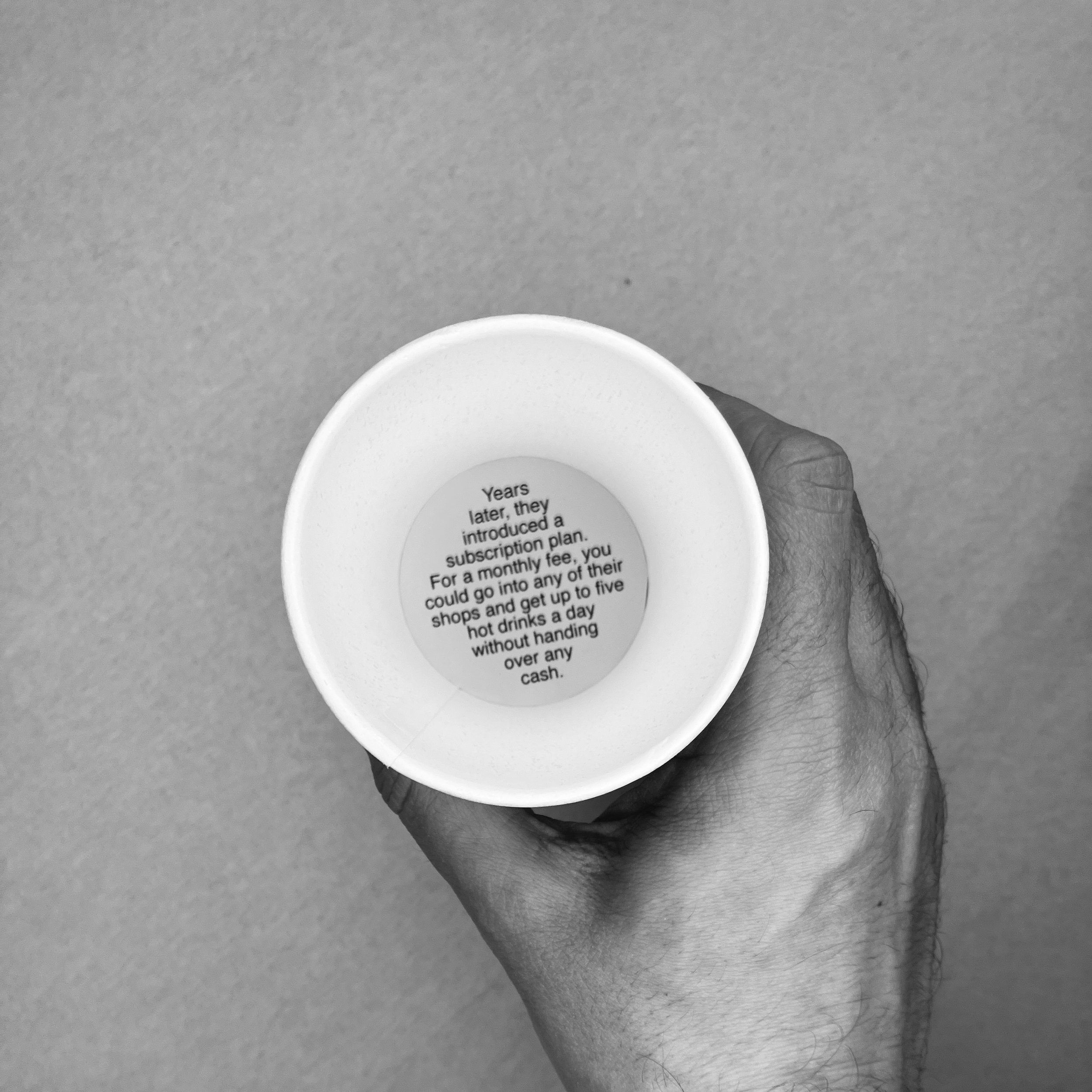
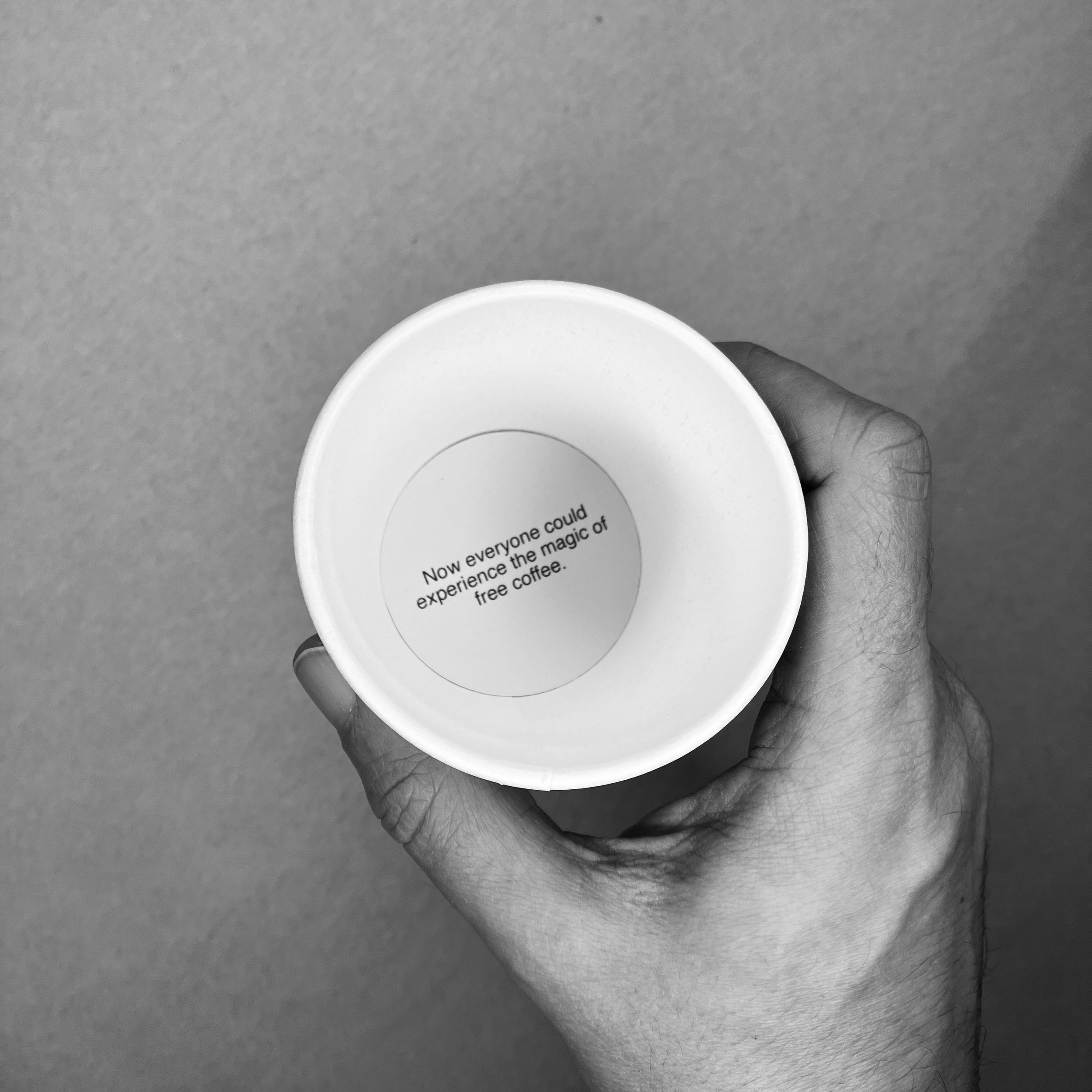

30 paper coffee cups, 60 x 600mm approx + A4 card base
Overview
A story about good fortune and self-belief, told through coffee cups.
Background
This is the story of my amazing run of free coffees from a particular chain of sandwich shops. It’s another step in the process of trying to find a way for form and content to not just coexist, but support each other in a mutually dependent way. It’s sometimes said that every object tells a story and I take that very literally by slapping a load of text over anything I might find in my immediate vicinity.
I had the idea for The Run while on a short break in Folkestone, which is a very nice seaside town in Kent with a lot of public art. I don’t know if it was this factor that inspired me to write a story on a stack of paper cups, but I don’t think it was coincidence. (There is also a very nice coffee shop there called Steep Street Coffee, which I can highly recommend.)
The amount of free coffees I used to get from Pret was a source of some annoyance to my partner, so creating a towering shrine to my good fortune seemed somehow appropriate. The reader takes a cup from the top of the left hand stack, reads the text printed inside the cup and then stacks it on the right hand side. (Instructions are printed on the base.)
Two sleeves of paper coffee cups were purchased from a local pound shop and I printed the sections of story on cardboard discs, which I then cut out using the Cameo Silhouette cutting machine. Those were then stuck down to the bottom of the cup using crafter’s tape. It’s not a perfect process. If I were to make it again, I think I would use edible ink and print them on the cup surface itself. The card stock doesn’t quite match the cups, which is why the pictures are presented in black and white. I did have plans for a fancy online version of The Run with animation and all kinds of bells and whistles, but I think a simple slideshow works just as well.
If anyone has any ideas of where I might be able to display The Run, I’d be interested to hear them. Coffee shops seem an obvious venue, but perhaps that would just lead to confusion.
Barry's Bottles
A lift-the-flaps board book about alcoholism.
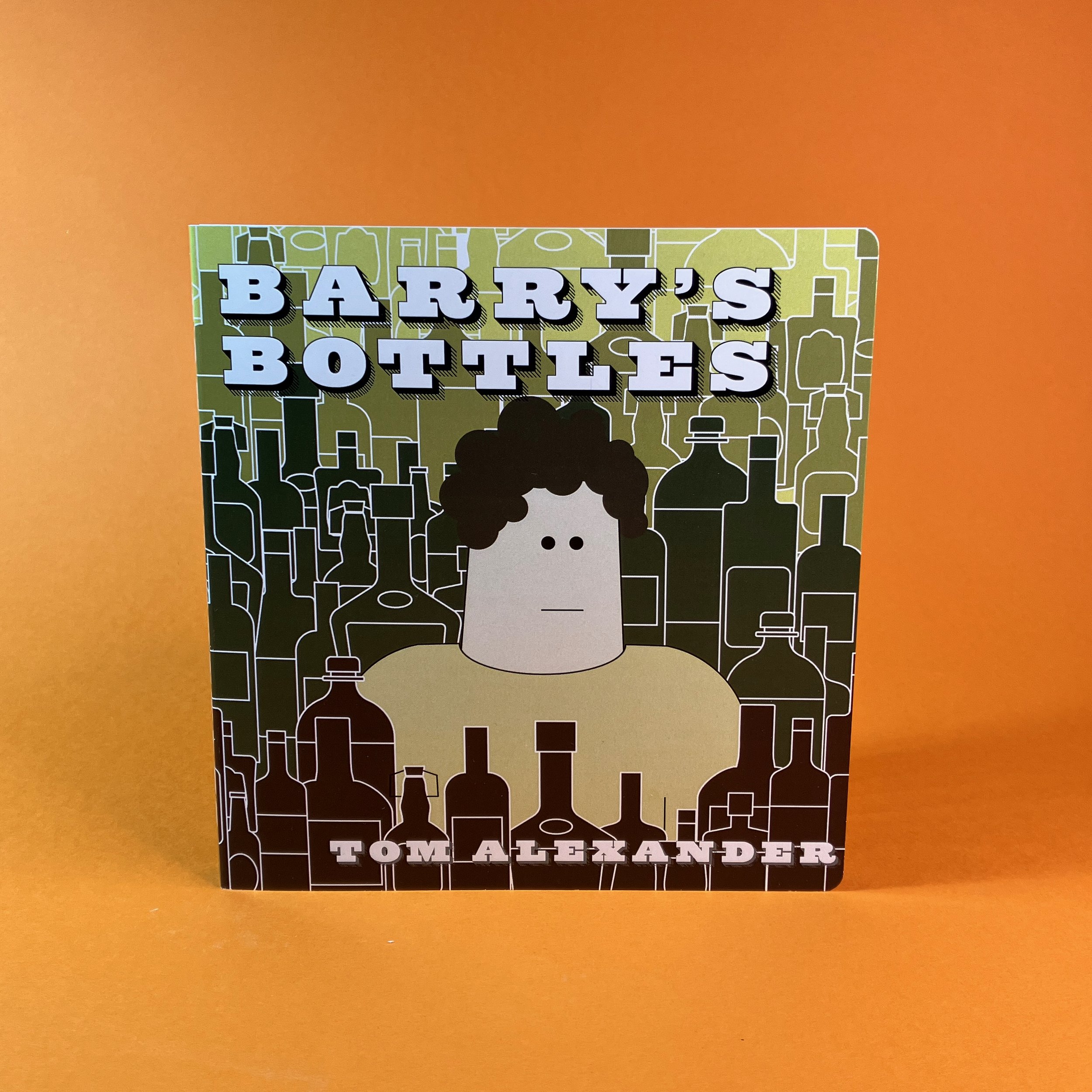


Board book, 140 x 140 x 12mm approx.
Overview
A lift-the-flaps board book about alcoholism.
Background
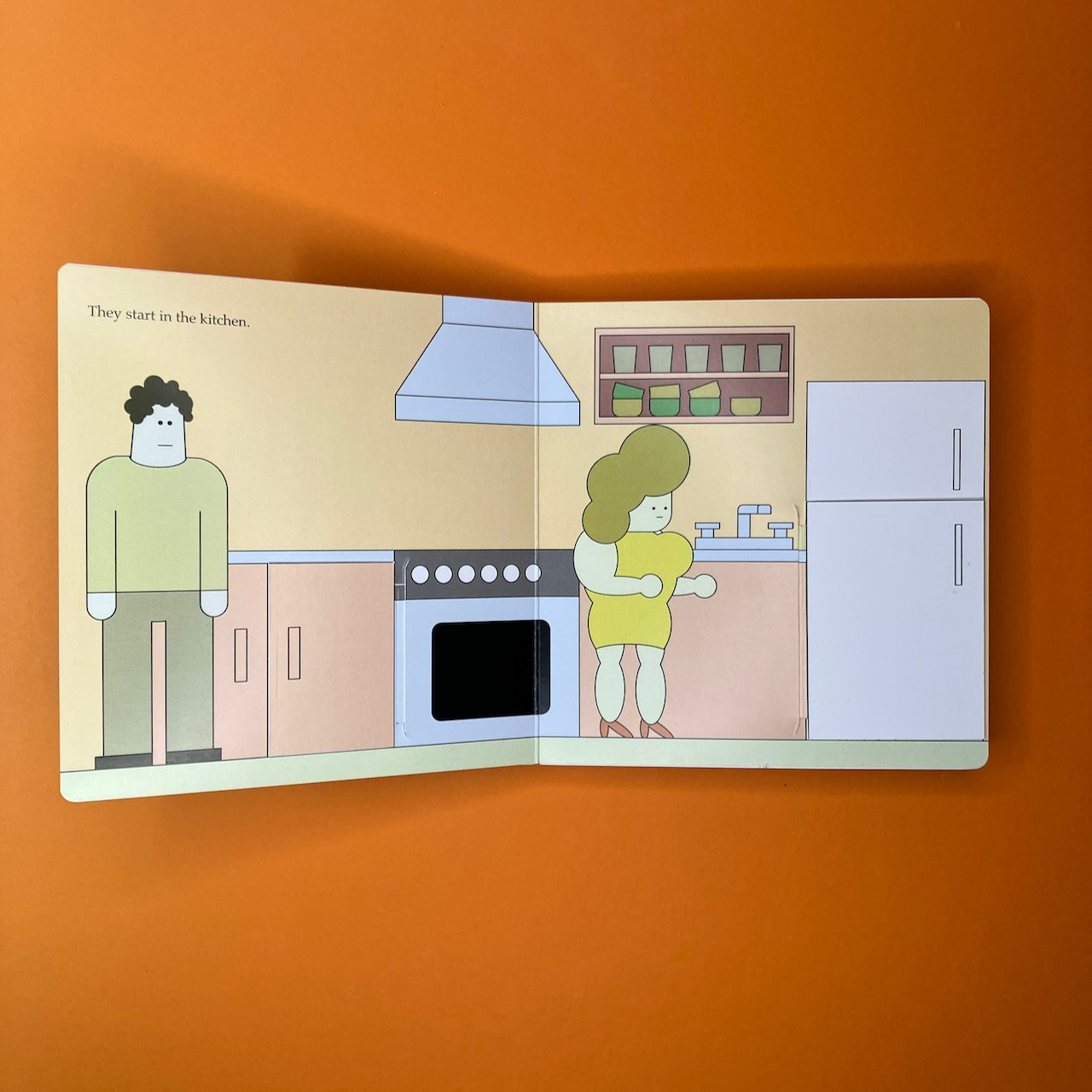
Barry’s Bottles is the story of a man and his partner, searching through their home to remove all the bottles of alcohol hidden there. It is an illustrated picture book with lift-up flaps, similar to books for very young children, such as Where’s Spot? Although it is illustrated in a similar fashion to My Secret Dog and Sometimes I Feel Sad, this isn’t a book for children. What I like about writing kid’s books, though, is the simplicity and directness you can use with them. That felt appropriate for this story about alcoholism, where all the attempts to control Barry’s drinking will be for naught if he can’t change the patterns of his thinking.
An early, black-and-white version of Barry’s Bottles was shown at the Work Show Grow group exhibition The Power of Play, in London in May 2023. There have been several changes since that version, most notably the addition of colour to the illustrations. The physical format of the book has also changed somewhat, with the heavy grey board removed from the volume to make it lighter and easier to work with.
Although I settled on the technique for constructing the book quite early on, this went through many, many iterations as I tried to get a result I was happy with. In the end, there are still a few kinks which I just couldn’t iron out. Board books are manufactured items, made with industrial die-cutting machines and mechanical folding and sticking processes. The precision required is a difficult thing to pull of by hand (at least for me). Had I realised earlier that there was no way to attain that absolute perfection, I might have leaned the other way and explored what imperfections and rough edges could bring to the story. As it stands, I’m quite happy with it, but also glad it’s over.
As the complexity of the making meant that Barry’s Bottles was going to be a very limited edition, I decided to make a digital version of the book which could be freely distributed. For this, I used an odd combination of software (Affinity Suite, Blender, Tumult Hype) to create something sort of like a Flash site of the early 2000s or a CD-ROM. Again, I settled on a process early on and made about 80% of the site before thinking it wasn’t perfect enough. After attempting a couple of times to remake it, I found the results were sterile and didn’t feel as good as the imperfect early version. I went back to the early version, finished it, and uploaded it to itch.io so it could have a permanent home. The online version of the book can be found at https://tomlxndr.itch.io/barrys-bottles.
Battlesecrets
A variation on the old pen-and-paper game Battleships, although potentially more harmful.


Pen & paper game, 210 x 148.5mm
Overview
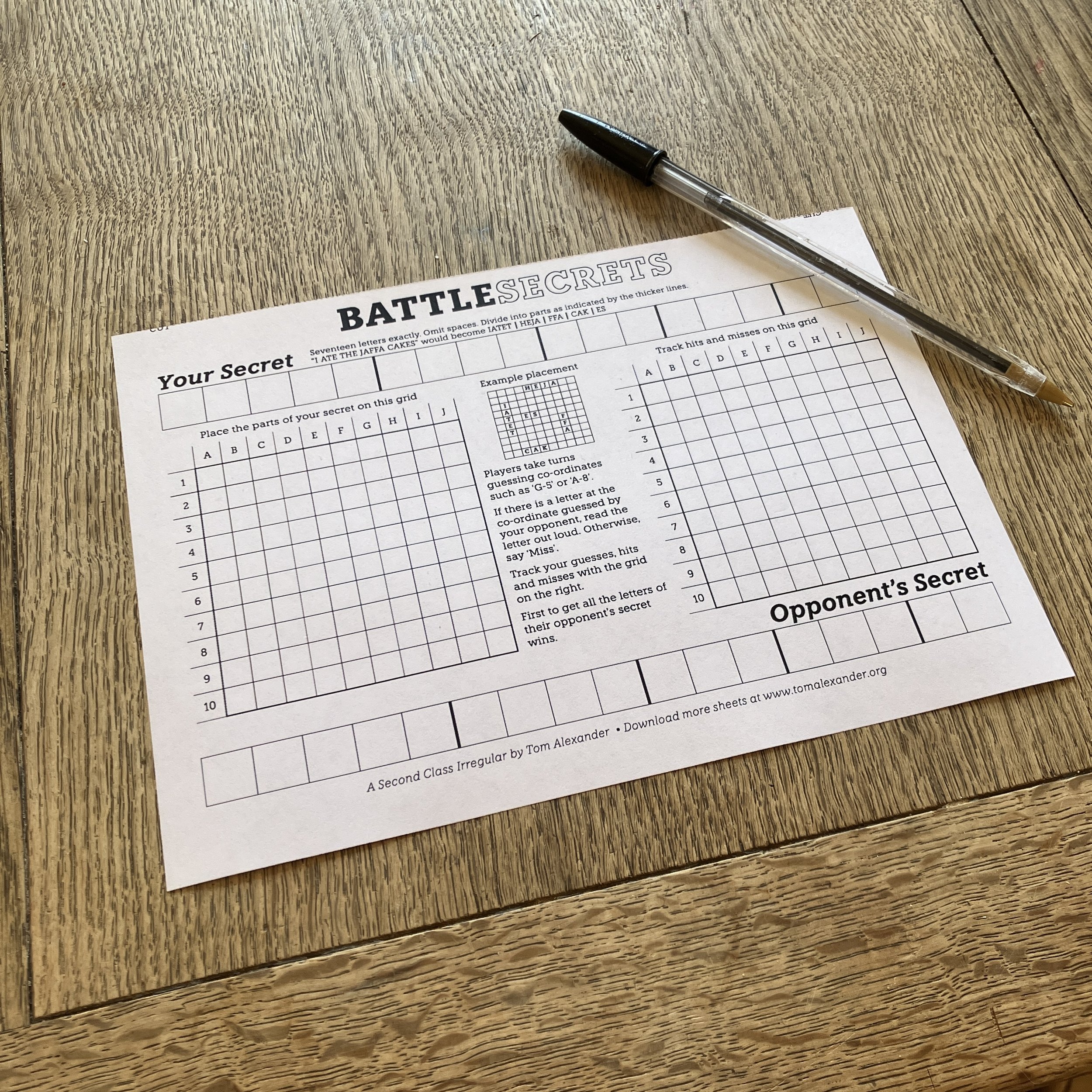
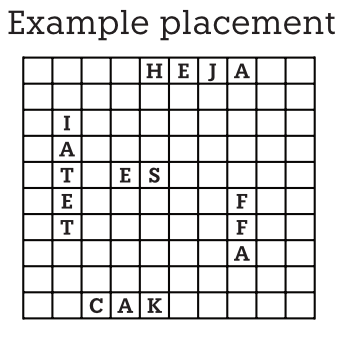
A variation on the game Battleship, using secrets as the main objective.
Background
When I’ve spent a long time on a single project (or several projects that are taking a long time to complete), it’s nice to have an idea and execute it within a day or two. That’s what happened with Battlesecrets.
Obviously it’s the old game Battleship, but using secrets as the targets for your opponent to uncover. Hopefully that makes things a little spicier but perhaps it doesn’t make much difference.
This was sent out to subscribers on 5th January 2024. It’s interesting to think about how my (physical) mailing list has evolved and changed over time. Initially it was a welcome distraction from my serious writing. Over time it became the main part of what I had to grudgingly concede was an artistic practice. Then, as I started to experiment more and make more complex work that I couldn’t justify giving away, it’s sort of achieved some focus. The idea now is to do as much as possible with a single sheet of paper. This doesn’t always happen. The Third Eye Test grew from the eye chart to a whole kit, but I think it’s benefitting from having defined parameters. Hopefully it means I can make more stuff.
Daniel's Dinner
A wooden cyanotype book about misunderstanding the people you live with.


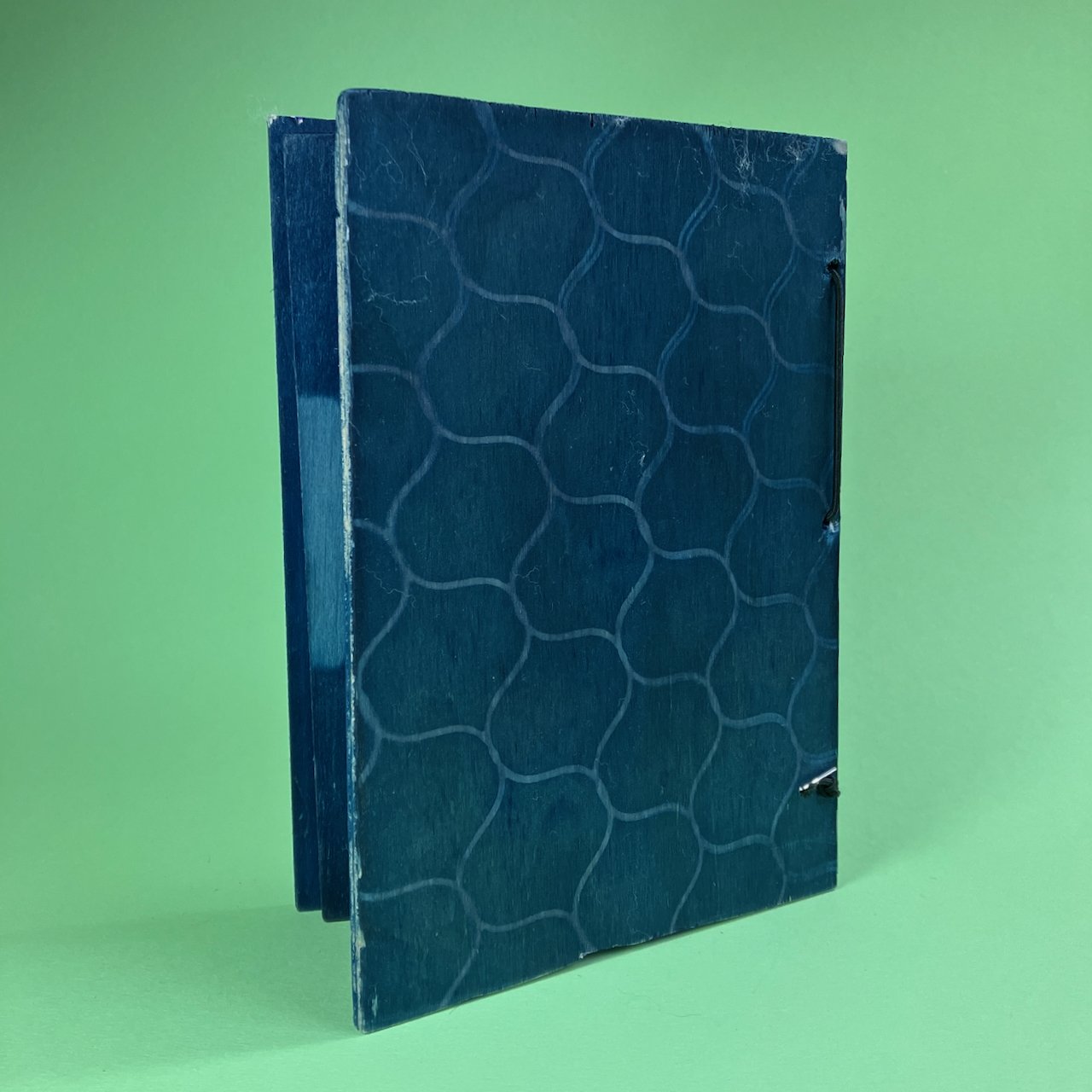
Wooden book, 220 x 150 x 20 mm
Overview
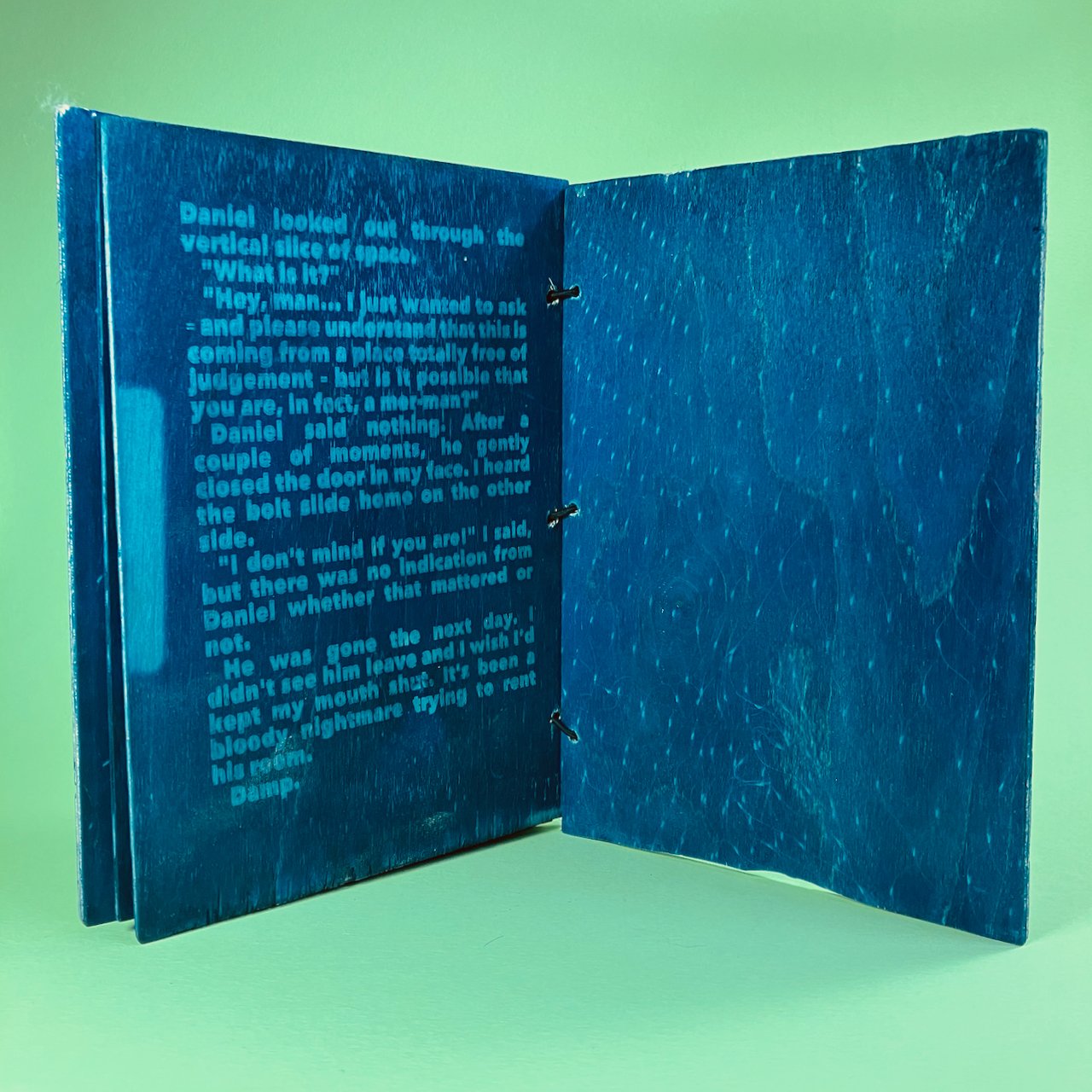
A story about misunderstanding the people you live with, presented as a wooden book with the text printed by cyanotype.
Background
Cyanotypes are quite a cool process - treat a surface with the chemicals, put some kind of mask over them and then expose it to sunlight. Where light is blocked, you get a pure white tone and where the sunlight reasches you get a rich blue. It’s an old process, used to reproduce drawings when accuracy and fidelity to the original was more important than the aesthetic. It’s where the term ‘blueprint’ comes from. I had made some cyanotypes before using the sun paper kits you can get, but had always wanted to try the chemicals on wood. When Upright Gallery posted an open call for artists books on the theme of water, it seemed like a good reason to implement some of those ideas.
I was on a short timeframe, so used a short story I had written as a basis for a simple book. The story was very short - less than a thousand words - and I typeset it on the computer before printing the layouts onto acetate. I then cut some pieces of plywood I had knocking around to the right size, treated them with the chemicals and exposed each of the sides to sunlight while covering them with the transparent masks I had made. Each side needs to be fixed with water, otherwise it’ll carry on reacting to light and eventually turn completely blue. Having to wait for each piece of wood to dry before applying the chemicals and exposing the other side is what made this such a tight race to deadline. That all worked out reasonably well and the exposures were OK. What turned out to be more difficult was applying my limited carpentry skills to cutting and sanding the boards to the right side. For some reason I got it in my head that the covers had to be thicker than the pages and, let me tell you, that thicker plywood was a bugger to cut. Also, I was using the wrong saw, so it was quite a wonky line. Also, I hadn’t drilled the holes for the binding before exposure, so everything was a bit off. Once I put it together, I could see that things were a bit wrong and did what I could to fix it, but my attempted fixes were just making things worse and I had to walk away and accept it as done, imperfect though it was.
I was glad to have finished it within a deadline and pleasantly surprised when it was accepted by Upright Gallery into their exhibition, which runs 2-23rd December 2023.
Making Waves at Upright Gallery, 3 Barclay Terrace, Edinburgh, EH10 4HP.
Ten Regrets
A collection of ten regretful incidents for you to reflect upon and then burn.

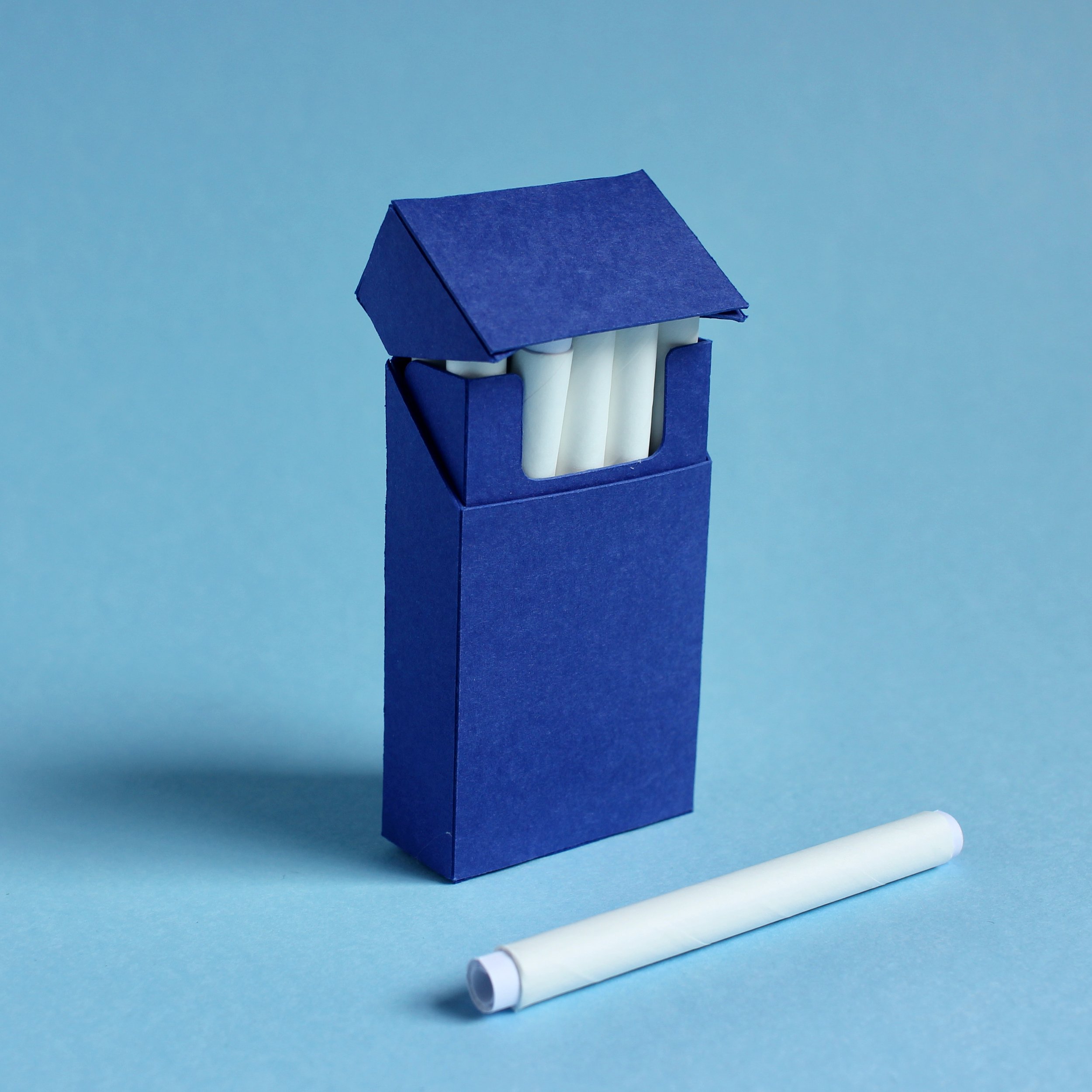


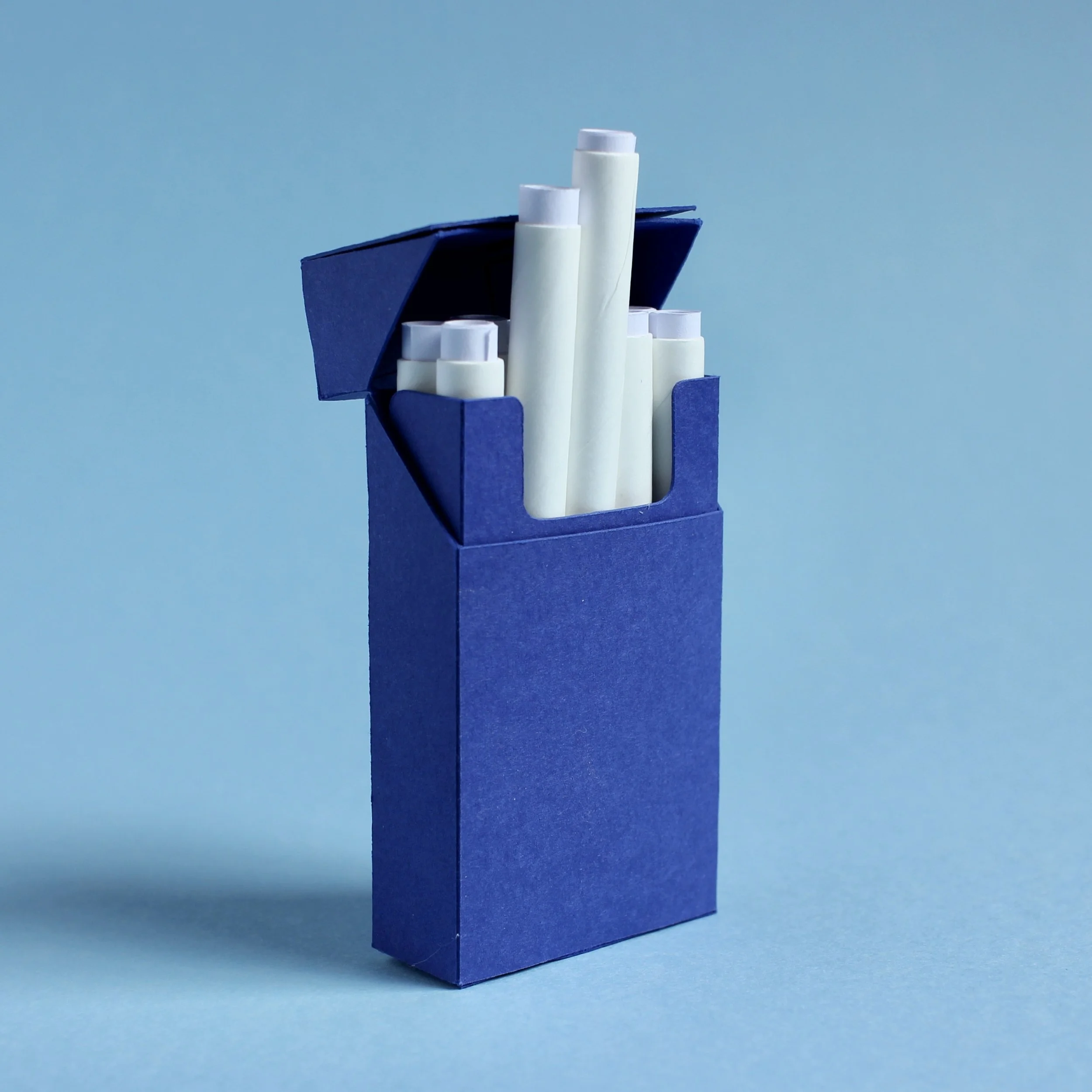
Ten Regrets is a collection of short texts which invite the reader to reflect on past mistakes. Each regret is rolled into a tube and collected in a box shaped like a cigarette packet. Each paper has blank spaces for the reader to write on and personalise it to their own specific regret. When this is done, the reader is encouraged to roll the paper back up and burn it in order to break the hold this past event has over them.
Paper and card, 20 x 90 x 46mm
Overview
A collection of ten regretful incidents for you to reflect upon and then burn.
Background
Ten Regrets is a collection of short texts which invite the reader to reflect on past mistakes. Each regret is rolled into a tube and collected in a box shaped like a cigarette packet. Each paper has blank spaces for the reader to write on and personalise it to their own specific regret. When this is done, the reader is encouraged to roll the paper back up and burn it in order to break the hold this past event has over them.
I also think it’s interesting that the reader is asked to burn the pages of this book. Although they are not bound in the same way as a regular volume, I’m interested in whether people will actually go through with the burning part. Obviously, book burning is an emotive issue. While I don’t want it to seem like I endorse it on a macro level, there’s also the fact that once you’ve bought it, you can do what you want with it.
There’s a specificity about the shape of a ten-box that puts my mind in a specific period of my life. The fact that the packet of ten is no longer available for sale also places it in a particular place in history, a pre-modern era that no longer exists and therefore adds an element of nostalgia. Nostalgia’s a tricky thing. It’s not accurate recall and in that way it’s similar to the process of looking back with a rueful eye about the things one should or should not have done in the past.
The regrets are taken from incidents in my own life, but hopefully are relatable to most people’s experiences to a greater or lesser extent. This kind of writing always feels like treading a fine line and I hope I’ve managed to make an emotional connection without it feeling mawkish or manipulative.
Third Eye Test
A kit for opening up your inner vision.
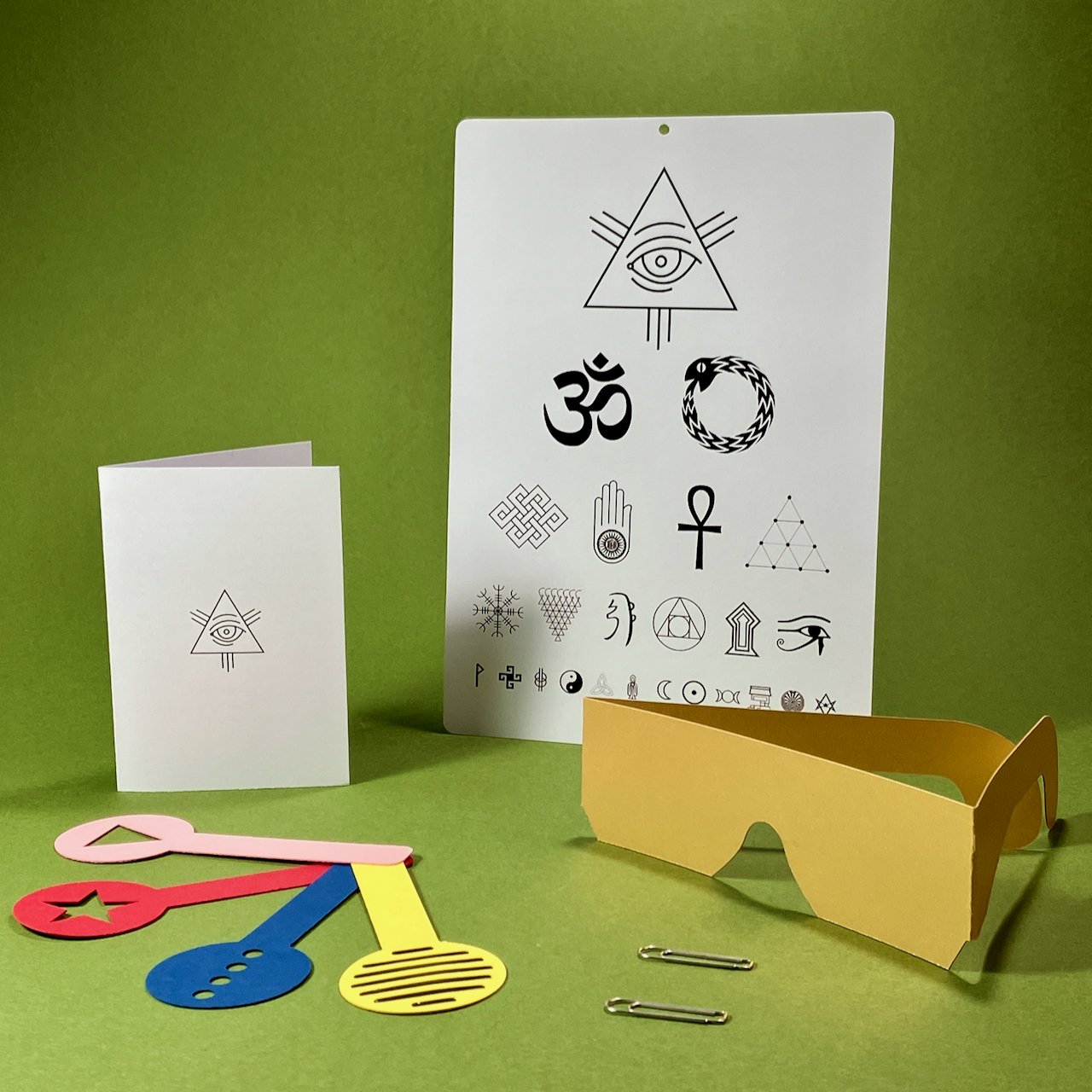
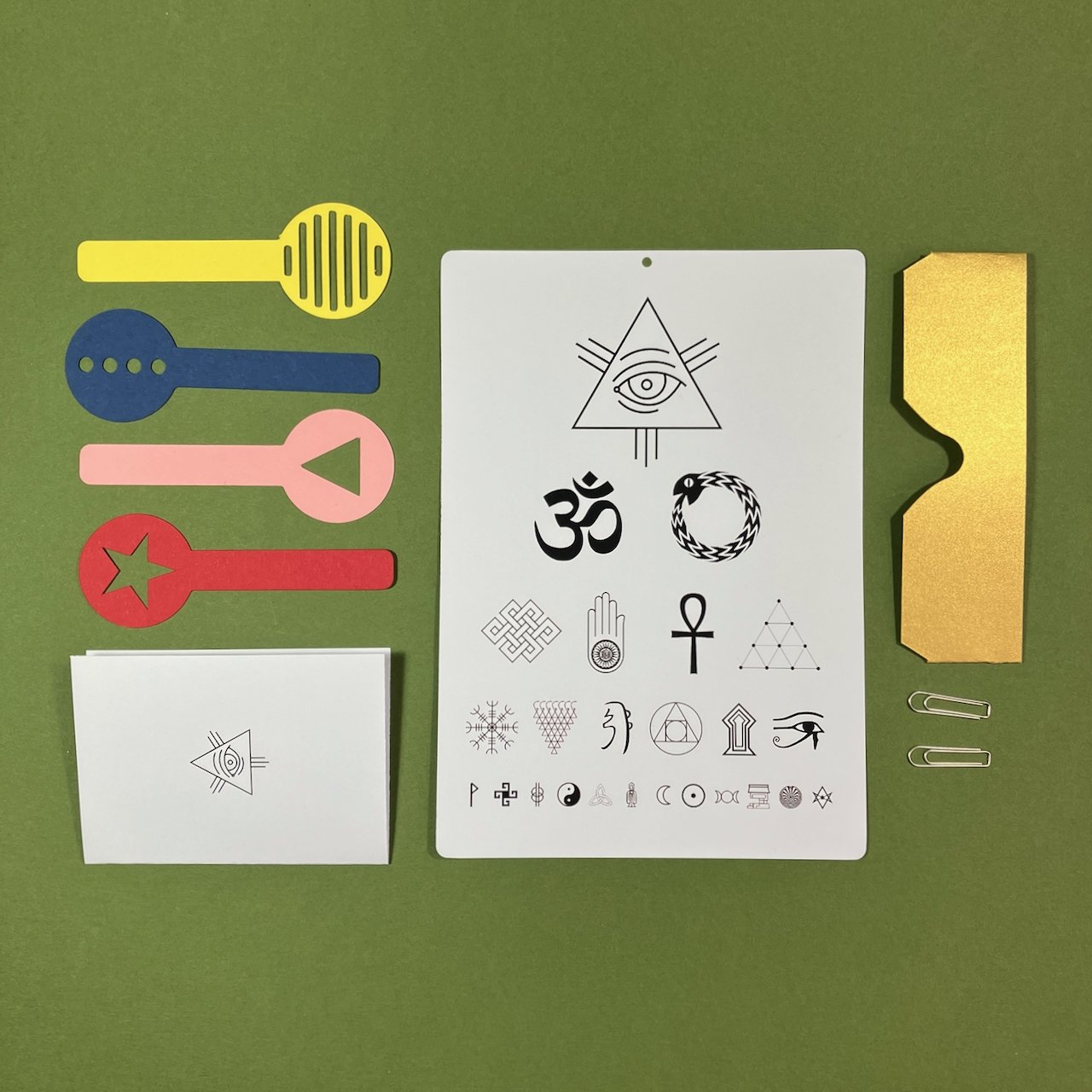
An at-home kit for testing your inner vision. Comprised of a Third Eye Chart, a covering for your First and Second Eyes, four corrective lenses, two lens clips and a short set of instructions.
Multi-part, assorted colour card, 2023
Overview
A kit for opening up your inner vision.
Contents
1 x Third eye chart
1 x Covering for first and second eyes
4 x Corrective lens paddles
2 x Lens clips
1 x Instruction leaflet
Background
I’ve been trying to buy new glasses for at least two years now. My current ones have the unfortunate habit of falling apart at inconvenient times. Apart from that, I like them. They’re light and they help me see.
That said, sometimes it’s difficult for me to read the train indicators on the Victoria Line and this told me that I should get my eyes checked. I went to the opticians and they told me that my eyes were exactly the same as when I last had them checked. When I asked about the problems seeing train times, they told me that was just being old and I shouldn’t worry too much about it. Huh.
Anyway, that led to this - an at-home testing kit for measuring the visual acuity of your third eye. It takes its cues from the equipment used to measure your other eyes and was originally going to be just an eye chart. Obviously, people would be able to see the symbols unless they were blocked out, so some sort of blindfold would be needed. Originally this was going to be a strip of cloth, but then I remembered the Peril-Sensitive Glasses that were packaged in with the text adventure adaptation of Hitchhiker’s Guide To The Galaxy (see here for a gallery of all the ‘feelies’ bundled with that and other Infocom games). I made my own version, but used some jazzy metallic card I had in the drawer. That would have been enough, but I always find an eye test isn’t an eye test without an optician holding lenses in front of my eyes and asking if it’s better “with…? or without…? with…? or without…?” and me saying things like “I’m not sure… maybe… with? …a bit?”. I really wanted people to be able to replicate that experience in their at-home tests, so created the little paddles that they could hold up in front of their foreheads.
But once they were done, I remembered that another great part about going to the opticians was wearing those incredible Frankenglasses with the lenses dropped in. Again, I wanted people to have some part of that with their Third Eye Tests, so set about fashioning some customised connectors that would allow people to attach the lens paddles to the coverings for their regular, ordinary eyes. I did not just buy a box of paperclips. No.
Anyway, the small idea ended up being 8 separate pieces (including the little explanatory leaflet that I was really in two minds about making and a little fold of card to stop the lens clips digging in to the main chart). Five of these elements required the use of the cutting machine, which is a slow process, meaning the simple little idea to knock out in an afternoon took a bit longer to put together. Still, once you embark on these things, you have to see them through.
Classifying stuff like this is kind of weird. Although it does have printed pages, it’s not a book. It’s not a wearable, although an element of it is worn. I guess it’s just a thing.
Babies – Invaders From The Future
A warning about the menace that lurks among us.
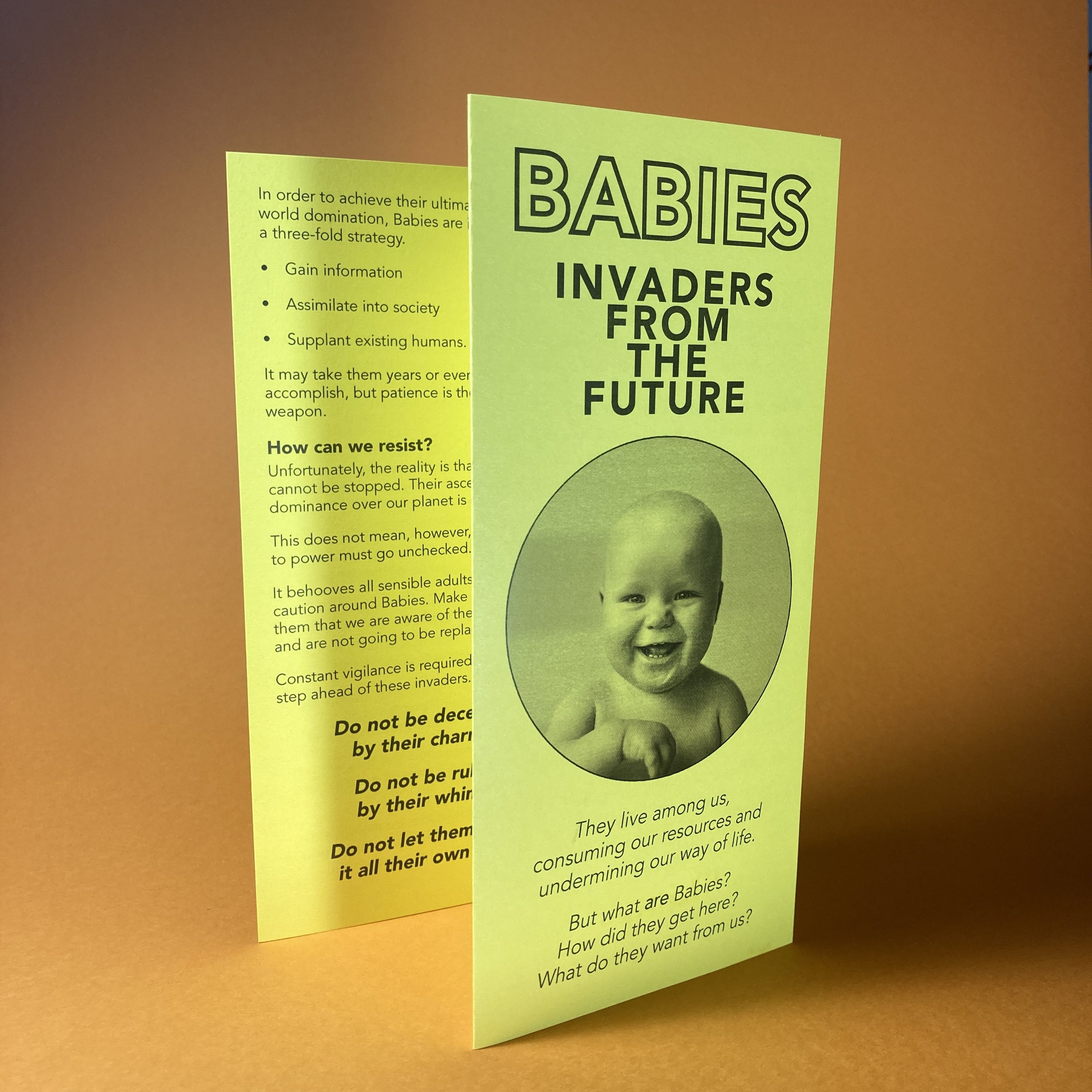
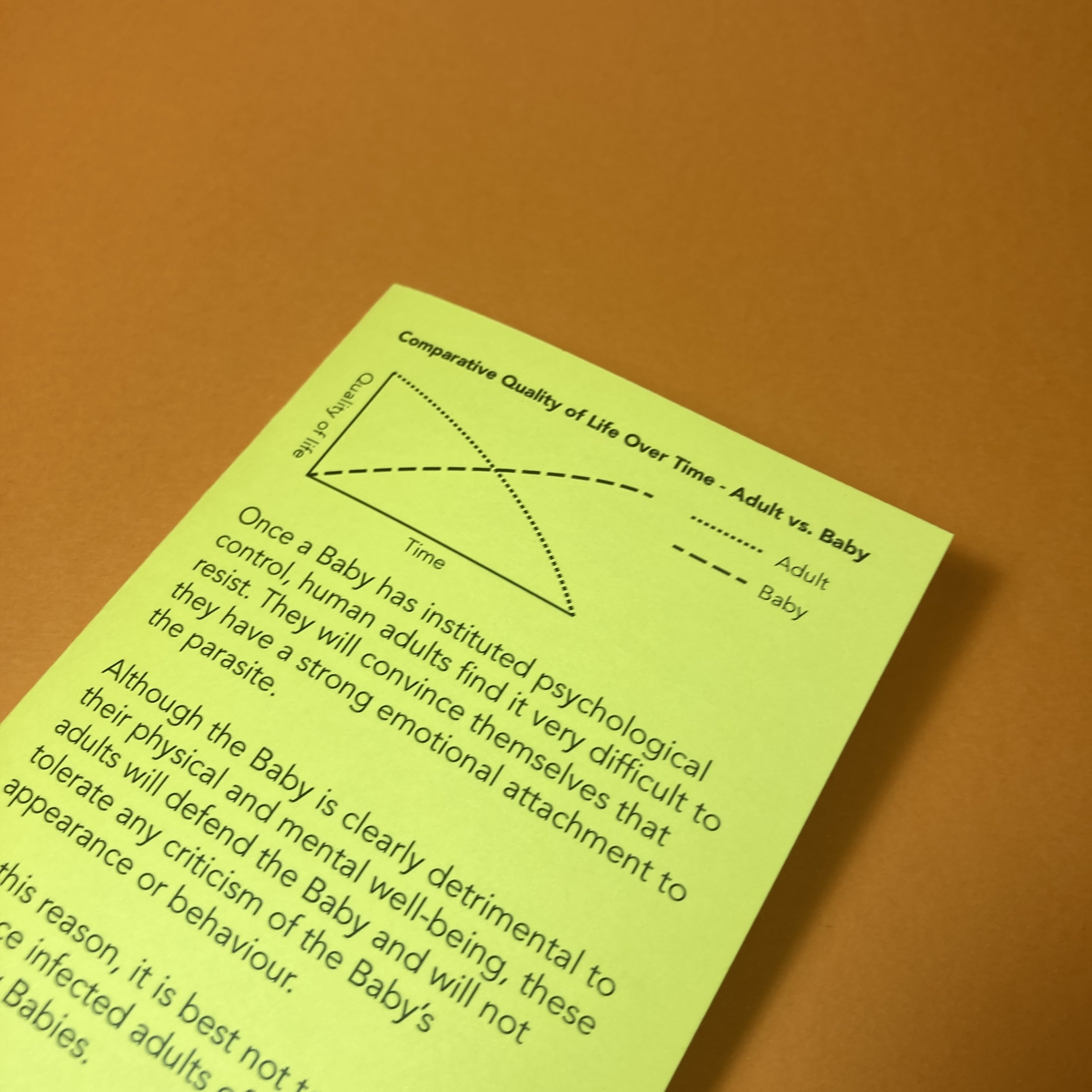
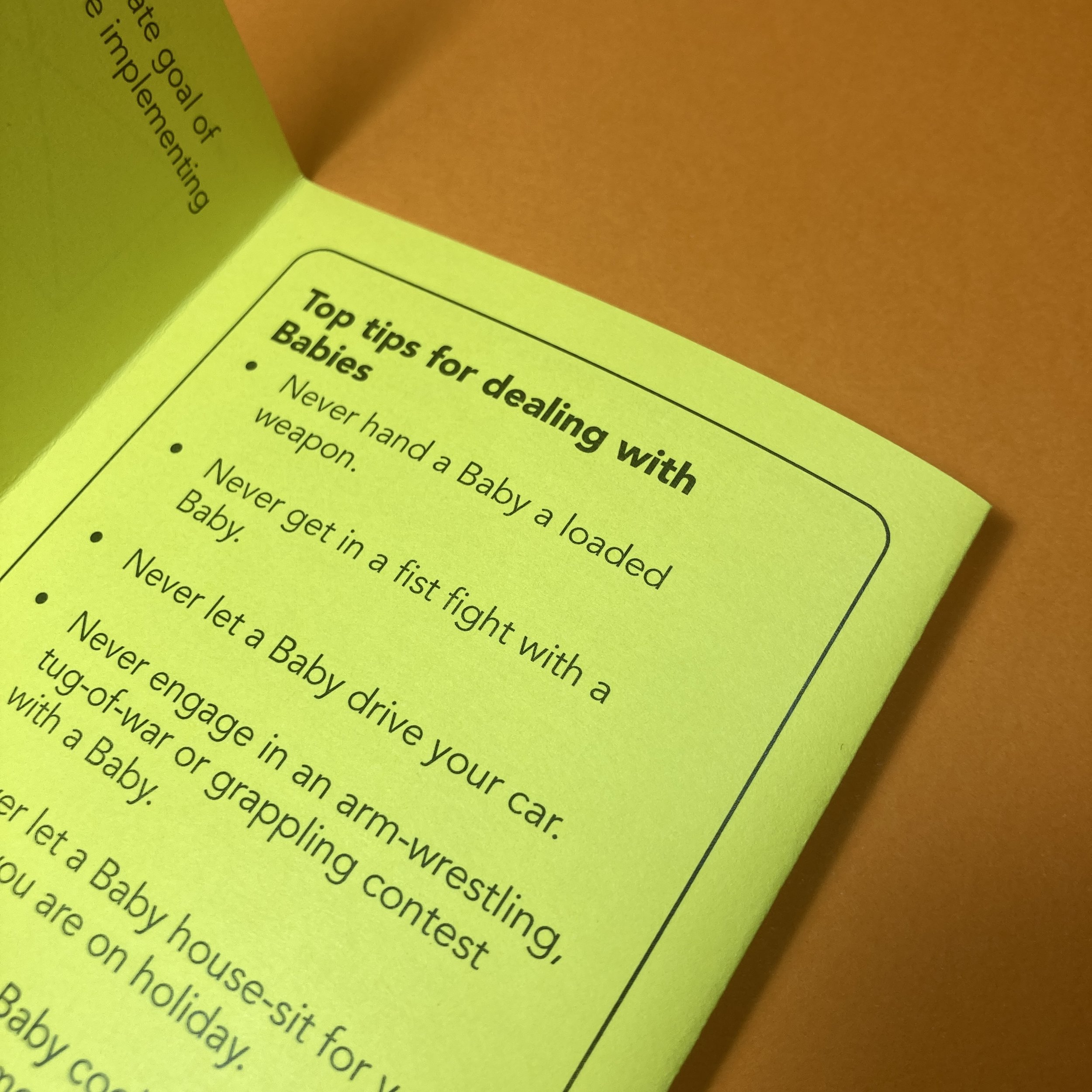
Tri-fold pamphlet, 99x210mm
Overview
A warning about the menace that lurks among us.
Background
The original concept for this - that babies are trying to take over the world - was originally expressed in another form. I wrote a 4000 word short story about the efforts of a difficult conception leading a man down a path of paranoia and suspicion. It was ok, but honestly the details of conception weren’t really that interesting me and I didn’t particularly want to publish a story about masturbating into plastic cups.
The core concept of babies as secret agents plotting to overthrow us stuck with me though. After a few false starts, made its way into this tri-fold leaflet, printed on high-vis yellow card.
This was sent to subscribers in April 2023 and copies were left in some locations in London.
Intern
A short story about a hapless member of the marketing department.
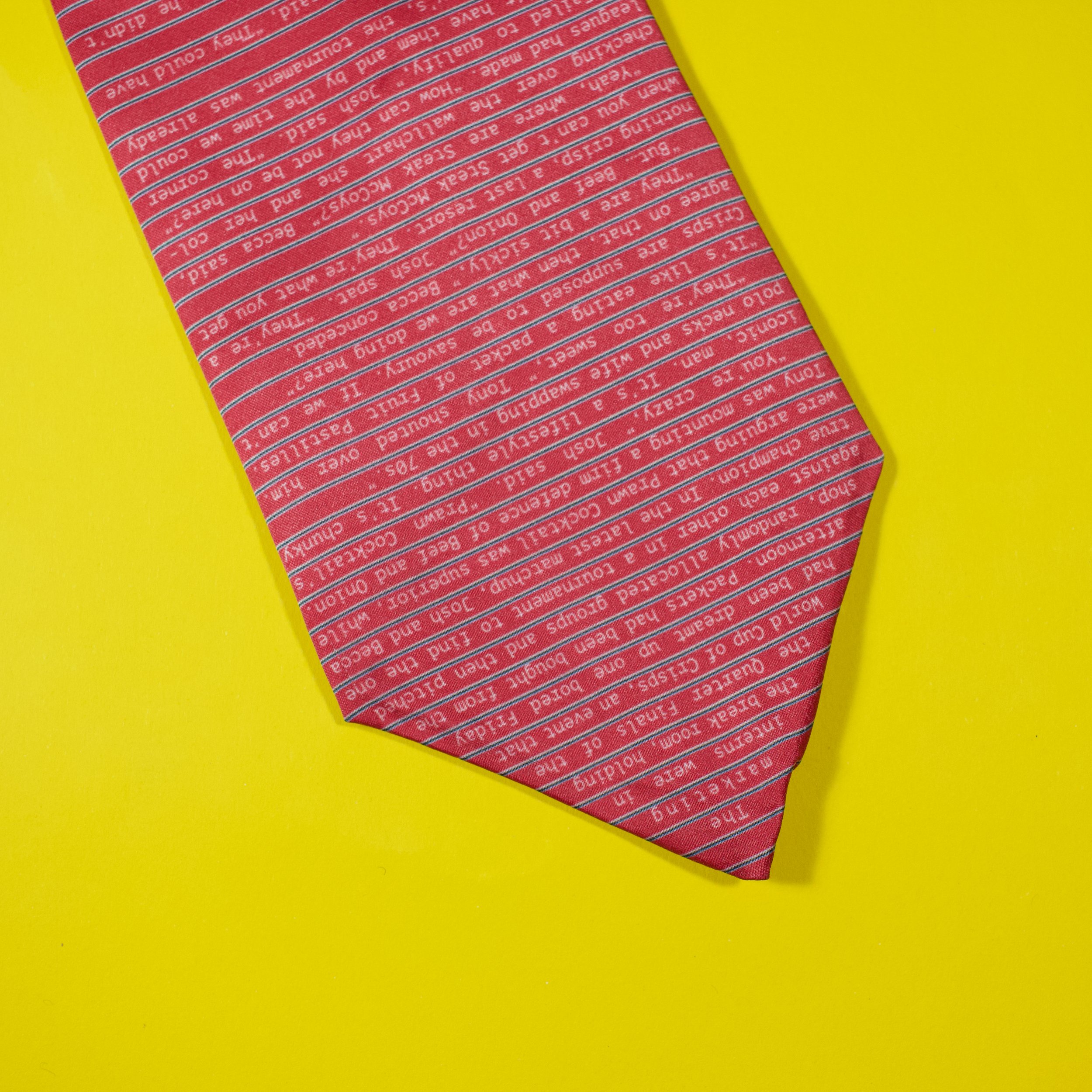
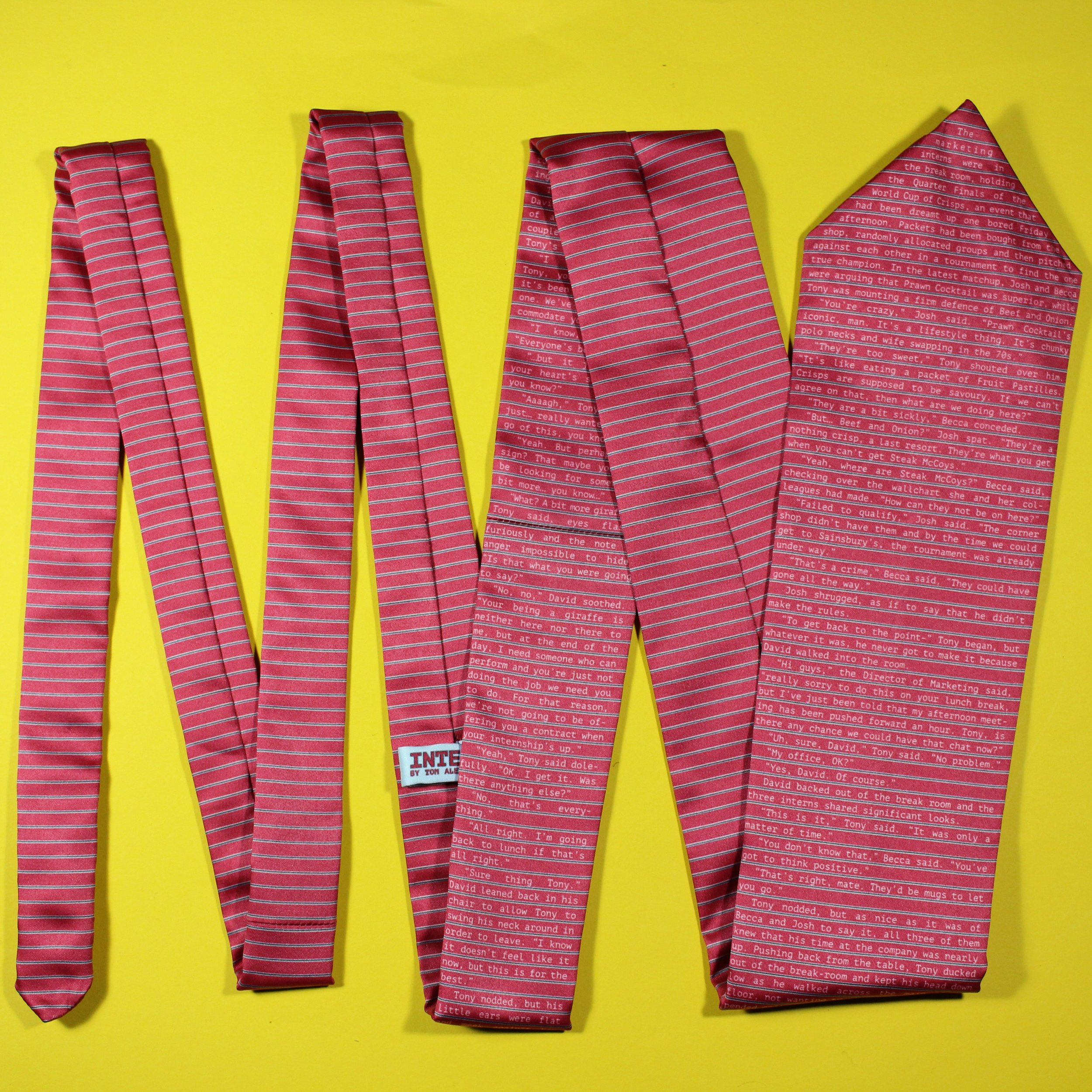
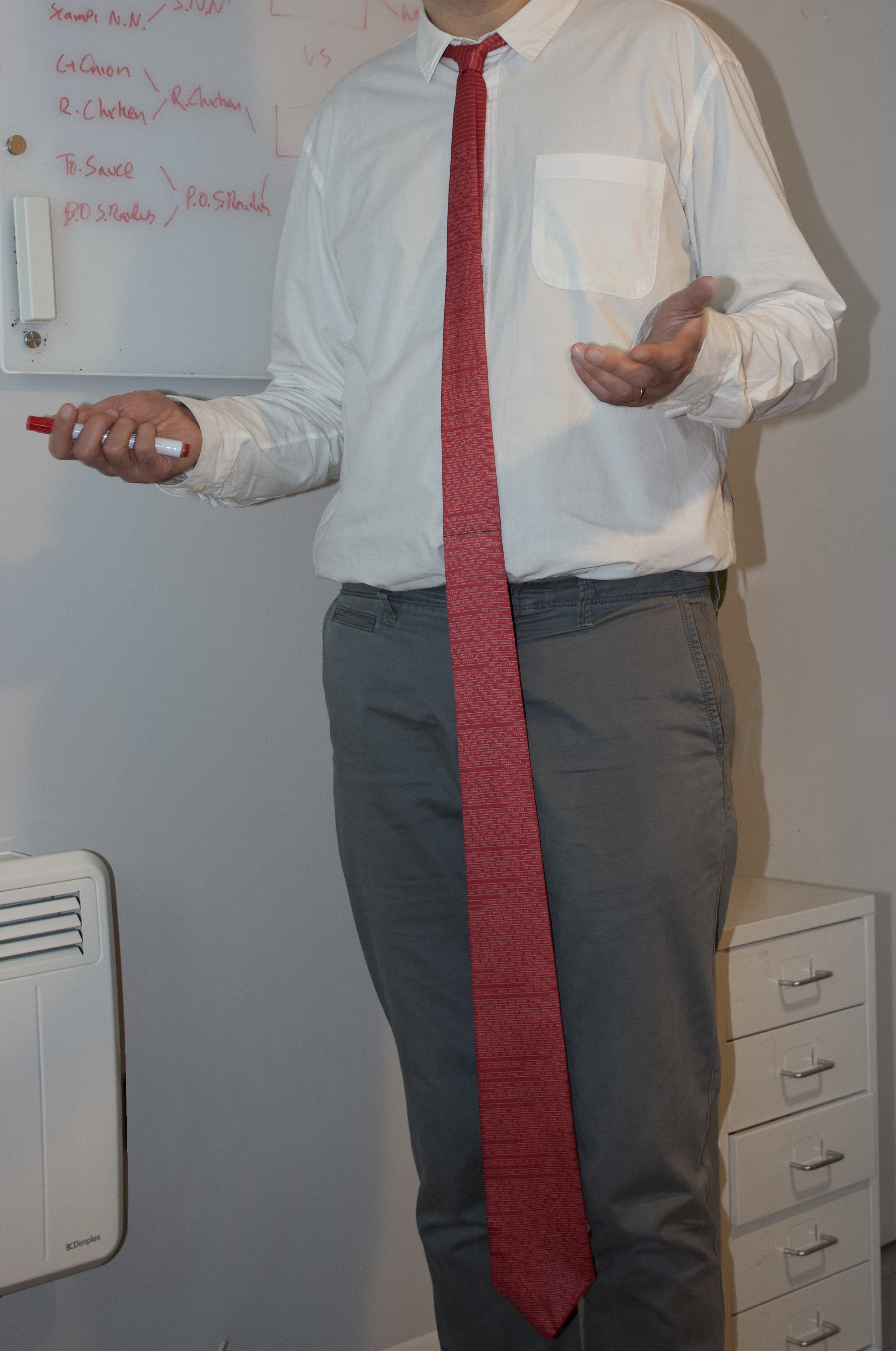
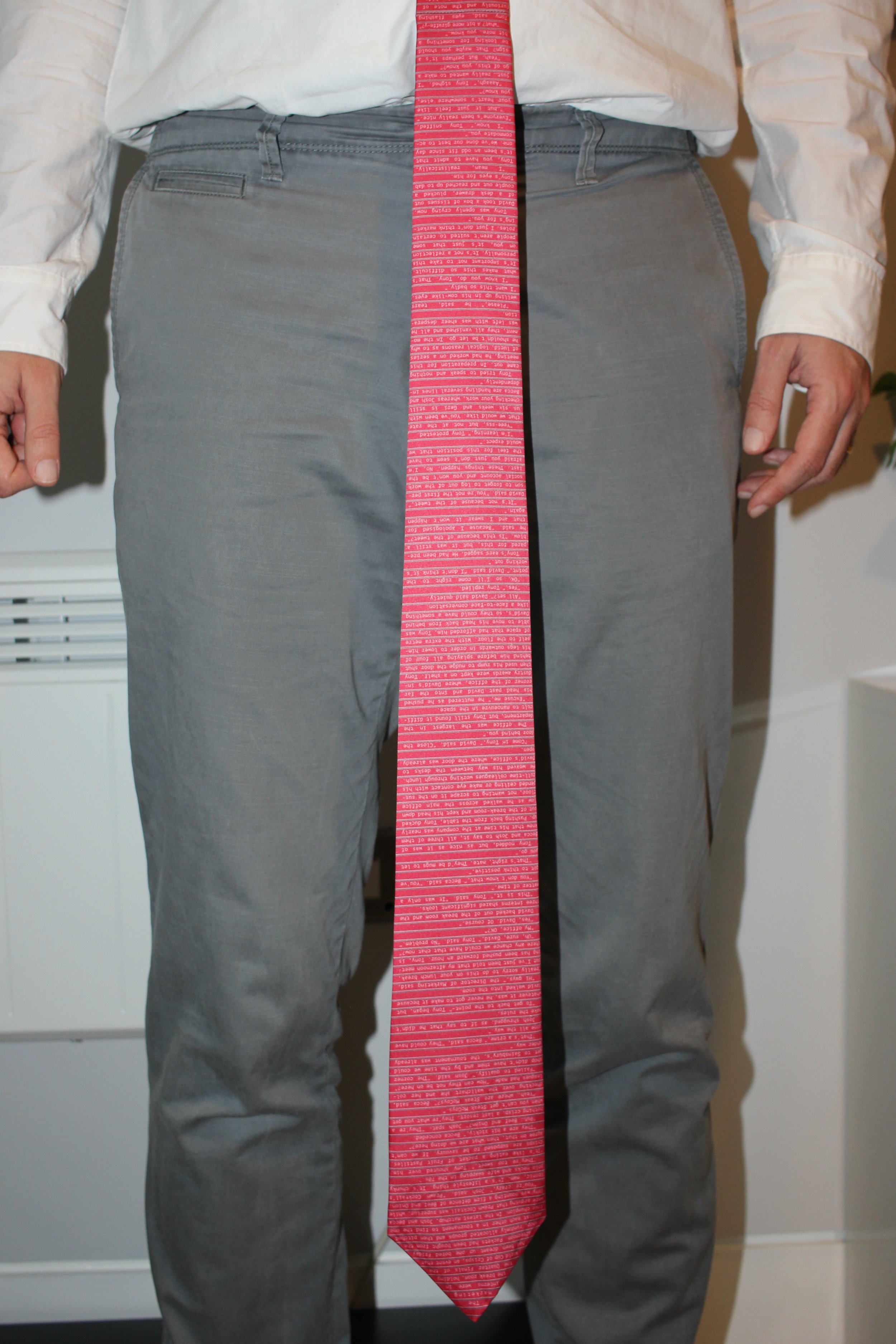
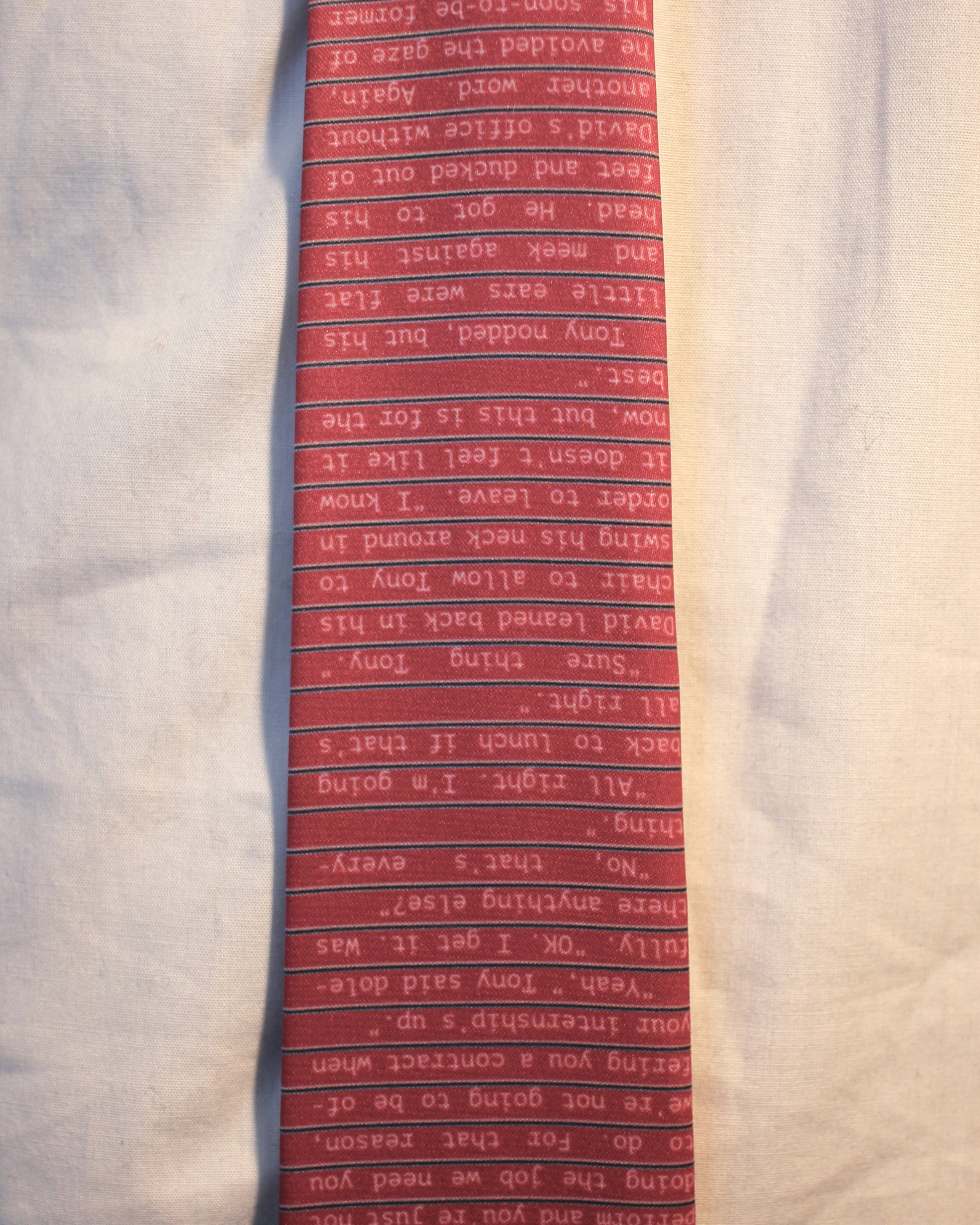
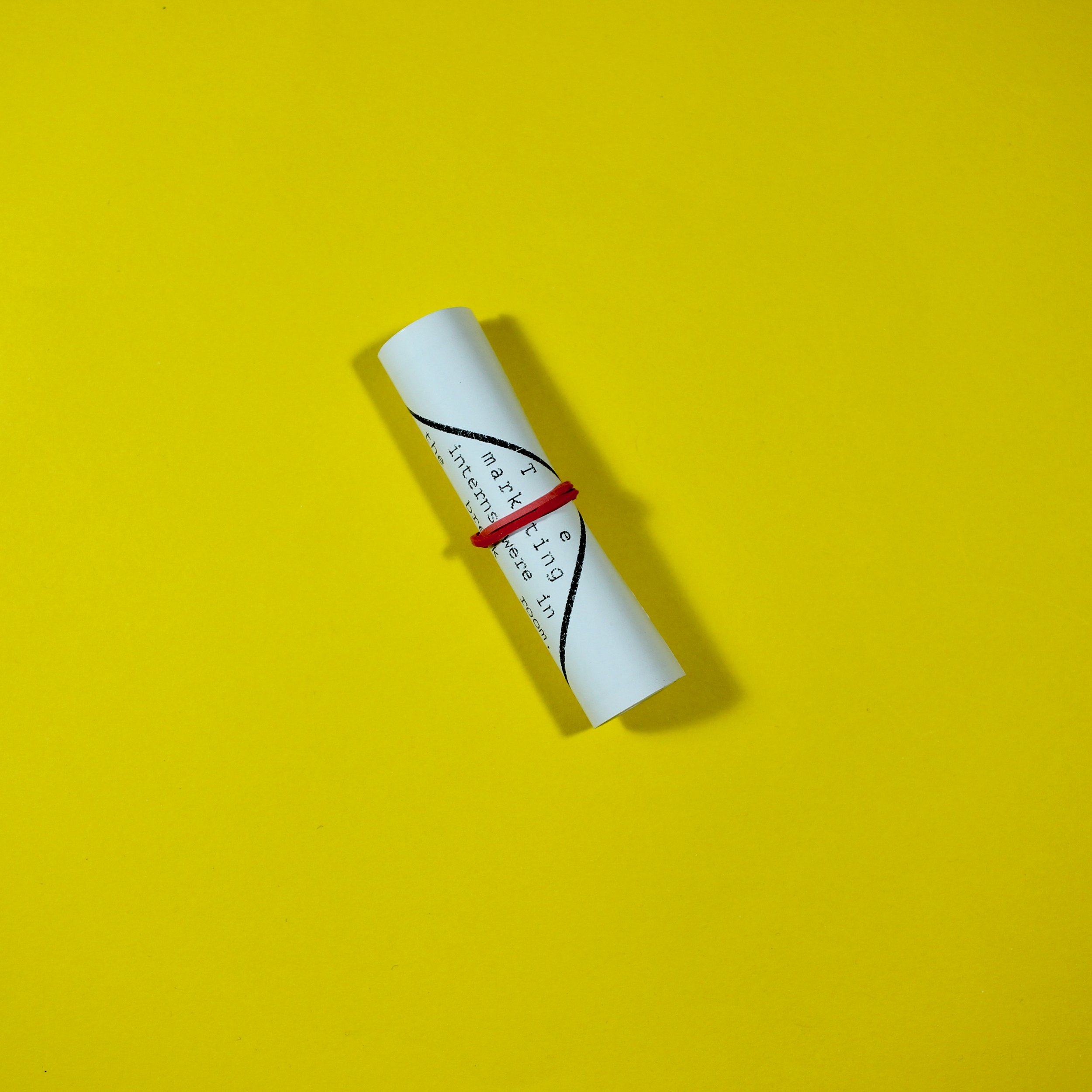
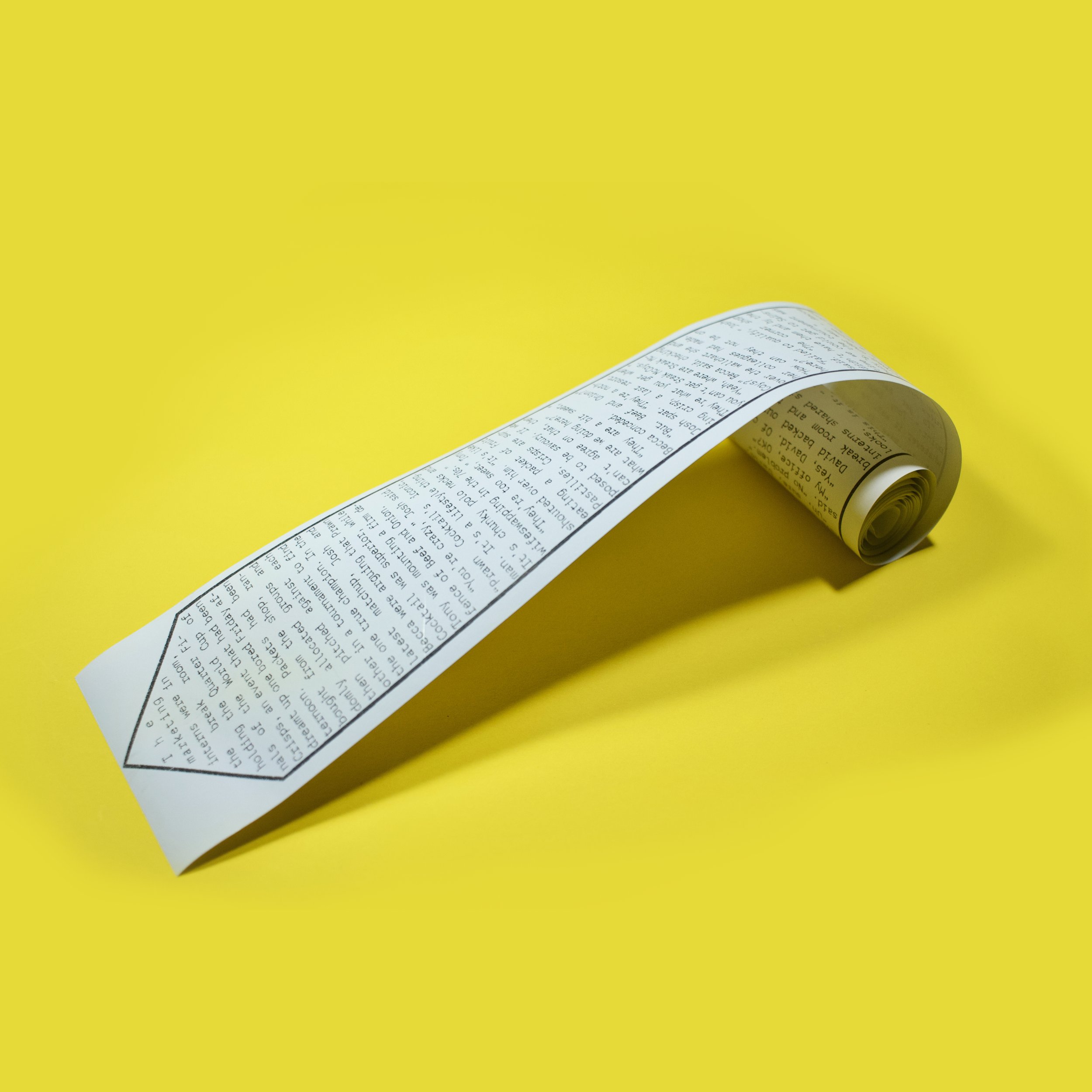
A short story printed on a tie. The text has been digitally printed on silk-like polyester and assembled by hand. It is approximately 2.5 metres long in total and is designed to be read by the wearer.
2023, multiple editions
Hand-sewn necktie, unique edition
Thermal paper, multiples.
Overview
Intern is a short story about a hapless member of the marketing department who is about to be let go. It was published by Idle Ink on 4th March 2023 and two physical editions were made to coincide with the story’s release on their website.
Background
So, it’s probably best to read the story on Idle Ink before continuing here. You’ll understand the rest of this a bit better and I’d like you to not know about the text before you read it.
Done? OK, let’s proceed.
This was one of several stories I wrote at the end of last year, when I really wasn’t feeling enthused about making books and instead was just concentrating of writing. This happens. I swing between those two modes - the simplicity of writing against the potential complexities of designing and constructing narrative vessels - quite frequently. Each time I do, I convince myself that I’ve stopped oscillating and that this is what I’m truly about. Then, inevitably, I go back the other way. Perhaps one day I’ll realise that they are, in fact, not two polar opposites, but in fact two complementary parts of the same thing. Anyway, I was loving the simplicity of writing by hand on lined paper and one of the stories that came out of that period was this short thing about Tony the intern and his crushing failure to make an impact on the Director of Marketing, who - and let’s be categorical about this - was not letting Tony go because he was a giraffe. It was short, silly and also kind of sad. That’s exactly where I like my stories to land, so I sent it out for submission.
It’s a weird thing, sending stories out. The wheels of literature turn slowly. I’m sure even the smallest publications are inundated with stories so the process is a slow one. Sometimes you sort of forget what you’ve done with a story. Or you pretend to, because you’re always hoping that it’ll find the right home.
While Intern was out, it occurred to me that I could use the digital fabric printing at Contrado to make a really long necktie with the story printed on it. I had previously used their services for Primates and found them to be quick and of good quality. Instead of a fuzzy fur, I was looking for a silky feel. I decided on a fabric (Silk Sensation poly 90gsm ID 2924, if you’re interested) and laid out the text. Trying to get my head around cloth patterns was a bit of a challenge. Luckily, I’m married to an expert, who took me through the things I needed to know, like seam allowances and the importance of the bias. Some of this I understood.
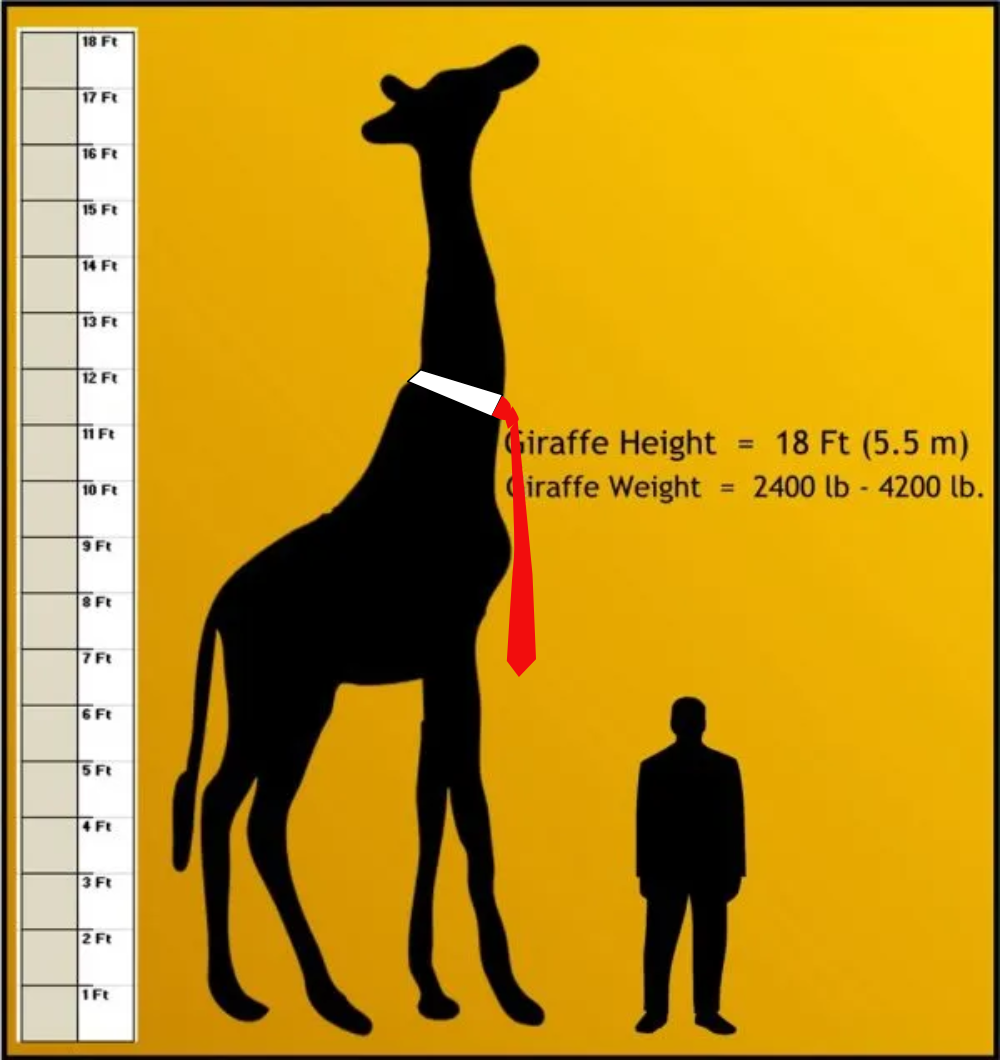
(In case it’s not clear - I added the tie.)
The question then presented itself - just how long would a giraffe’s tie be? This graphic helped me figure it out:
By my estimation, that put the tie at around 2 metres long, at least for the story part. I’m not going to lie, it wasn’t as long as I initially hoped. A six foot long tie didn’t seem as ridiculous as I’d wanted. One could imagine Donald Trump wearing one as a power move. But I told myself that this wasn’t some big joke - this was Tony’s tie and I had to remain true to that. Also, y’know, the story’s only about 1200 words long.
Working with a two-metre long document presents some challenges. The Affinity suite1 did… ok in this regard. Large documents are quite a lot of for my now-quite-old Mac and I think pasting the pattern inside a text box caused more problems than it should. Anyway, I laid out the long skinny tie and then, because I was ordering a sample print at A1 size, placed cropped copies of this document on a standard sized page. Then it went off to Contrado and within a few days I had a red silky pattern ready to be assembled.
This part of the process I had nothing to do with. I get the impression, though, that it was quite annoying to make. We had failed to account for the fact that a 2.5 metre piece of cloth is just plain unwieldy. Added to that, I had placed the pieces a little too close together, making the construction tolerances a bit tight. I thought it came out pretty nice, though.
With that done, I started to think about taking a couple of photos and posting it online for the fleeting glory of a dozen or so likes. What I wasn’t expecting was for someone to actually want to publish the story. Idle Ink, a nice website of weird stories, accepted it and I had a bit of a chat with the editor there and they agreed to mention the tie version of the story.
The process of photographing the tie was frustrating. It felt like the tie needed to be seen in an office environment. That’s fine when you have a job, but you can’t just stroll into a random office wearing a six foot long tie and start taking pictures. (Maybe you can, but I don’t have the front for it.) In the end, we went round to the in-laws home office, which is much tidier and efficient-looking than either of our workspaces. We took some pictures there, but they didn’t come out quite how I would have liked. There was a combination of daylight and tungsten lightbulbs which gave everything a mixed pallor. Although the shots with the flash going off were accidents, they ended up being the ones used. Flash photography isn’t really a look I like, but it is at least a look. If I’d had more time, I might have done them again, but it was all thrown together quite quickly on a Sunday afternoon. So, thanks to Jemima and Sarah for putting up with an impromptu photoshoot taking place while they were still working. If you want a website made, get in touch with them at www.websitedepartment.co.uk.
Anyway, it was while doing the photoshoot that it occurred to me that it would be pretty easy to make a cheap paper version of intern using the Epson TM-88V thermal printer I acquired a while ago. It would be pretty straightforward to do, as I had all the files and so long as I got the print settings right, I could have a long, narrow strip of paper with the story on. These went out to mailing list subscribers on publication date.
Some might say that three separate editions of one short and admittedly quite silly story is perhaps overkill. To them I would say… yeah… well… you just don’t get it.
I switched from Adobe a few years ago. For the most part Affinity has been a pretty good substitute. Sometimes I miss the more esoteric parts of Creative Suite, but I never really did enough with them to justify the cost. ↩︎
Butterfly Mask
A short story printed on a mask which must be read in a mirror.
Paper / card
2023, 20pp, paperback
Overview
A short story printed on a mask which must be read in a mirror.
Background
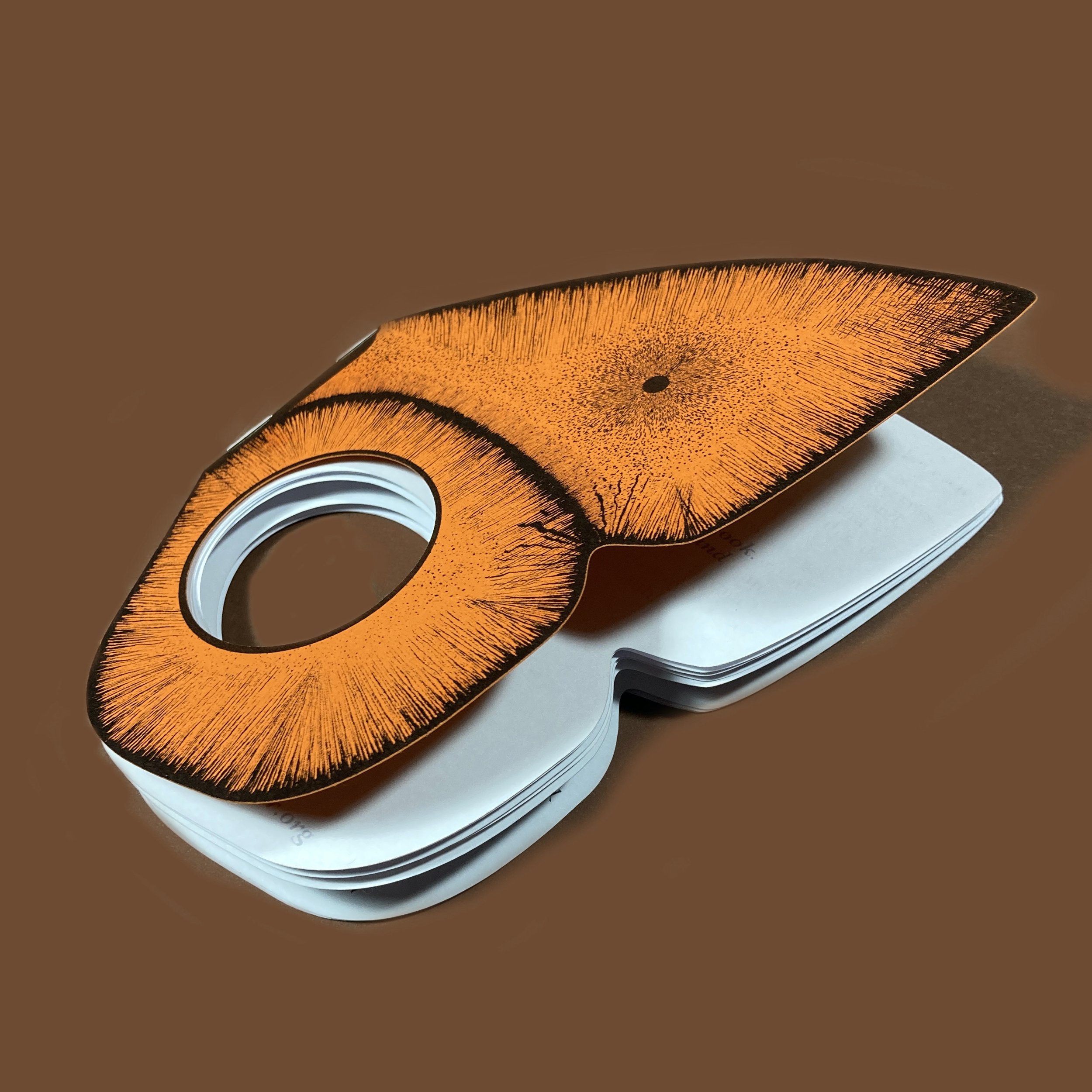
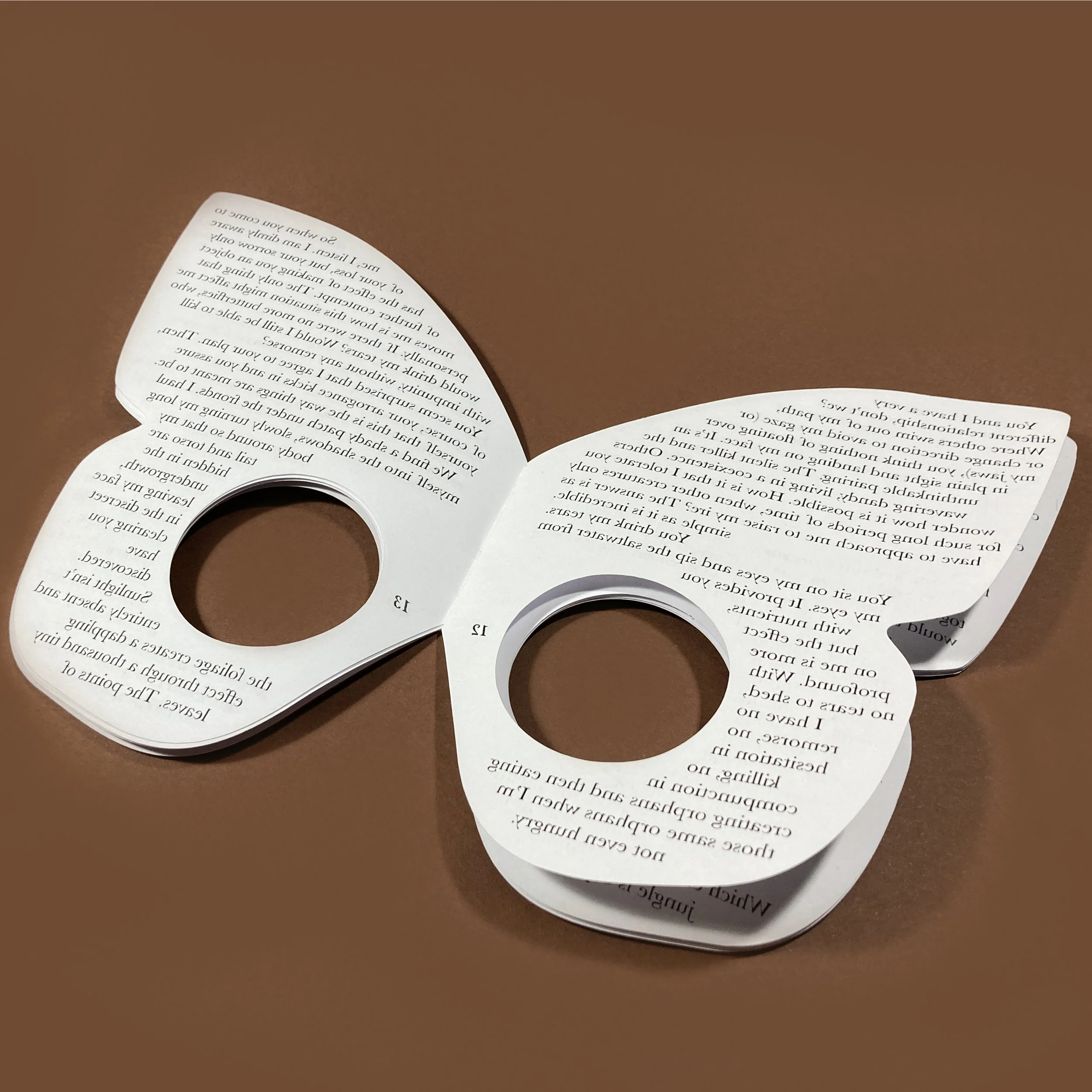
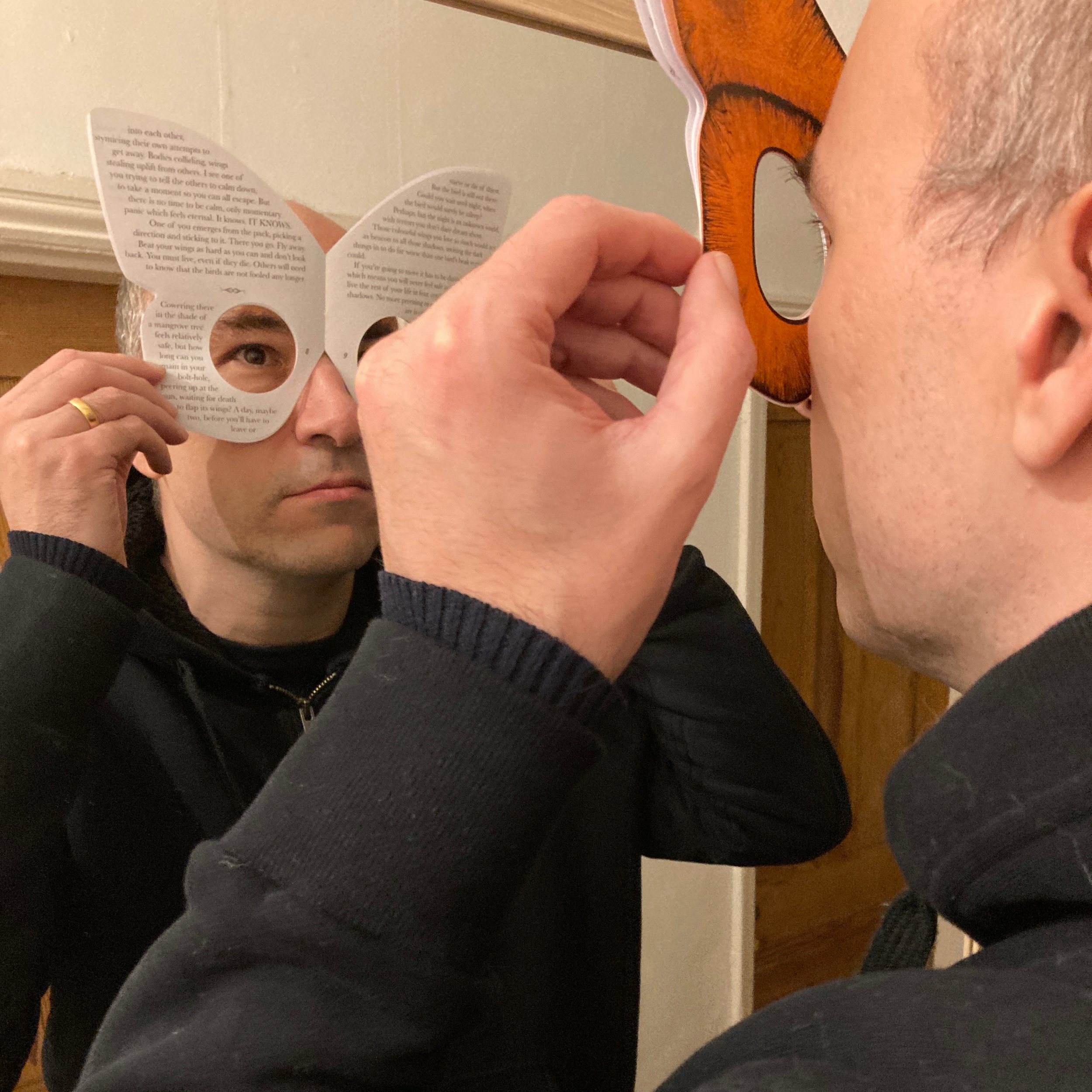
Butterfly Mask started as an expansion on some of the ideas presented in Oubliette, namely that of mirrored text and an uncomfortable physical process to read the story. Rather than using an implement like a dental mirror, I thought it would be interesting to have the story on the reader’s face. Obviously, you can’t see through the pages so cutting holes out would be necessary.
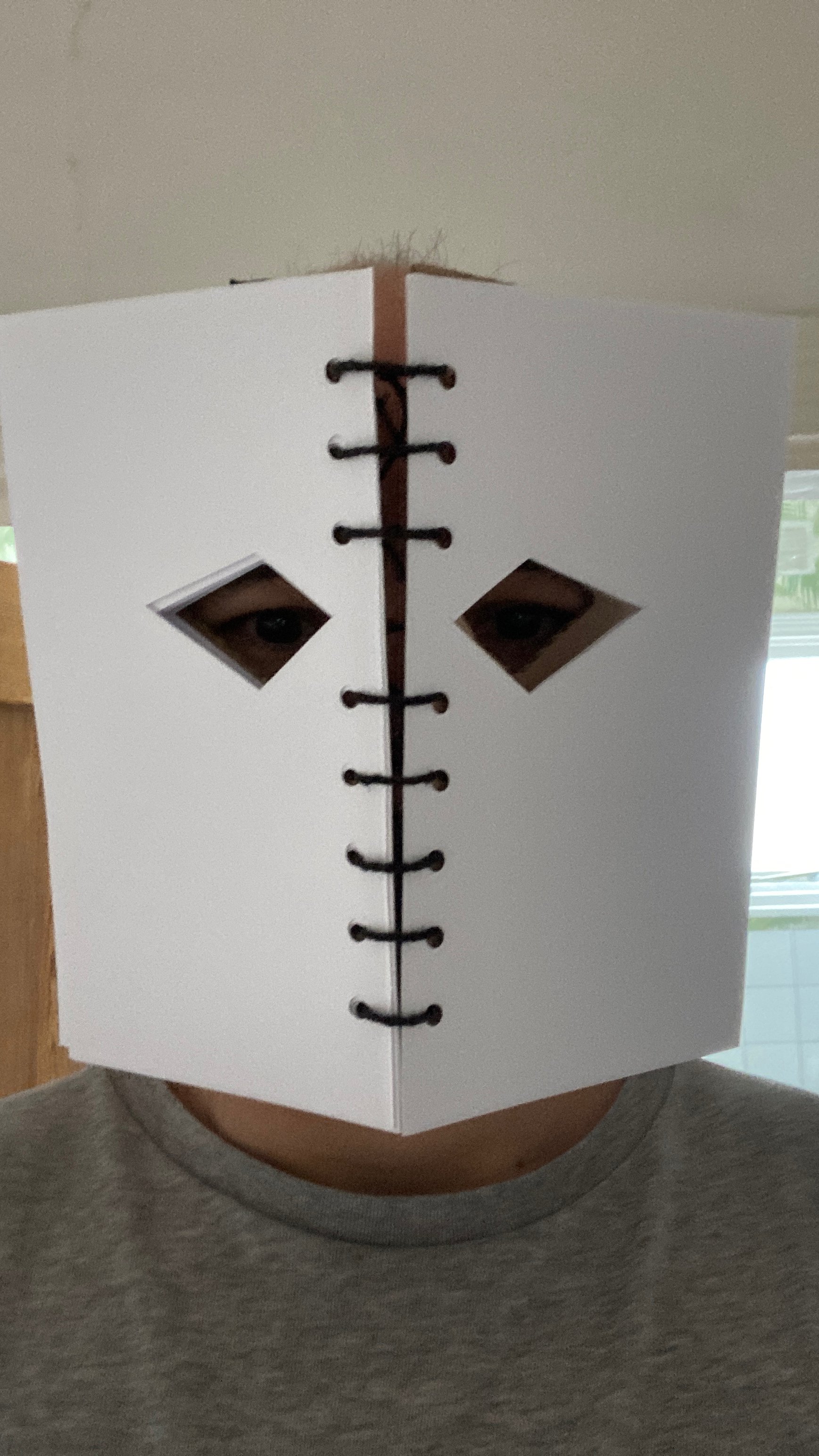
A rough prototype was made out of scrap paper and something about the blank face that I saw put me in mind of classical horror film bogeymen like Michael Myers and Jason Vorhees. I didn’t really want to write a horror story, though - at least, not one like that. Further experiments pulled me towards the ideas of camouflage and I found myself thinking about the deceptive wings of butterflies, which represent themselves as the faces of big, scary creatures to scare away predators. I thought the process of looking at oneself in order to read this story could have an interesting side-effect on the text. Rather than the text being out there, on a separate plane, it would be one’s own reflection, the face that you’re wearing to the outside world. Furthermore, there was the opportunity to do some playful stuff with the narrator - the ‘you’ of second person perspective giving way to the ‘I’ of first person as the story progresses.
Although the prototype was a plain book, I got it in my head to form it in a form more like that of a butterfly. This proved to be a pretty stupid idea. At first I wanted the text to flow on non-straight lines and spent a loooooong time setting text on various different arcs which were supposed to look like butterfly wings. They didn’t, and just looked crap. I then allowed myself the benefit of straight typesetting, albeit in a butterfly-shaped text frame, with the words flowing around the eye holes. The first versions had these towards the top of the page, but moving them to the bottom allowed for the curve of the wing to form a more natural shape for the reader’s nose.

Although the basic principles had been set out in the early prototype, finding the right sort of binding was a time-consuming process. I really wanted an elasticated strap that would keep the book secured on the reader’s face, but this proved too difficult to work out. I just couldn’t get the right combination of materials that would stay in position, but also allow the pages to fall open and allow the reader to see them properly. The strap had to be abandoned, much to my annoyance. It is for the best. Masks can be hand-held and so are books. I tell myself this in order to keep the loathing at bay.
There was no way I was going to be able to cut this consistently by hand, so I used the Cameo 3 cutter for both the pages and the cover. I’m getting a little tired of this process, particularly as Affinity Publisher doesn’t allow for addressing the cutter directly, meaning lots of exported PDFs, which are then placed into another application, then sent to the cutter. It’s a bit of a convoluted method and I miss the Illustrator plugin I used to use. There’s also the broader issue of everything being quite computer-based. My attempts at hand-making things tend to be quite shoddy, though, so I think that’s going to continue for a while.
The end product is a lot simpler than I had in mind, although it does maintain the fundamental principle of the idea from first conception – that of reading through the book and relying on external perception for an understanding of self. The whole process took a lot longer than I would have liked, although this was partly due to personal factors in the second half of 2022. Had I known it would end up as a stapled pamphlet, I could have knocked it out a lot earlier. Possibly. It’s more likely that I had to go through all those iterations in order to get to the simple version. I’ve really got to learn how to start simple and stay there.
The Real Writers' Handbook
A small guide to all the things writers use as justification for not writing - notebooks, pens, sexual infidelity, that sort of thing.
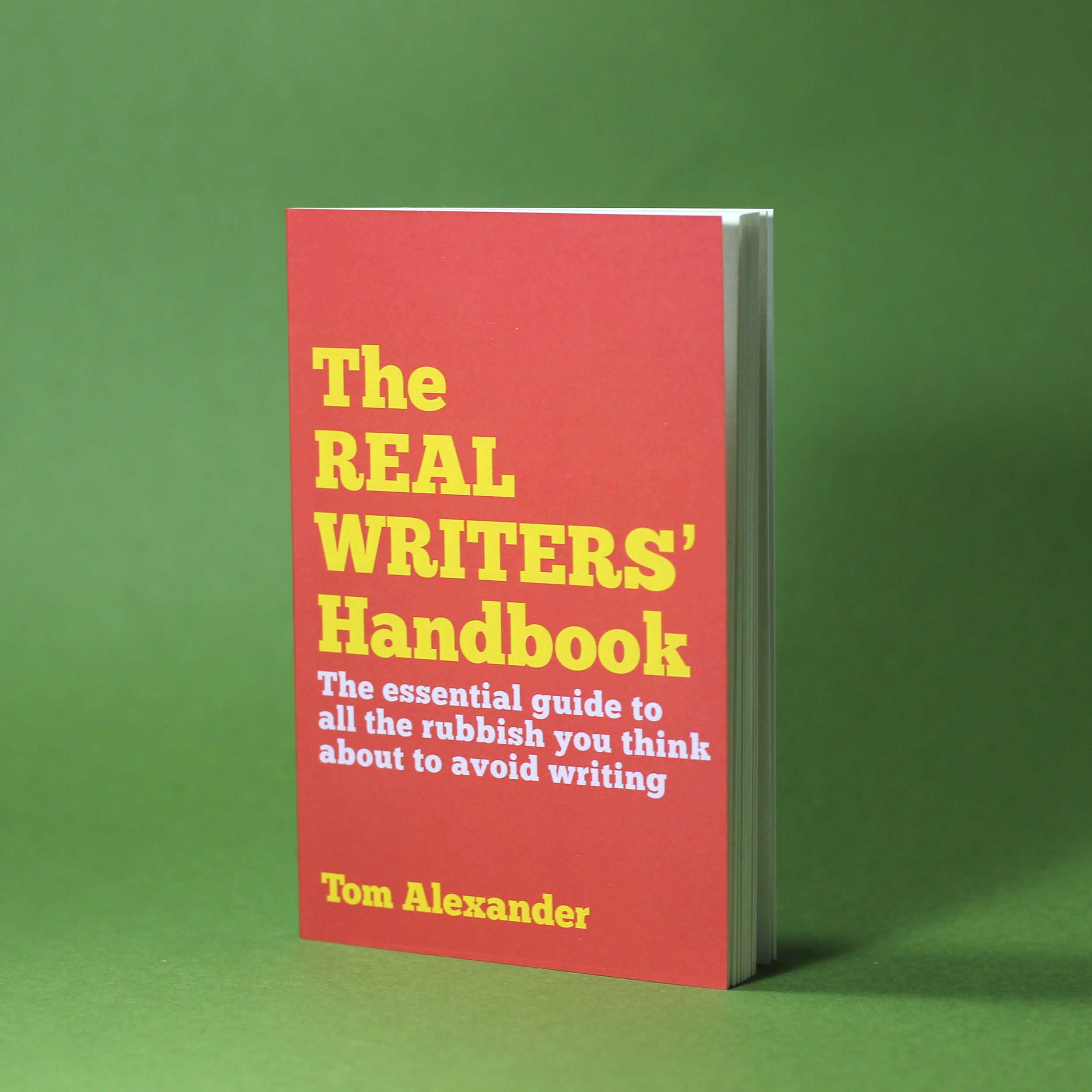
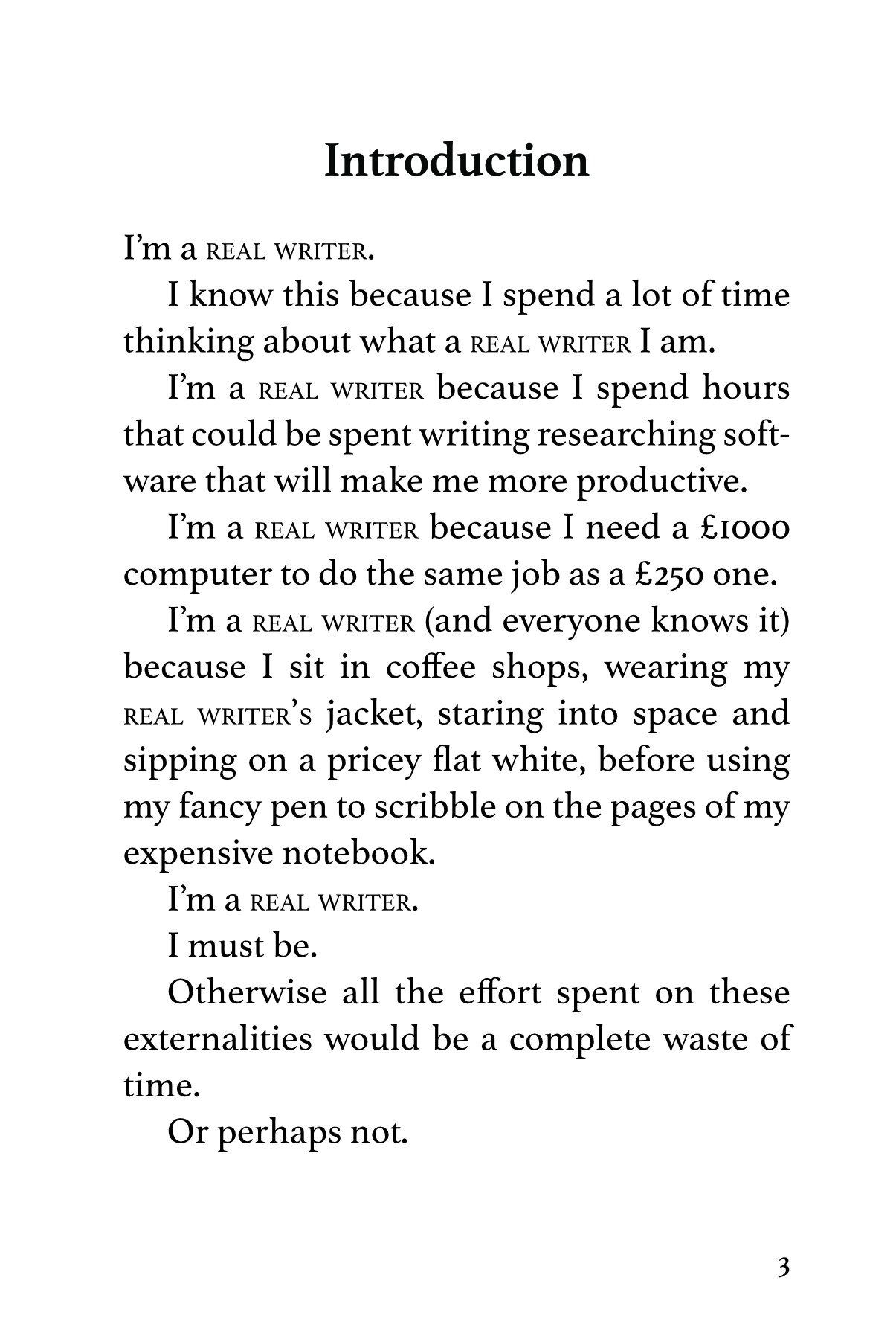
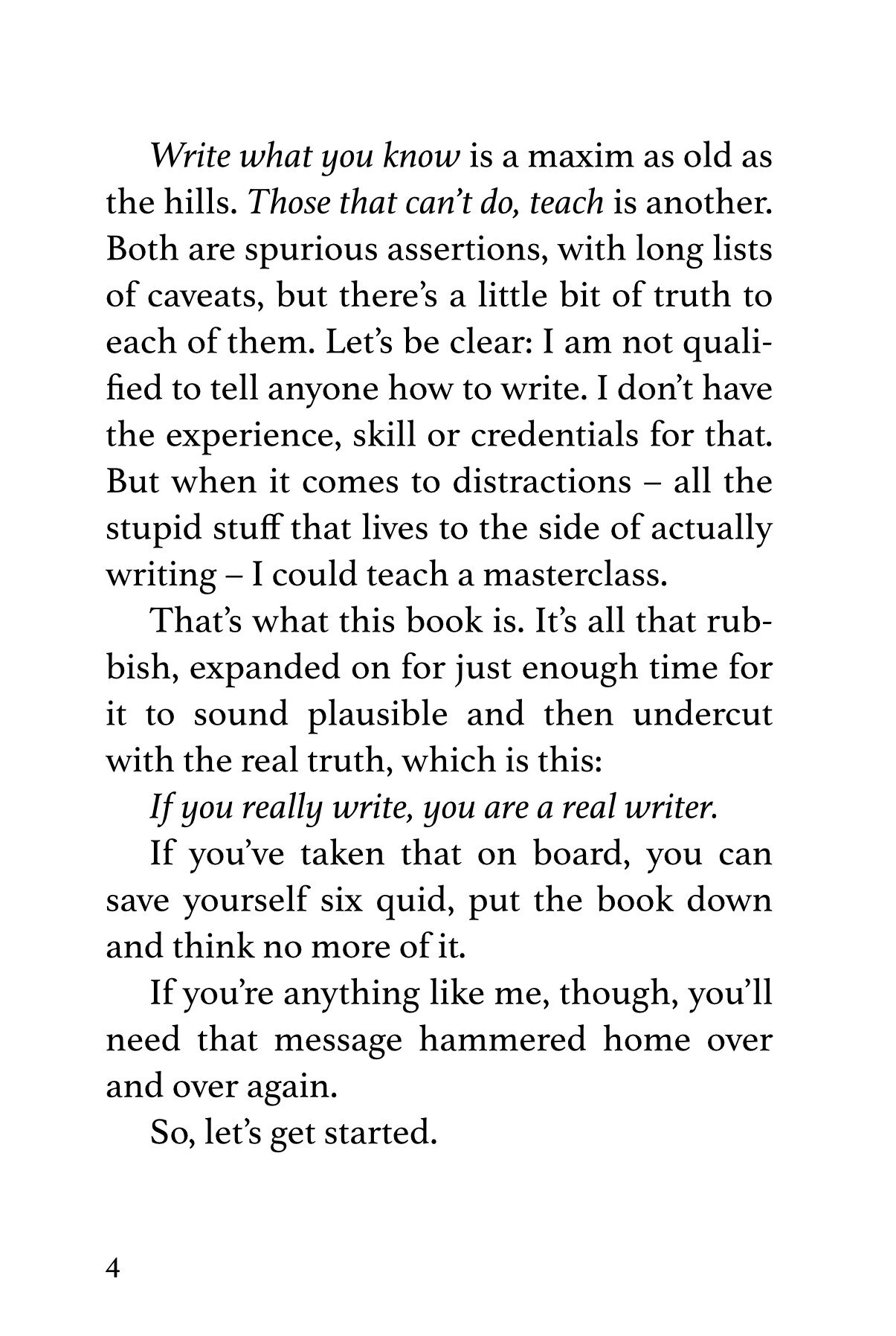
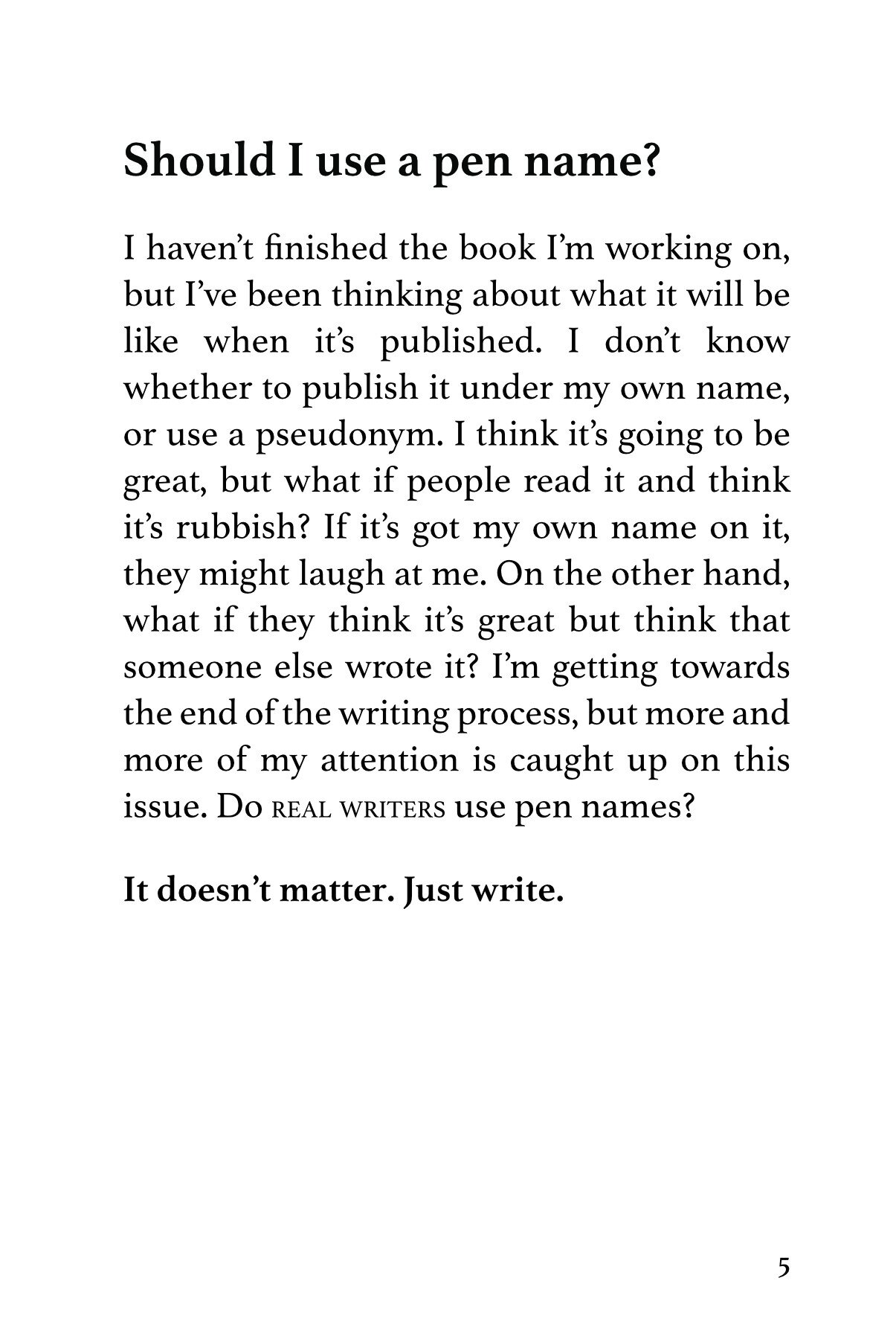
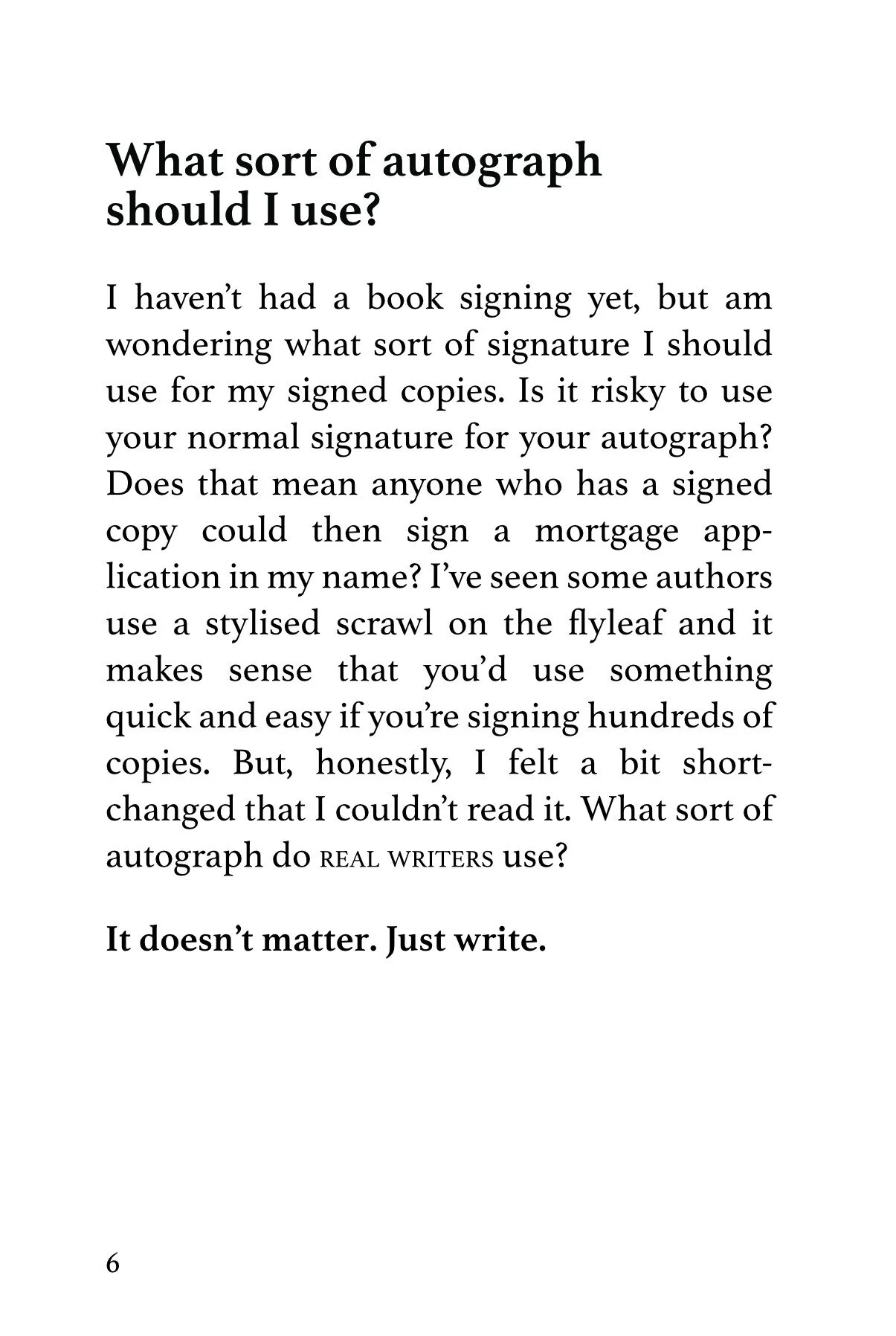
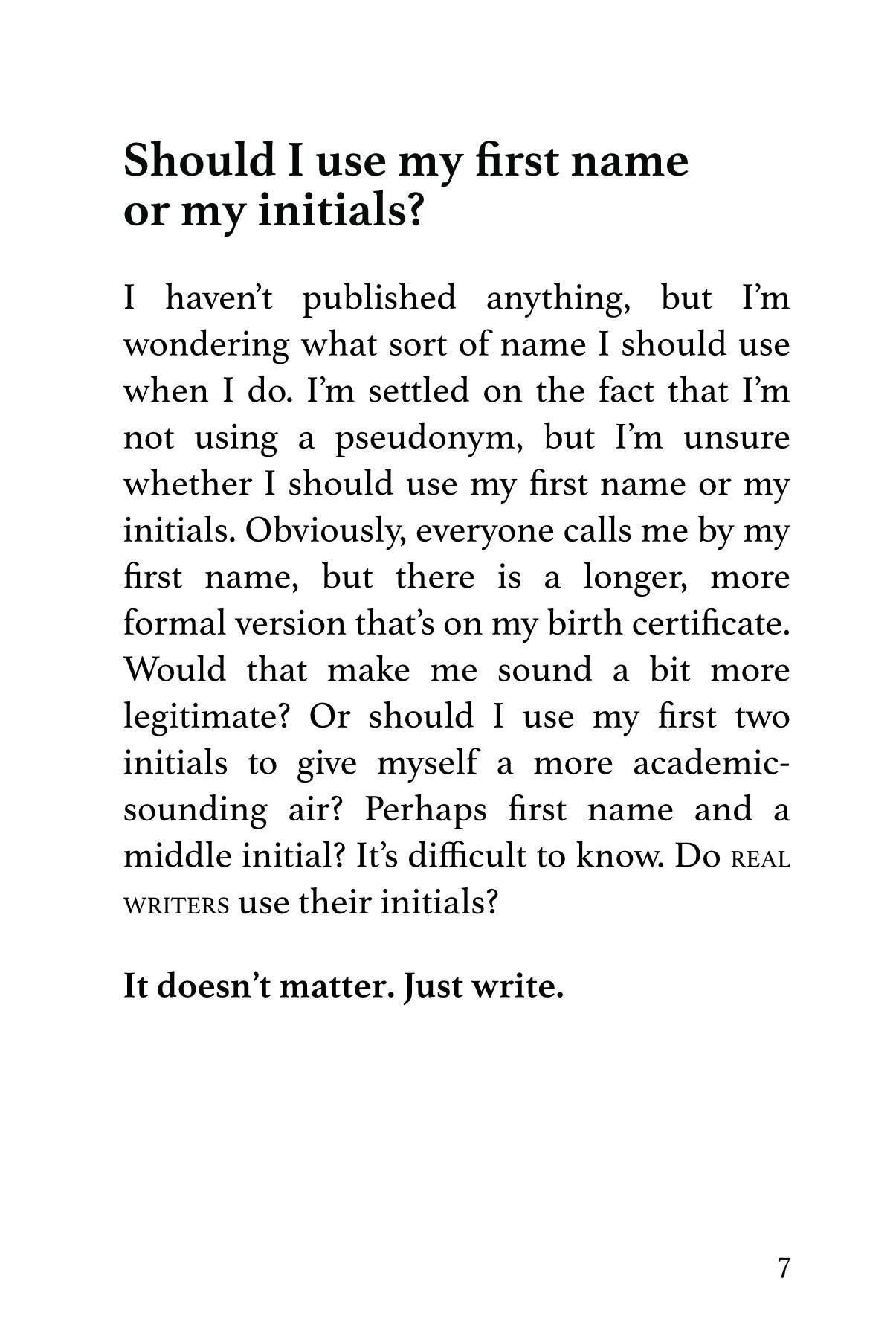
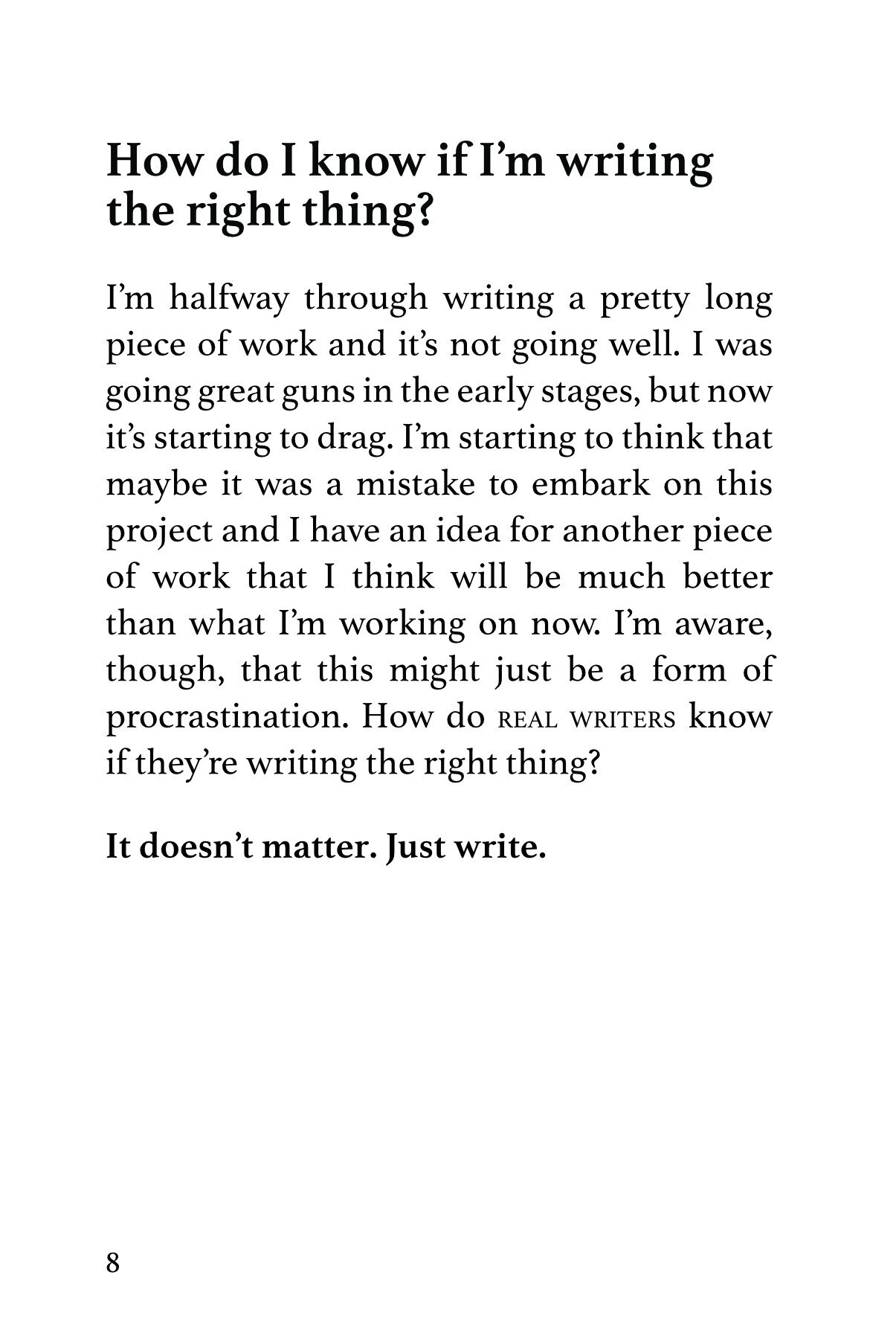
The essential guide to all the rubbish you think about to avoid writing, this pocket guide will transform you from idle dreamer to productivity powerhouse. (Not a guarantee).
Paperback, b&w, 2022, 101x152mm, 56pp
Overview
A small guide to all the things writers use as justification for not writing - notebooks, pens, sexual infidelity, that sort of thing.
Background
I’ve had a lot of long-running projects that, while not stalling exactly, have felt sometimes like they will never reach anything like an endpoint. Wanting to just get something finished, I blurted out this short How-To book, aimed at people like me who call themselves writers but often do anything but.
It’s basically a series of stupid questions, all of which have the same answer (It doesn’t matter. Just write.). Most of them are drawn from my own personal experience, when I’ve used all manner of excuses for not knuckling down and doing the work.
As the idea had been brewing for a while, I was able to put everything together quite quickly. It’s very short, so I did the first draft on Monday and had everything typeset and proofed by Friday evening. I used Ingram Spark (as I had previously on Forms) and the whole process reminded me of working in the production department at JKP. It’s the first time in a while that I’ve made an ebook and I had forgotten what a finickiy process that is.
Anyway, I think it’s a nice little book. If you know someone who writes (or claims they do) then it might make a good gift.
Writing.IE asked me to write an article about the book’s genesis. It’s almost all true. You can read it here.
Writers Write
A series of stories about writer’s block, contained in a recursively bound booklet.
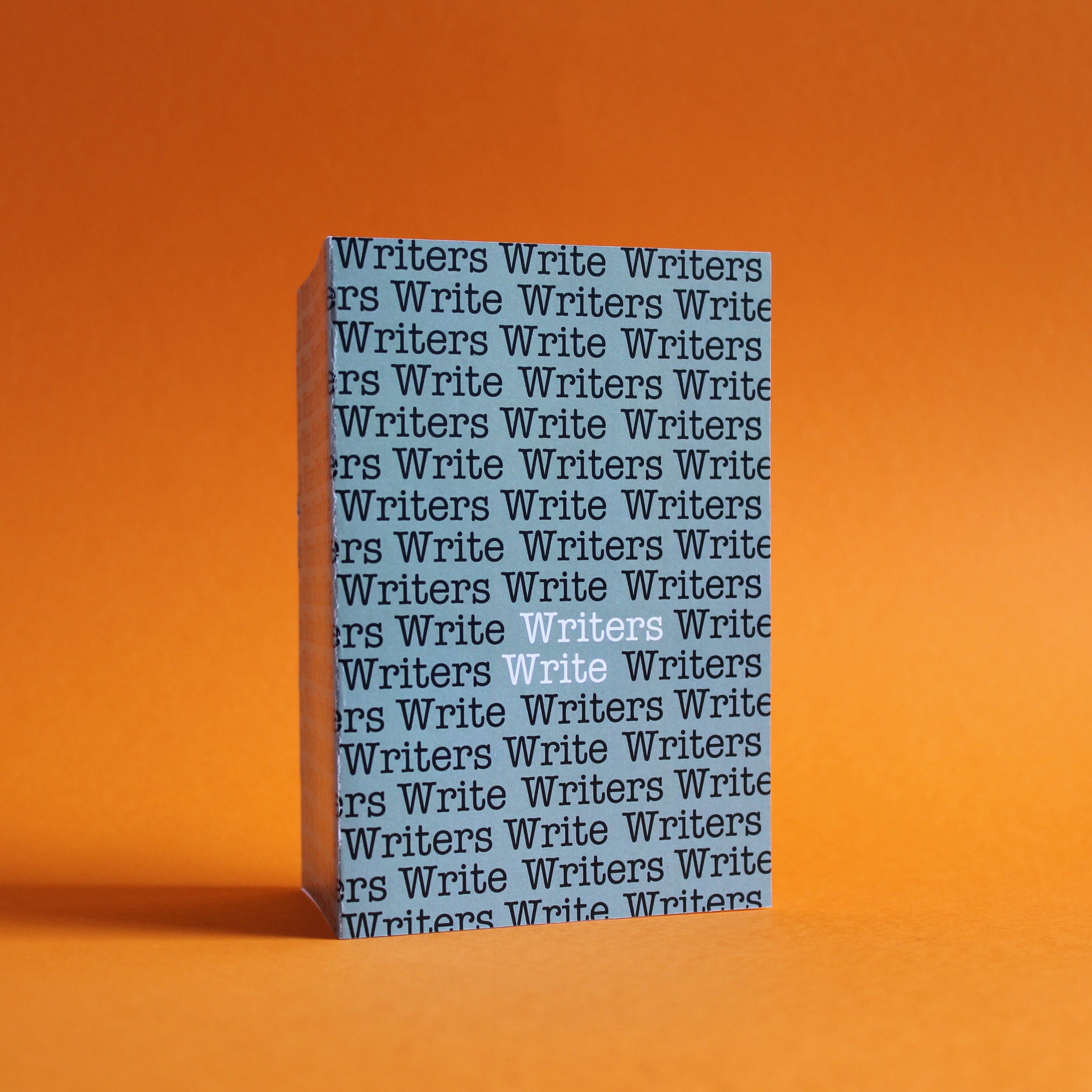
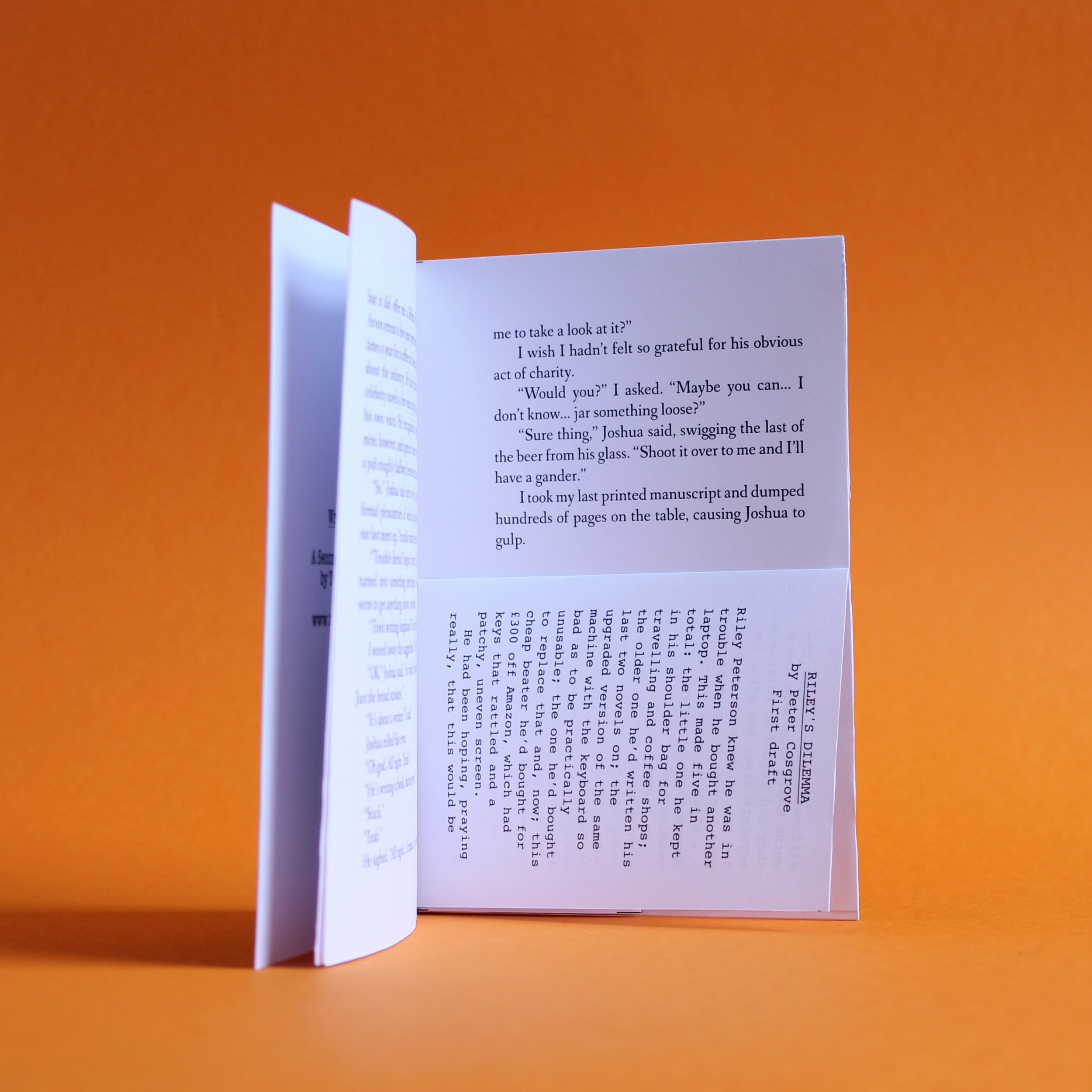
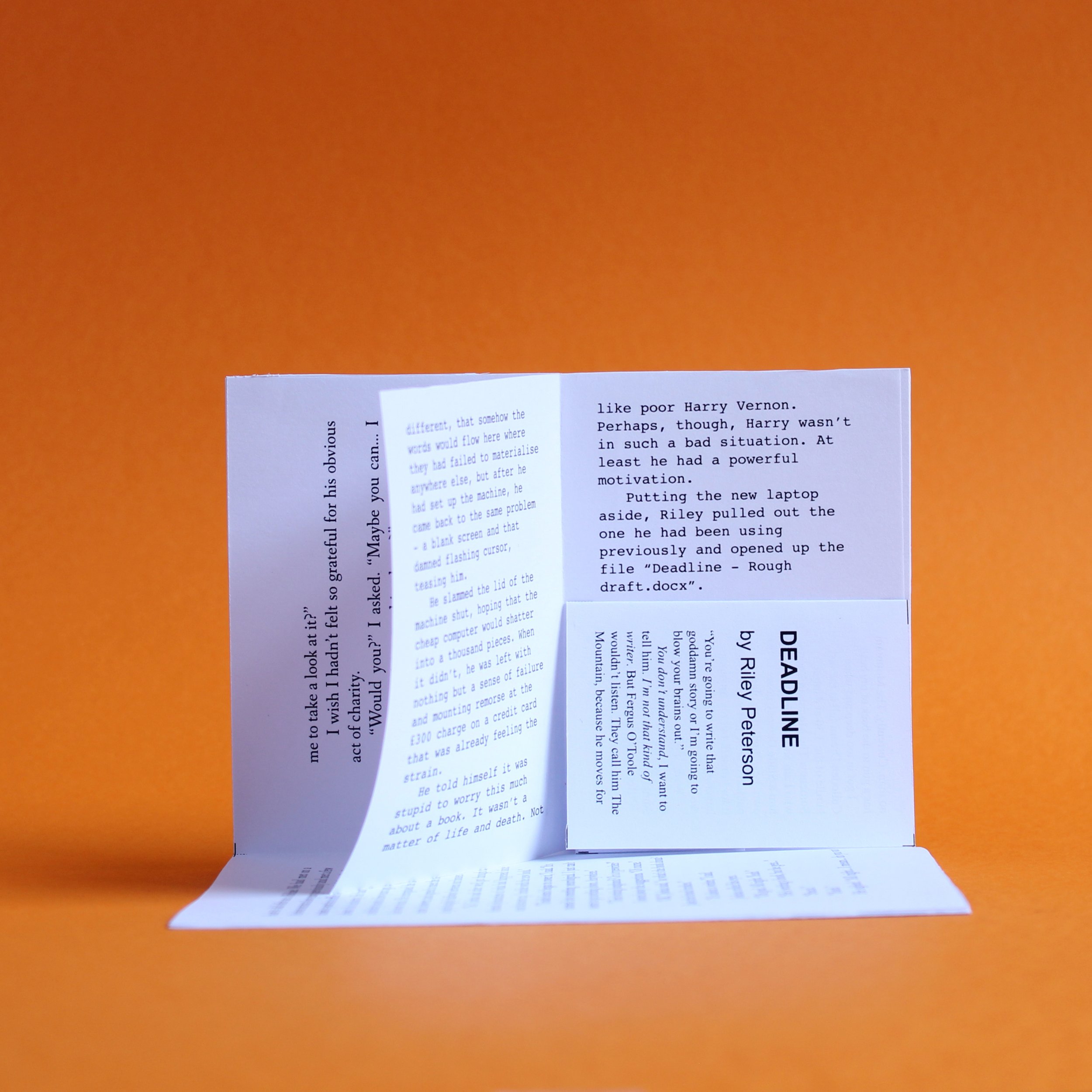
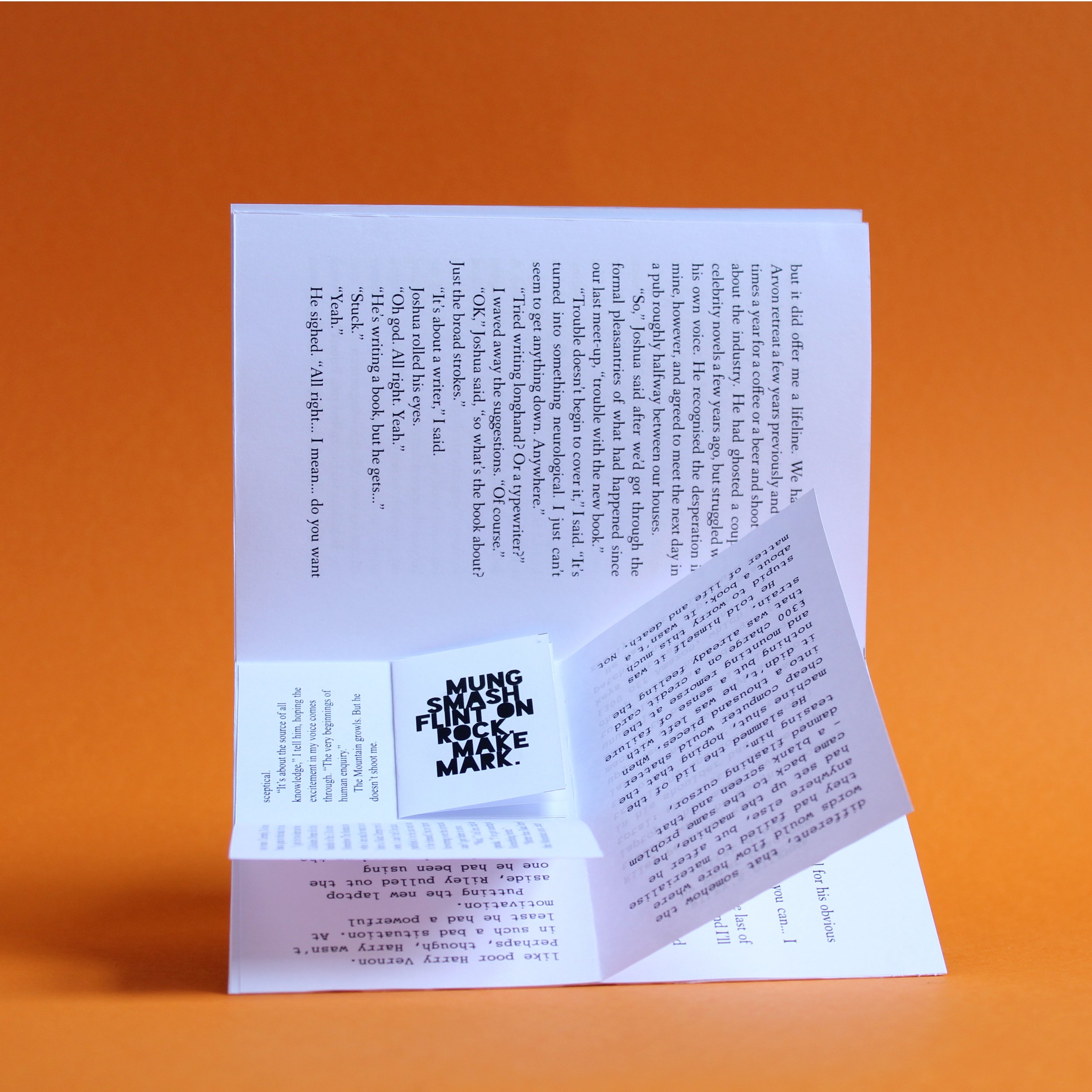
Recursive booklet, 105 x 148mm, 2022
Overview
Writers Write is a series of stories about writer’s block, contained in a recursively bound booklet.
Background
I had this idea a while ago and dismissed it because I thought it was disgustingly self-indulgent. Then I read Billy Summers and realised that some people had made entire careers basing stories on barely-disguised proxies of themselves, so figured I was joining a rich tradition. Furthermore, the edition I had in mind was just a few pages long, rather than several hundred, so I went ahead and made it.
The story is pretty much what it sounds like. One author struggling to write about another, who is, in turn, having their own difficulties writing their own story because that author is having difficulty… and so on and so on.
Praise be to the ISO paper sizing scheme, which makes this all possible. The booklet is bound by glueing the back page of the smaller booklet to bottom half of the recto in the centre spread. For someone who doesn’t like glue, I seem to be using a lot of it.
Lazy Dog
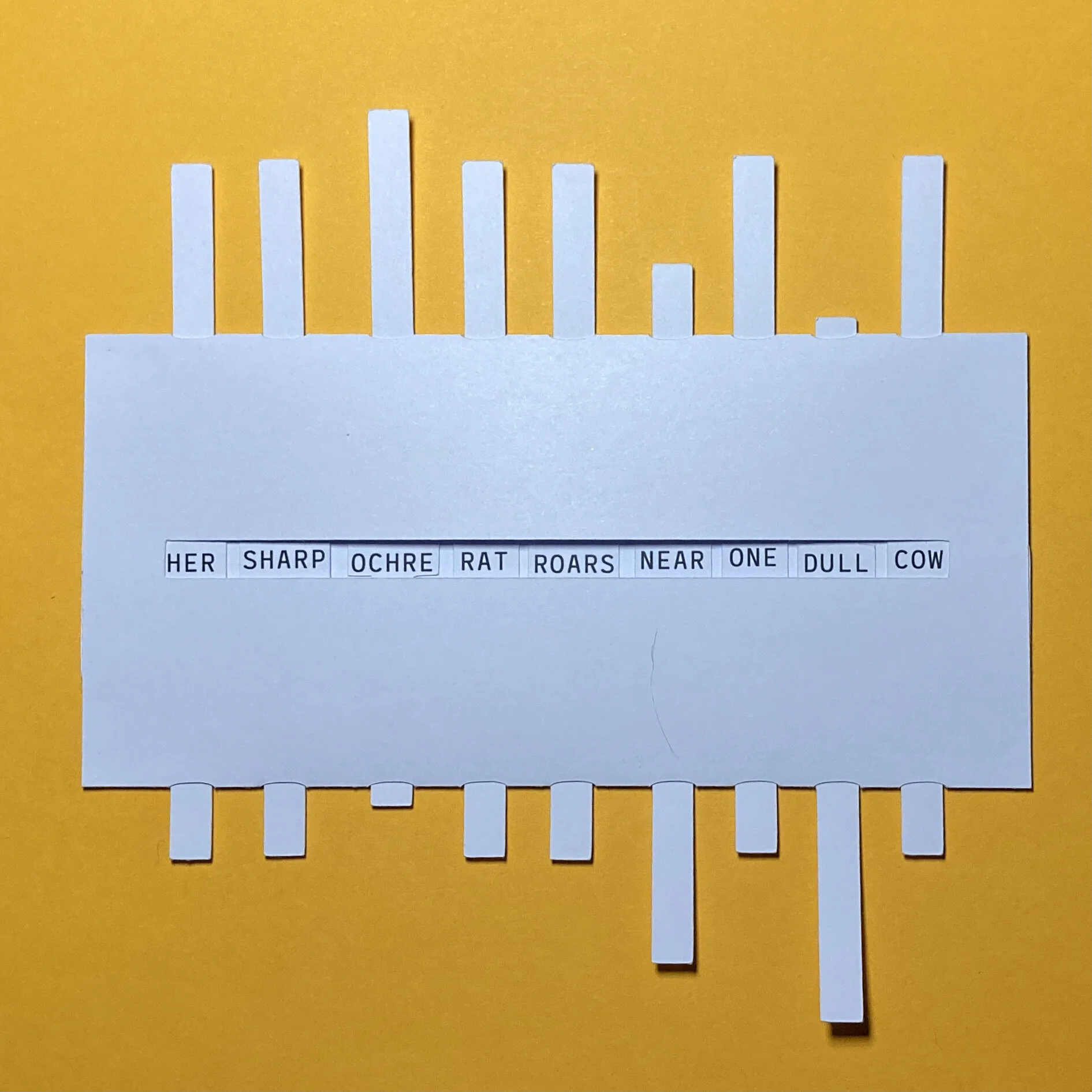
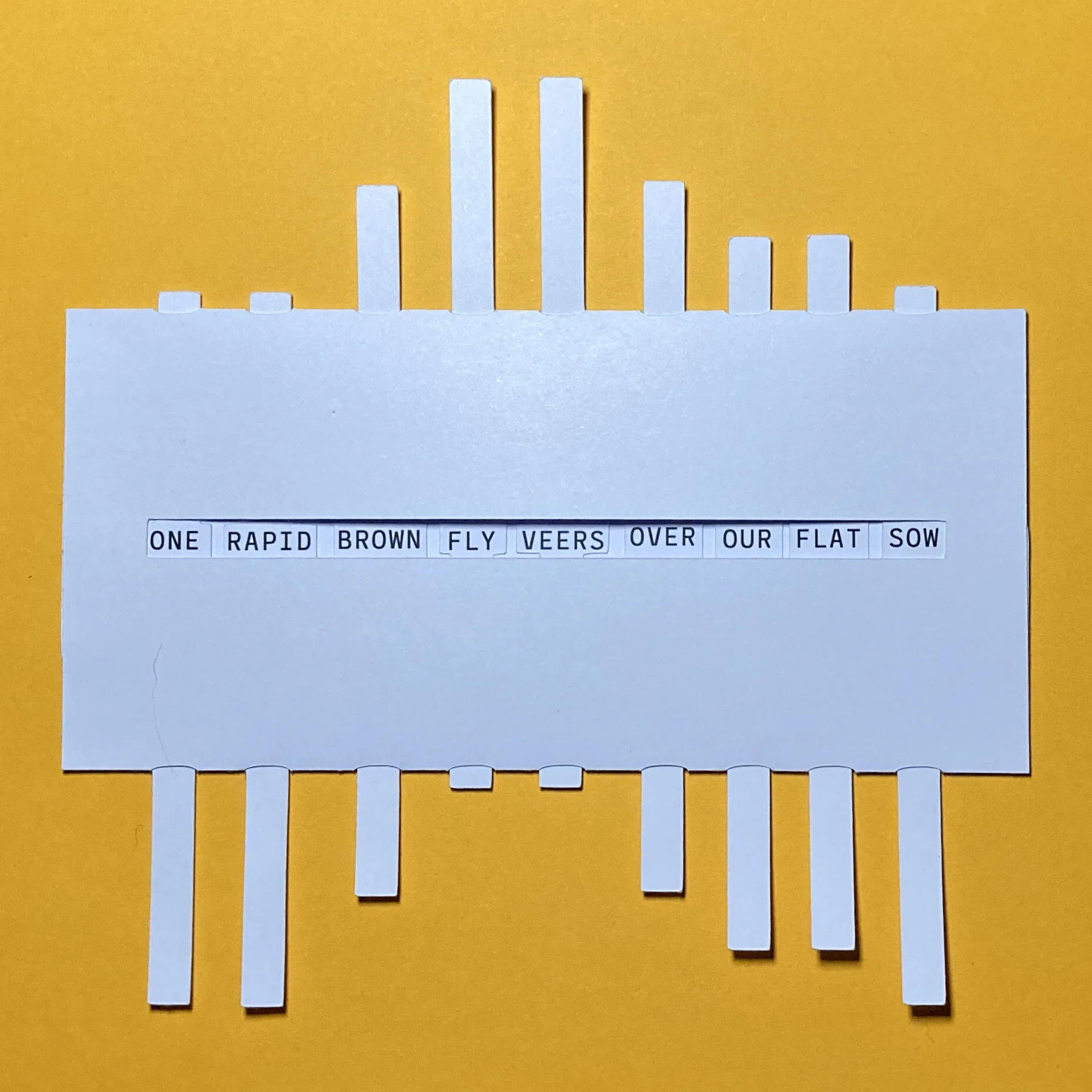
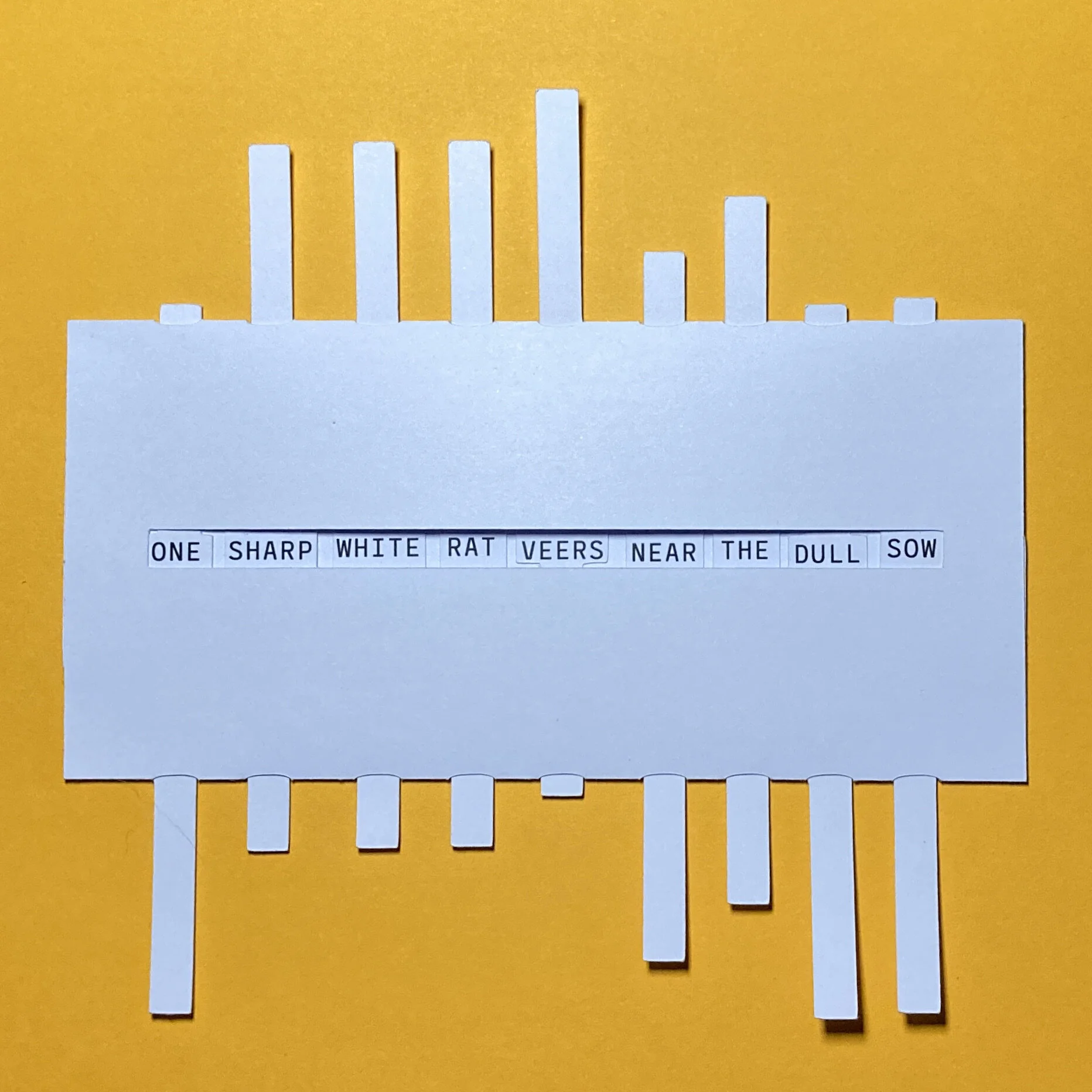
A small text toy derived from the phrase “The quick brown fox jumps over the lazy dog”.
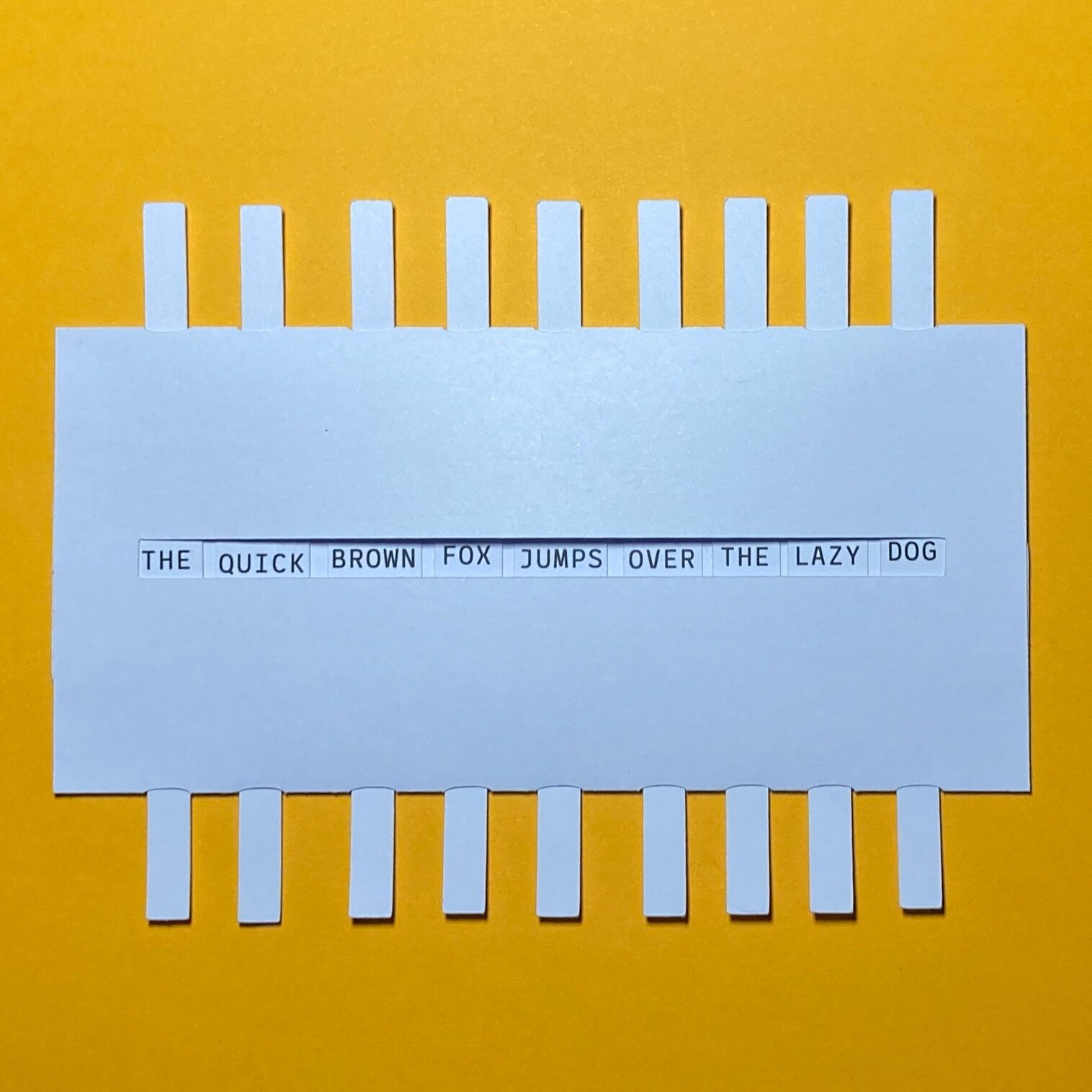
Card plaything, 115 x 150 mm, 2021
Overview
Lazy Dog is a small text toy derived from the phrase “The quick brown fox jumps over the lazy dog”. Readers push and pull the strips to create new variations.
Background
This started as a thought experiment, idly scribbling synonyms in my notebook for each words. Initially, I thought I could make it in to an interactive web thing, but then decided it would be more fun to make it out of card as physical object. Initially set in proportional type, I changed that to a monospace font so that each column could remain the same width.
Although nothing is taken from it directly, the book The Elements of Pop-Up sits on the bookshelf above my desk and probably got me thinking about push and pull strips.
Portrait / Landscape
Orientation defines story in this two postcard set.

If you buy a set, please note that stands are not included.


Postcards, colour, 2021
Overview
Orientation defines story in a pair of digital mosaics.
Background
The idea for this was originally an interactive HTML piece, where the text would change depending on the shape of the browser window or the orientation of the phone/tablet. That proved too much for my rudimentary coding skills and was thrown away into a dark folder on an old hard drive. Later, it occurred to me that it would be better as pieces of paper and that led to the postcards you see now.
The intersection of pixel art, mosaic and monospace typography seemed to be a pretty straightforward one. I could just take a picture, reduce the resolution, slap a fixed-width font on top of that and wait for those sweet postcard bucks to come rolling in.
I sourced two pieces of art from the same artist, Jean-Pierre Renoir. The Portrait of Alfred Sisley and The Bay of Algiers seemed to scale well, in that they were still identifiable as a portrait and landscape when scaled down to a resolution of 37 x 44 pixels. The aspect ratios of the paintings didn’t quite match the target page size, so I had to fill in some bits of background and crop others.
The tiles are a customised version of the ‘scrabble squares’ in the Apple Symbol font. I used Font Forge to hack together a version that corresponded to their actual letters. Font Forge is a pretty frustrating piece of software to use. I’m sure it’s very powerful, but it has that inscrutable, in-depth technical sheen that a lot of open-source applications use to scare off users.
With that done, I wrote several versions of the short stories on the cards. Obviously, one was going to be about a person and the other was about a place, but it took a couple of drafts to get the right tone.
As with a lot of my pieces, writing and design process go hand-in-hand, but pull in different directions. The needs of the story are often constrained by the physical space that contains it. I don’t know if this is making me better or worse as a writer, but I find it’s an interesting way to work. It’s not so much “what’s good” as “what fits”.
Like a lot simple ideas, this one proved to be really fiddly. Trying to work out correlations of pixels to points and getting the colours balanced so they would be both readable and recognisable was a bit of a pig. It’s worth mentioning that Affinity’s ability to swap instantly between Publisher, Designer and Photo toolsets was a really handy. It’s one of the things I like most about it (as well as not having to pay a monthly fee).
Printing was outsourced to Print24, who are pretty good - fast and well priced, although they do send a ridiculous amount of emails about delivery. Most importantly, their postcards seem like they would stand up to the rigours of the postal system.
Strip
A never-ending story about not getting the hang of it.

Twisted paper
Overview
A never-ending story about not getting the hang of it.
Background
The Möbius Strip is, according to Wikipedia “a surface with only one side (when embedded in three-dimensional Euclidean space) and only one boundary curve.” I say it’s a cool shape with a cool name. For years I tried - and failed - to come up with a way of using it to tell a story. Obviously it would be a loop, with no formal beginning or ending, but apart from that I didn’t have much to go on. I bandied around some ideas, including a short treatise on time and space, based on this Worf-sampling Orbital track, a biography of French cartoonist Jean Giraud and a see-through comic about topless dancers.
None of these things worked, either because I didn’t really understand the concepts behind them (the first), because I didn’t have a strong affection for them (second) or because I was too embarrassed (third).
In the end, as with most things, I found bringing it close to personal experience was what unlocked it. I’ve never been a great one for home decorating and find the concept of wallpaper too strange to get my head around. The idea of every piece aligning perfectly made me feel stressed and this tension formed the the emotional heart of the story. As a former temp worker, I’ve had a lot of different jobs and can well remember the sinking feeling that comes with realising that no matter how hard you try, you’re just not getting it.
That understanding came with an insight sparked by the shape of the paper. What I like about the möbius strip is the twist it has in it, making it more interesting than a simple loop. That idea of the paper folding over itself put the picture in my head of wallpaper easing off one part of the wall, only to reattach itself to another.
This is one of several pieces I’ve created lately that involve loops or continuous cycles. Perhaps I just don’t like endings.
Mug
A story about a mug, on a mug.
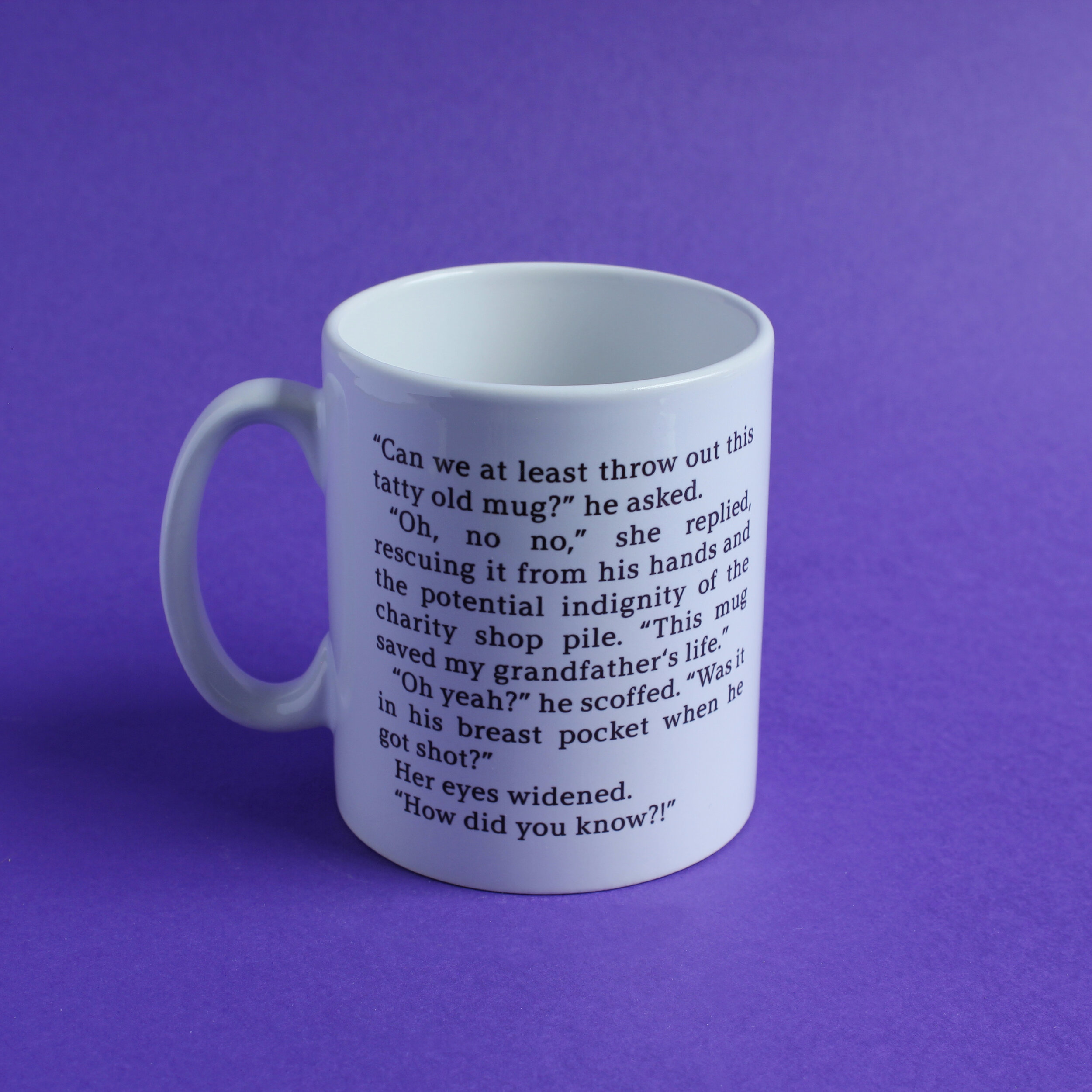
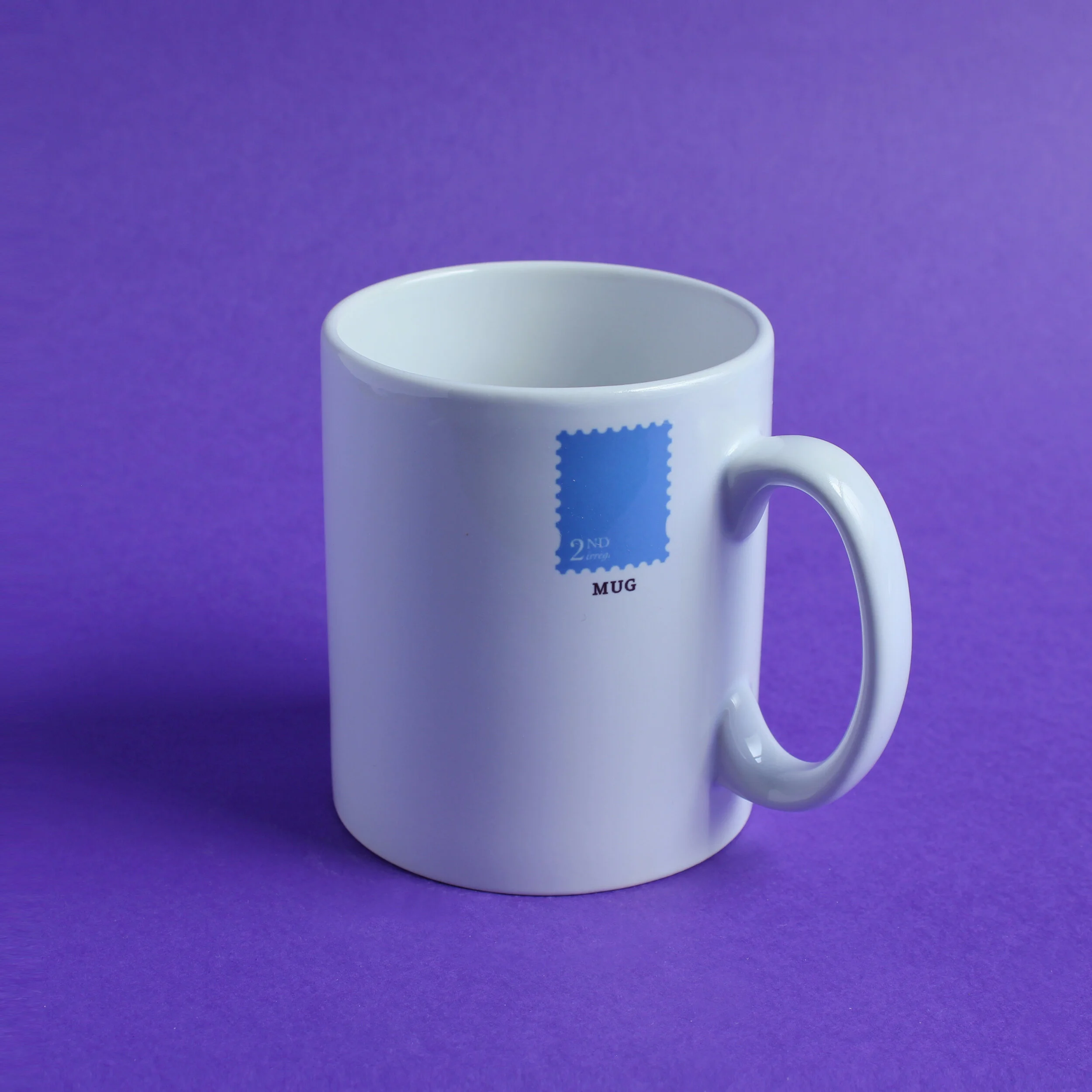

A 10oz white ceramic mug, emblazoned with a little story (about a mug, naturally) and some tasteful Second Class Irregular branding.
Dishwasher & microwave safe.
Overview
A story about a mug, on a mug.
Background
Sometimes you redefine the interplay between form and content… and sometimes you just put a story on a mug. No shame in the latter. I made this really to entertain myself, but it’s as easy to offer it for sale as well. Buy one if you like mugs (and who doesn’t?).
Primates
A set of two backpack-like volumes about a pair of animals sharing their habitat.
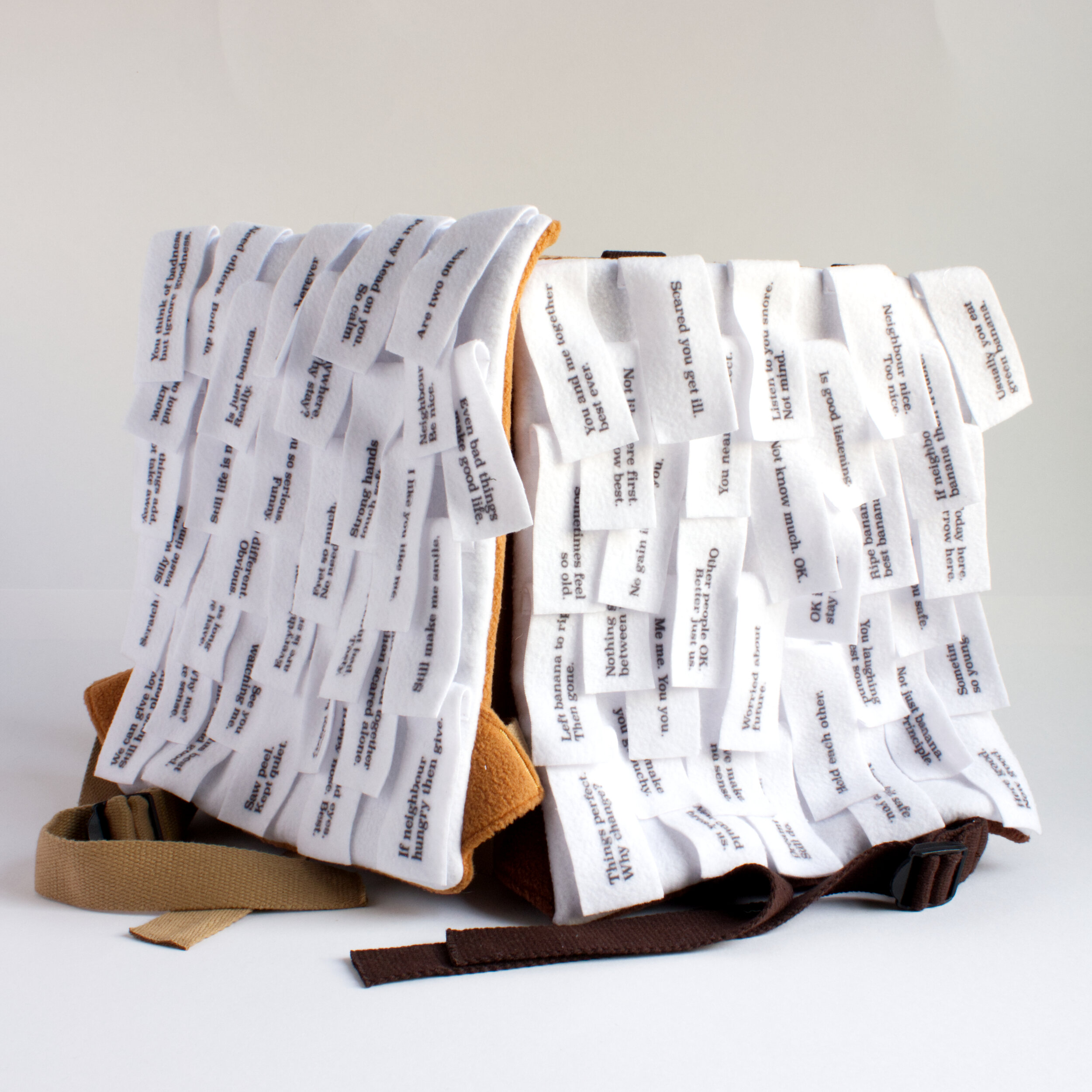
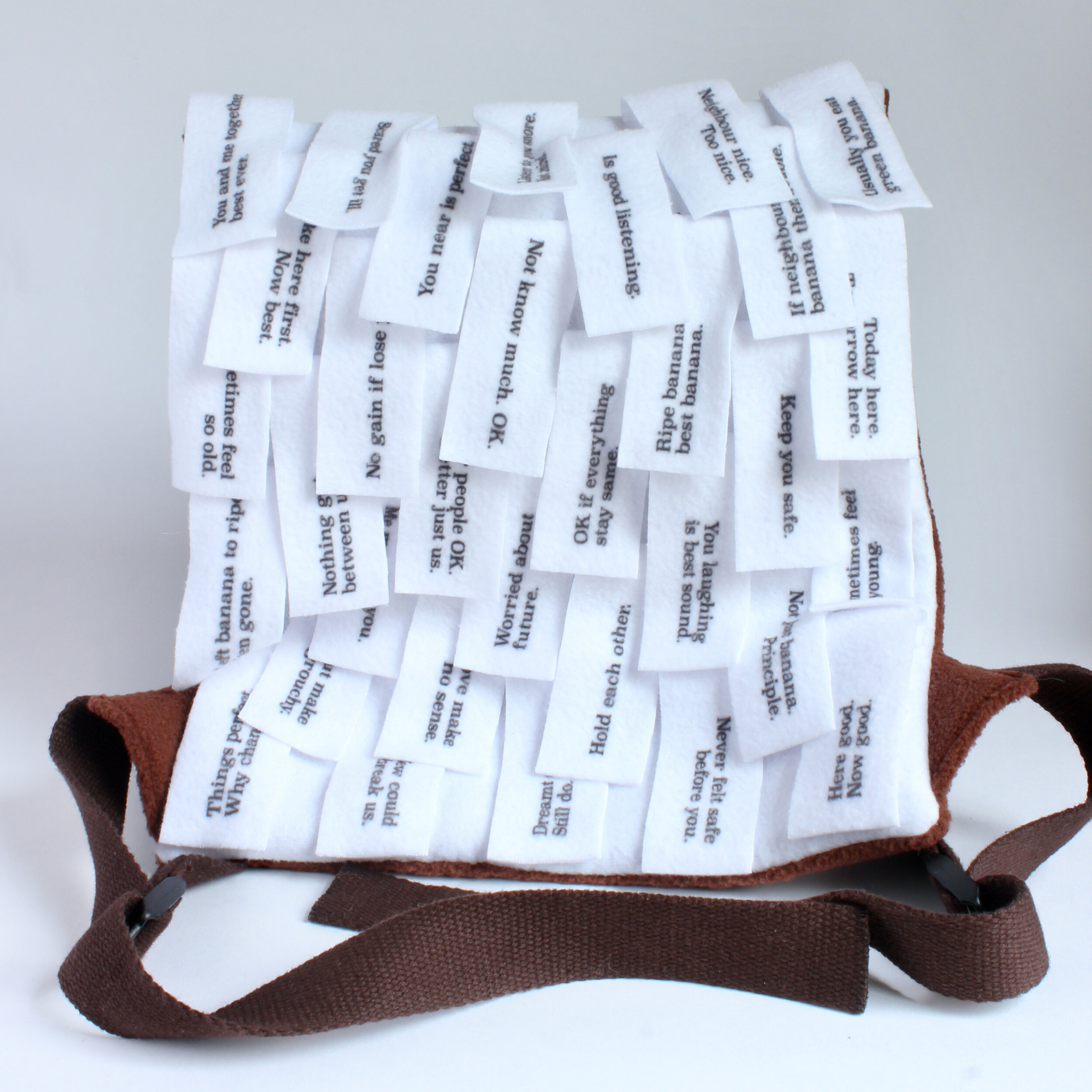
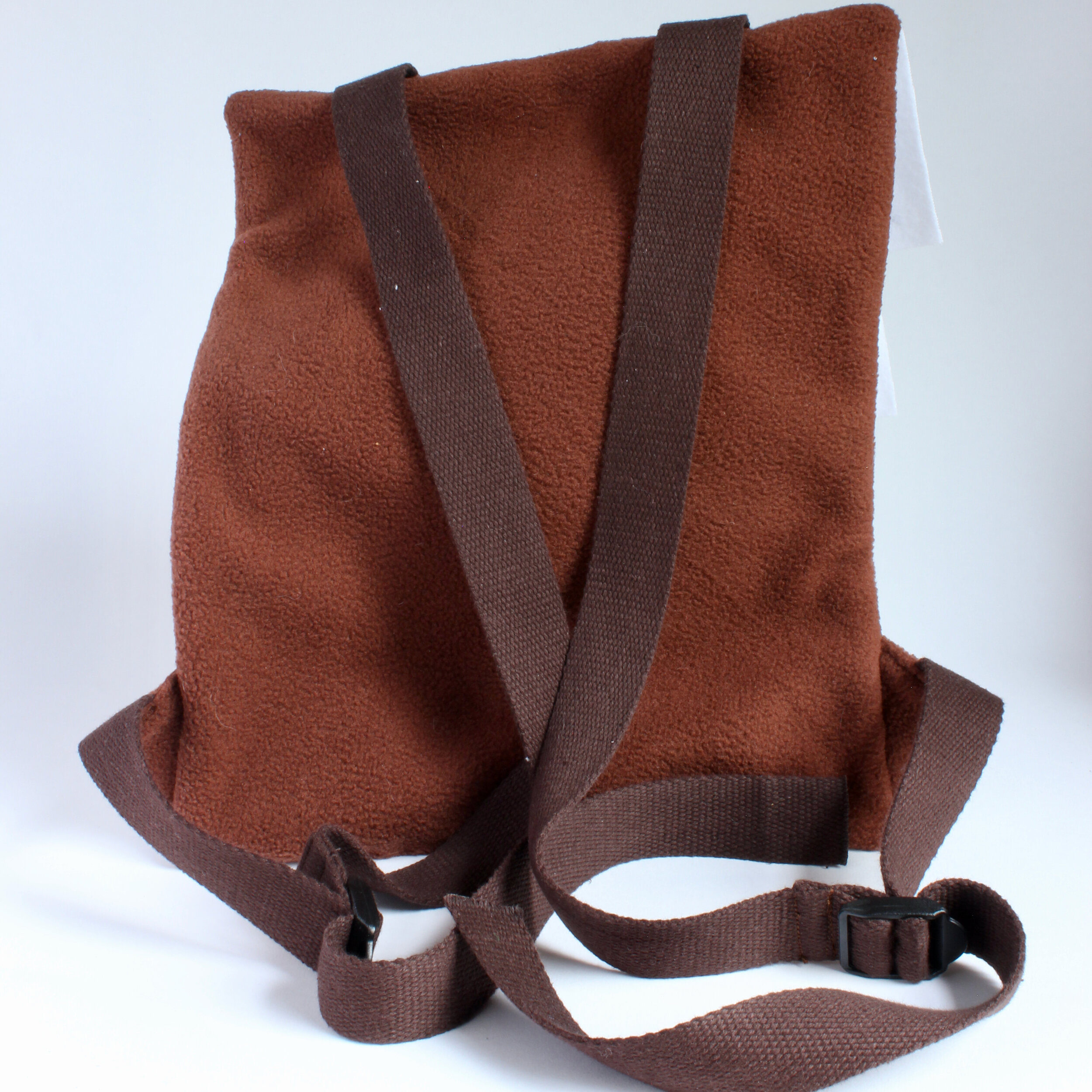
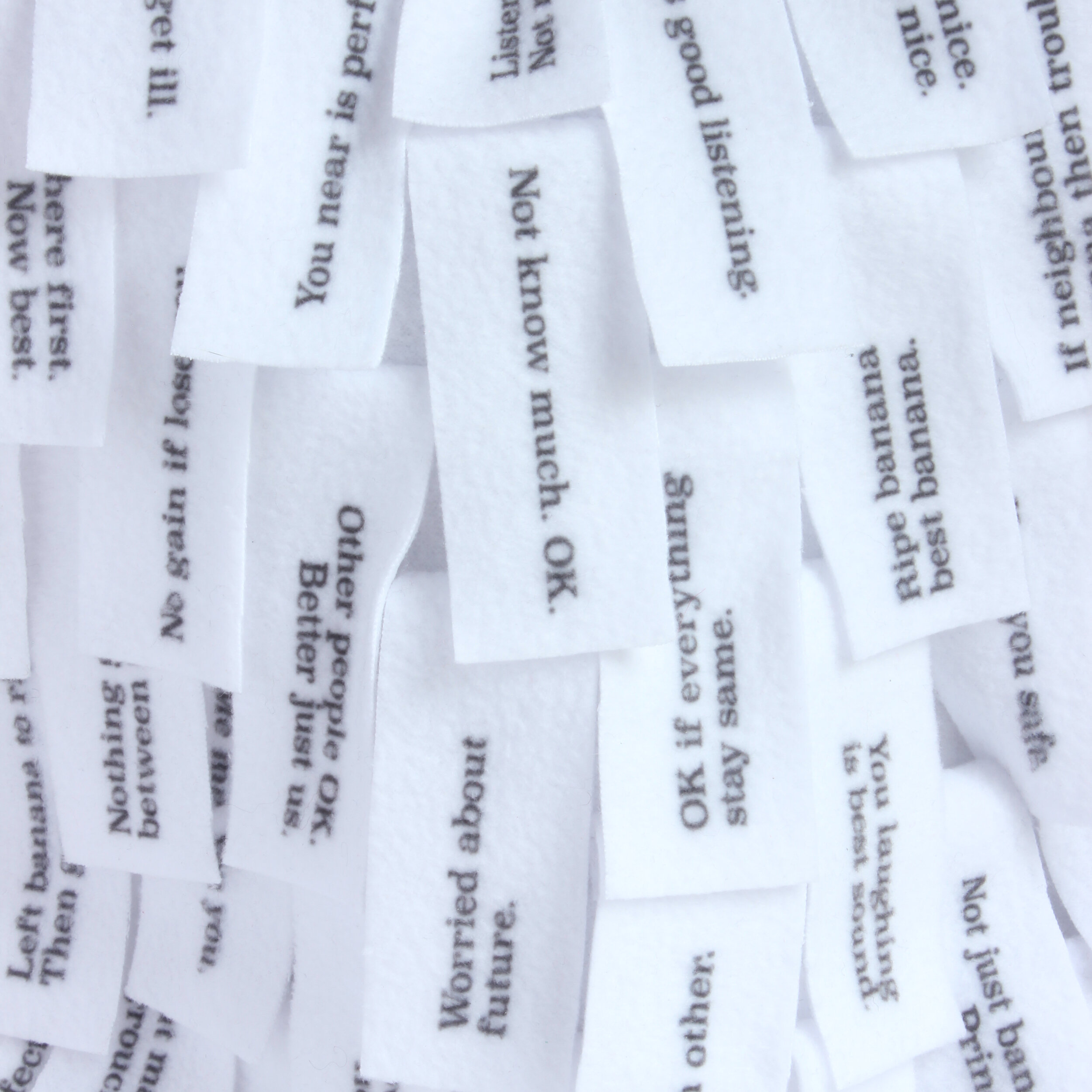
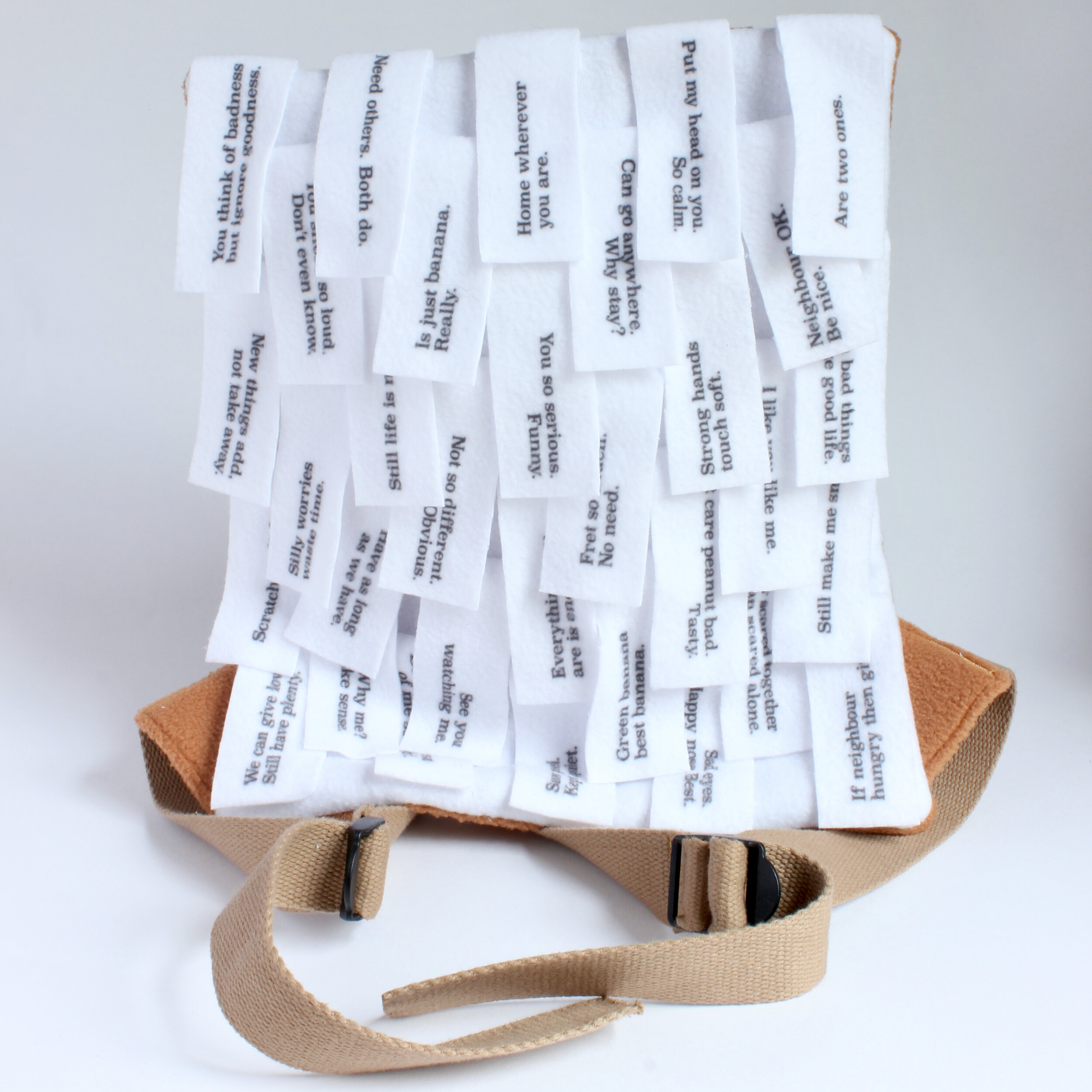
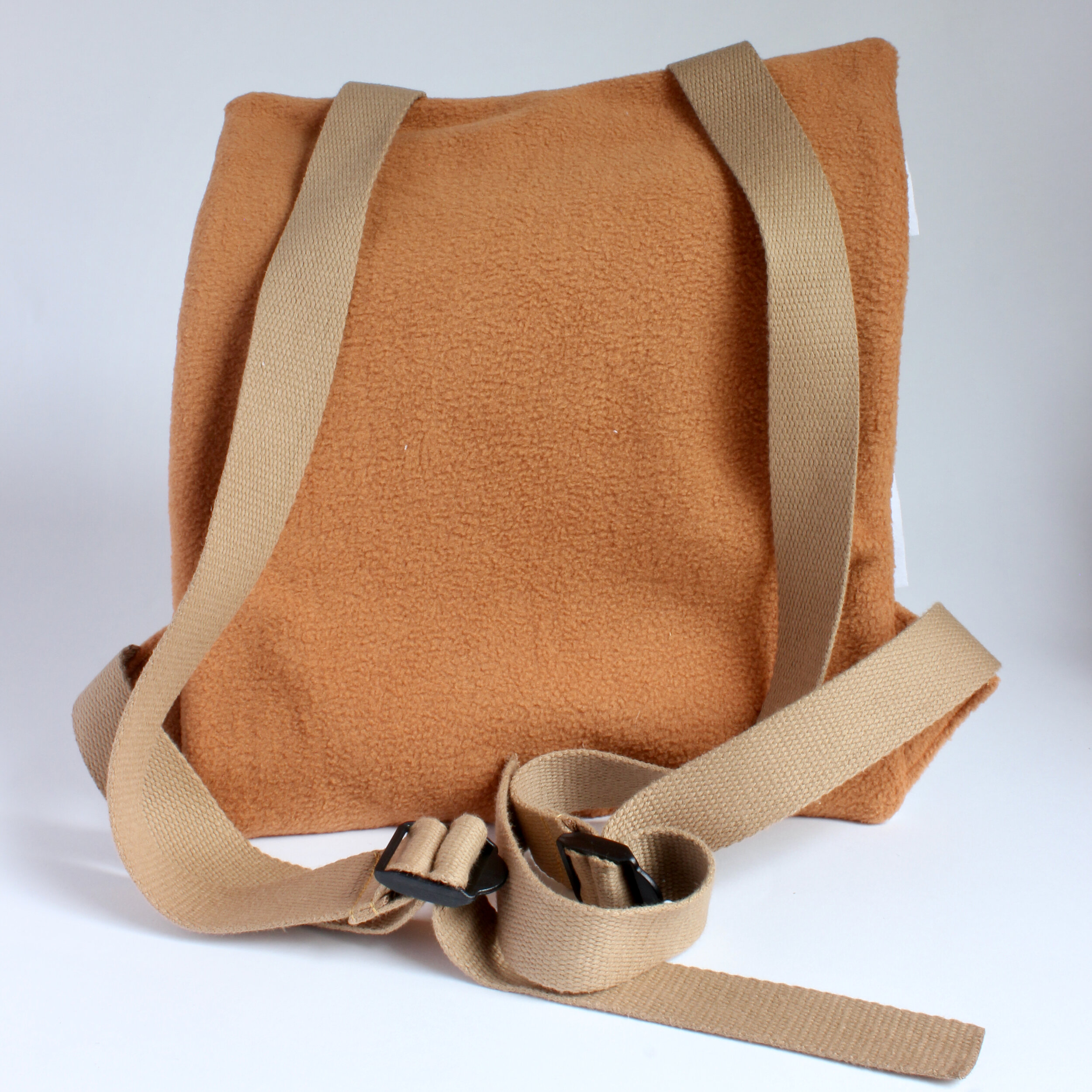
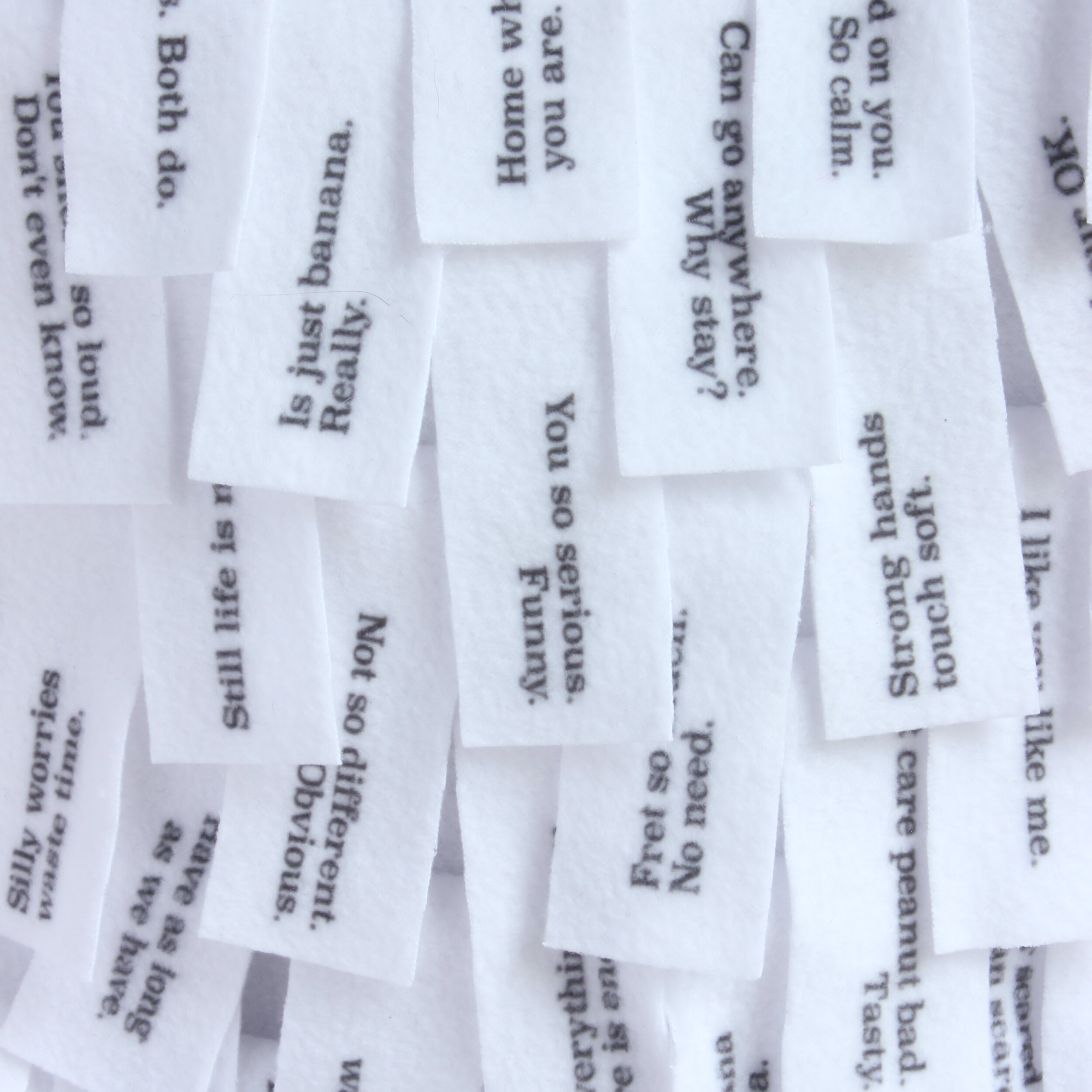
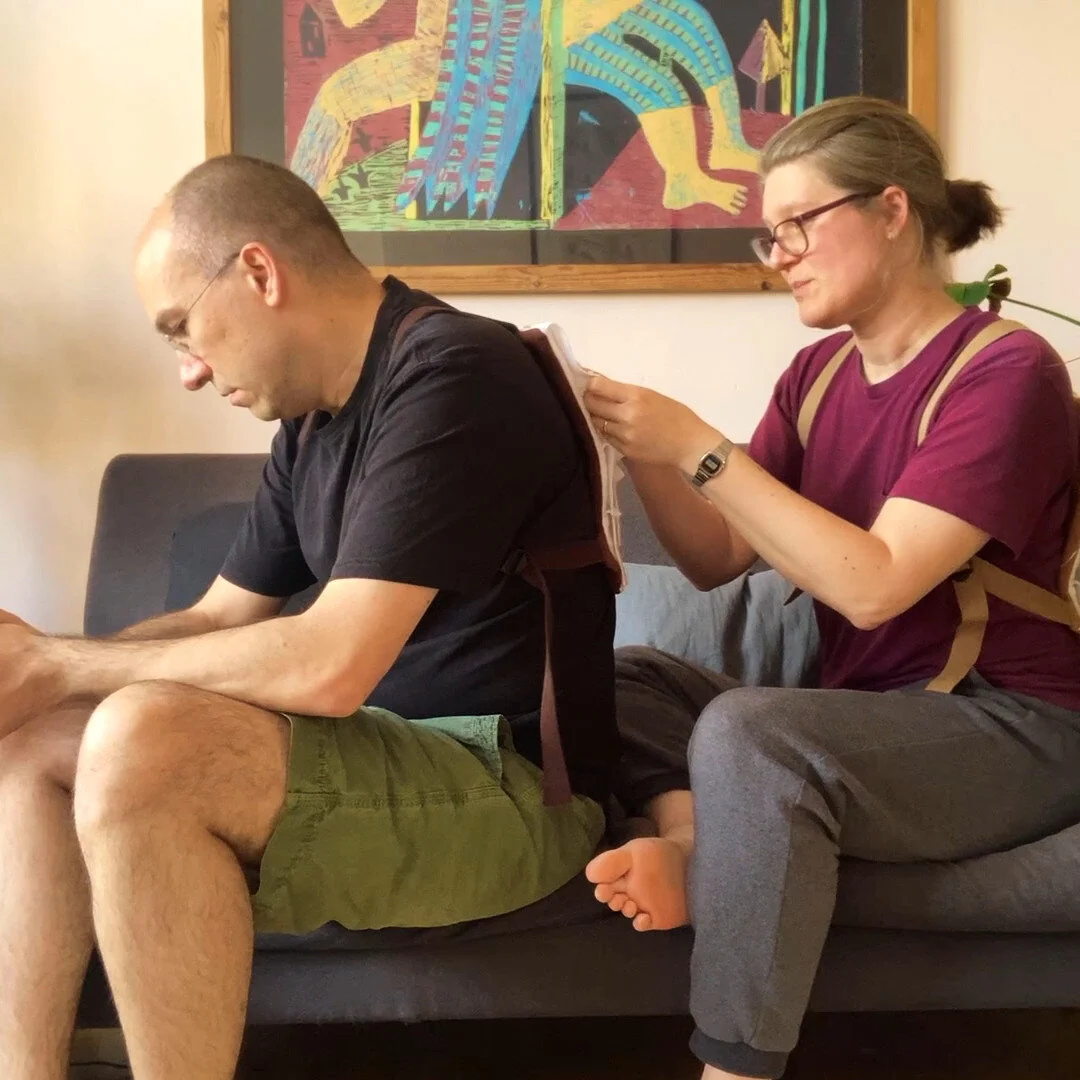
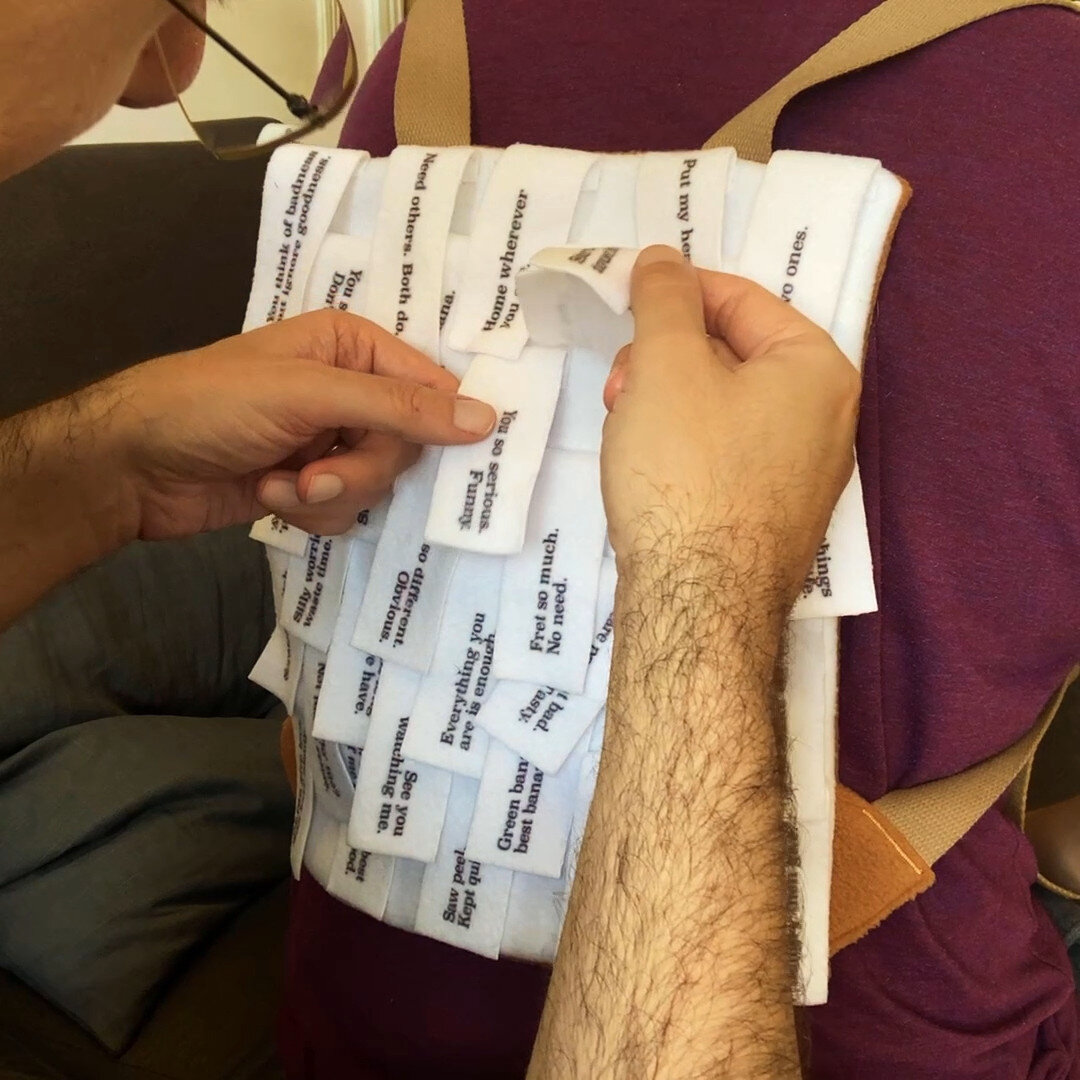

Set of two back-pack like volumes, made of fleece. It is designed for two people to read aloud to one another. It tells the story of two animals sharing a habitat.
Click here for more information about the book and how it was made.
Printed fleece and fabric rucksacks, two pieces
Overview
Primates is a set of two volumes, intended to created a shared reading experience. The pieces are worn on the readers' backs, meaning each has to read to the other. The text is a fragmented narrative in two halves, from two perspectives, about the shared lives of the two protagonists and their differing perspectives thereof. The text is printed on fleecy fabric and the tactile experience of stroking, smoothing and preening the material is an inherent part of the book. This sensuous element, combined with the suggested position of the readers, creates a sense of closeness, care and intimacy.
Background
For a while now I've been wanting to do something that allowed the reader to get more hands on and really dig in to a text. I experimented with a few things, but these early prototypes were unsatisfying, as I didn't really have understanding of what I could and couldn’t do.
Two courses helped bring this project in to focus. The first was a five-week paper folding and pleating course at the Working Men's College, taught by Thomas Prendeville. This gave me a better understanding of what was possible and also deepened my appreciation for the hands-on feel of working with paper and card.
The second was Artists Books - Theory and Methods by Ben Denzer, taught online from the Center for Book Arts in Brooklyn, NY. In just two short sessions, Ben introduced the wide world of artist's books and explained a lot of the theory and practice involved in making them. The first week was this overview and we were briefed to come up with our own artist's book for the next session.
The vague notions of folds and tactility combined with the living situation we were experiencing during Coronavirus lockdown. My partner and I get on well for the most part, but each of us was the only person the other saw for several months at a time. Being in such close quarters for so long requires patience and kindness to be active practices.
The image of apes grooming each other struck me as an intimate act of caring. Reading books is usually a solitary act and adults seldom get the opportunity to read aloud to one another. I wanted to explore the idea of reading as a shared experience. I sketched out a rough idea of two backpacks with strands of words on them that each person would have to untangle and read to the other.


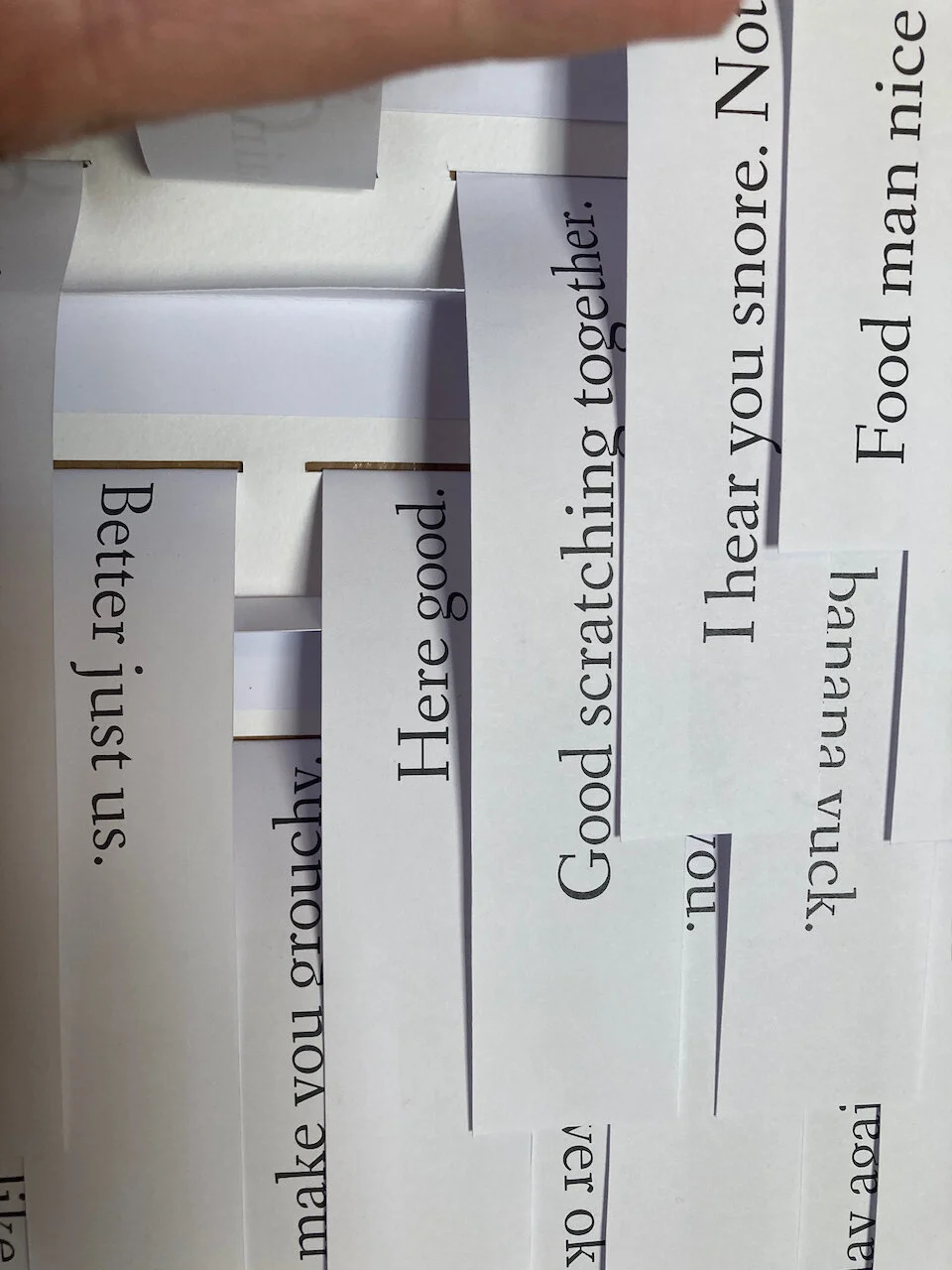

The first prototype took the entire week to make. While I had the physical form very much in my head, trying to find the right tone for the actual words was difficult. I knew that the writing would be piecemeal, that a reader would not necessarily read things in any particular order, or might skip some. This meant short sentences and I had a lot of difficulty making it feel genuine without it being pretentious and poetic. In the end, form and content combined and I turned the text into a simplified ape-speak that could still be read by humans. (I also added in an unnecessary amount of references to bananas.)

Test printing with felt and thermal transfer sheets.
Having made the prototype from paper and card, I looked into fabric printing options. T-shirt transfer sheets had a weird film on them and washproof markers were too fuzzy to read at the size I wanted. In the end I went with digital printing through a company called Contrado, who have a wide range of fabrics. After running through samples, I settled on polar fleece because it’s furry, feels nice and doesn’t fray.
Octavia was able to cut and assemble the printed pieces into these two wearable volumes.
Oubliette
A free standing story about imprisonment, written in reverse text and read with a dental mirror.
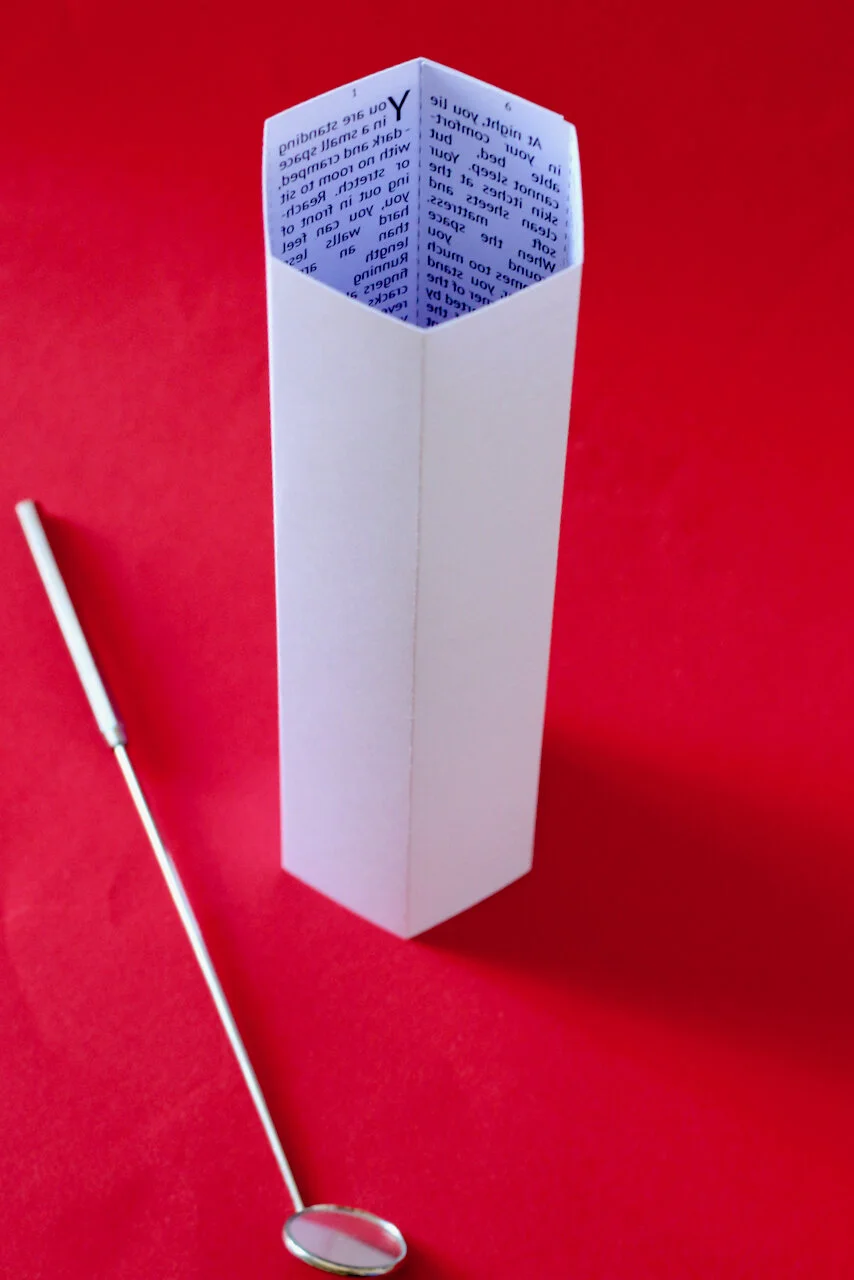
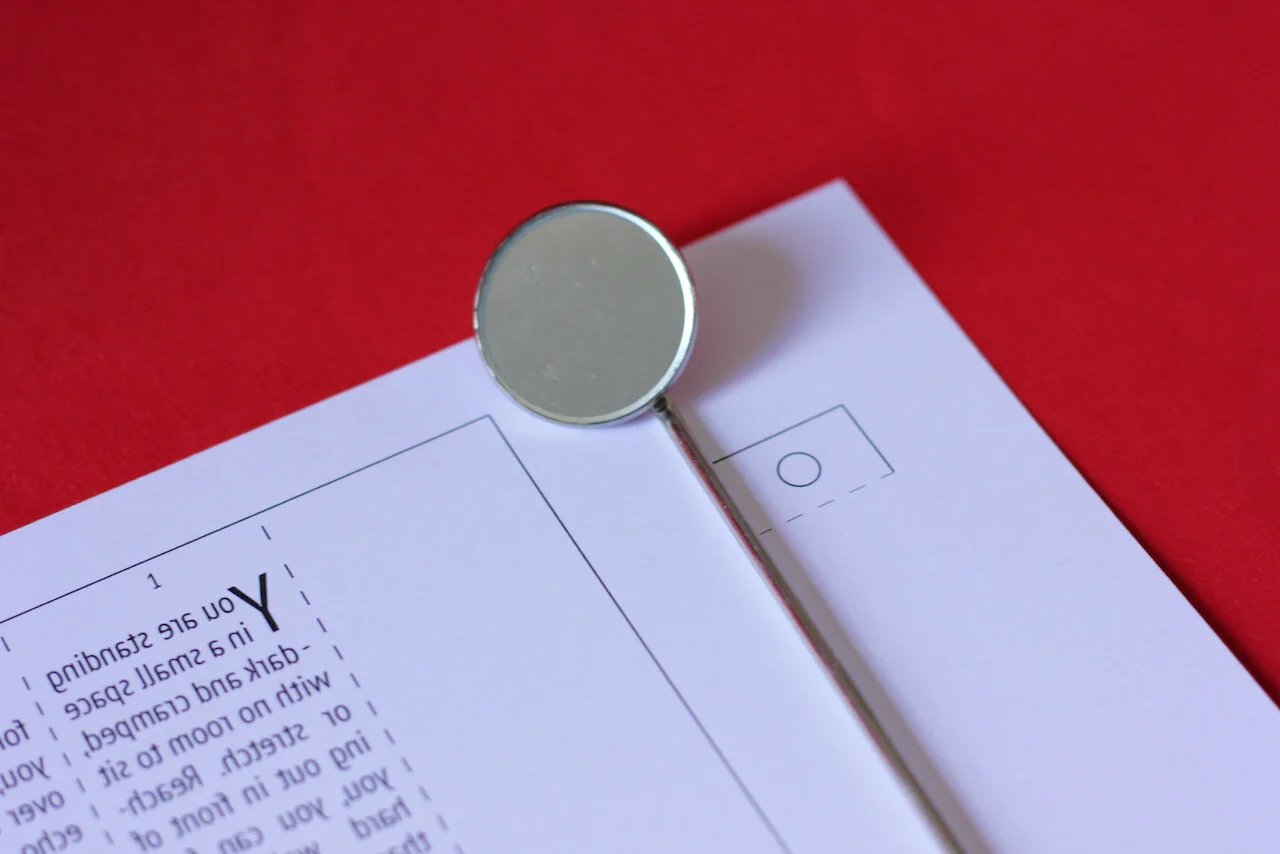
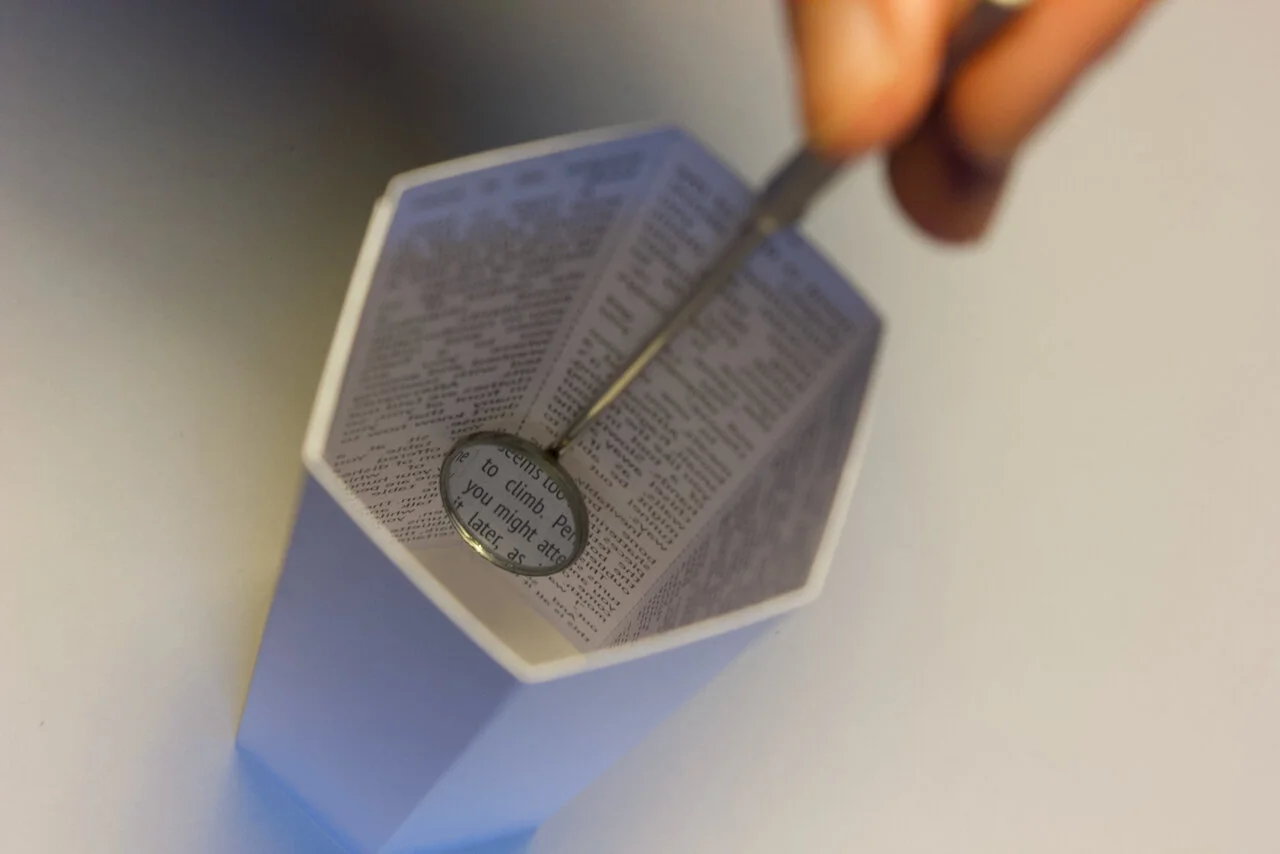
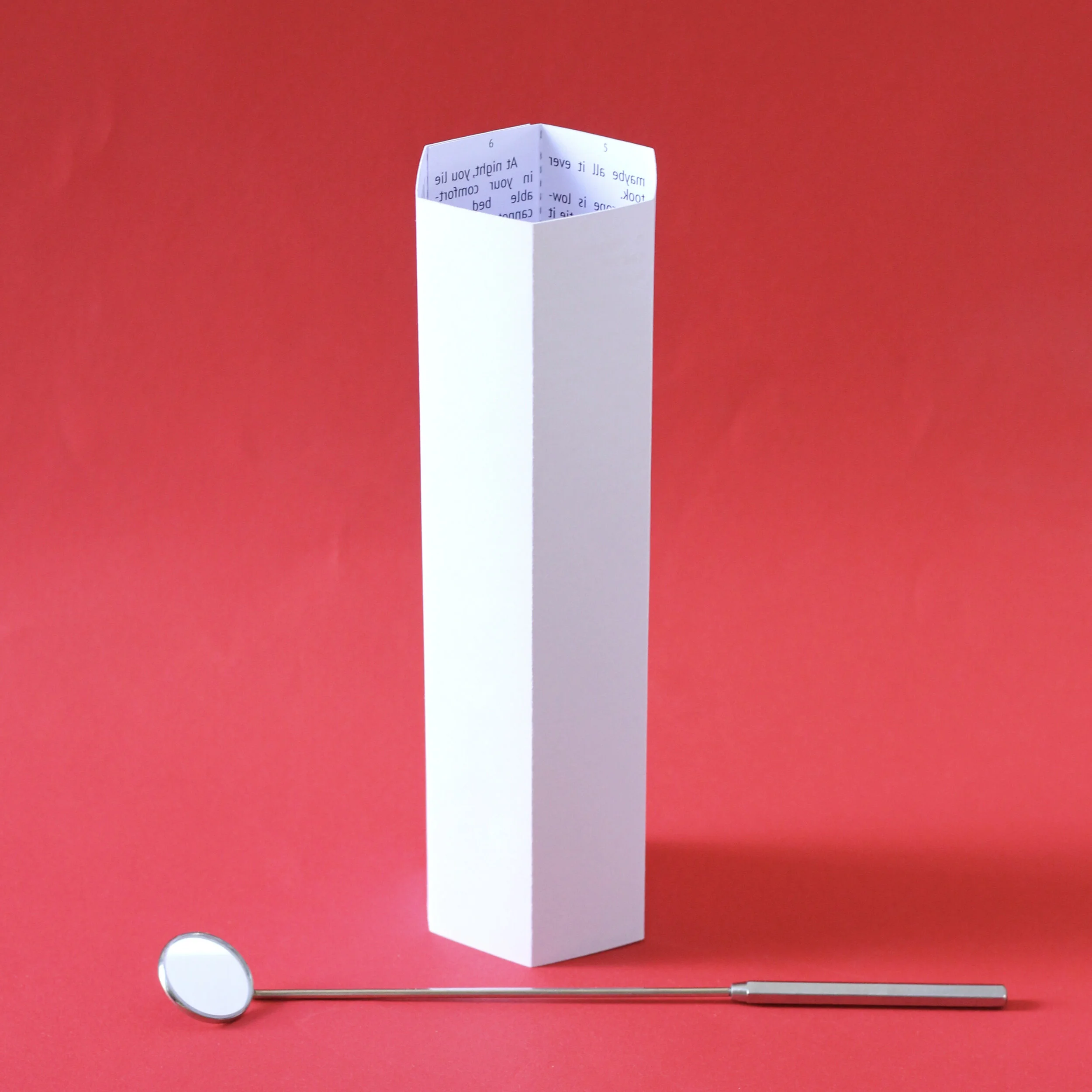
A free-standing short story about imprisonment, printed in reverse and read with a dental mirror.
This edition is pre-printed, scored and includes a professional-quality larangeyal mirror. Simple assembly required.
B&W, card
Overview
Oubliette is a story written on the walls of a free-standing vertical structure. The text is printed in reverse and must be read with a dental mirror.
Background
The first draft of Oubliette was written in 2020 as a short story exploring themes of constraint and freedom. The short (<1000 word) piece is sort of timeless and could be anyone and anywhere at any time. The use of second person perspective (“You”) is meant to put the reader directly at the bottom of the oubliette and directly understand the desire to get out and then, later, why someone might want to go back.
As I was experimenting more and more with putting text in physical forms other than flat pages, it seemed obvious to put ‘Oubliette’ in an oubliette. As reading the bottom lines would be difficult with the naked eye, I decided to print the words reversed so that they could be read with a long dental mirror.
A real oubliette has rounded walls, but mine would use a hexagonal cylinder as it would be able to lay flat. Initially, I wanted Oubliette to appear to be a thin book that would open up to reveal a pop-up structure inside. The first prototype was made from corrugated card, with text pasted on as strips of copy paper.
This prototype was documented in a short video which was uploaded to Youtube.
The first version was way too big, however, as the stem of the dental mirror wasn’t long enough to reach the bottom of the chamber. This made the text in the bottom sections unreadable.
A second version, scaled down to roughly A4 landscape, was made with grey board and coloured paper. While semi-authentic in its representation of the stone walls, the colour made it all feel a bit chintzy. I also couldn’t solve the problem of how to integrate a floor and a grille over the top. Various methods were tried, but none of them worked very well. Having them flap around, not really fitting or attaching to anything, made me hate the whole piece.
Trying to set the text took a few different approaches. I had wanted the reader to have to move the mirror both up and down the chamber walls to read the text. This proved even more confusing and although I had written the text, laid it out and constructed the piece even I couldn’t follow it. As the circular head of the mirror is only 25mm in diameter, the text was typeset as thin columns, first as one word per line, with two columns per wall.
Nothing was working very well, so I took things back to basics. I reduced the text to one column per wall, setting it in a condensed typeface that allowed for more than one word per wall. I also removed the lid and floor appendages and set the structure in simple white card of sufficient weight to stand, but also light enough to run through a printer. This one-sheet card has lines for cutting and scoring, but is a simpler and more elegant version of what came before. While this was the right move, I do sort of miss the more convoluted version. I’m sure there will be other stupidly complicated pieces in the future.