GROW
A book for plants, to encourage growth.
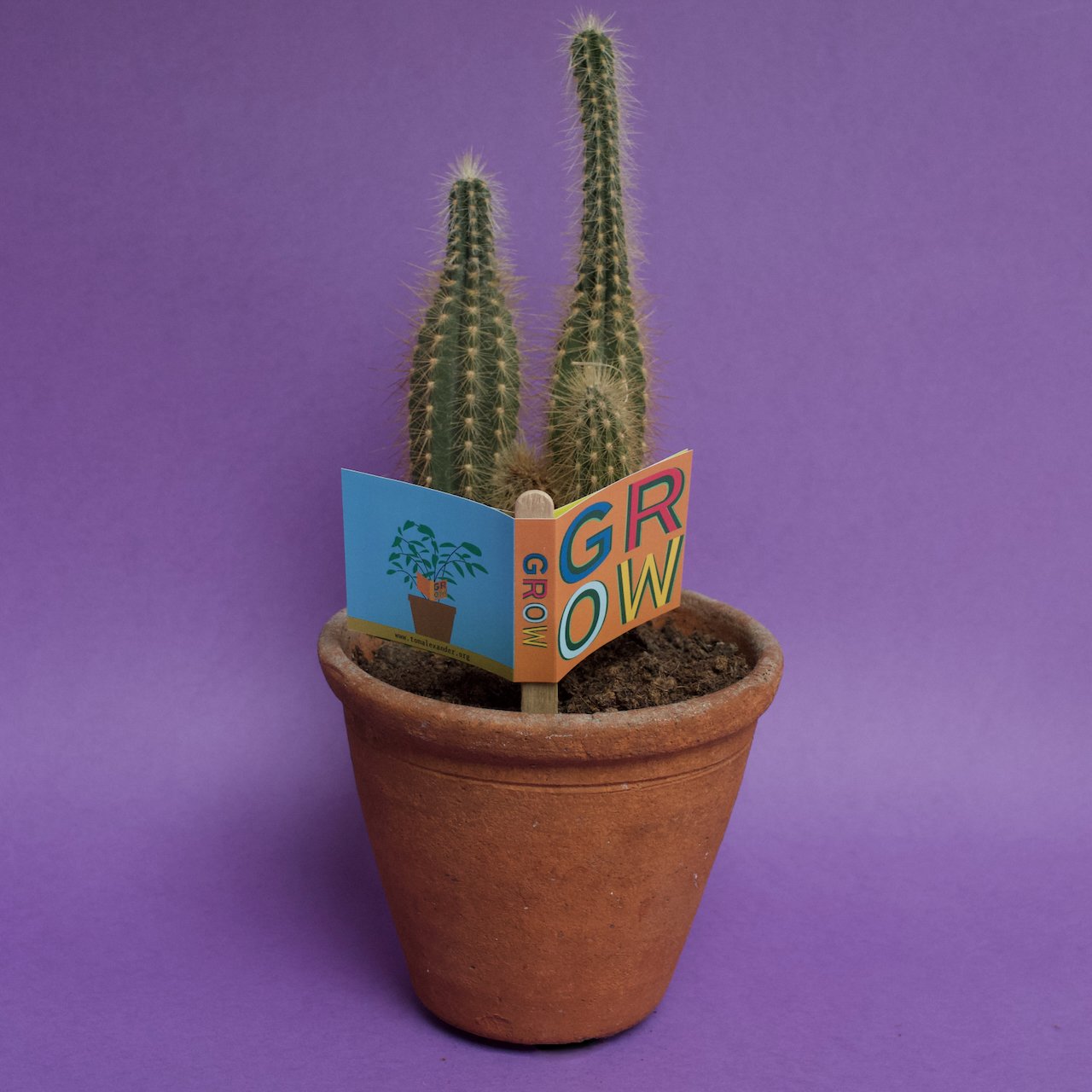
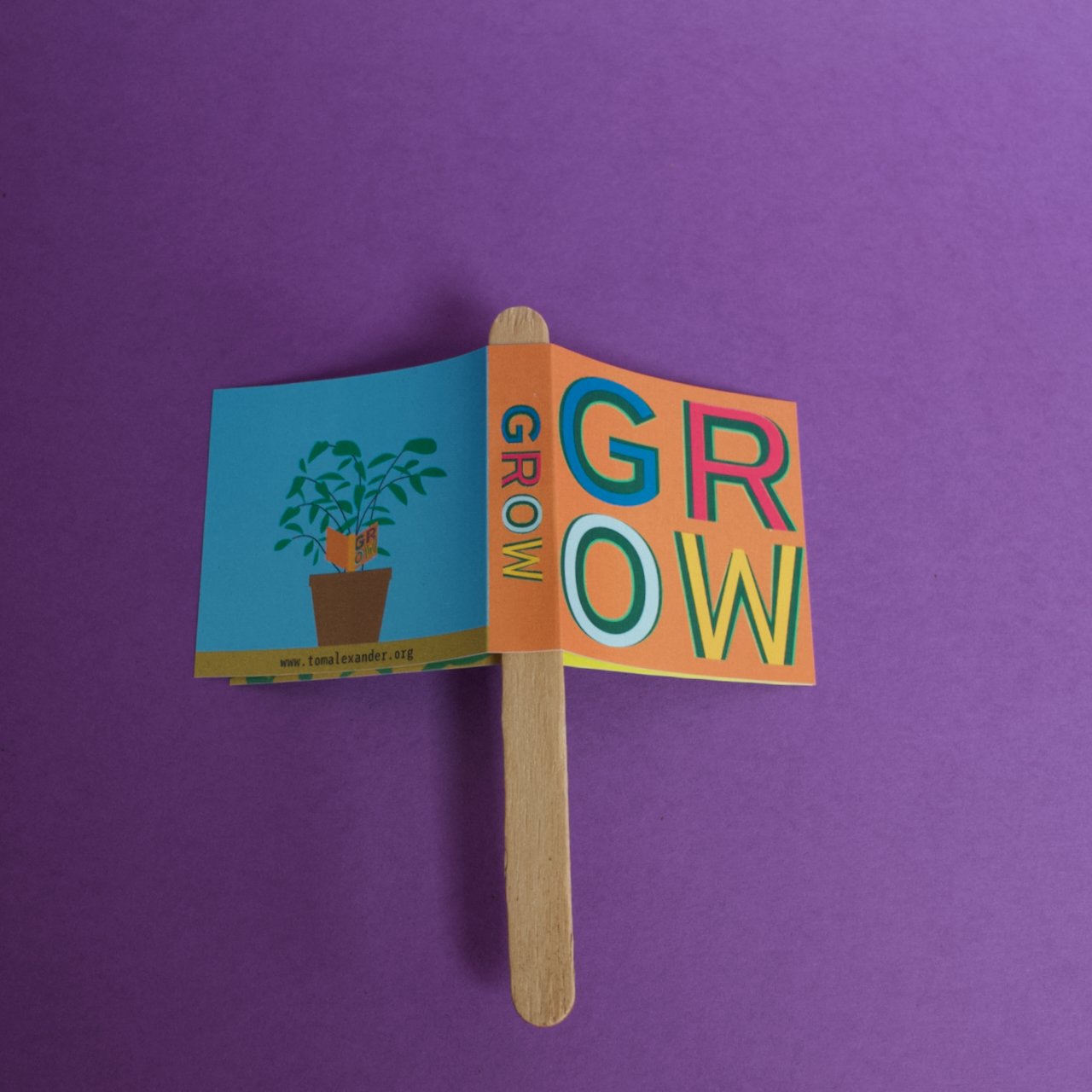
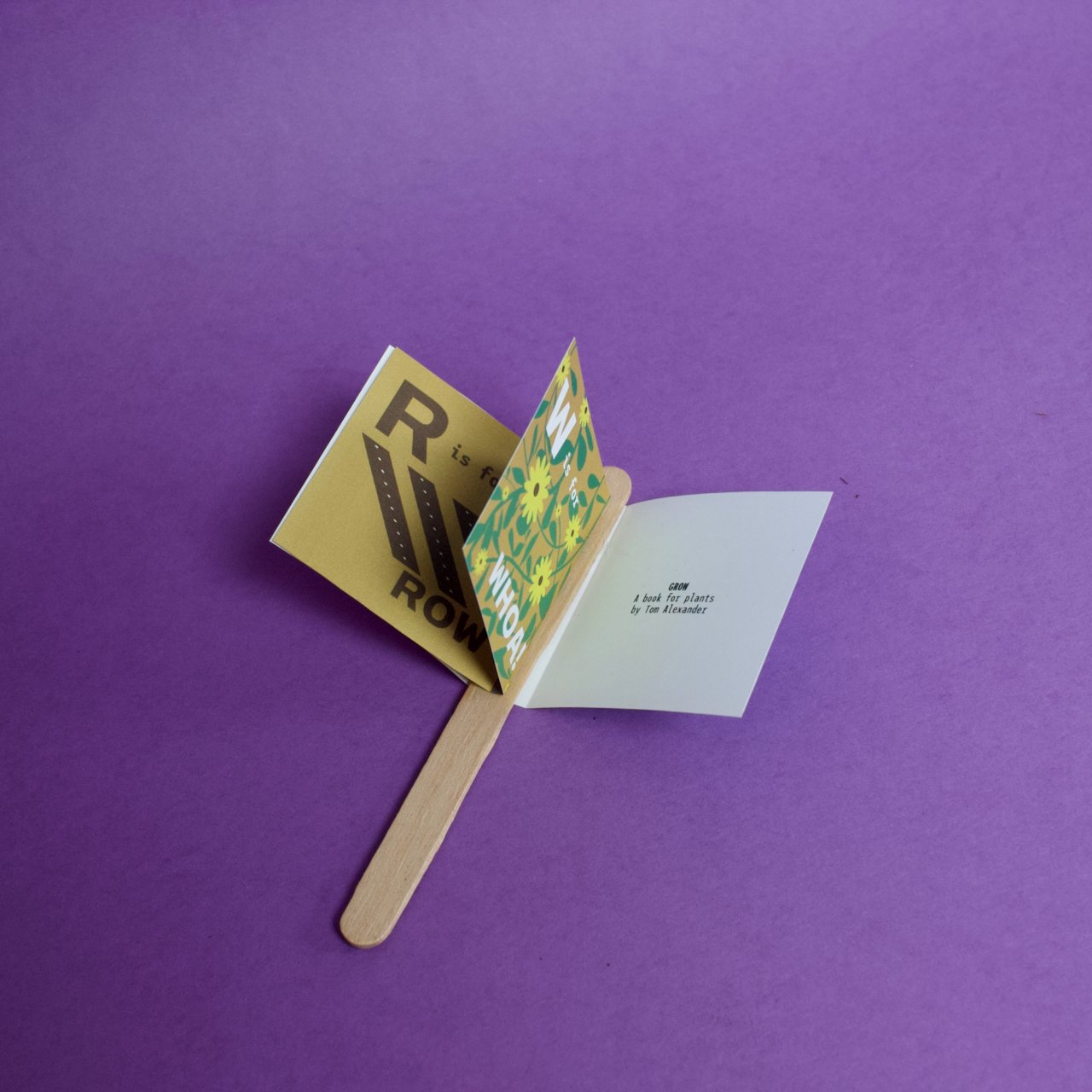
Paper and Wood, 115 x 10 x 50 mm
Overview
A book for plants, to encourage growth
Background
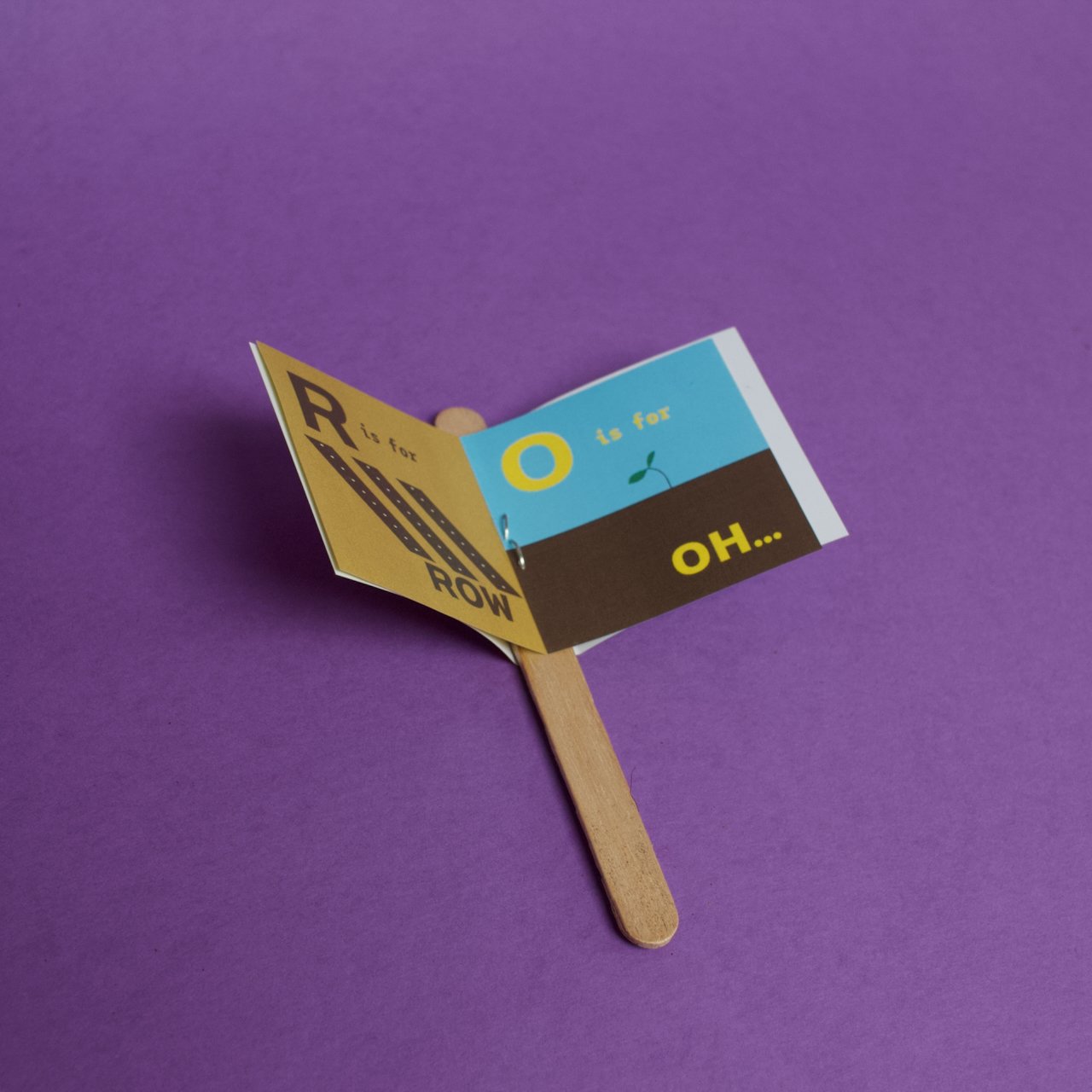
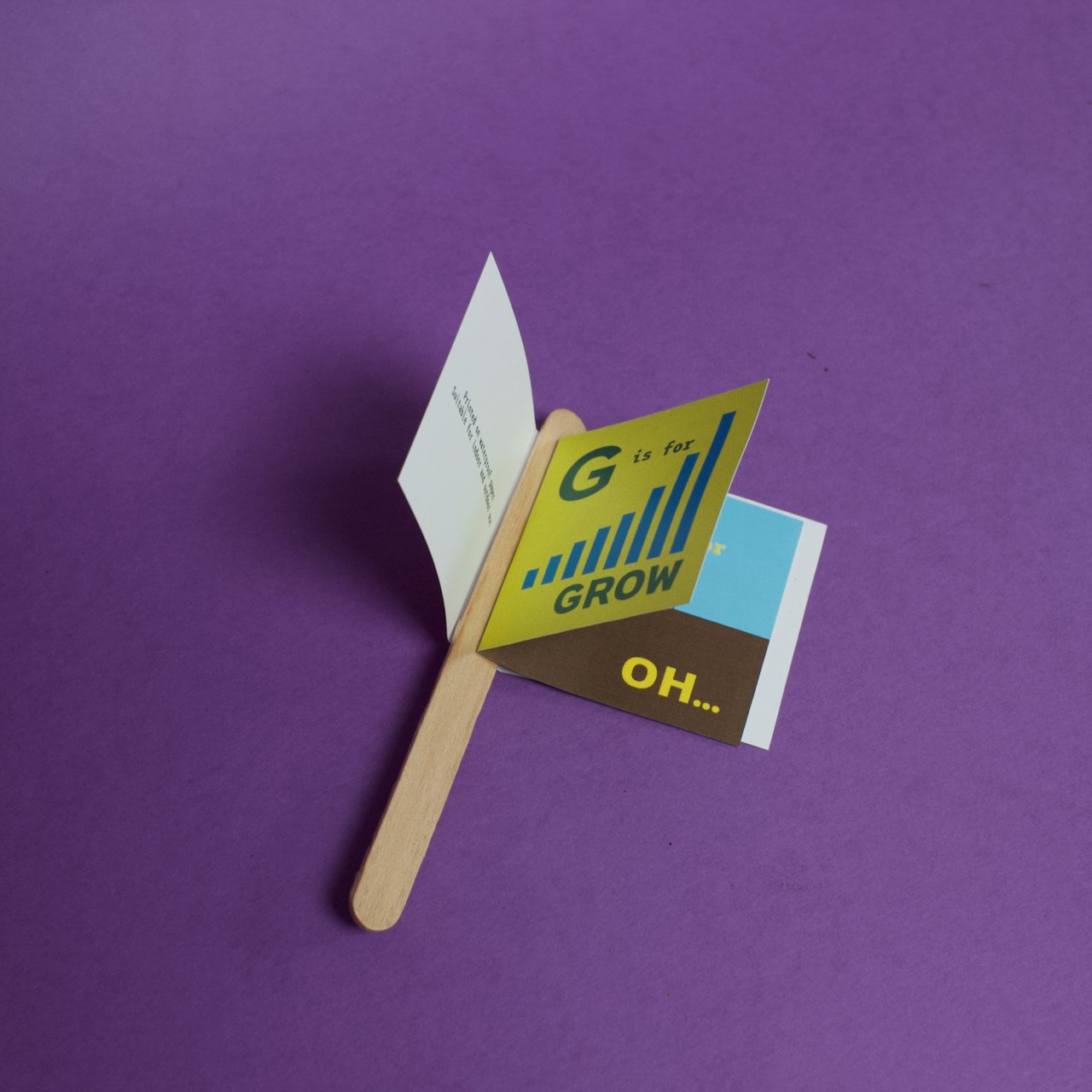
These little paperback pamphlets are printed on waterproof paper, which means they should survive outdoors or at least a watering or two. The simple story encourages even the most remedial plants to strive for more. There was originally going to be a more complex narrative and perhaps even a range of plant books for different species at different stages of their lives. Eventually, though, I hit upon the (fairly stupid) schema used in the book:
G is for Grow
R is Row
O is for Oh…
W is for Woah!
Which is pretty silly, but made me chuckle.
Construction was mostly about figuring out which way to put the staples and whether the book needed a ‘spine’ or not. In the end, I decided to cover the stick with the book title. I figured it was more aesthetically pleasing. A heavy duty staple binds it and hot glue is osed to cover that staple with the cover.
Daniel's Dinner
A wooden cyanotype book about misunderstanding the people you live with.


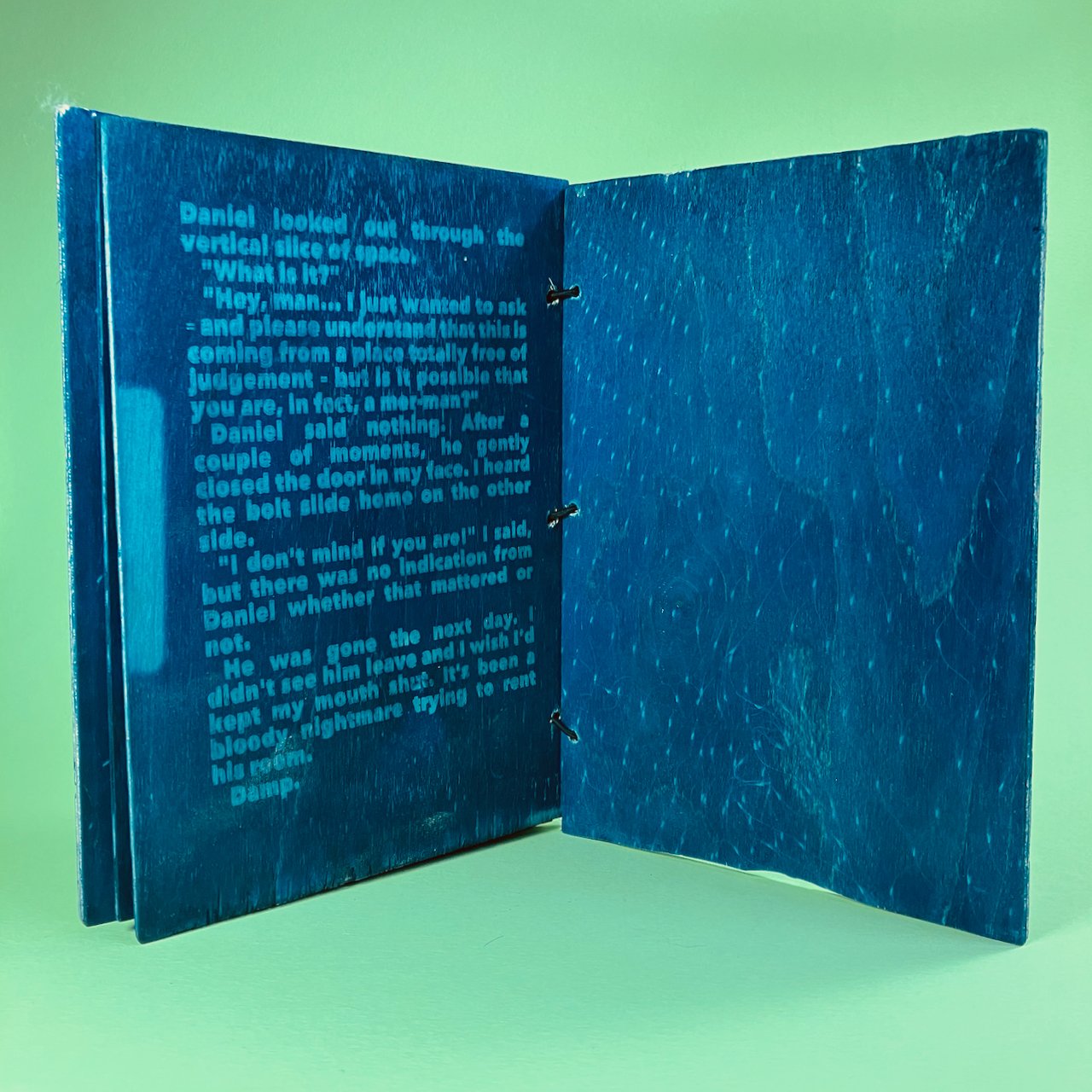
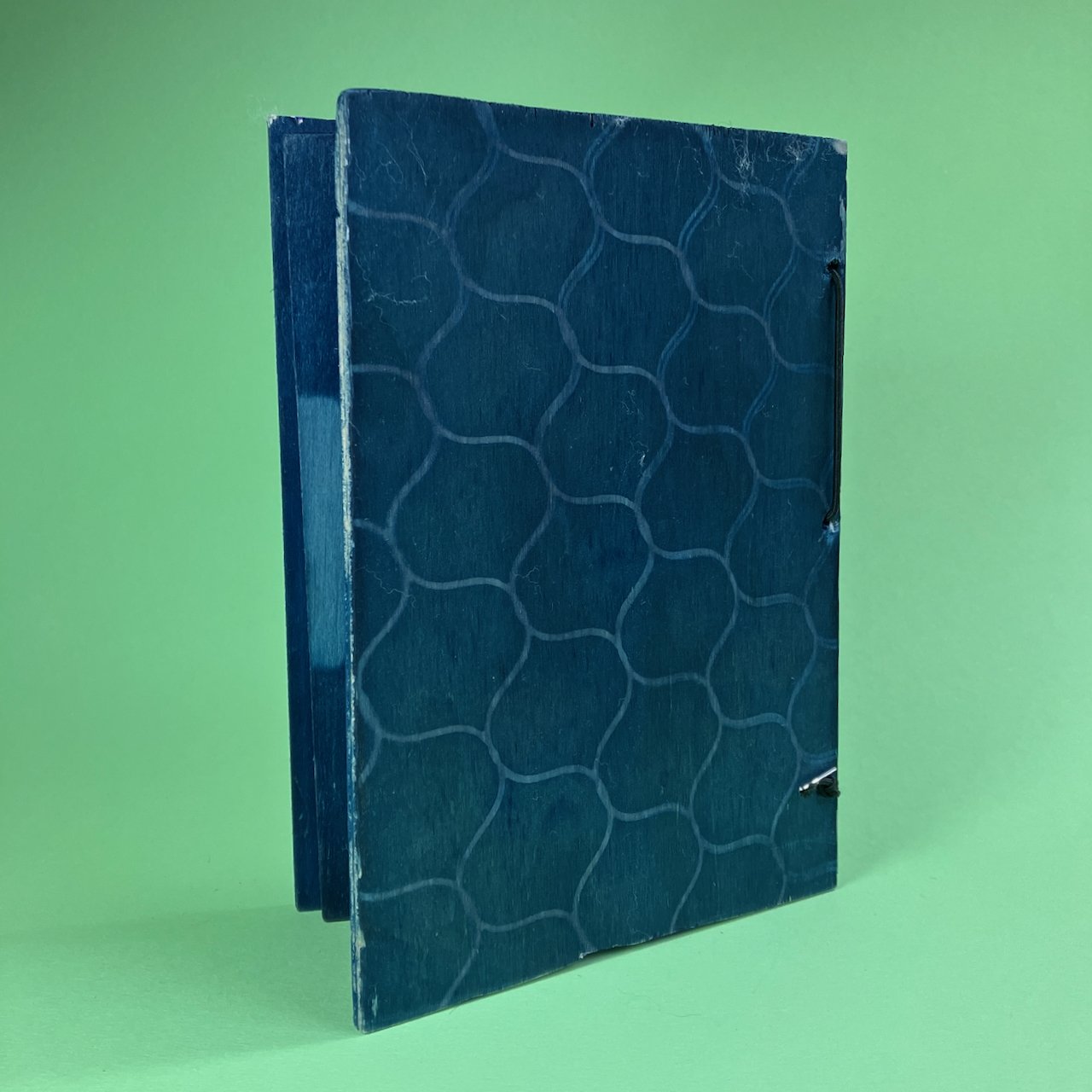
Wooden book, 220 x 150 x 20 mm
Overview
A story about misunderstanding the people you live with, presented as a wooden book with the text printed by cyanotype.
Background
Cyanotypes are quite a cool process - treat a surface with the chemicals, put some kind of mask over them and then expose it to sunlight. Where light is blocked, you get a pure white tone and where the sunlight reasches you get a rich blue. It’s an old process, used to reproduce drawings when accuracy and fidelity to the original was more important than the aesthetic. It’s where the term ‘blueprint’ comes from. I had made some cyanotypes before using the sun paper kits you can get, but had always wanted to try the chemicals on wood. When Upright Gallery posted an open call for artists books on the theme of water, it seemed like a good reason to implement some of those ideas.
I was on a short timeframe, so used a short story I had written as a basis for a simple book. The story was very short - less than a thousand words - and I typeset it on the computer before printing the layouts onto acetate. I then cut some pieces of plywood I had knocking around to the right size, treated them with the chemicals and exposed each of the sides to sunlight while covering them with the transparent masks I had made. Each side needs to be fixed with water, otherwise it’ll carry on reacting to light and eventually turn completely blue. Having to wait for each piece of wood to dry before applying the chemicals and exposing the other side is what made this such a tight race to deadline. That all worked out reasonably well and the exposures were OK. What turned out to be more difficult was applying my limited carpentry skills to cutting and sanding the boards to the right side. For some reason I got it in my head that the covers had to be thicker than the pages and, let me tell you, that thicker plywood was a bugger to cut. Also, I was using the wrong saw, so it was quite a wonky line. Also, I hadn’t drilled the holes for the binding before exposure, so everything was a bit off. Once I put it together, I could see that things were a bit wrong and did what I could to fix it, but my attempted fixes were just making things worse and I had to walk away and accept it as done, imperfect though it was.
I was glad to have finished it within a deadline and pleasantly surprised when it was accepted by Upright Gallery into their exhibition, which runs 2-23rd December 2023.
Making Waves at Upright Gallery, 3 Barclay Terrace, Edinburgh, EH10 4HP.
Ten Regrets
A collection of ten regretful incidents for you to reflect upon and then burn.

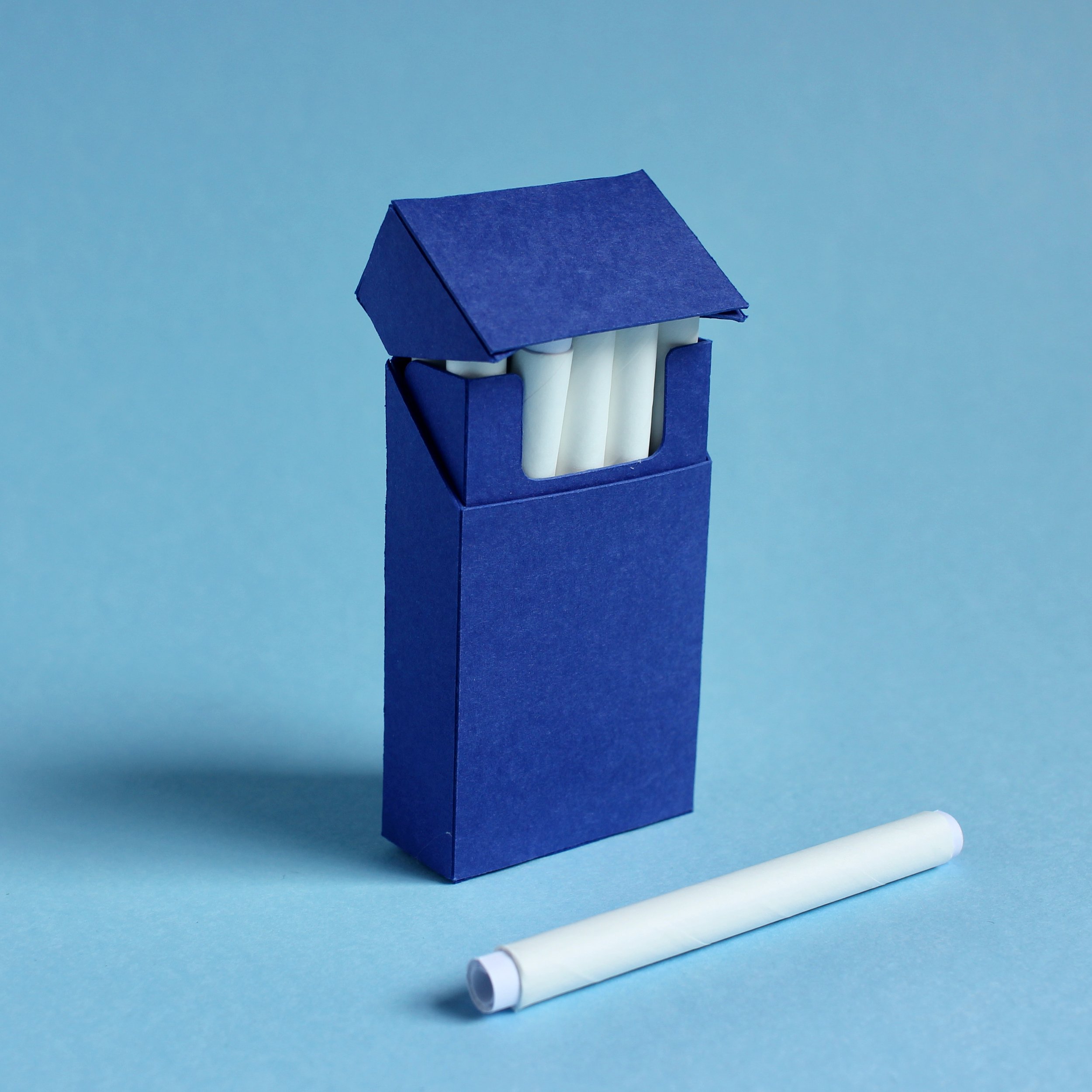


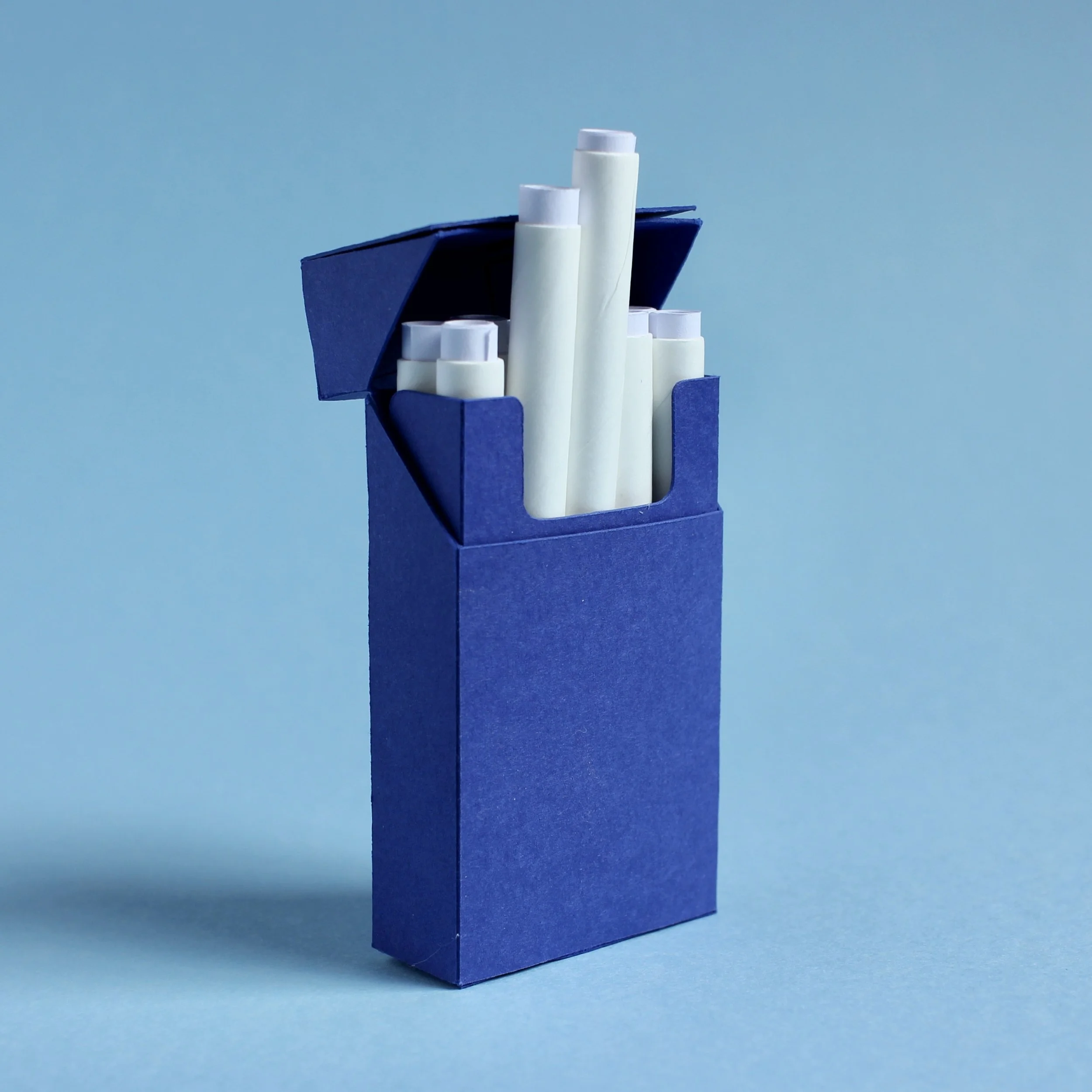
Ten Regrets is a collection of short texts which invite the reader to reflect on past mistakes. Each regret is rolled into a tube and collected in a box shaped like a cigarette packet. Each paper has blank spaces for the reader to write on and personalise it to their own specific regret. When this is done, the reader is encouraged to roll the paper back up and burn it in order to break the hold this past event has over them.
Paper and card, 20 x 90 x 46mm
Overview
A collection of ten regretful incidents for you to reflect upon and then burn.
Background
Ten Regrets is a collection of short texts which invite the reader to reflect on past mistakes. Each regret is rolled into a tube and collected in a box shaped like a cigarette packet. Each paper has blank spaces for the reader to write on and personalise it to their own specific regret. When this is done, the reader is encouraged to roll the paper back up and burn it in order to break the hold this past event has over them.
I also think it’s interesting that the reader is asked to burn the pages of this book. Although they are not bound in the same way as a regular volume, I’m interested in whether people will actually go through with the burning part. Obviously, book burning is an emotive issue. While I don’t want it to seem like I endorse it on a macro level, there’s also the fact that once you’ve bought it, you can do what you want with it.
There’s a specificity about the shape of a ten-box that puts my mind in a specific period of my life. The fact that the packet of ten is no longer available for sale also places it in a particular place in history, a pre-modern era that no longer exists and therefore adds an element of nostalgia. Nostalgia’s a tricky thing. It’s not accurate recall and in that way it’s similar to the process of looking back with a rueful eye about the things one should or should not have done in the past.
The regrets are taken from incidents in my own life, but hopefully are relatable to most people’s experiences to a greater or lesser extent. This kind of writing always feels like treading a fine line and I hope I’ve managed to make an emotional connection without it feeling mawkish or manipulative.
Swiss Army Book
A small practical volume for the roving reader.
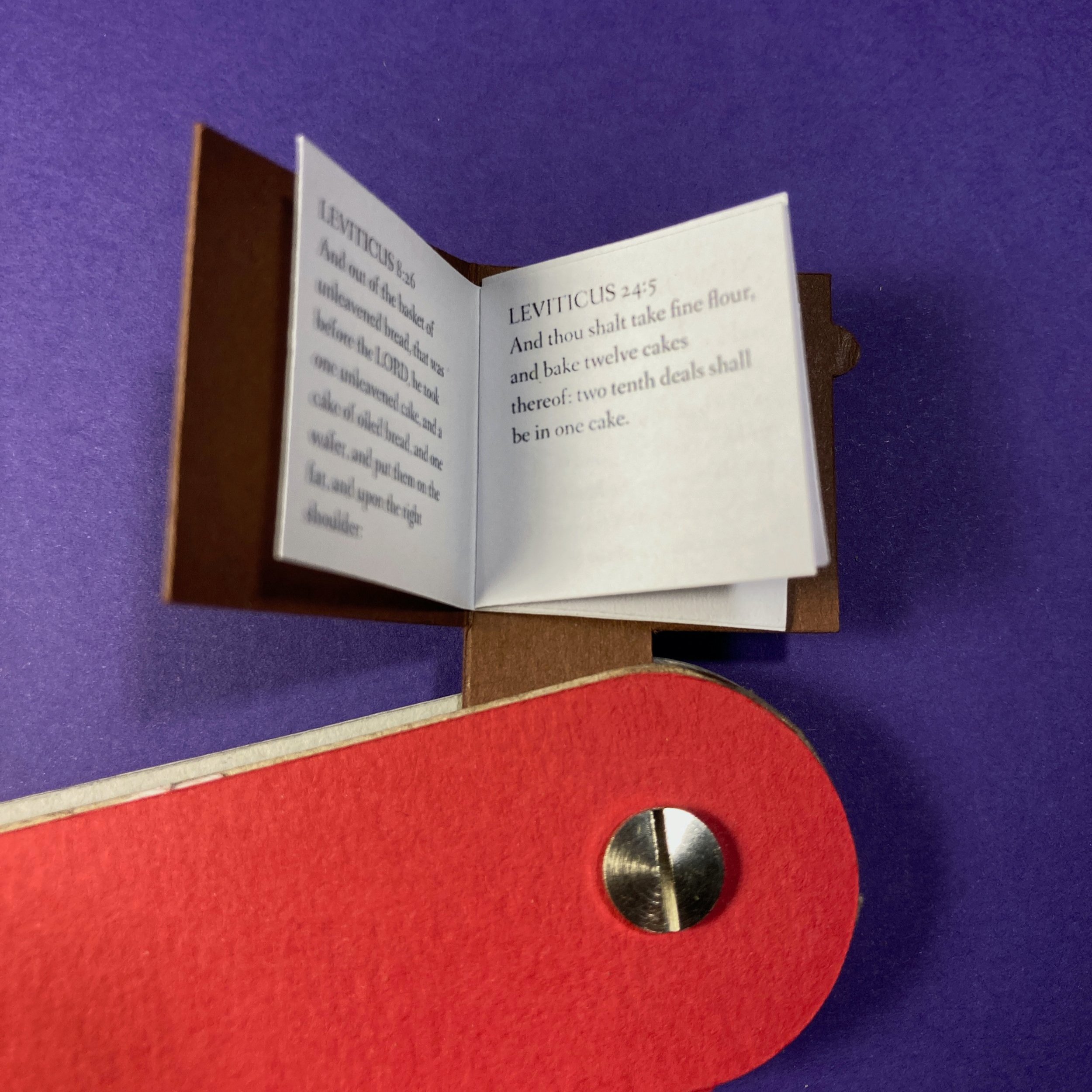
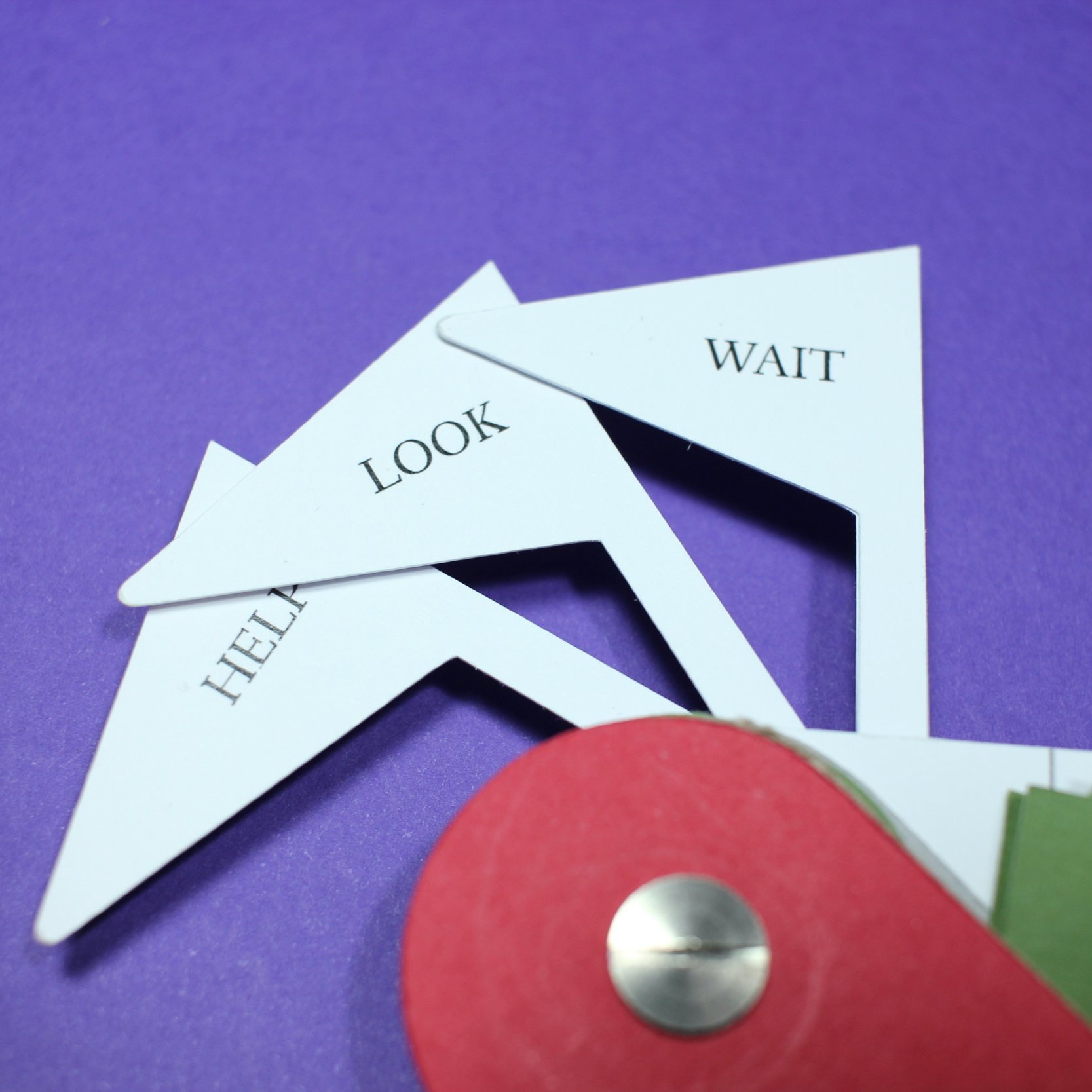
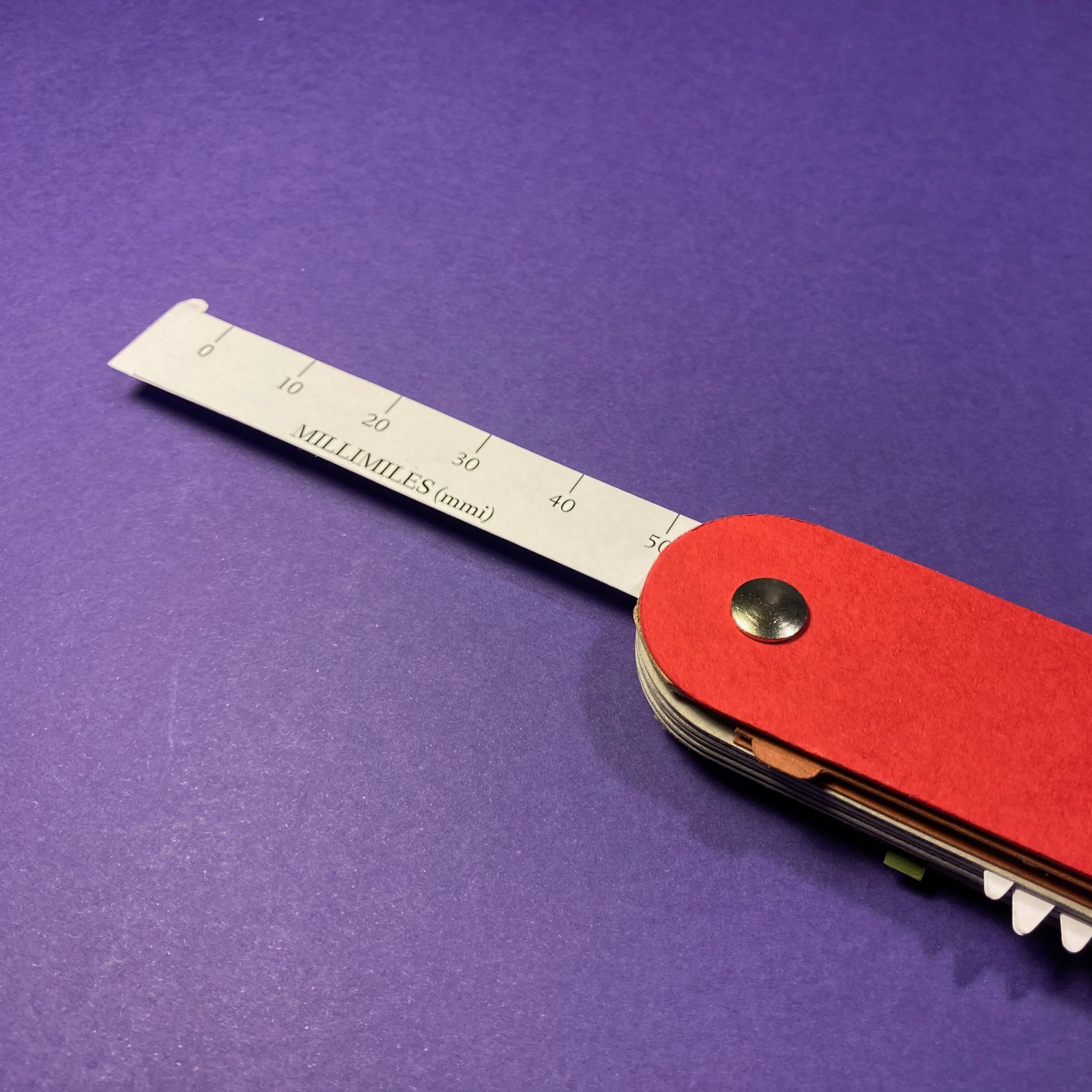
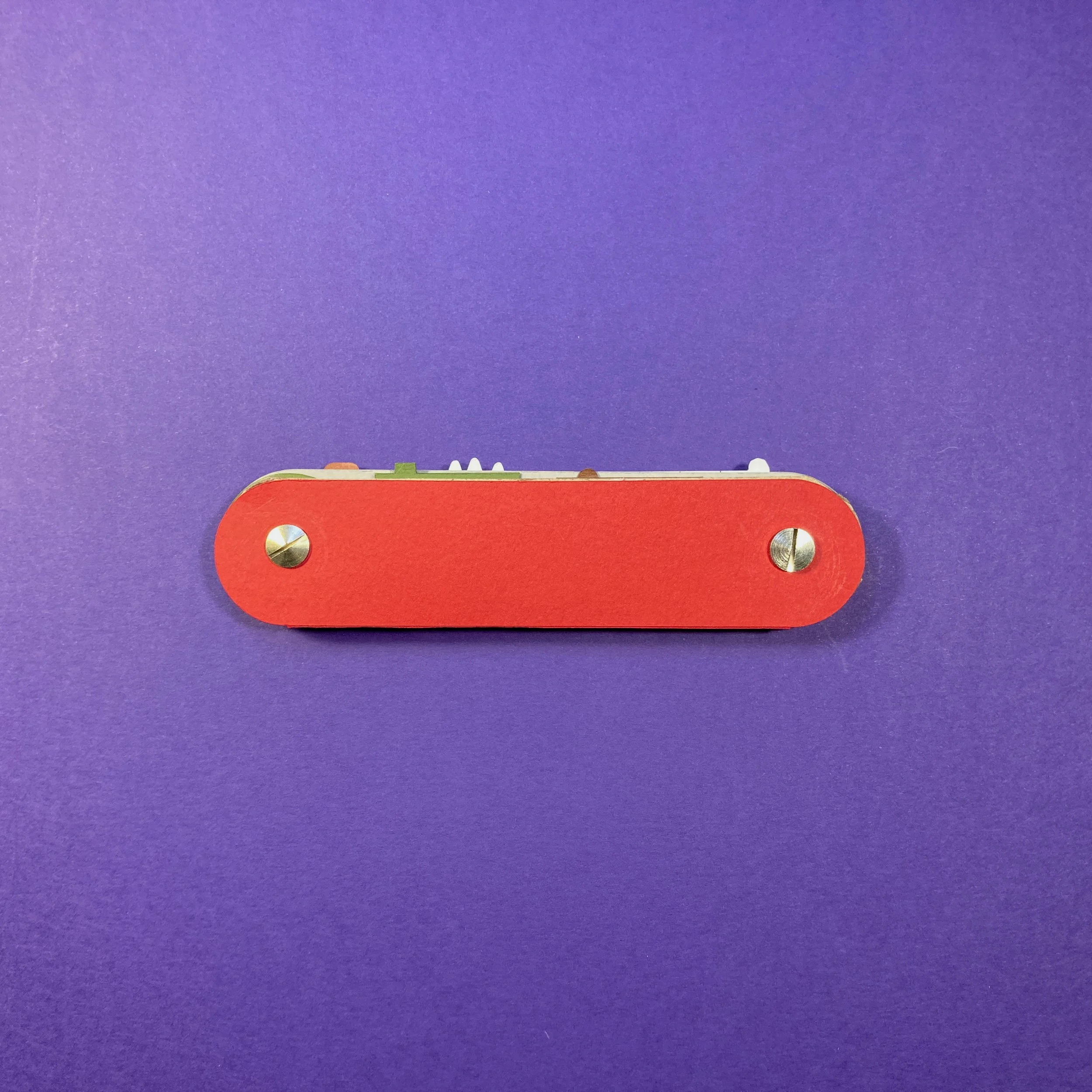
Paper/Card, 2022, 35 x 140 x 20 mm
Overview
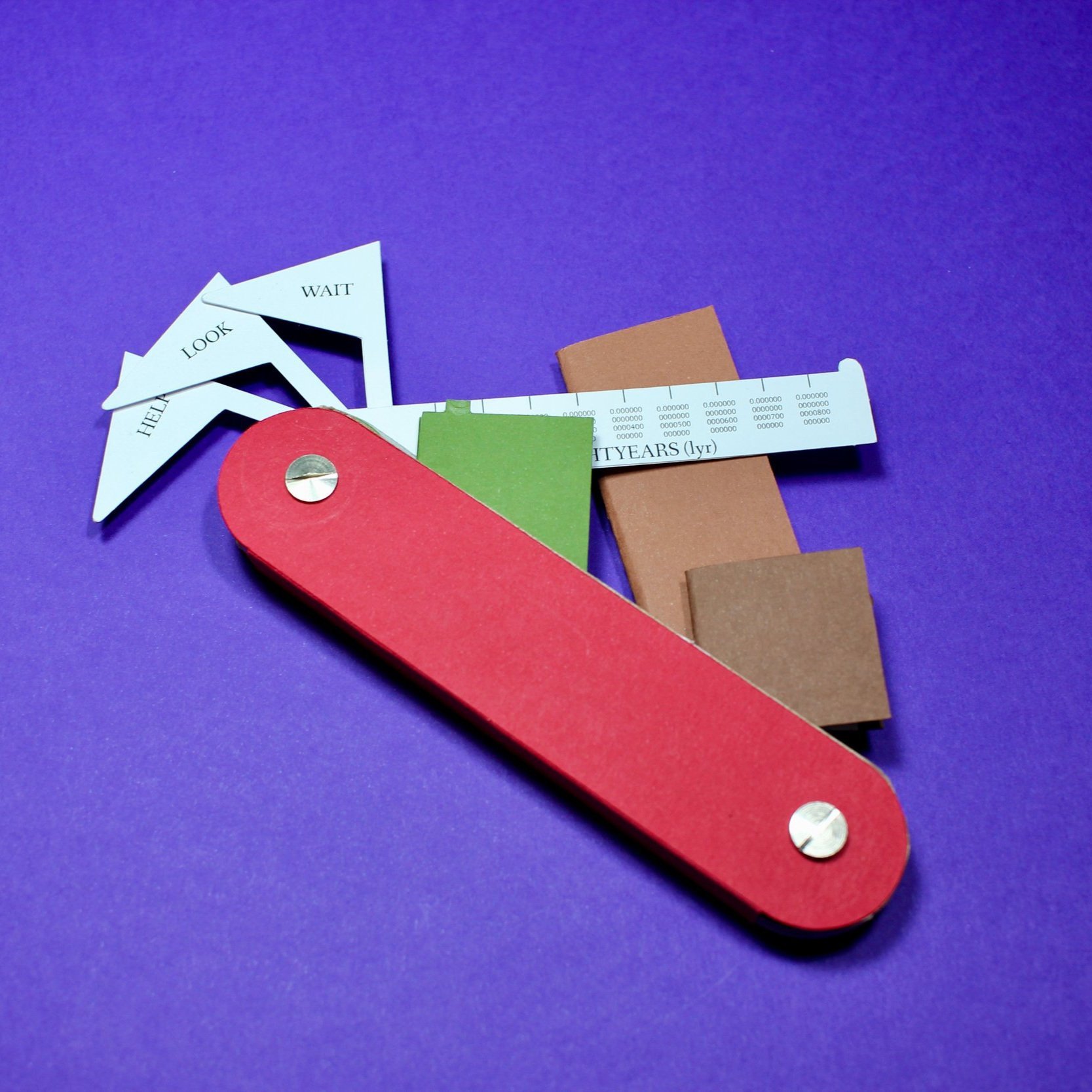
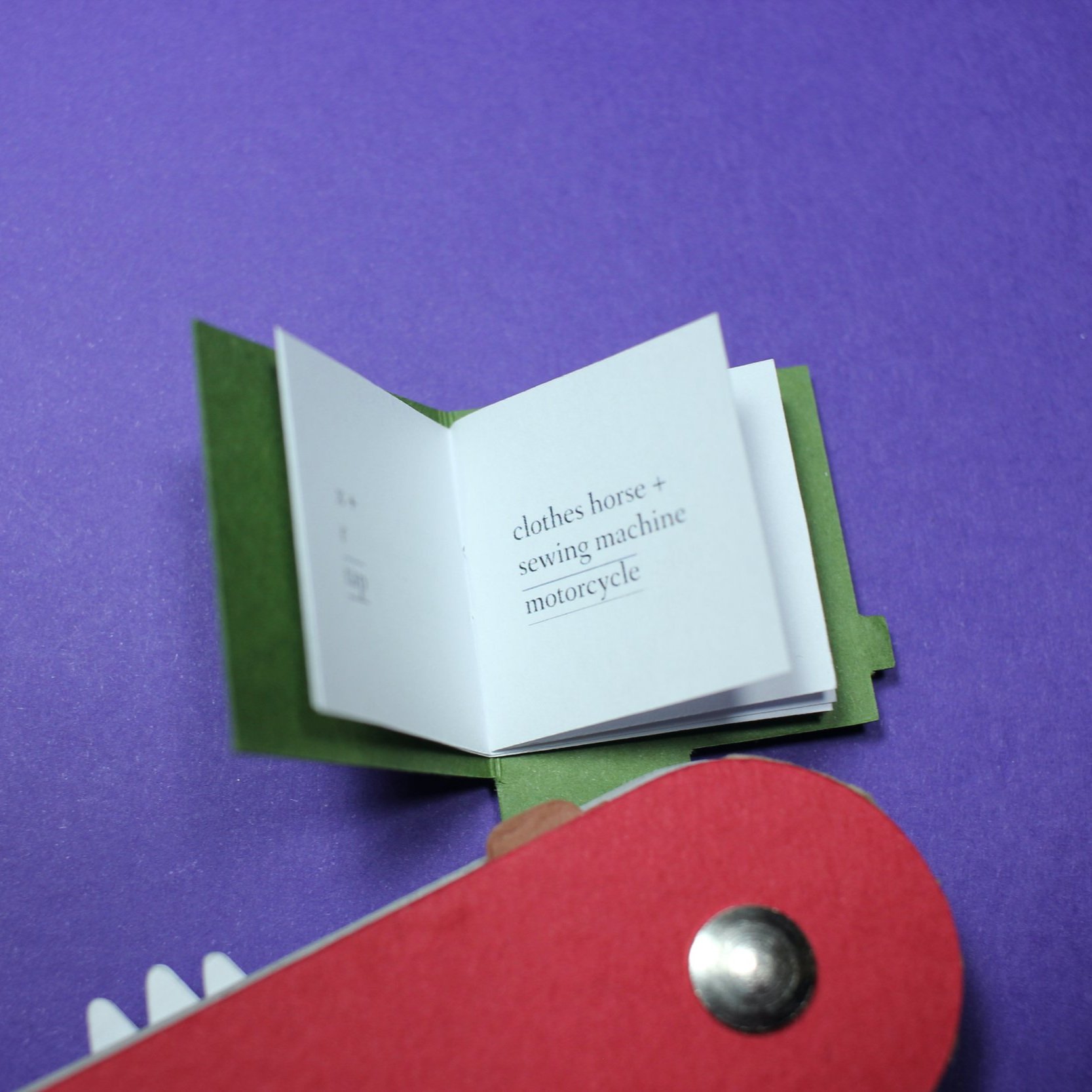
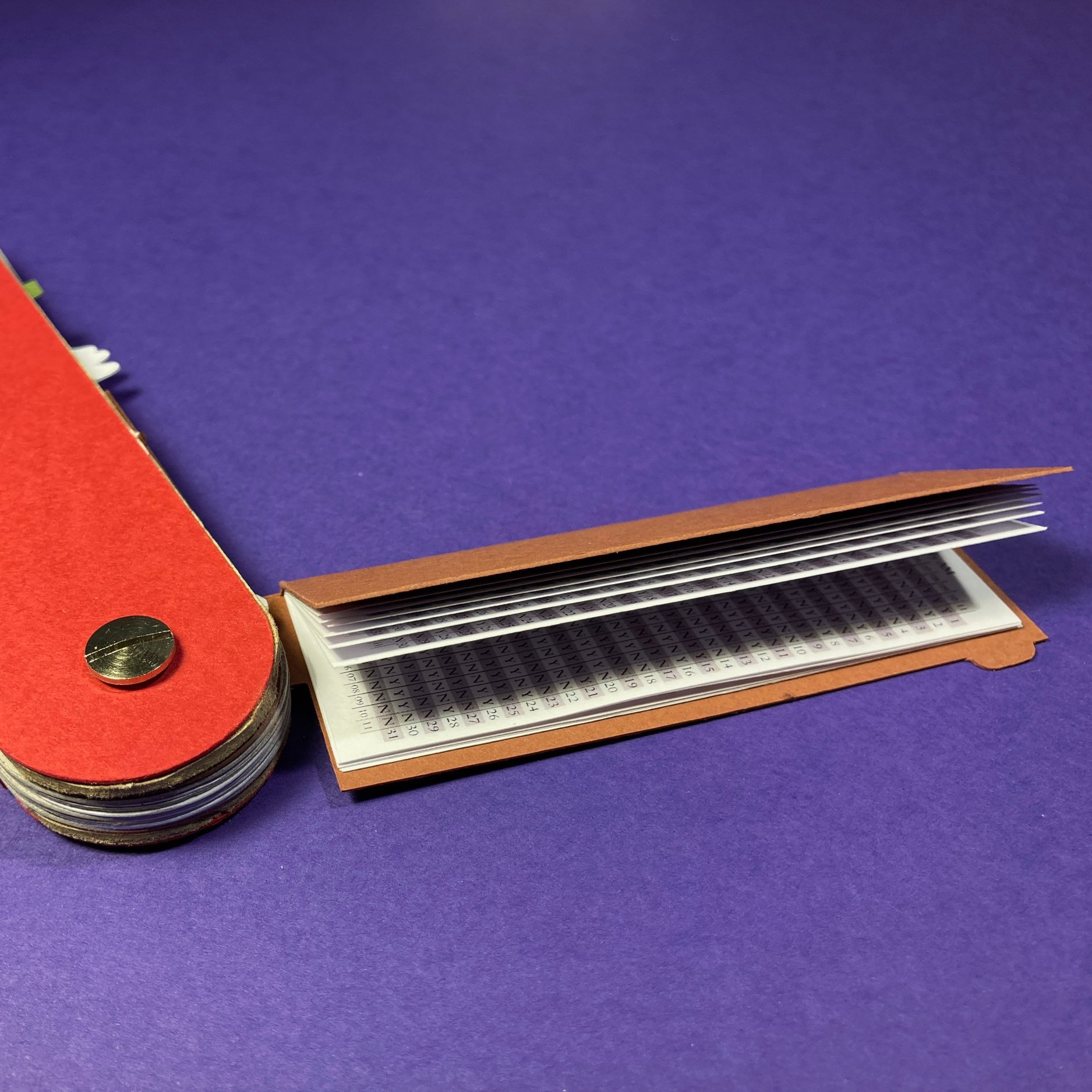
A small practical volume for the roving reader, containing several useful texts and tools that fold out from the main body.
Contents
Yes / No Guide
Cakes of the Bible
Aggregate Objects
2-sided Ruler
Millimiles
Lightyears
Tiny Flags
Help
Look
Wait
Background
It’s rare that I remember how or when I have an idea - they just sort of appear. In the case of Swiss Army Book, however, I remember exactly how it came about. I had a period of quite intense anxiety at the end of 2021 and attempted all sorts of methods to try and ease the symptoms while working on the cause. As well as massage, shiatsu and acupuncture, I had a couple of sessions in an floatation tank. Bobbing around in salt water in the dark is… all right. I didn’t find it to be a life-changing experience, but it was quite nice. And while I was floating around in Epsom salts, I had a vision. Not of God, the future, or the interconnectedness of all living things, but a book shaped like a Swiss Army Knife. I emerged determined to make that dream a reality.
Having just made several pieces that were small and fiddly to construct, I wasn’t that keen on doing so again. Wanting to get a grasp on how the pieces would interact, I made a large version of what I had in mind, thinking that the ‘blades’ of the book would be around A6 size. It was immediately clear that this was stupidly big and, despite my misgivings, it would have to be much smaller. Not as small as a real Swiss Army Knife, but certainly of a more compact size. That first humungous version wasn’t a waste of time, as there are some things that you can only know when you have an object in your hands. As an example, that first version had the books spine-out, which made putting them away a problem as the pages would get caught up in the next compartment. Flipping it around so that the spines went into the body first made the pages close as well, making it a more pleasing motion.
(At this point I’ll be honest and admit that I did entertain the notion of a beautifully made hardback version of this book made of wood, leather and brass. After a few abortive attempts to casebind a 30x30mm book, I had to admit that such a thing was beyond my capabilities and conceded that paper and card would be the best materials for me to use.)
As I went about shrinking the size of the book, I also had to think about what would be in it. It was clear that a narrative story didn’t really fit in with the concept, so I thought about non-fiction ideas that could be implemented in a very small space. Just as the swiss army knife has an assortment of tools within its body, the swiss army book should cover a number of potential situations.
There were a false starts here, which were largely to do with issues of tone. I thought about Swiss mythology and entertained creating a history of the great gnomes of Europe, but it was a bit twee and not quite right. Thinking of books that a person might turn to when up a mountain, I thought about the bible. But, as I didn’t really want to make something that was either religious or actually practical, I tried to use it in a way that wasn’t actually useful, even to the most devout theologian. I searched the bible for passages that mention cake. (Originally it was bread, but there were too many of them.)
I also wanted something that would be a practical survival guide, but obviously not that practical. I also put together a set of ‘aggregate objects’ based around a simple 1+1=2 method, which I thought was adjacent to a survival, but not actually useful. After prototyping these, my partner suggested adding in the Yes/No Guide I had previously made as a small item for my mailing list. I also created rulers using impractical measurements and three very tiny flags. In time, I’d like to print these on rigid plastic, but I suspect I won’t get to it.
Construction was both simple and fiddly. I used the Cameo cutter to create the various pieces, but a few stupid errors here and there led to some wrongly-sized pieces, which was exasperating and led to a massive crisis of confidence until I saw where I’d gone wrong.
The final piece consists of 39 pieces, 8 different paper stocks and 7 separate volumes. The binding is two screw-and-post binders There’s a little bit of glue to make some things sit flush and nice, but for the most part it just relies on things being aligned. I think it came out all right.
Mug
A story about a mug, on a mug.
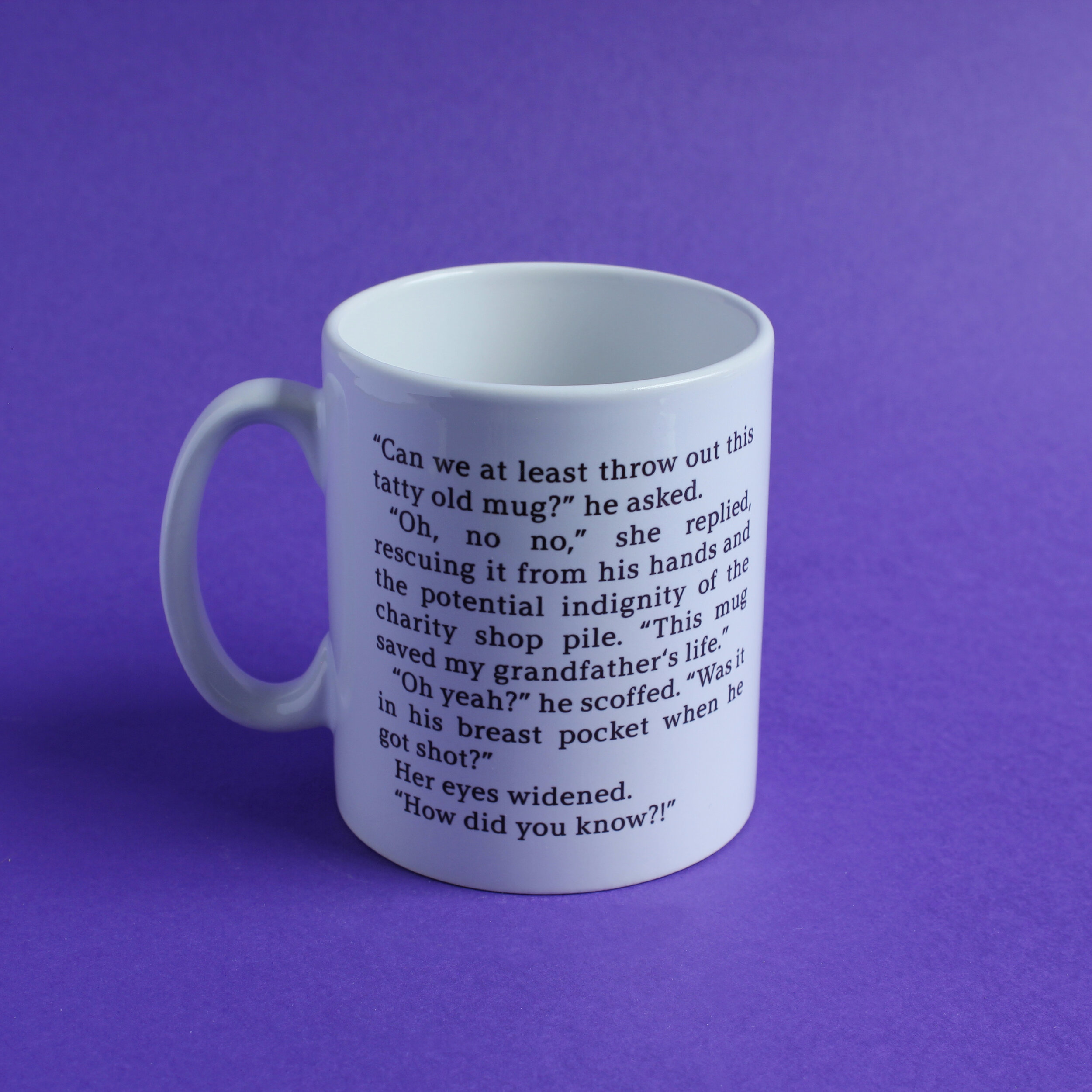
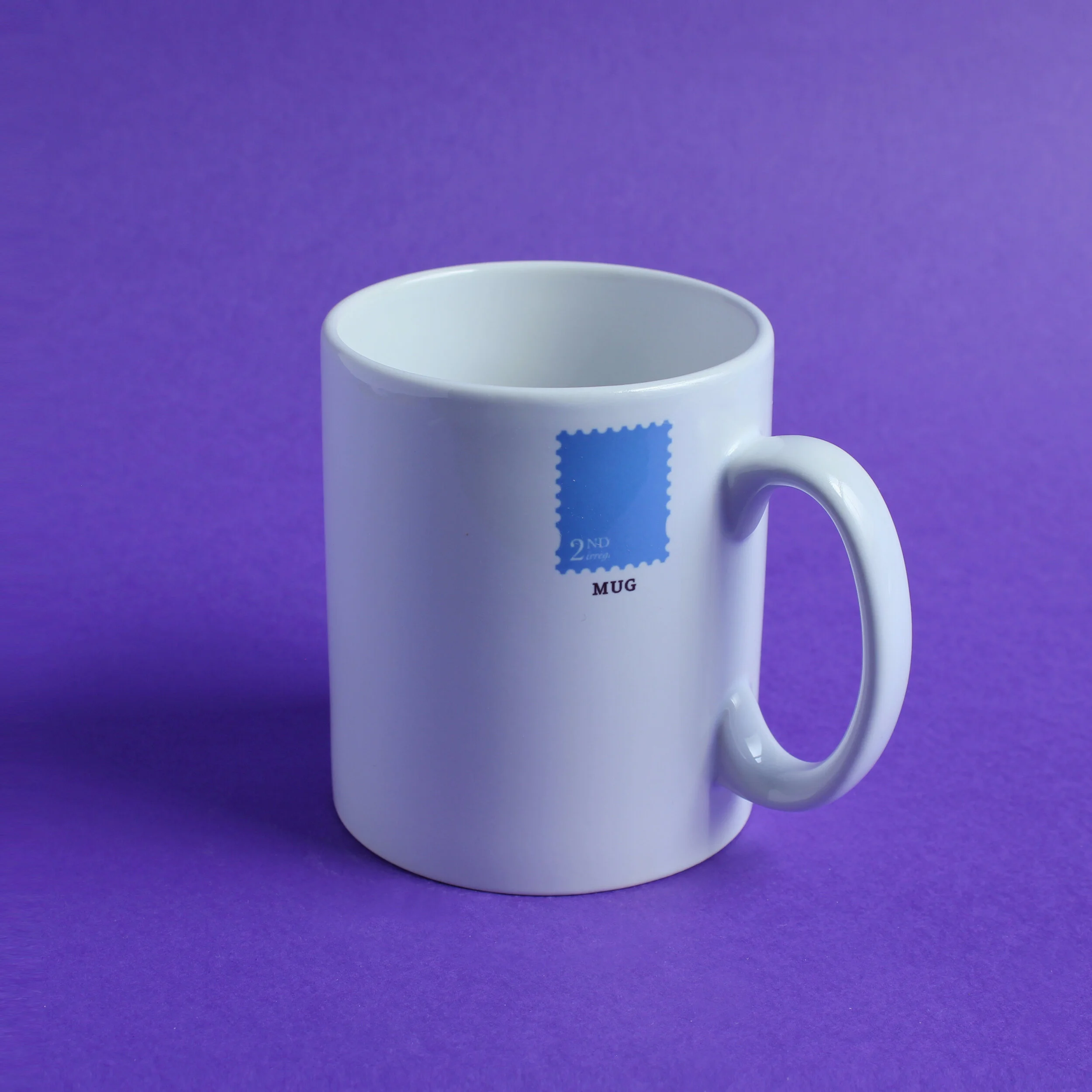

A 10oz white ceramic mug, emblazoned with a little story (about a mug, naturally) and some tasteful Second Class Irregular branding.
Dishwasher & microwave safe.
Overview
A story about a mug, on a mug.
Background
Sometimes you redefine the interplay between form and content… and sometimes you just put a story on a mug. No shame in the latter. I made this really to entertain myself, but it’s as easy to offer it for sale as well. Buy one if you like mugs (and who doesn’t?).
Teatotum
A small plastic throwing die to determine the most important question of all: who will make the tea?

The idea for this came when I found out about teetotums (small hand-made throwing dies used in games of chance) and it seemed obvious that one letter changed would give it a different spin. Obviously, they should be used to decide who would make a cup of tea. This may have been inspired by the arduous negotiations that happen between my niece and nephew whenever the subject of a brew comes up.
“I’ll make it if you put the kettle on.”
“I’ll put the kettle on if you fill it.”
“I don’t mind filling it, but I’m not getting the milk out of the fridge.”
“I don’t want milk.”
“But I do.”
“Then you can get it out the fridge.”
“OK… but only if you get the mugs.”
And so on and so on, until the end of time.
My Teatotum is designed to settle some of these debates. Its four sides offer unequivocal directions:
I’ll make it, where the thrower does the honours.
You make it, where the other person has to.
We’ll make it, where the honours are split equally
No Tea, in which case nobody gets anything and ten minutes must pass before the matter is broached again.
(The threat of No Tea may be enough to forgo use of the Teatotum entirely, as it is a situation that everybody wants to avoid.)
The piece is 3D printed plastic and fits into a standard matchbox. I wish the Teatotums themselves were printed at higher… resolution?… but I’d been through many iterations by this point that I had to accept what I was given.
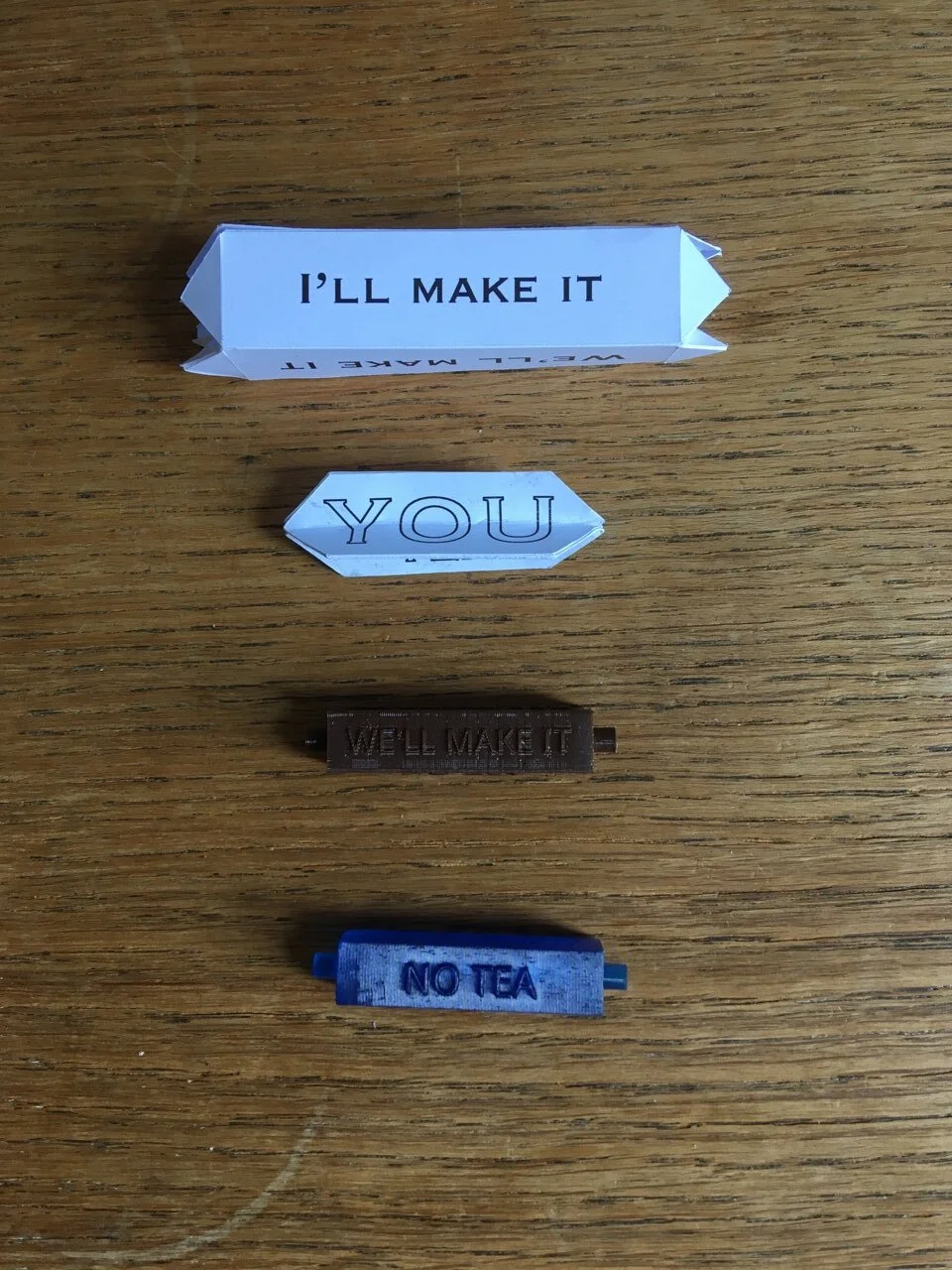
Teatotum prototypes in paper, card, ABS and… some weird resin stuff

This version was a bit bigger and the recessed text might have been an improvement, but it couldn’t be printed in a vertical orientation, apparently, meaning that one side’s text was always mangled.
Invisible Man Action Figure
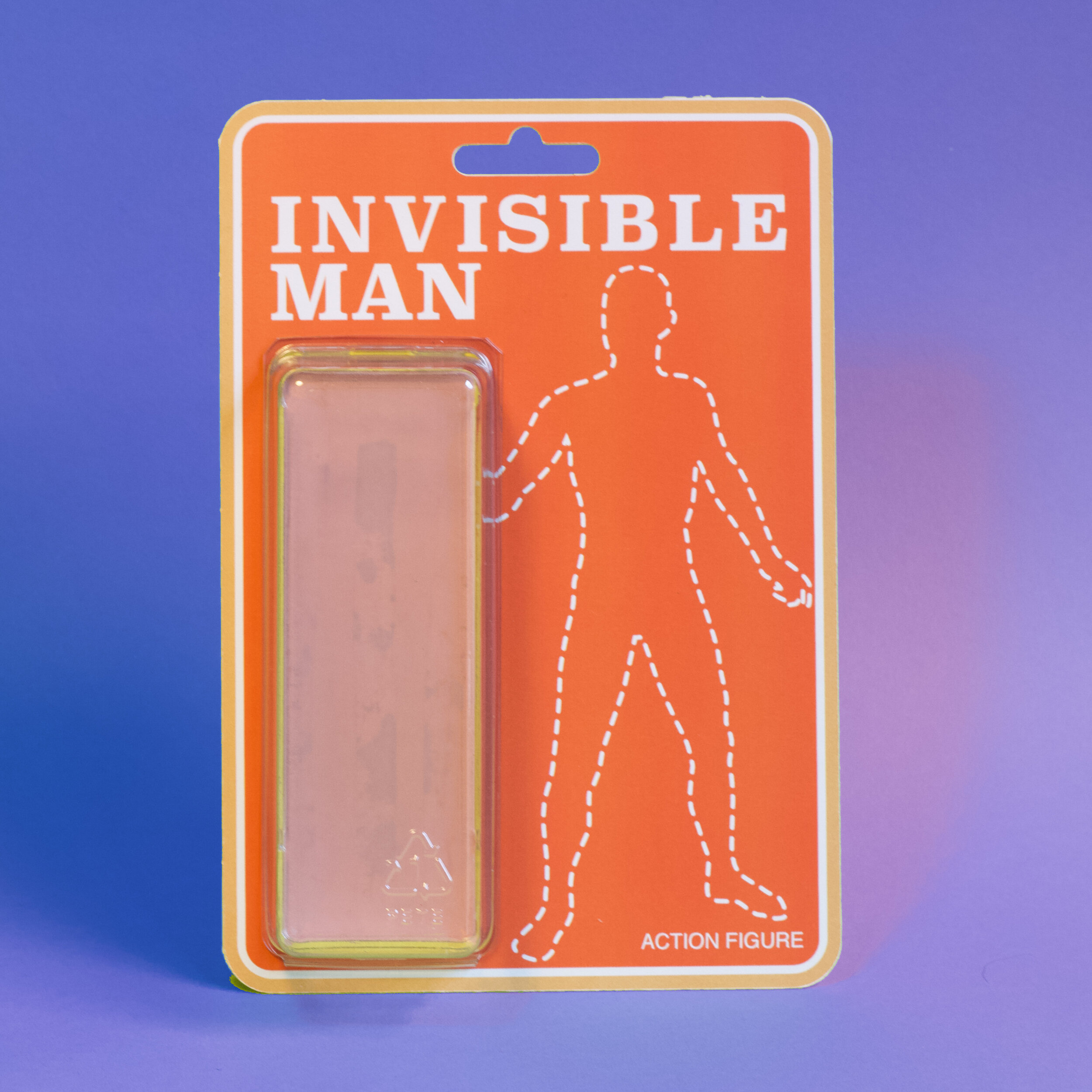
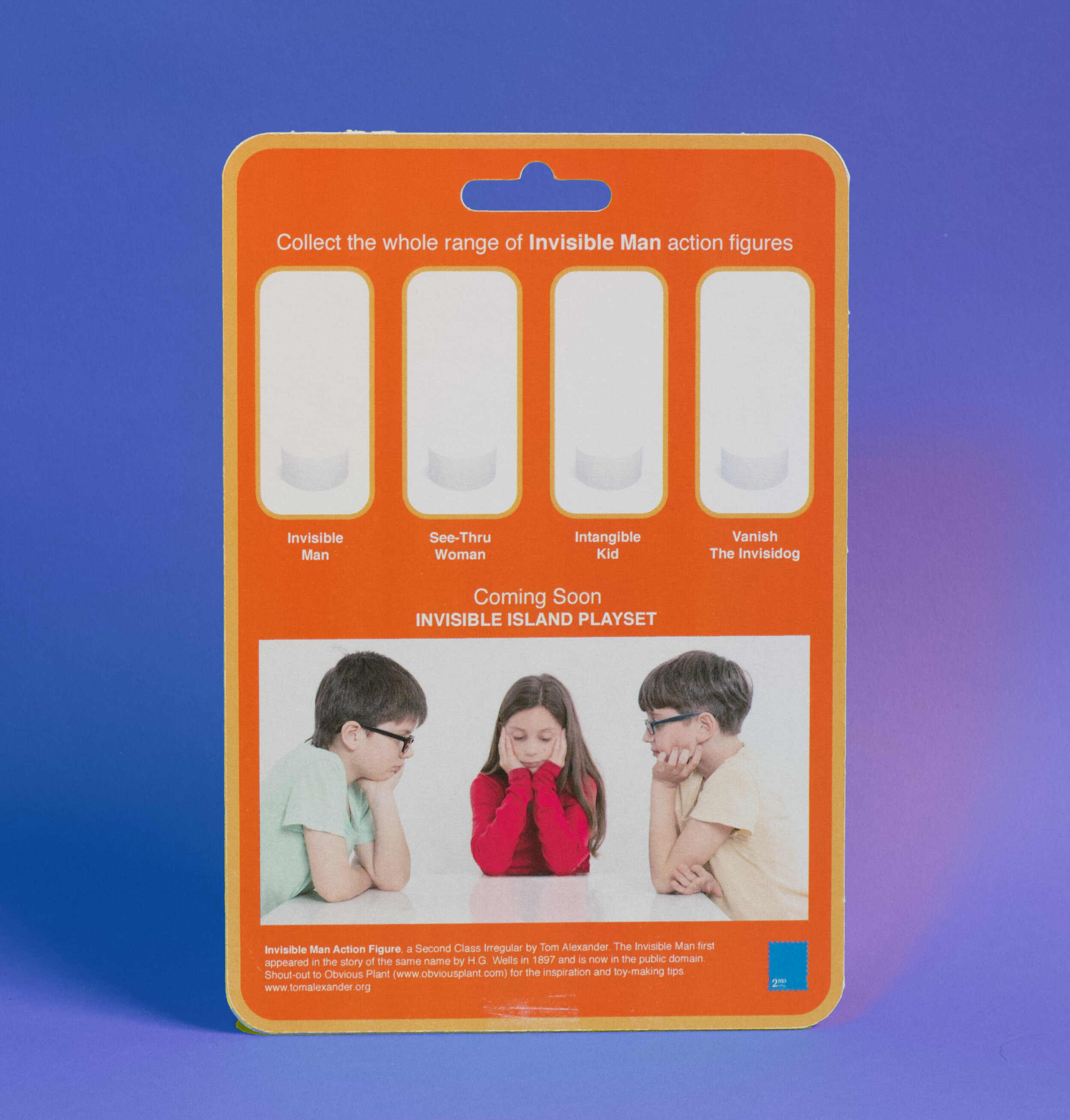
A card-backed, clear plastic shell containing an intangible representation of HG Wells’ classic character. Alternately, an empty piece of packaging.
Description
A card-backed, clear plastic shell containing an intangible representation of HG Wells’ classic character. Alternately, an empty piece of packaging.
Background
This seemed like one of those ‘so obvious, someone must have already done this’ ideas. But research didn’t find anything, so I pressed on with it. (This is not to say that someone hasn’t done it before, but just that I wasn’t deliberately ripping someone off.)
I had a lot of Star Wars figures when I was a kid and I think most people my age did, too. But my collection was made up mainly of ones acquired from jumble sales and charity shops. My collection was made up mainly of Rebel Commanders or Imperial Walker Captains - mid-level bureaucrats who could be seen in the background while Luke and Han did more interesting stuff. That was OK, though. I quite liked making stories around these utility players and they could fit in more easily with other types of figures in a way that movies stars like Harrison Ford couldn’t.
Looking back on it, I must have had some new figures, though, because I distinctly remember poring over the group photo on the back of the packaging, learning the names of all the different characters and trying to remember where they had been in the films.
But these were childhood toys. I’ve never really got the whole collectables market and certainly never kept anything in its box. They were meant to be played with and any that survived the trip to adulthood did so battered and bruised, with their paint flecked off and their accompanying laser guns long since lost. The thought of paying a hundreds of pounds for something that cost £1.75 when I was little seemed odd.
(I sadly remember a university friend of mine buying into the errant notion that merchandise from The Phantom Menace would appreciate in value the same way. I’m pretty sure he asked everyone to give him Star Wars toys for his 21st birthday and even then I thought it was an odd time to be alive. Who knows, though? Maybe in another twenty years, those Jar Jar Binks action figures and Liam Neeson face masks really will be worth a fortune.)
Anyway, the Invisible Man Action Figure is a homage to those days and a pretty obvious comment on the collectables market. It should be pointed out, though, that it wouldn’t exist without said market. Buying authentic plastic shells to stick on card would be impossible if figure collectors didn’t want to do exactly that.
It should also be noted that it was while researching this piece that I discovered the work of Obvious Plant, who makes all manner of weird toys before secreting them onto store shelves. As well as thinking that their work was brilliant, I’m also grateful to them for introducing me to Crafter’s Tape, which is as effective as it is ecologically profligate.
The background photos were modified images from a stock image library. I wondered whether those miserable kids looking at the invisible island playset were a little too ‘winky-winky’ in-on-the-joke, but their expressions won me over.