GROW
A book for plants, to encourage growth.
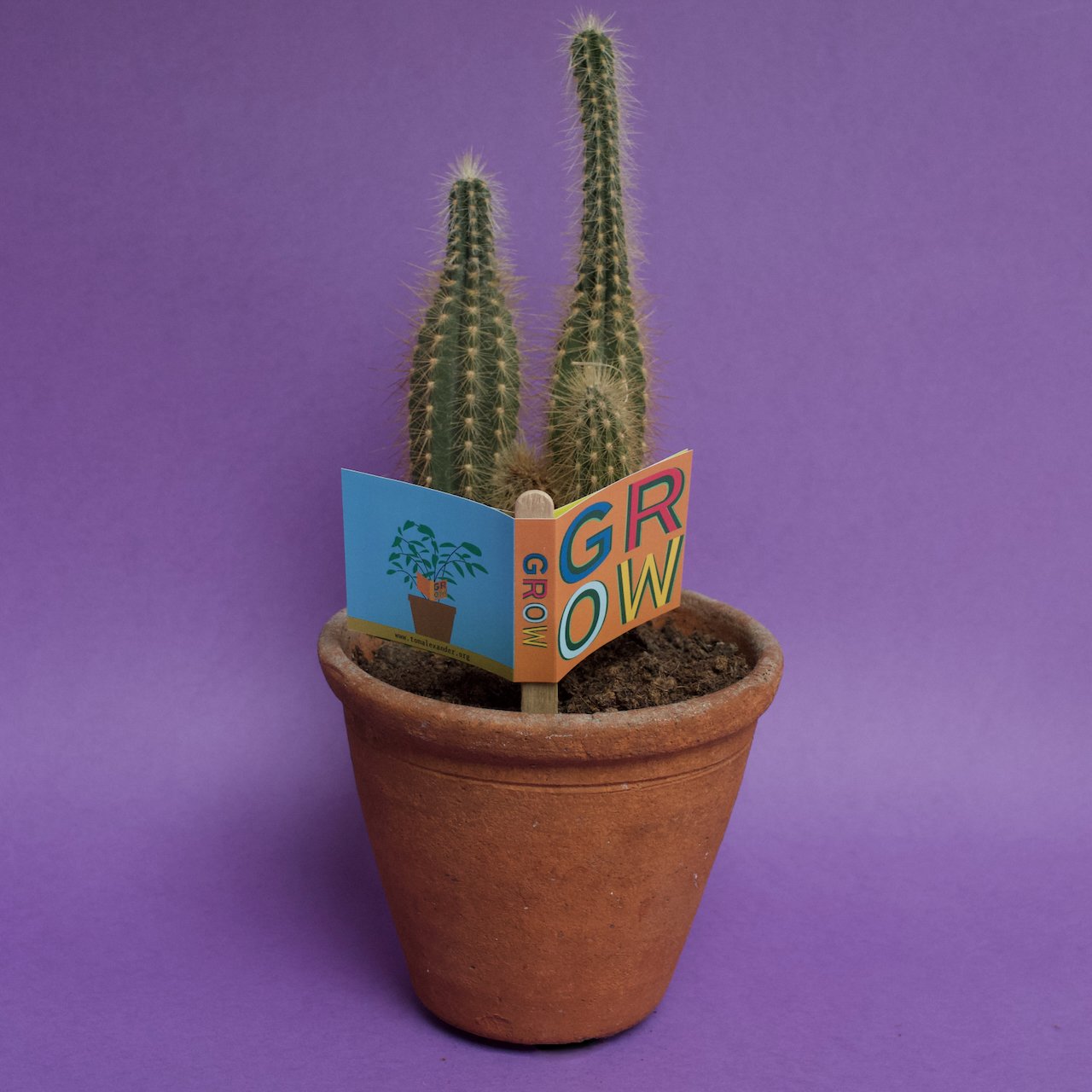
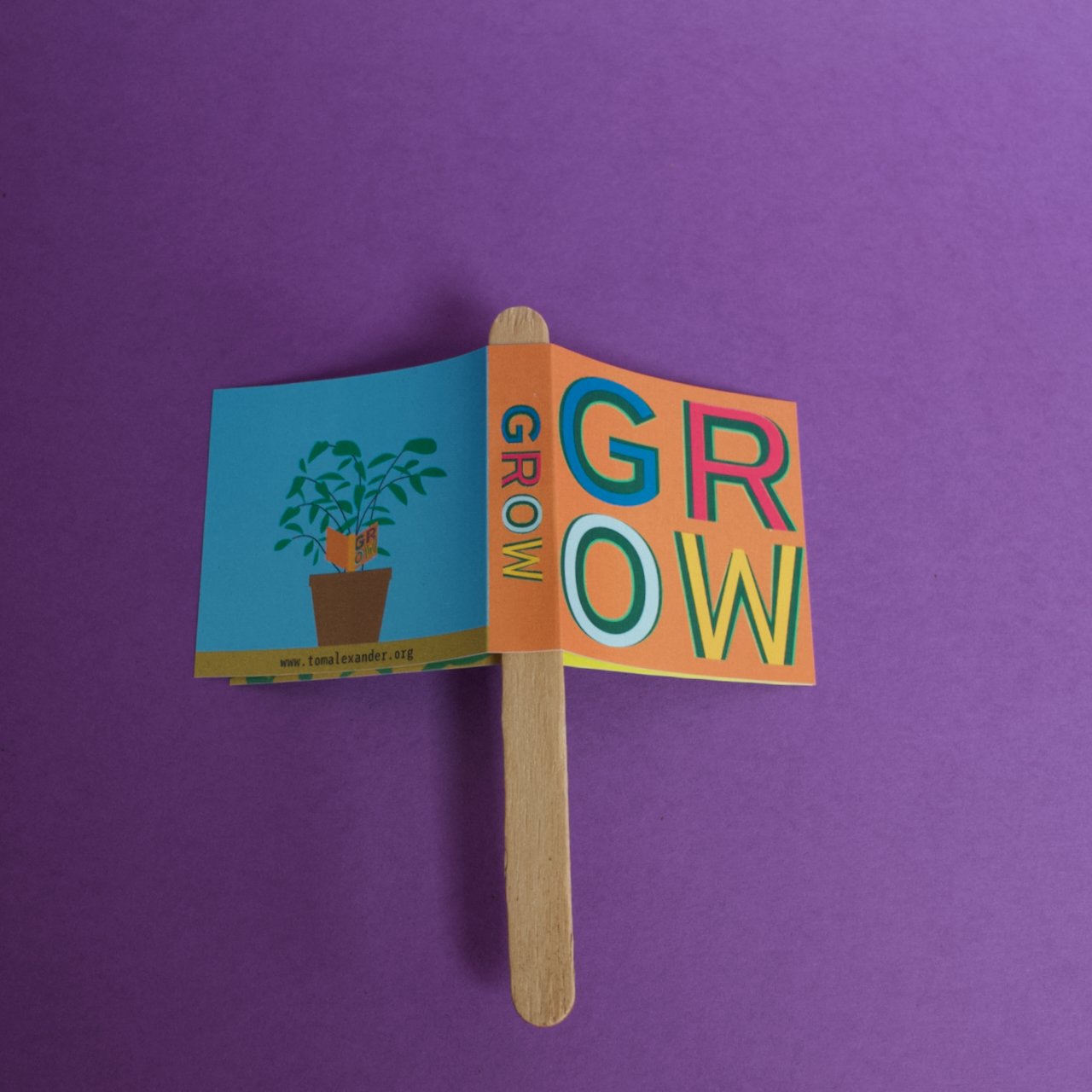
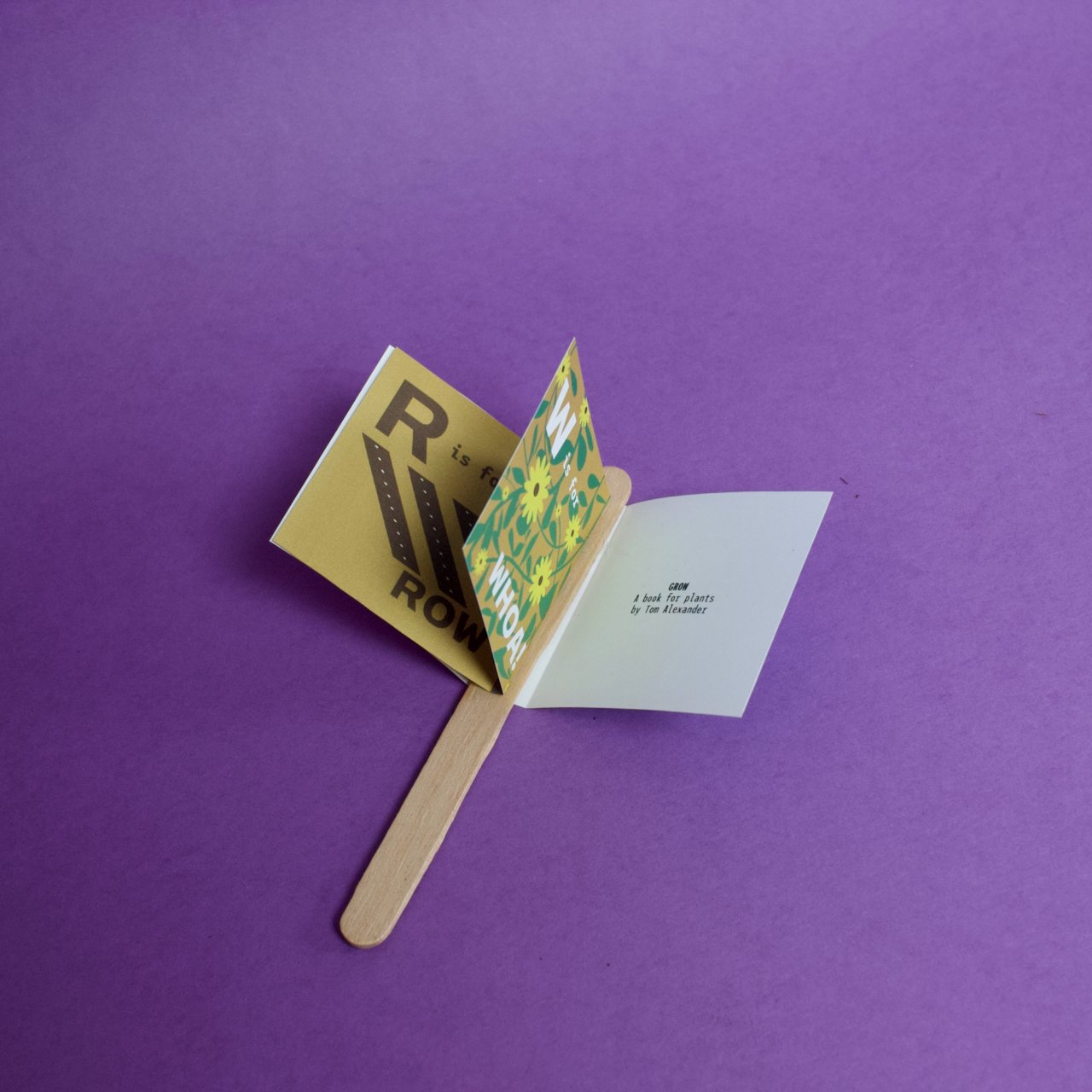
Paper and Wood, 115 x 10 x 50 mm
Overview
A book for plants, to encourage growth
Background
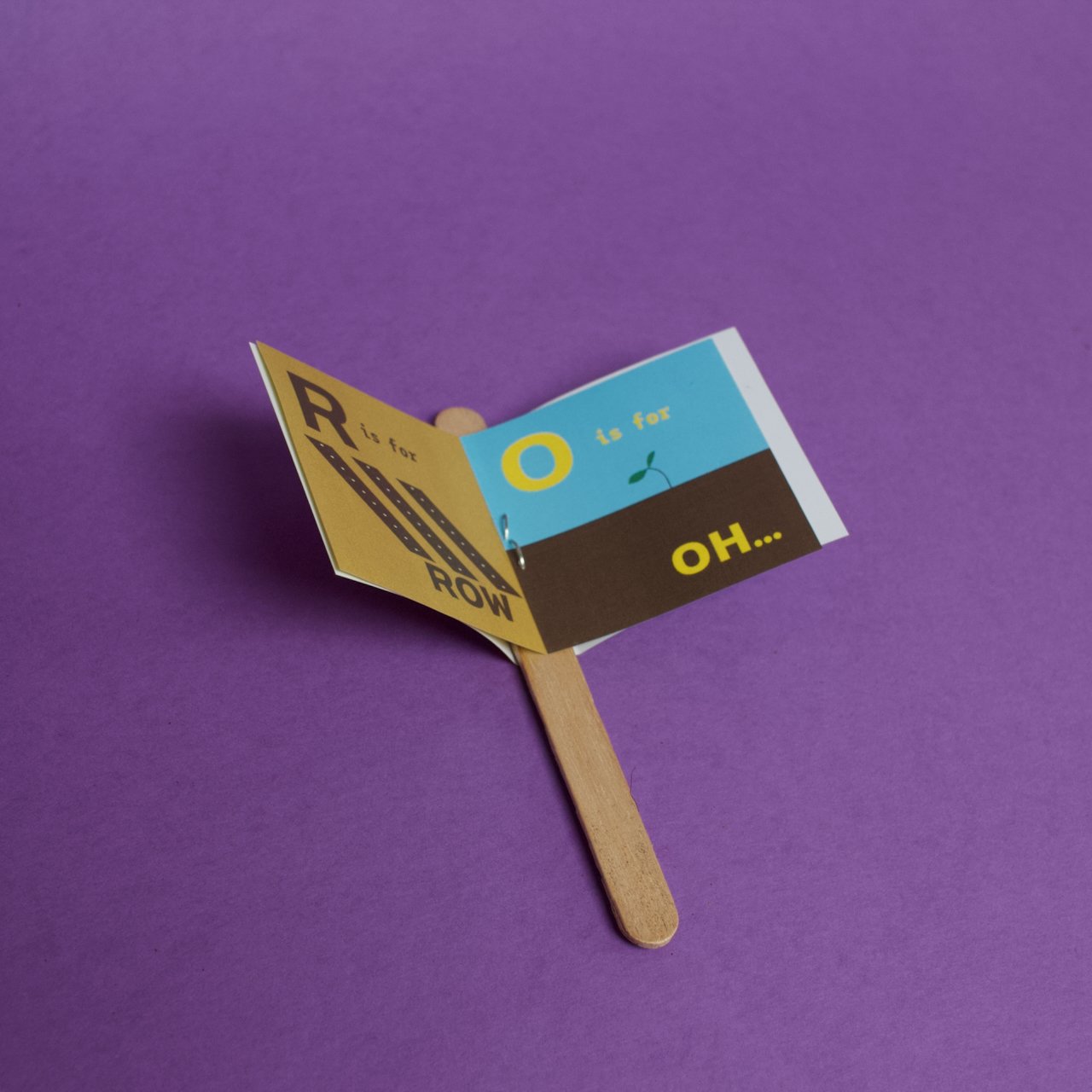
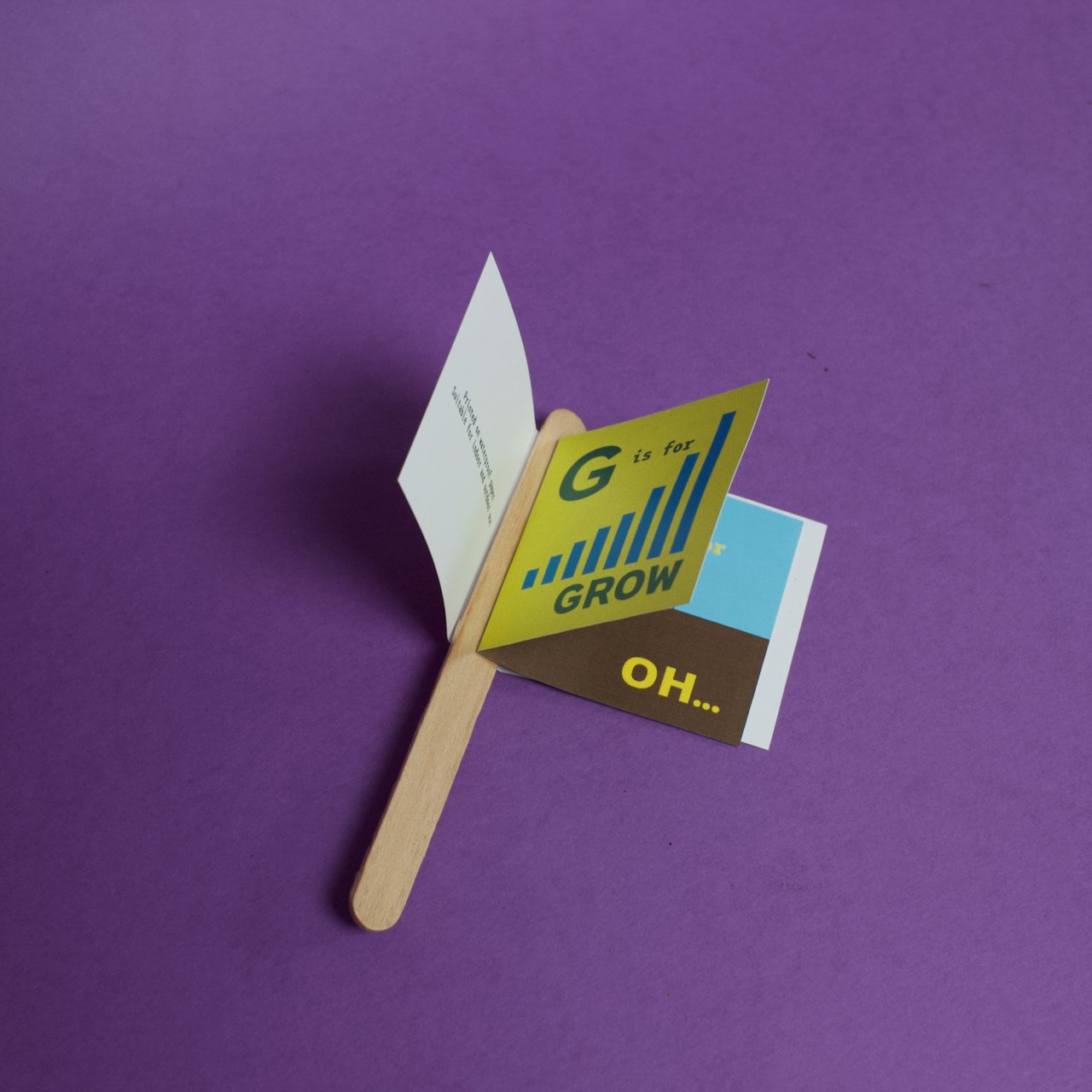
These little paperback pamphlets are printed on waterproof paper, which means they should survive outdoors or at least a watering or two. The simple story encourages even the most remedial plants to strive for more. There was originally going to be a more complex narrative and perhaps even a range of plant books for different species at different stages of their lives. Eventually, though, I hit upon the (fairly stupid) schema used in the book:
G is for Grow
R is Row
O is for Oh…
W is for Woah!
Which is pretty silly, but made me chuckle.
Construction was mostly about figuring out which way to put the staples and whether the book needed a ‘spine’ or not. In the end, I decided to cover the stick with the book title. I figured it was more aesthetically pleasing. A heavy duty staple binds it and hot glue is osed to cover that staple with the cover.
Six Six Six
One hundred and eleven six-word stories about hell, in three editions.


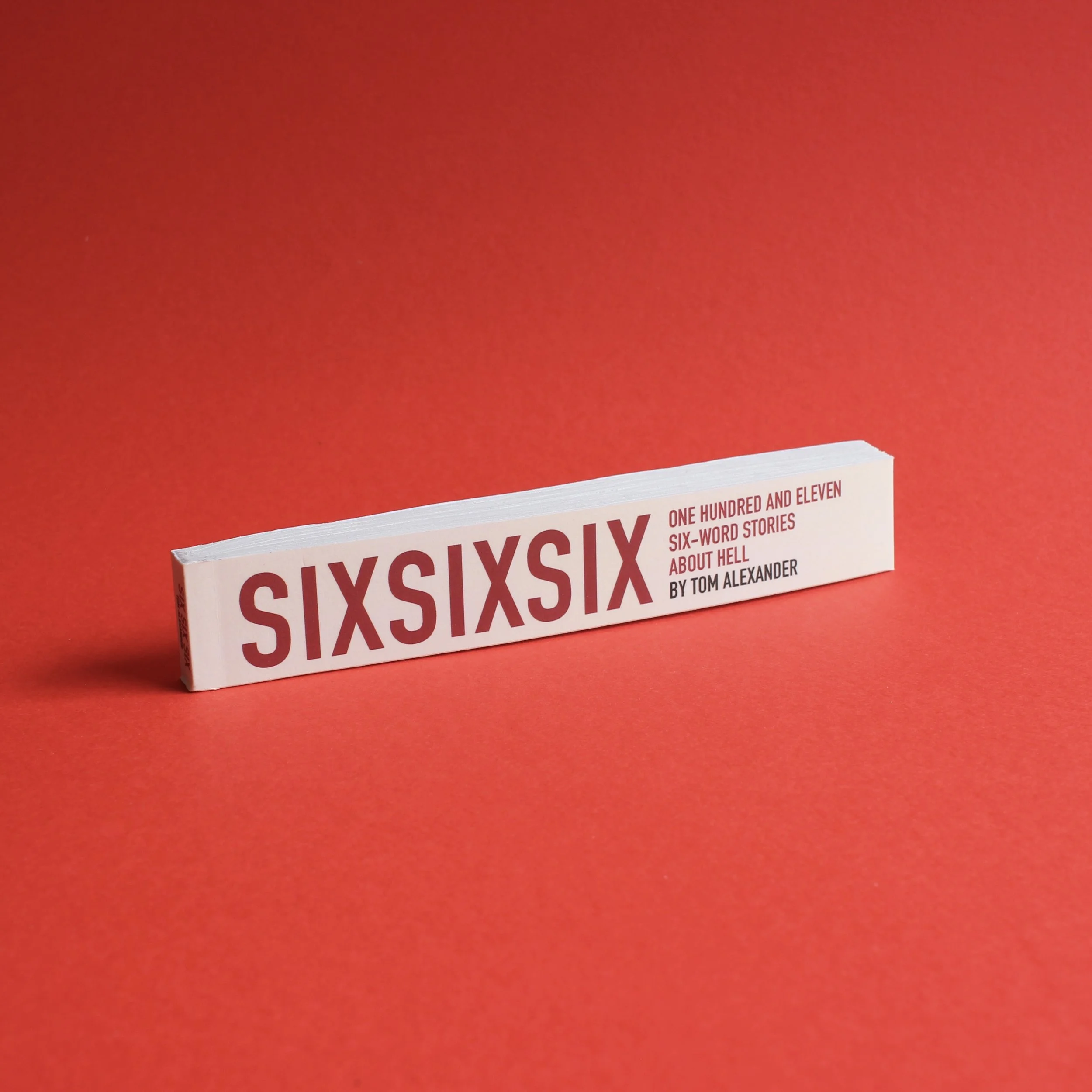


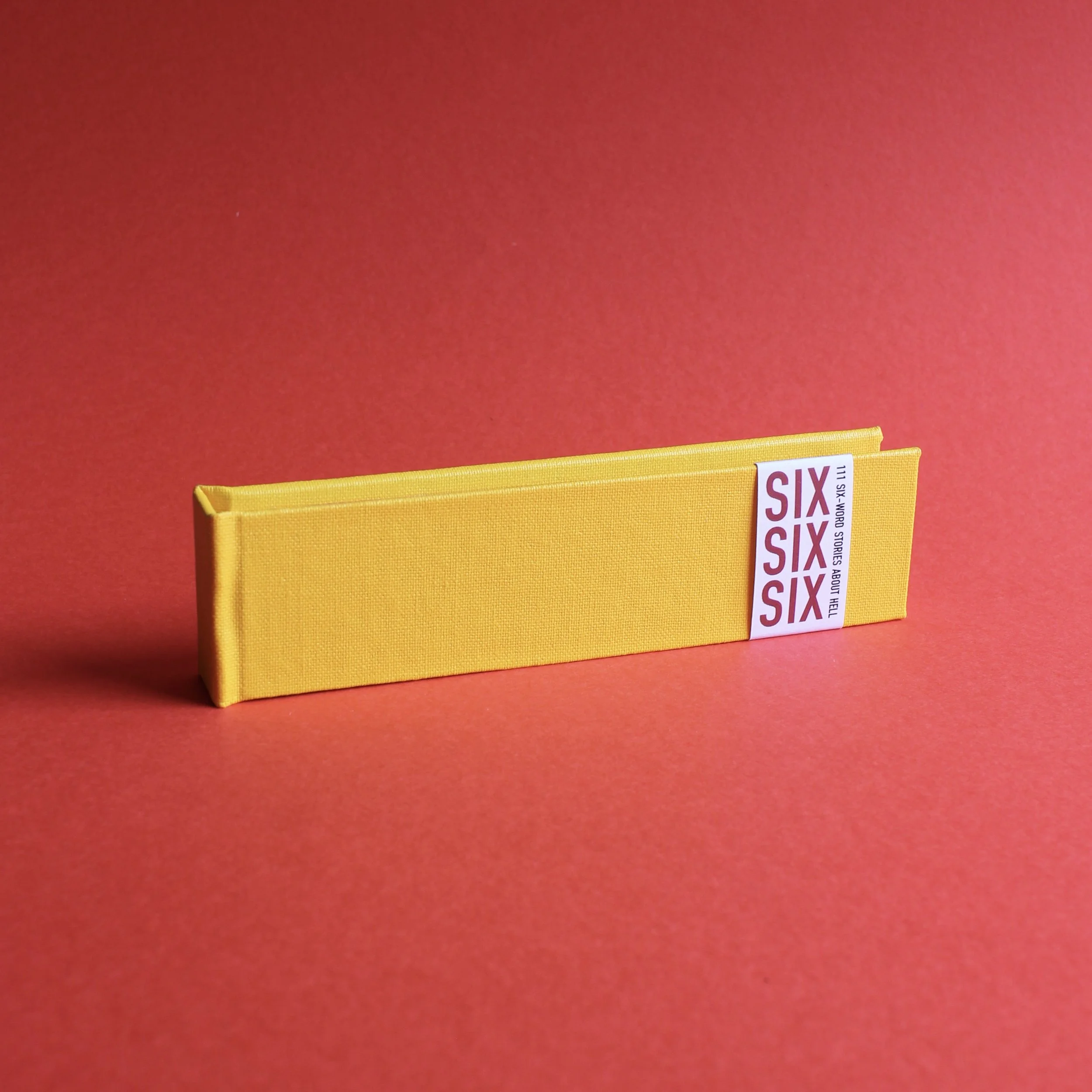
One hundred and eleven six-word stories about Hell. This is one of only 6 handmade limited edition hardbacks telling the story of Lucifer’s exile from heaven, his reinvention as Satan and his infernal revenge against those that wronged him. But, y’know, funny.
Hardback, 145 x 37 x 10mm
Paperback, 151 x 25.4 x 10mm
ebook, PDF format
Overview
One hundred and eleven six-word stories about Hell, in three editions.
Background
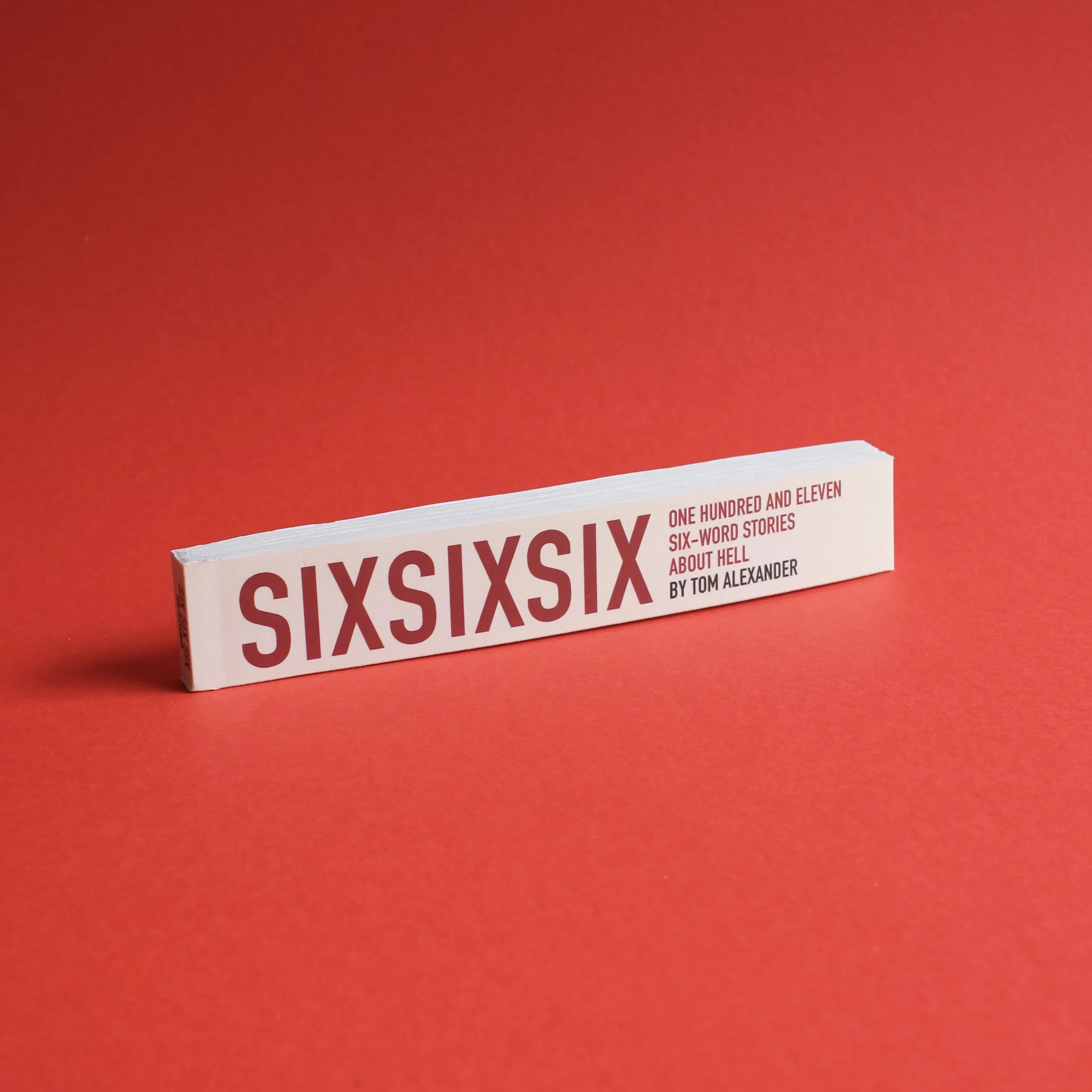
One hundred and eleven six-word stories about Hell. This is one of 60 limited edition paperbacks telling the story of Lucifer’s exile from heaven, his reinvention as Satan and his infernal revenge against those that wronged him. But, y’know, funny.
I really like projects with constraints. When I made films, some of the best work we did was in projects where we were given briefs with tight parameters, most notably shooting and editing within 48 hours. Those pieces were inventive and had a kind of manic energy to them which wouldn’t have been possible if they’d had more time or resources. I’ve often set myself guidelines to follow trying to chase that high, sometimes successfully and sometimes… not. Perhaps it’s getting older, but I’ve come to appreciate a bit of time to think, to ruminate and reflect on the work. Perhaps that means it doesn’t have the raw energy of more frenzied projects, but I think for the most part it does mean it comes out better. Maybe.
But there is something appealing about projects which fit within certain parameters. Those don’t have to be time based. In fact, I’ve found myself less able to work to those self-imposed deadlines for anything more than three days. (The last one was the 3 Day Novel Competition, which produced a novella I was pretty pleased with. It didn’t win, but did make the shortlist.) When it goes beyond that short intense burst, other things sort of get in the way and I can’t make it work. That said, sometimes you see something where the pieces fit together perfectly in your head. So it was with Six Six Six. I’ve been thinking about the six word story for a while now, mostly due to my friends at TYPE! magazine, who feature them in their brilliant bookmark literary journal. Obviously, I could have just written some six-worders and submitted them, but my grandiosity wouldn’t allow for it. Instead, this project came to mind, based first of all on the maths. One hundred and eleven six word stories equals six hundred and sixty six words total. That, obviously, is the Number of the Beast, so it made perfect sense to do a connected series of tiny stories about the Dark Lord himself. I’d make it into a book that would have 666 copies and sell them for £6.66 each.
And that’s what I’ve done. Almost. Some things have changed along the way. In the process of prototyping the physical books, it became clear that I had to make some hardback copies. I wasn’t about to do 666 of them though, so the idea of separate printings came to mind. There would be six hand-made hardbacks, sixty mass-produced paperbacks and then it seemed obvious to make six hundred ebooks. The pricing was obvious: £66.60 for the handmade books, £6.66 for the paperbacks and 66p for the ebooks.
Writing the stories was fun. I did it piecemeal over several months, jotting down any half-idea that came to mind and spending an hour or so twisting them into shape. Six words isn’t a lot, but it allows for a surprising amount of variation and experimentation. When I started amassing an amount of stories of what I thought was a decent quality, I started looking at the overall structure of the story. It’s basically Lucifer: My Fall and Rise of Lucifer, although I must say that my knowledge of the story comes more from popular culture than it does from scripture. Milton scholars should look elsewhere. I think it’s pretty entertaining, though, and I’m pleased with how it came out. The niceness of the hardbacks was a surprise and I’ve learned a lot about bookbinding through doing it. It’s another tiny fiddly project, though, and I’ve promised myself that next time I’m going to make something larger so I’m not dealing with teeny-tiny margins for error. I am almost certainly going to ignore my own advice, though.
Enormous thanks should go to the brilliant Jemima Kingsley, who created the system that allows me to sell individually numbered PDFs for next to nothing. Anyone looking for any sort of technical solution to a problem should hire her.
Third Eye Test
A kit for opening up your inner vision.
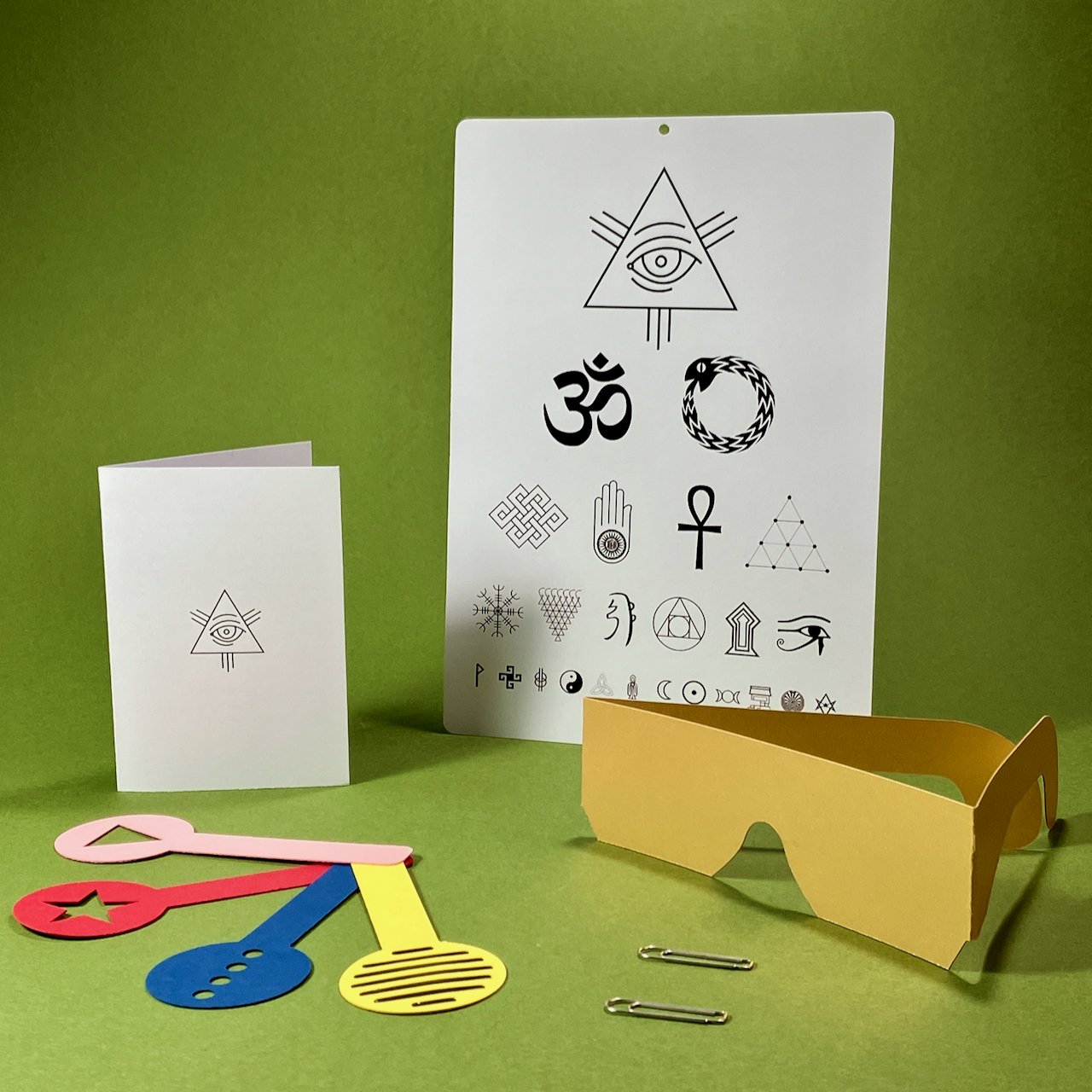
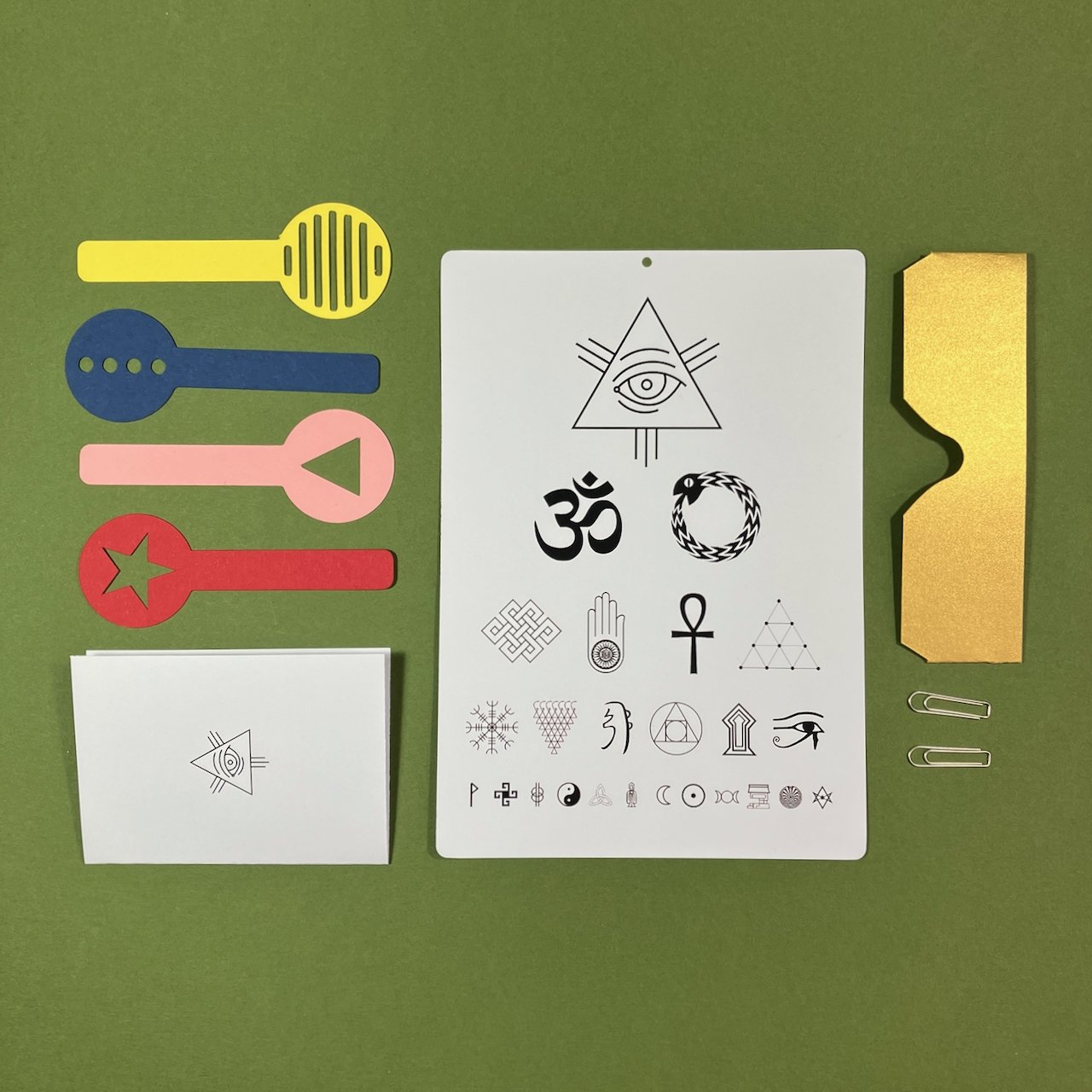
An at-home kit for testing your inner vision. Comprised of a Third Eye Chart, a covering for your First and Second Eyes, four corrective lenses, two lens clips and a short set of instructions.
Multi-part, assorted colour card, 2023
Overview
A kit for opening up your inner vision.
Contents
1 x Third eye chart
1 x Covering for first and second eyes
4 x Corrective lens paddles
2 x Lens clips
1 x Instruction leaflet
Background
I’ve been trying to buy new glasses for at least two years now. My current ones have the unfortunate habit of falling apart at inconvenient times. Apart from that, I like them. They’re light and they help me see.
That said, sometimes it’s difficult for me to read the train indicators on the Victoria Line and this told me that I should get my eyes checked. I went to the opticians and they told me that my eyes were exactly the same as when I last had them checked. When I asked about the problems seeing train times, they told me that was just being old and I shouldn’t worry too much about it. Huh.
Anyway, that led to this - an at-home testing kit for measuring the visual acuity of your third eye. It takes its cues from the equipment used to measure your other eyes and was originally going to be just an eye chart. Obviously, people would be able to see the symbols unless they were blocked out, so some sort of blindfold would be needed. Originally this was going to be a strip of cloth, but then I remembered the Peril-Sensitive Glasses that were packaged in with the text adventure adaptation of Hitchhiker’s Guide To The Galaxy (see here for a gallery of all the ‘feelies’ bundled with that and other Infocom games). I made my own version, but used some jazzy metallic card I had in the drawer. That would have been enough, but I always find an eye test isn’t an eye test without an optician holding lenses in front of my eyes and asking if it’s better “with…? or without…? with…? or without…?” and me saying things like “I’m not sure… maybe… with? …a bit?”. I really wanted people to be able to replicate that experience in their at-home tests, so created the little paddles that they could hold up in front of their foreheads.
But once they were done, I remembered that another great part about going to the opticians was wearing those incredible Frankenglasses with the lenses dropped in. Again, I wanted people to have some part of that with their Third Eye Tests, so set about fashioning some customised connectors that would allow people to attach the lens paddles to the coverings for their regular, ordinary eyes. I did not just buy a box of paperclips. No.
Anyway, the small idea ended up being 8 separate pieces (including the little explanatory leaflet that I was really in two minds about making and a little fold of card to stop the lens clips digging in to the main chart). Five of these elements required the use of the cutting machine, which is a slow process, meaning the simple little idea to knock out in an afternoon took a bit longer to put together. Still, once you embark on these things, you have to see them through.
Classifying stuff like this is kind of weird. Although it does have printed pages, it’s not a book. It’s not a wearable, although an element of it is worn. I guess it’s just a thing.
Babies – Invaders From The Future
A warning about the menace that lurks among us.
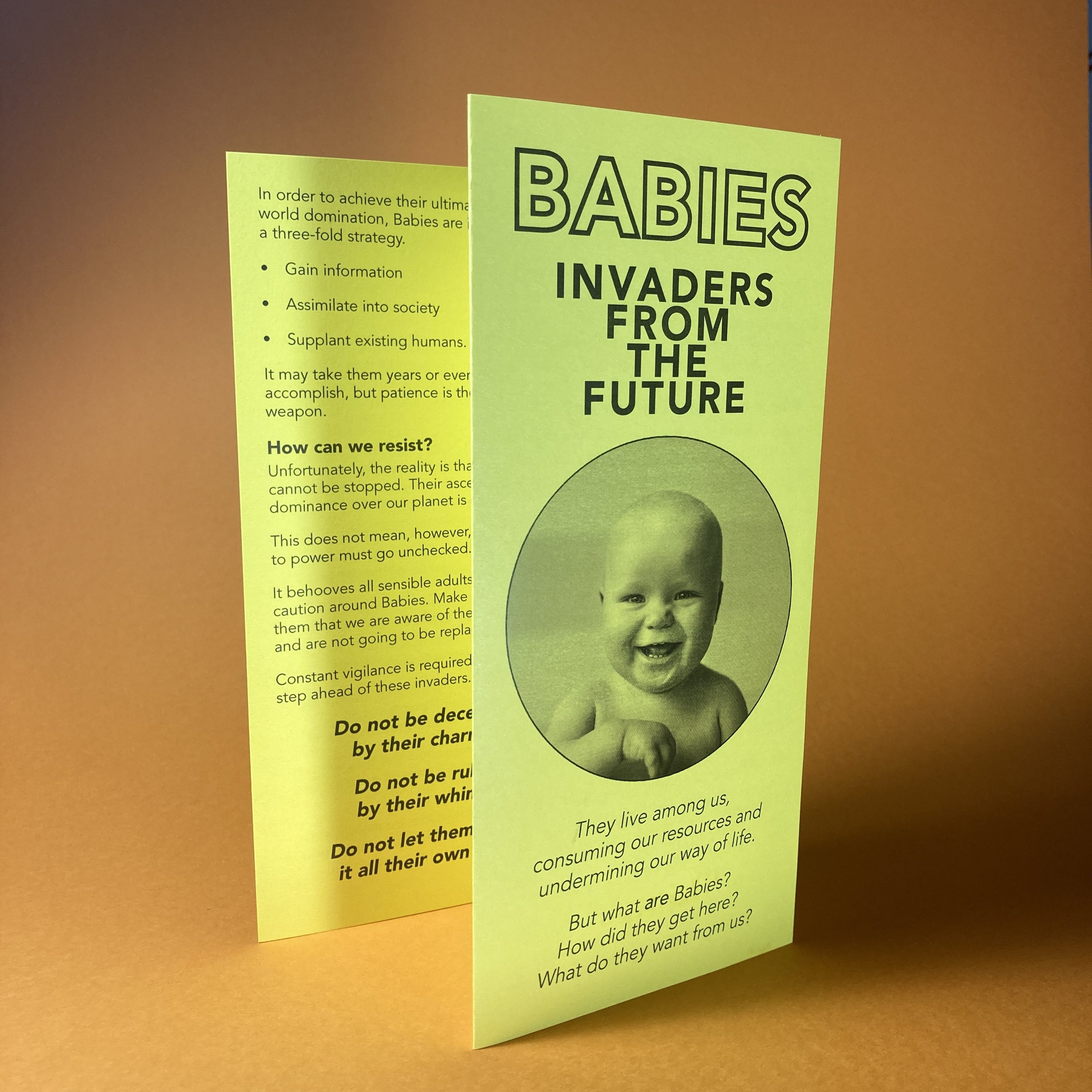
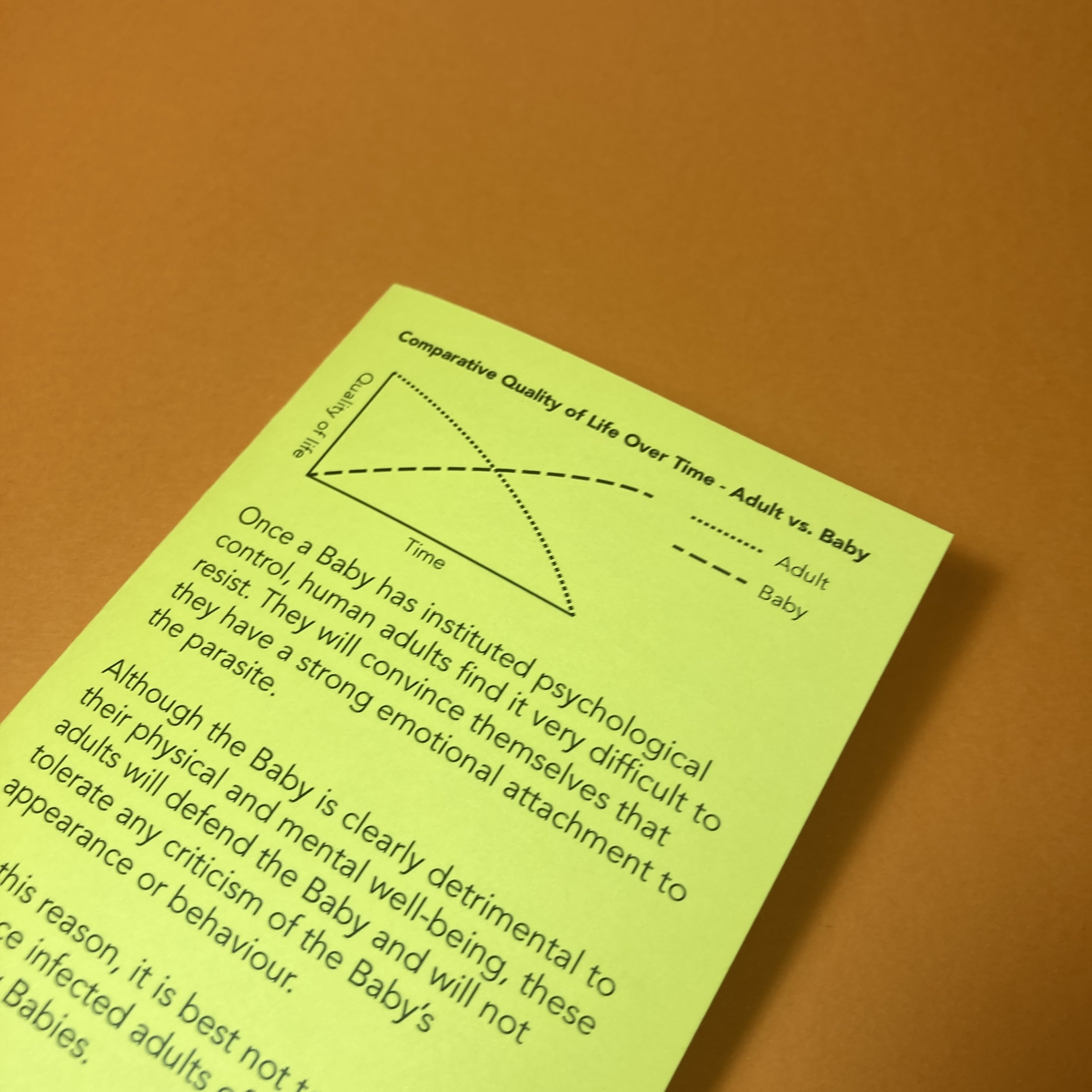
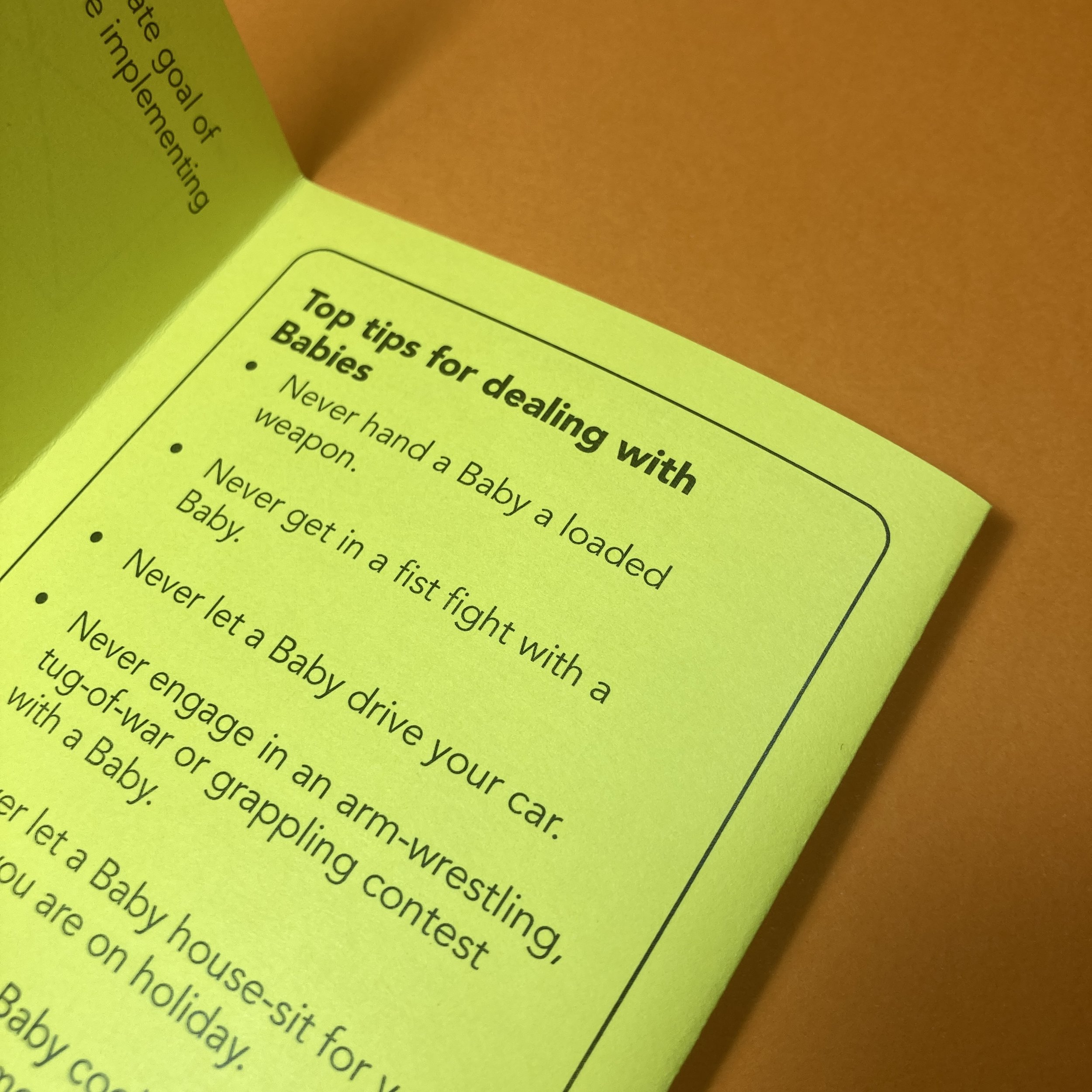
Tri-fold pamphlet, 99x210mm
Overview
A warning about the menace that lurks among us.
Background
The original concept for this - that babies are trying to take over the world - was originally expressed in another form. I wrote a 4000 word short story about the efforts of a difficult conception leading a man down a path of paranoia and suspicion. It was ok, but honestly the details of conception weren’t really that interesting me and I didn’t particularly want to publish a story about masturbating into plastic cups.
The core concept of babies as secret agents plotting to overthrow us stuck with me though. After a few false starts, made its way into this tri-fold leaflet, printed on high-vis yellow card.
This was sent to subscribers in April 2023 and copies were left in some locations in London.
Intern
A short story about a hapless member of the marketing department.
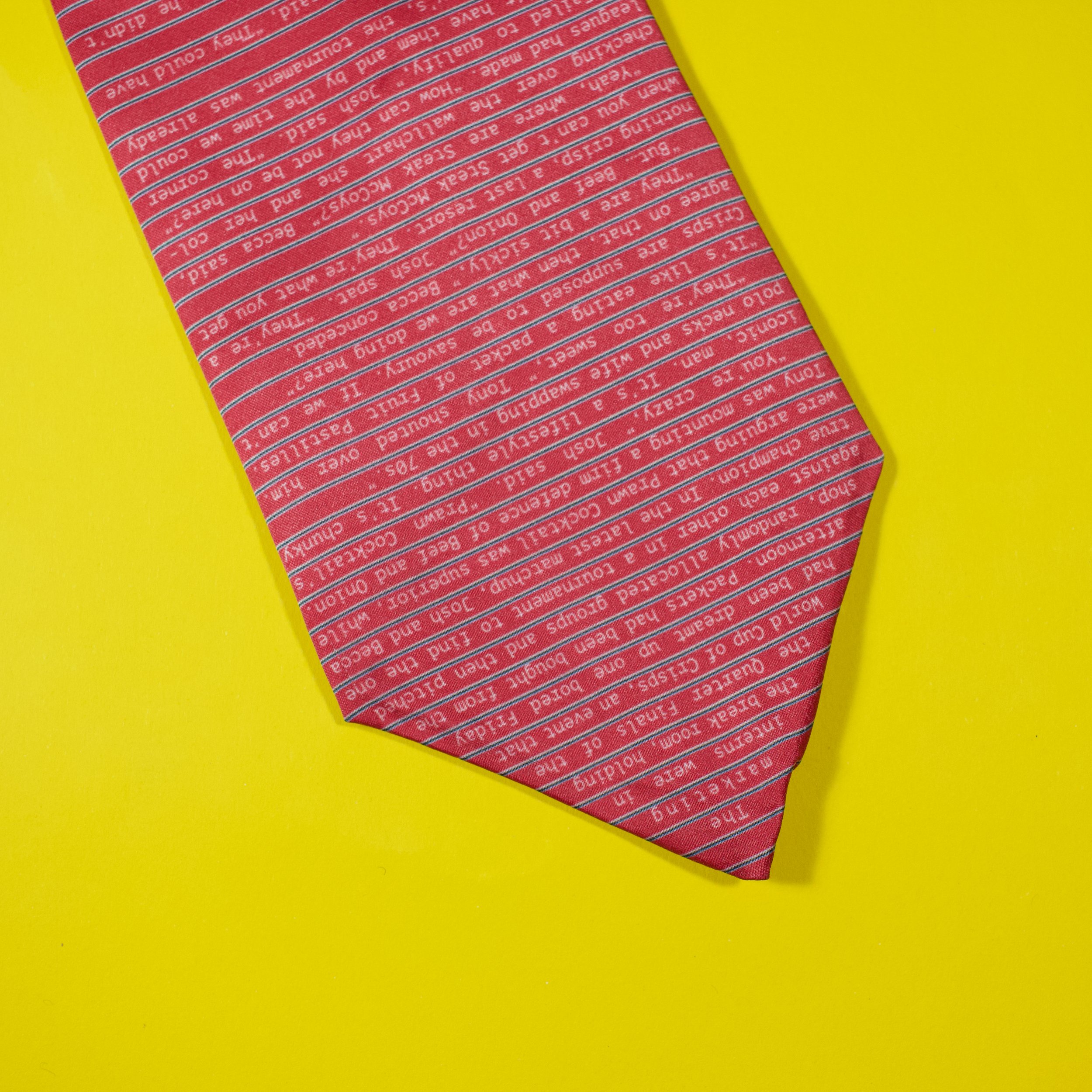
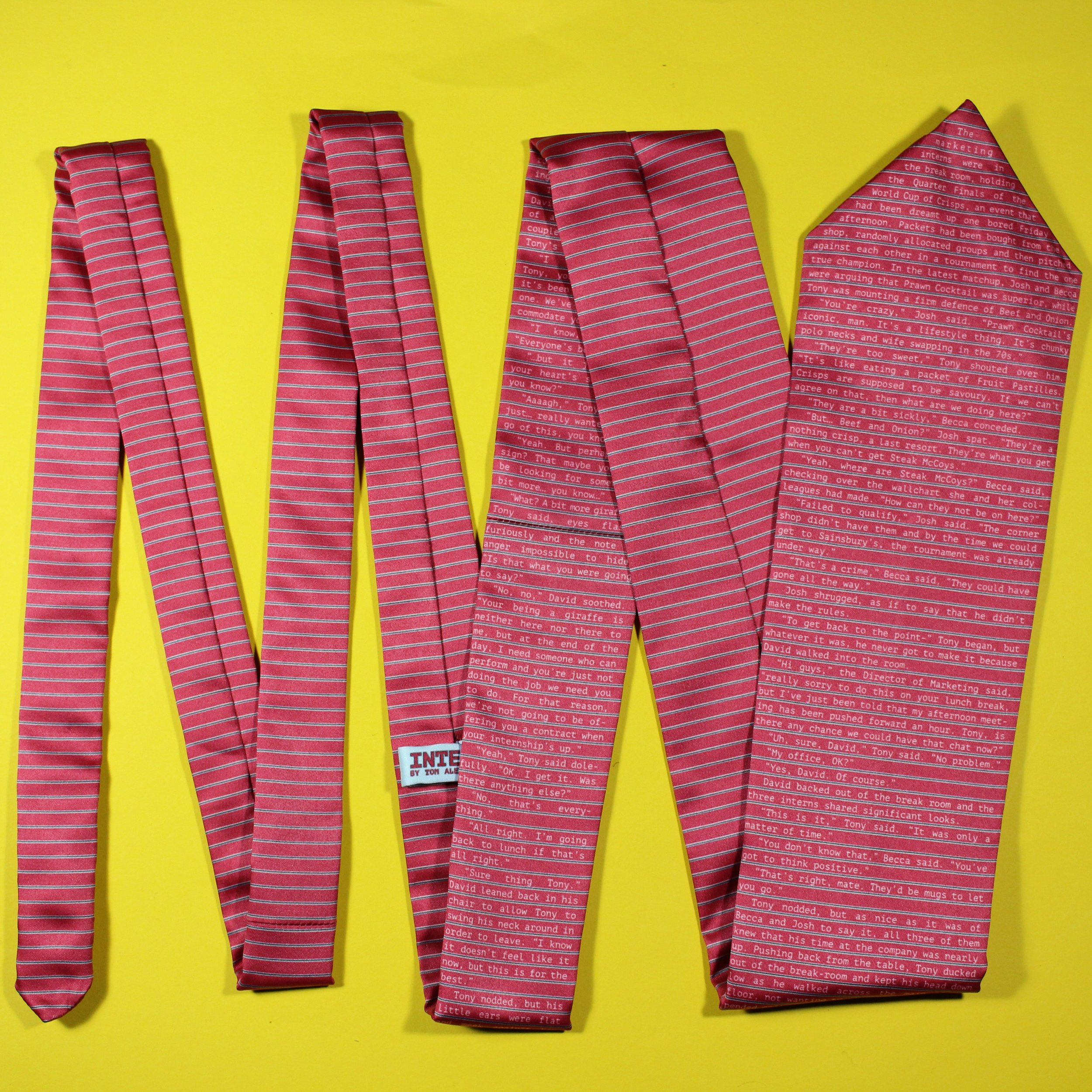
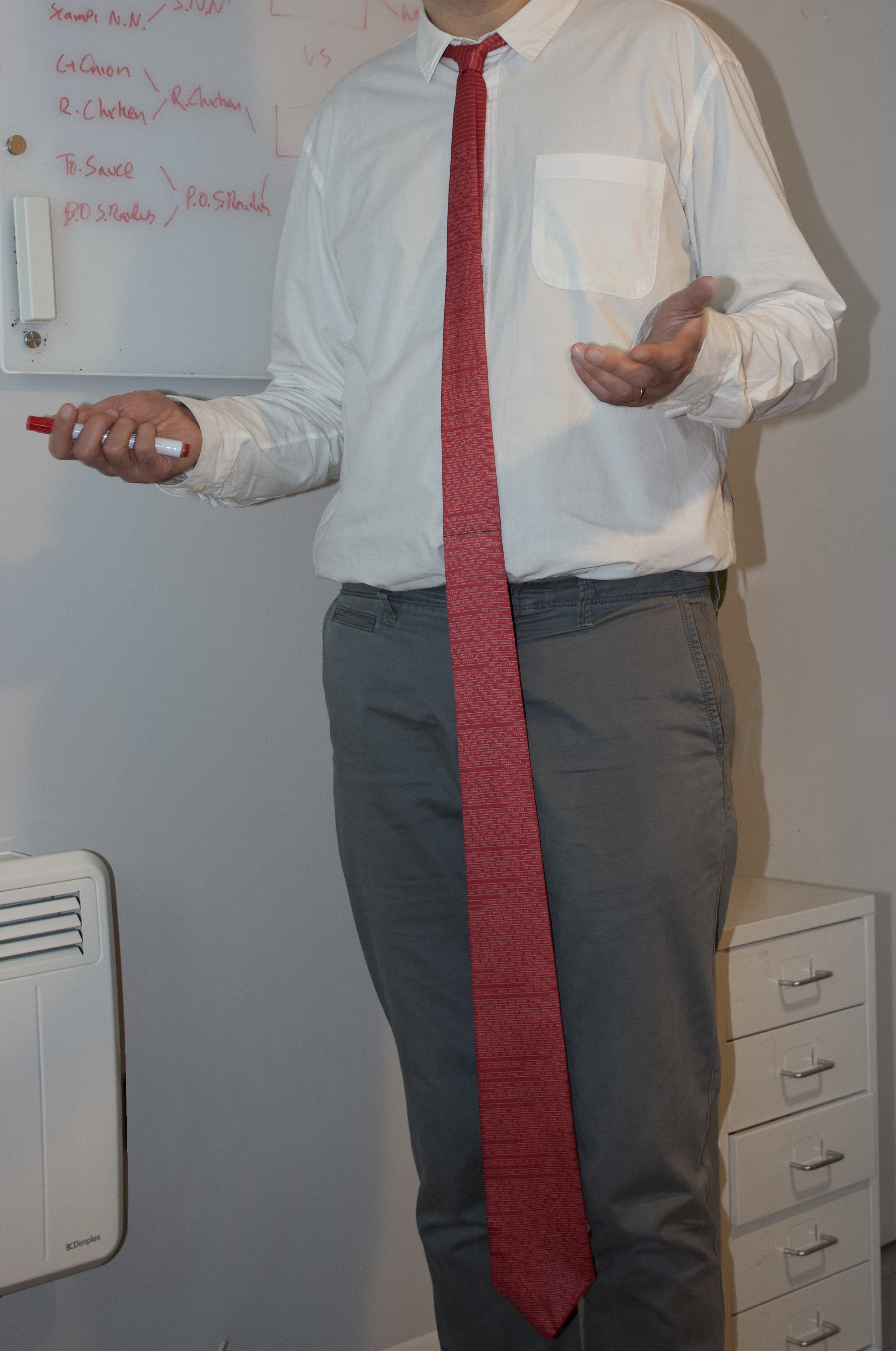
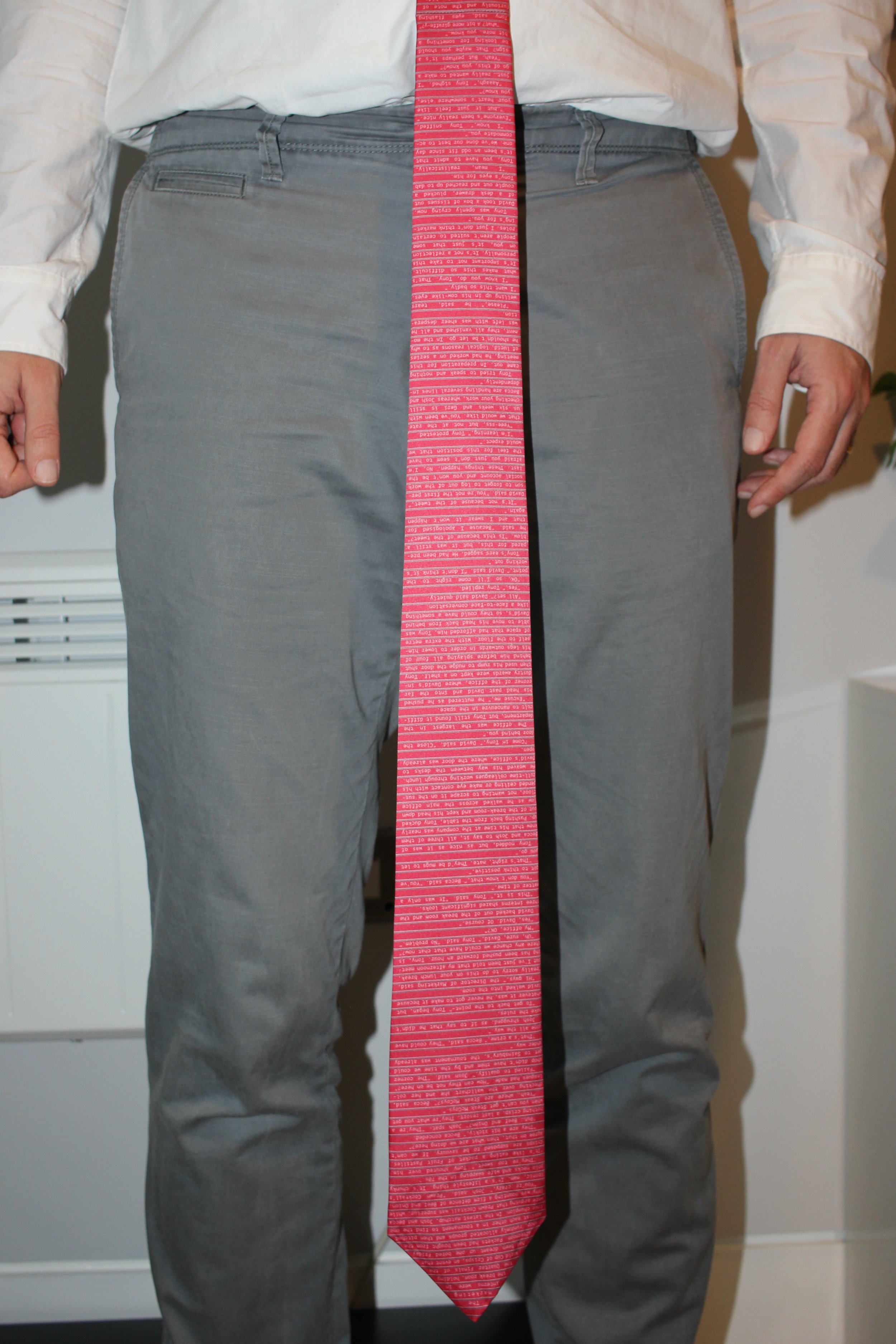
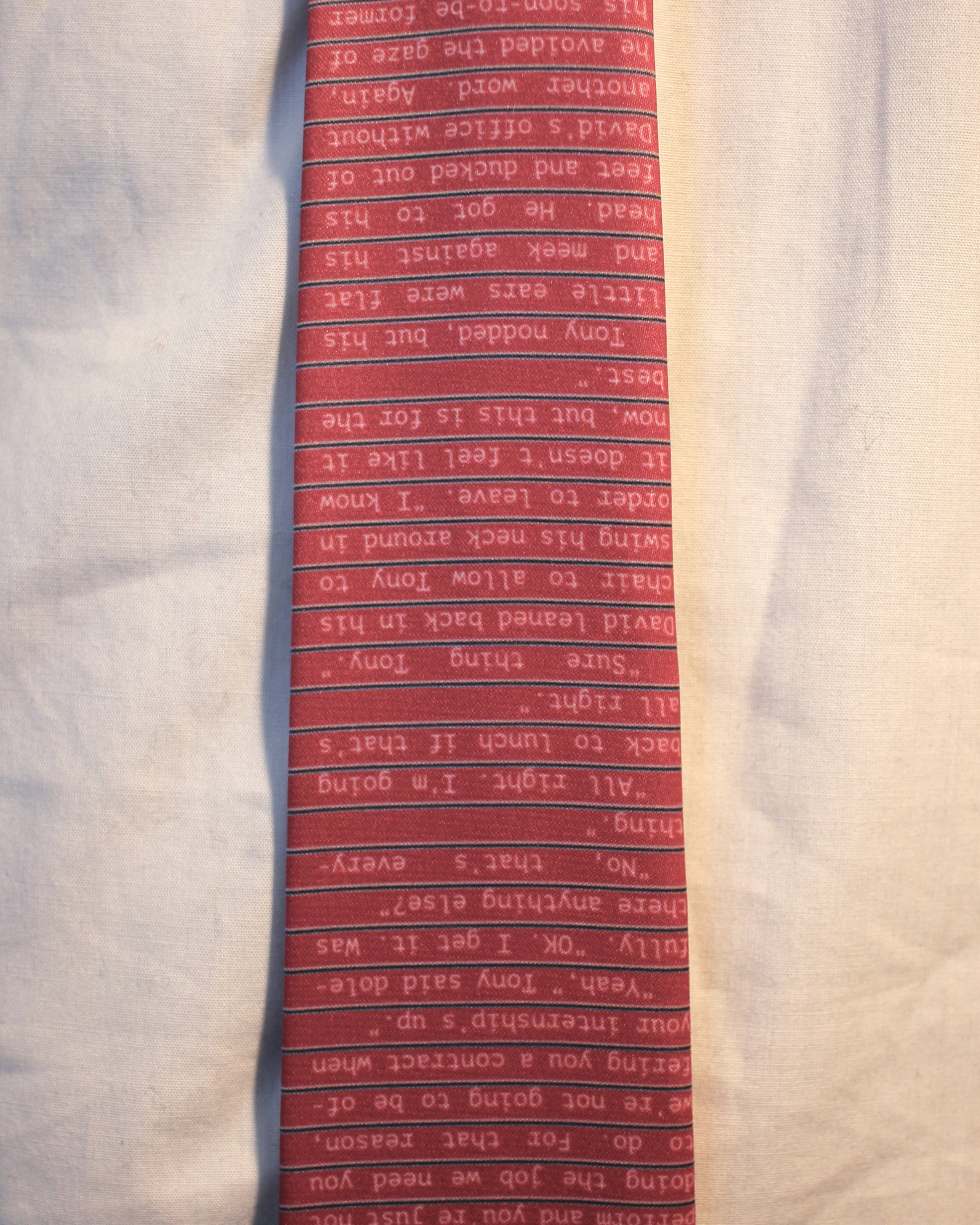
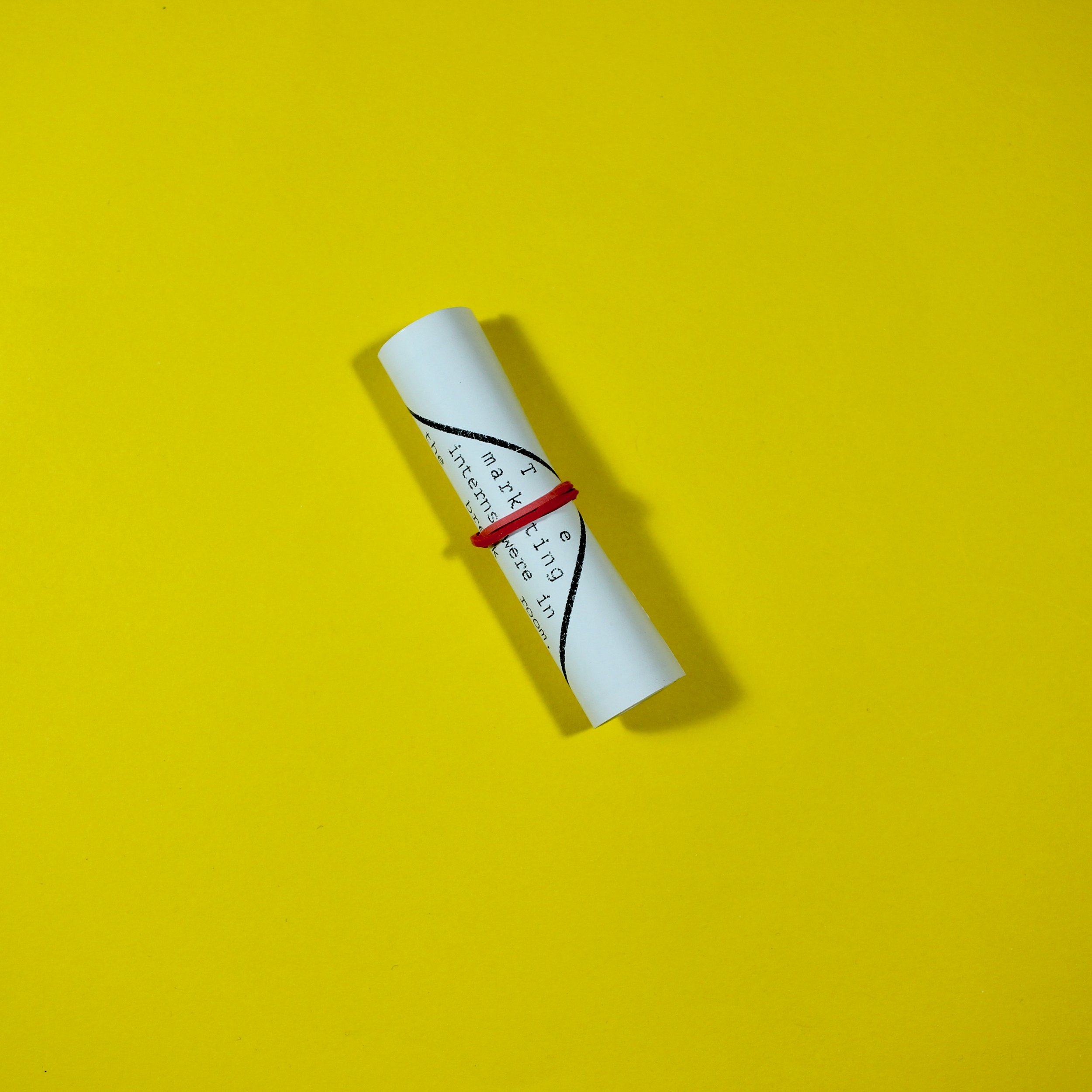
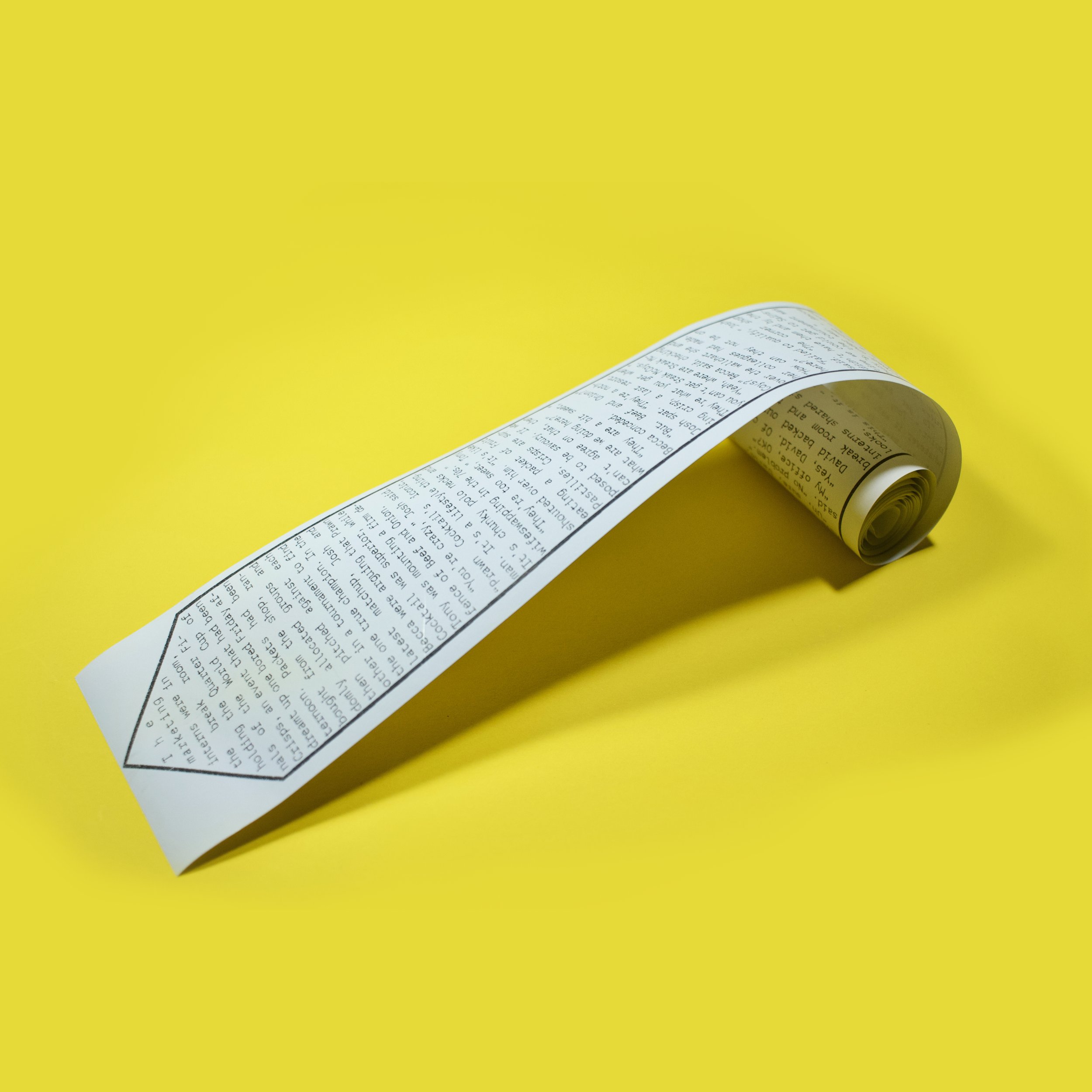
A short story printed on a tie. The text has been digitally printed on silk-like polyester and assembled by hand. It is approximately 2.5 metres long in total and is designed to be read by the wearer.
2023, multiple editions
Hand-sewn necktie, unique edition
Thermal paper, multiples.
Overview
Intern is a short story about a hapless member of the marketing department who is about to be let go. It was published by Idle Ink on 4th March 2023 and two physical editions were made to coincide with the story’s release on their website.
Background
So, it’s probably best to read the story on Idle Ink before continuing here. You’ll understand the rest of this a bit better and I’d like you to not know about the text before you read it.
Done? OK, let’s proceed.
This was one of several stories I wrote at the end of last year, when I really wasn’t feeling enthused about making books and instead was just concentrating of writing. This happens. I swing between those two modes - the simplicity of writing against the potential complexities of designing and constructing narrative vessels - quite frequently. Each time I do, I convince myself that I’ve stopped oscillating and that this is what I’m truly about. Then, inevitably, I go back the other way. Perhaps one day I’ll realise that they are, in fact, not two polar opposites, but in fact two complementary parts of the same thing. Anyway, I was loving the simplicity of writing by hand on lined paper and one of the stories that came out of that period was this short thing about Tony the intern and his crushing failure to make an impact on the Director of Marketing, who - and let’s be categorical about this - was not letting Tony go because he was a giraffe. It was short, silly and also kind of sad. That’s exactly where I like my stories to land, so I sent it out for submission.
It’s a weird thing, sending stories out. The wheels of literature turn slowly. I’m sure even the smallest publications are inundated with stories so the process is a slow one. Sometimes you sort of forget what you’ve done with a story. Or you pretend to, because you’re always hoping that it’ll find the right home.
While Intern was out, it occurred to me that I could use the digital fabric printing at Contrado to make a really long necktie with the story printed on it. I had previously used their services for Primates and found them to be quick and of good quality. Instead of a fuzzy fur, I was looking for a silky feel. I decided on a fabric (Silk Sensation poly 90gsm ID 2924, if you’re interested) and laid out the text. Trying to get my head around cloth patterns was a bit of a challenge. Luckily, I’m married to an expert, who took me through the things I needed to know, like seam allowances and the importance of the bias. Some of this I understood.
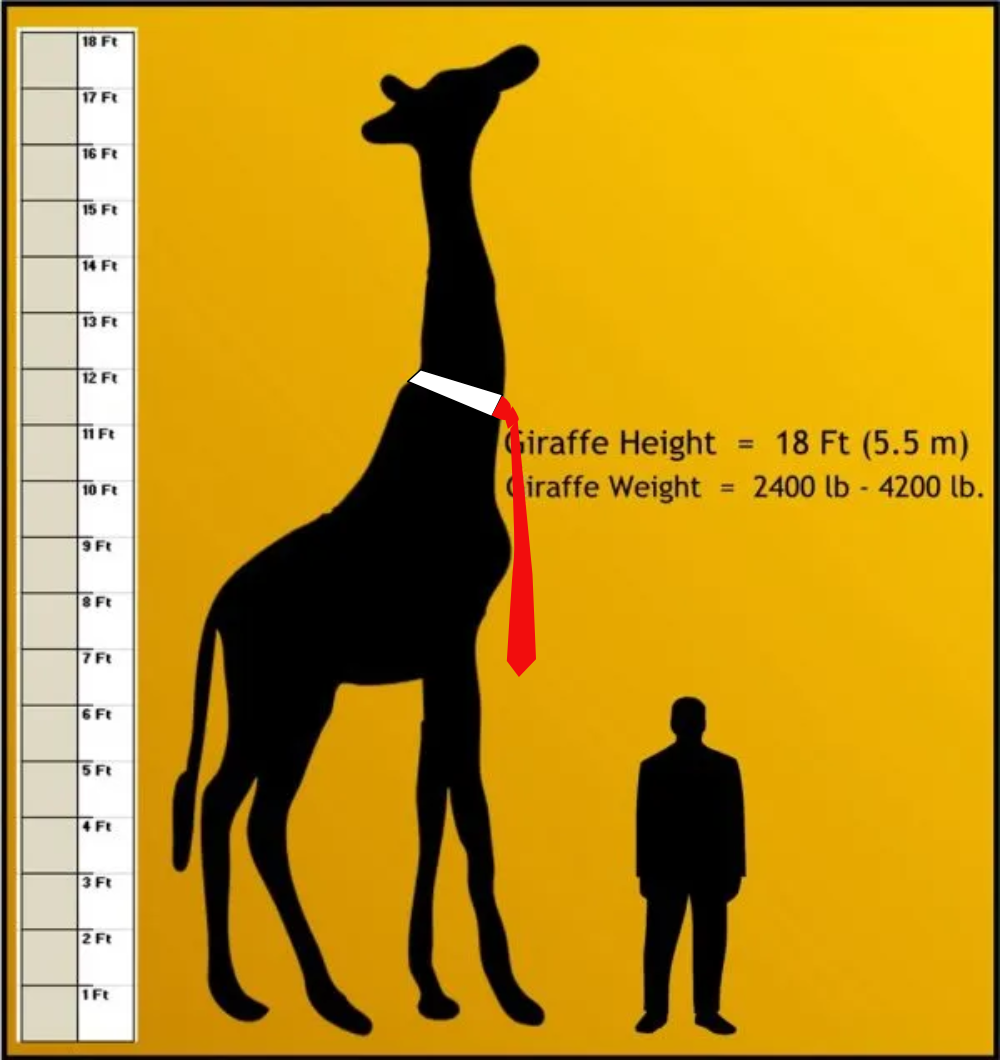
(In case it’s not clear - I added the tie.)
The question then presented itself - just how long would a giraffe’s tie be? This graphic helped me figure it out:
By my estimation, that put the tie at around 2 metres long, at least for the story part. I’m not going to lie, it wasn’t as long as I initially hoped. A six foot long tie didn’t seem as ridiculous as I’d wanted. One could imagine Donald Trump wearing one as a power move. But I told myself that this wasn’t some big joke - this was Tony’s tie and I had to remain true to that. Also, y’know, the story’s only about 1200 words long.
Working with a two-metre long document presents some challenges. The Affinity suite1 did… ok in this regard. Large documents are quite a lot of for my now-quite-old Mac and I think pasting the pattern inside a text box caused more problems than it should. Anyway, I laid out the long skinny tie and then, because I was ordering a sample print at A1 size, placed cropped copies of this document on a standard sized page. Then it went off to Contrado and within a few days I had a red silky pattern ready to be assembled.
This part of the process I had nothing to do with. I get the impression, though, that it was quite annoying to make. We had failed to account for the fact that a 2.5 metre piece of cloth is just plain unwieldy. Added to that, I had placed the pieces a little too close together, making the construction tolerances a bit tight. I thought it came out pretty nice, though.
With that done, I started to think about taking a couple of photos and posting it online for the fleeting glory of a dozen or so likes. What I wasn’t expecting was for someone to actually want to publish the story. Idle Ink, a nice website of weird stories, accepted it and I had a bit of a chat with the editor there and they agreed to mention the tie version of the story.
The process of photographing the tie was frustrating. It felt like the tie needed to be seen in an office environment. That’s fine when you have a job, but you can’t just stroll into a random office wearing a six foot long tie and start taking pictures. (Maybe you can, but I don’t have the front for it.) In the end, we went round to the in-laws home office, which is much tidier and efficient-looking than either of our workspaces. We took some pictures there, but they didn’t come out quite how I would have liked. There was a combination of daylight and tungsten lightbulbs which gave everything a mixed pallor. Although the shots with the flash going off were accidents, they ended up being the ones used. Flash photography isn’t really a look I like, but it is at least a look. If I’d had more time, I might have done them again, but it was all thrown together quite quickly on a Sunday afternoon. So, thanks to Jemima and Sarah for putting up with an impromptu photoshoot taking place while they were still working. If you want a website made, get in touch with them at www.websitedepartment.co.uk.
Anyway, it was while doing the photoshoot that it occurred to me that it would be pretty easy to make a cheap paper version of intern using the Epson TM-88V thermal printer I acquired a while ago. It would be pretty straightforward to do, as I had all the files and so long as I got the print settings right, I could have a long, narrow strip of paper with the story on. These went out to mailing list subscribers on publication date.
Some might say that three separate editions of one short and admittedly quite silly story is perhaps overkill. To them I would say… yeah… well… you just don’t get it.
I switched from Adobe a few years ago. For the most part Affinity has been a pretty good substitute. Sometimes I miss the more esoteric parts of Creative Suite, but I never really did enough with them to justify the cost. ↩︎
Butterfly Mask
A short story printed on a mask which must be read in a mirror.
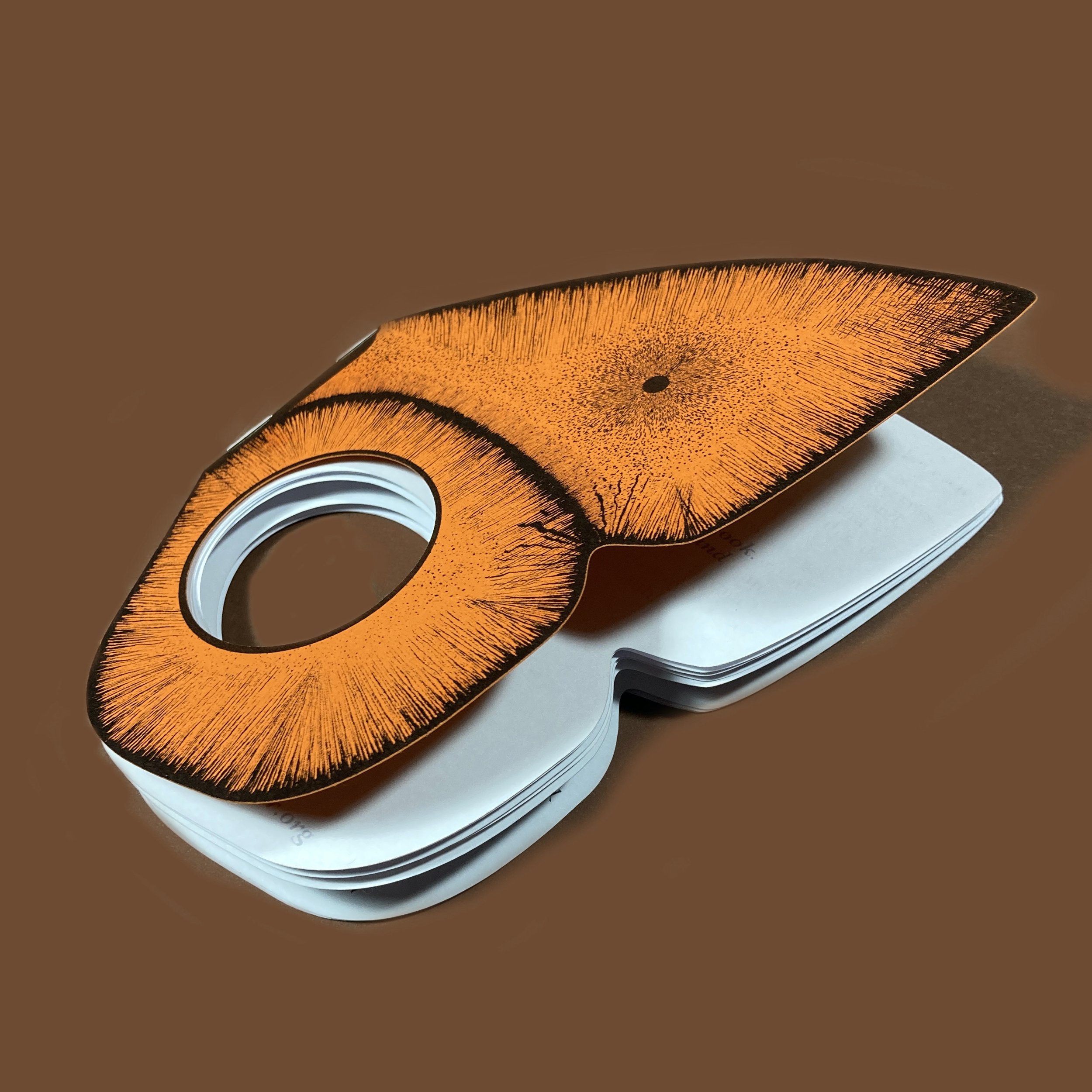
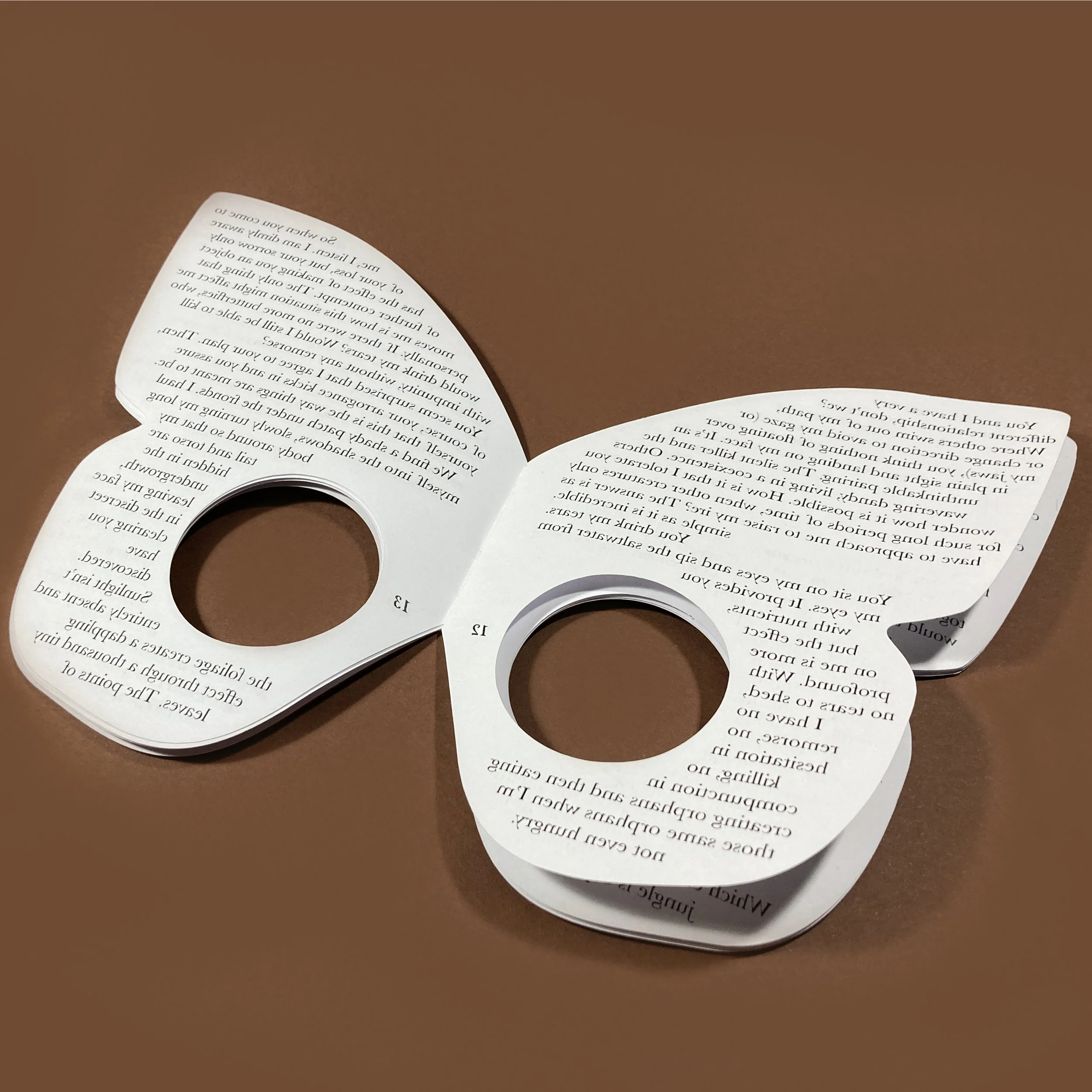
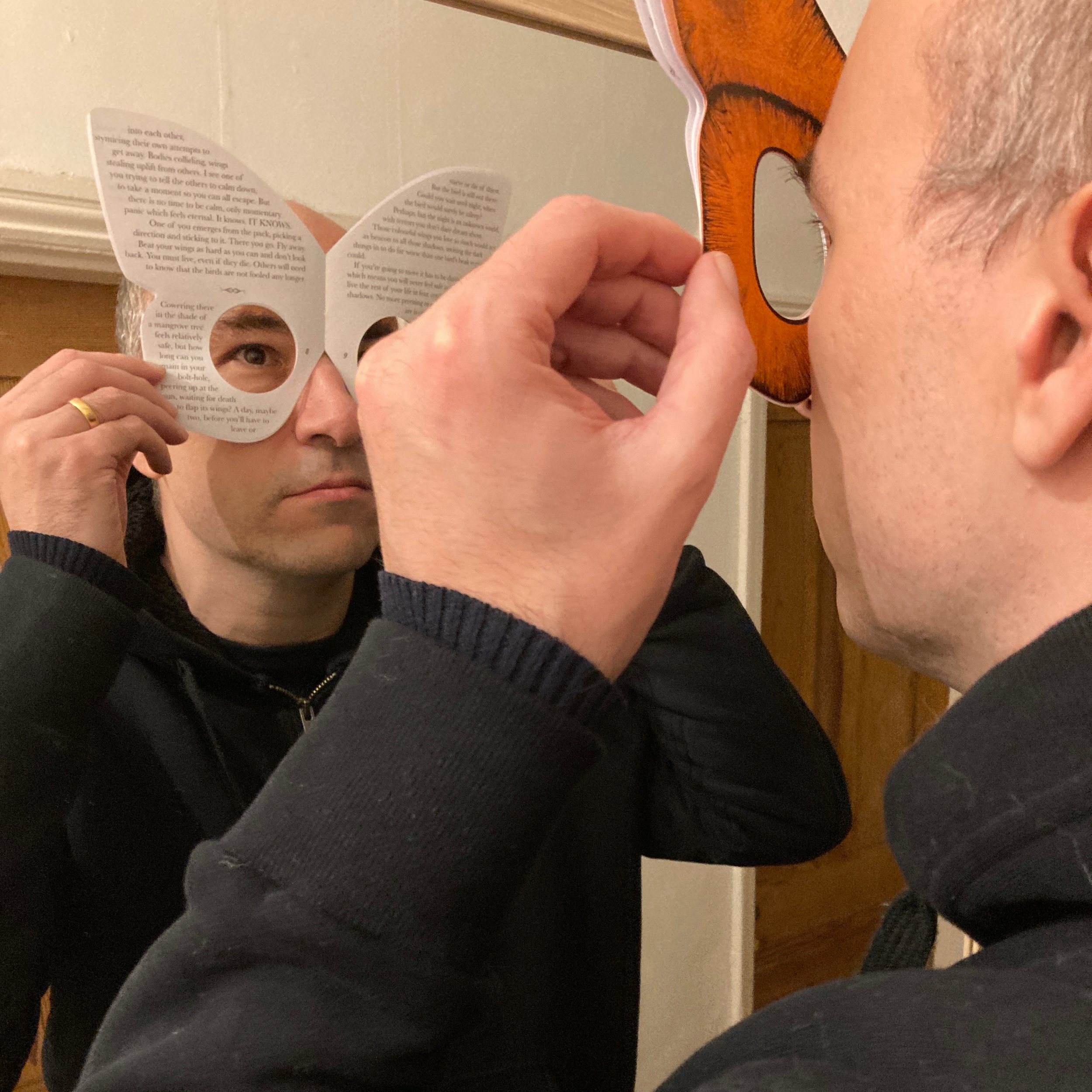
Paper / card
2023, 20pp, paperback
Overview
A short story printed on a mask which must be read in a mirror.
Background
Butterfly Mask started as an expansion on some of the ideas presented in Oubliette, namely that of mirrored text and an uncomfortable physical process to read the story. Rather than using an implement like a dental mirror, I thought it would be interesting to have the story on the reader’s face. Obviously, you can’t see through the pages so cutting holes out would be necessary.
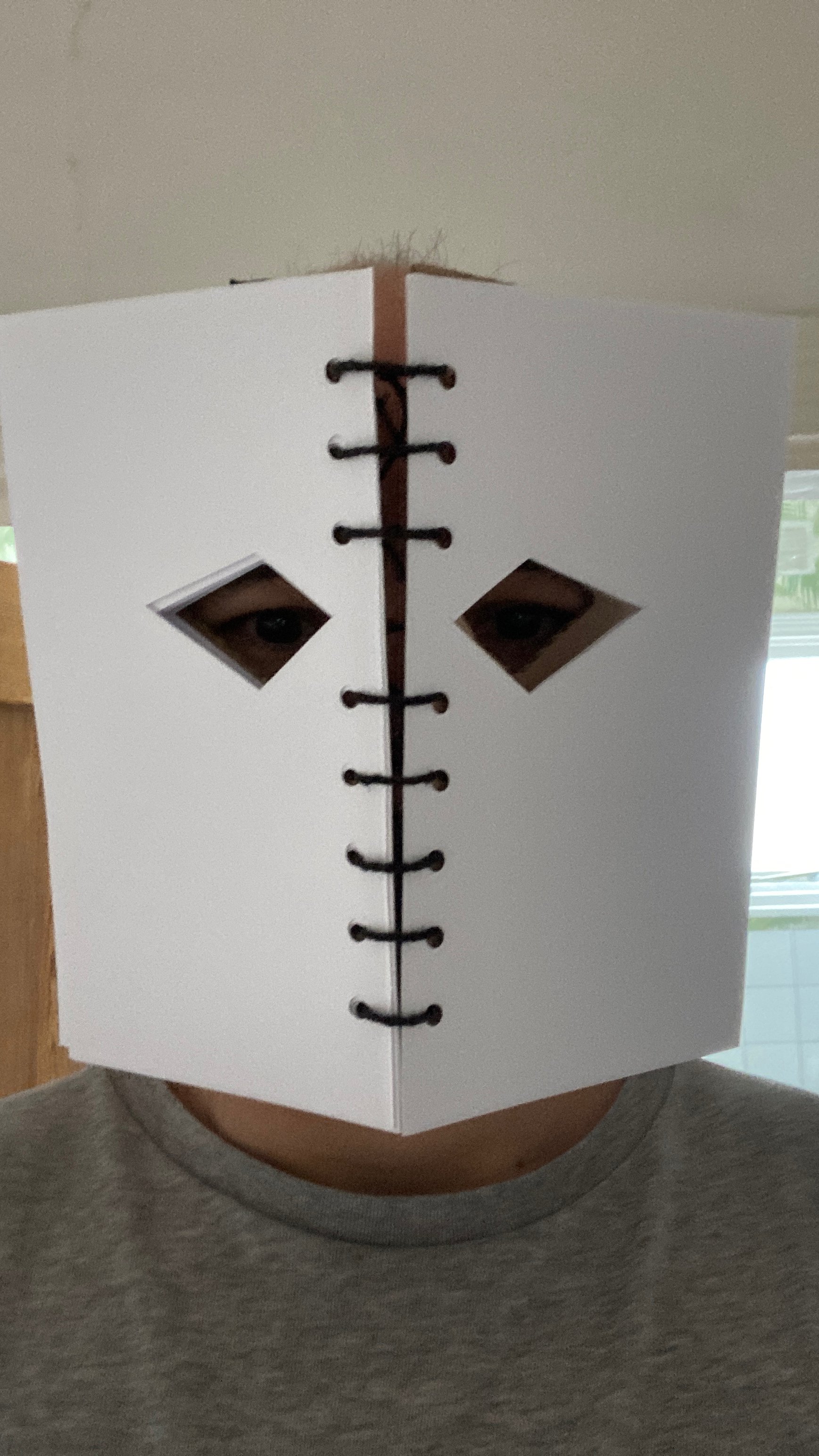
A rough prototype was made out of scrap paper and something about the blank face that I saw put me in mind of classical horror film bogeymen like Michael Myers and Jason Vorhees. I didn’t really want to write a horror story, though - at least, not one like that. Further experiments pulled me towards the ideas of camouflage and I found myself thinking about the deceptive wings of butterflies, which represent themselves as the faces of big, scary creatures to scare away predators. I thought the process of looking at oneself in order to read this story could have an interesting side-effect on the text. Rather than the text being out there, on a separate plane, it would be one’s own reflection, the face that you’re wearing to the outside world. Furthermore, there was the opportunity to do some playful stuff with the narrator - the ‘you’ of second person perspective giving way to the ‘I’ of first person as the story progresses.
Although the prototype was a plain book, I got it in my head to form it in a form more like that of a butterfly. This proved to be a pretty stupid idea. At first I wanted the text to flow on non-straight lines and spent a loooooong time setting text on various different arcs which were supposed to look like butterfly wings. They didn’t, and just looked crap. I then allowed myself the benefit of straight typesetting, albeit in a butterfly-shaped text frame, with the words flowing around the eye holes. The first versions had these towards the top of the page, but moving them to the bottom allowed for the curve of the wing to form a more natural shape for the reader’s nose.

Although the basic principles had been set out in the early prototype, finding the right sort of binding was a time-consuming process. I really wanted an elasticated strap that would keep the book secured on the reader’s face, but this proved too difficult to work out. I just couldn’t get the right combination of materials that would stay in position, but also allow the pages to fall open and allow the reader to see them properly. The strap had to be abandoned, much to my annoyance. It is for the best. Masks can be hand-held and so are books. I tell myself this in order to keep the loathing at bay.
There was no way I was going to be able to cut this consistently by hand, so I used the Cameo 3 cutter for both the pages and the cover. I’m getting a little tired of this process, particularly as Affinity Publisher doesn’t allow for addressing the cutter directly, meaning lots of exported PDFs, which are then placed into another application, then sent to the cutter. It’s a bit of a convoluted method and I miss the Illustrator plugin I used to use. There’s also the broader issue of everything being quite computer-based. My attempts at hand-making things tend to be quite shoddy, though, so I think that’s going to continue for a while.
The end product is a lot simpler than I had in mind, although it does maintain the fundamental principle of the idea from first conception – that of reading through the book and relying on external perception for an understanding of self. The whole process took a lot longer than I would have liked, although this was partly due to personal factors in the second half of 2022. Had I known it would end up as a stapled pamphlet, I could have knocked it out a lot earlier. Possibly. It’s more likely that I had to go through all those iterations in order to get to the simple version. I’ve really got to learn how to start simple and stay there.
The Real Writers' Handbook
A small guide to all the things writers use as justification for not writing - notebooks, pens, sexual infidelity, that sort of thing.
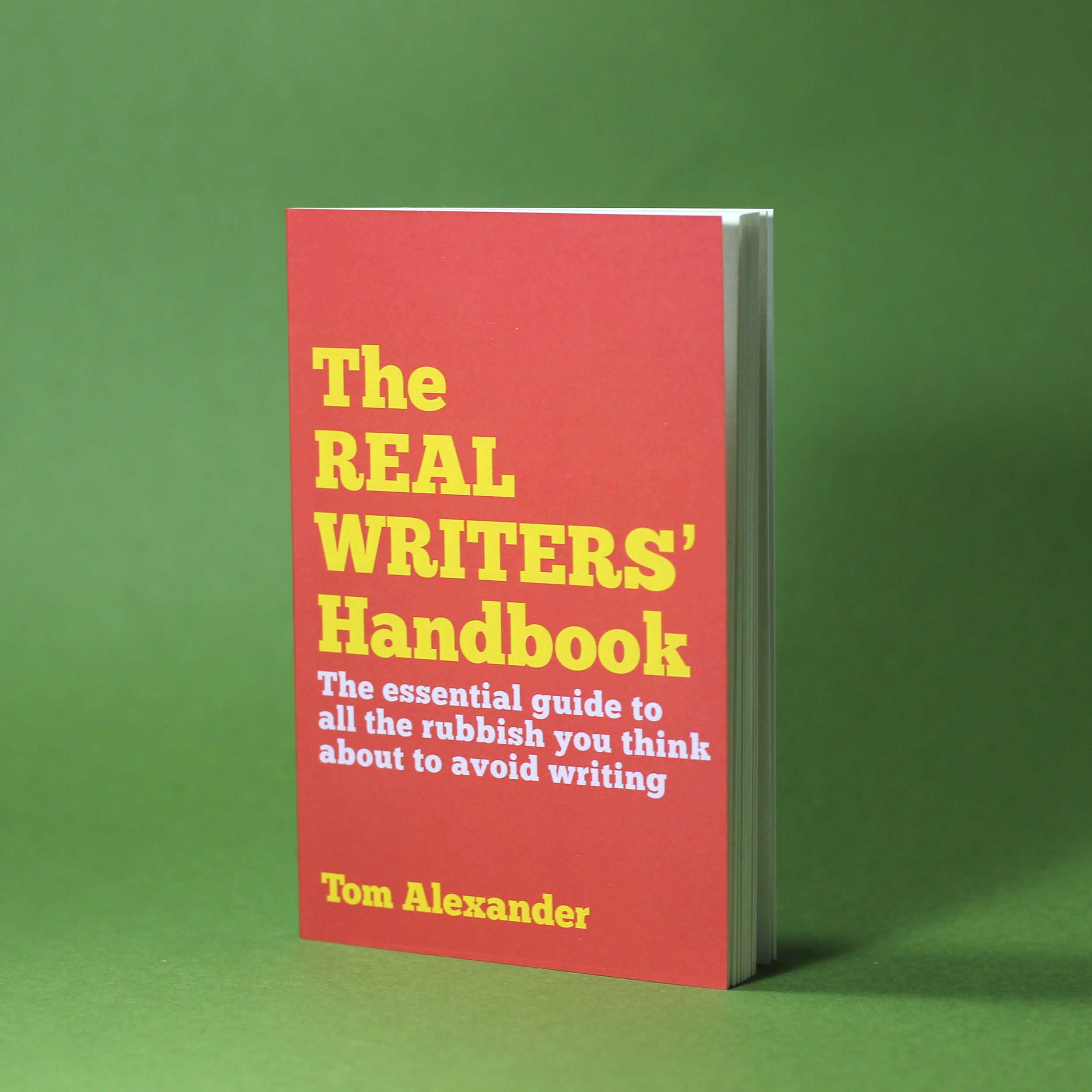
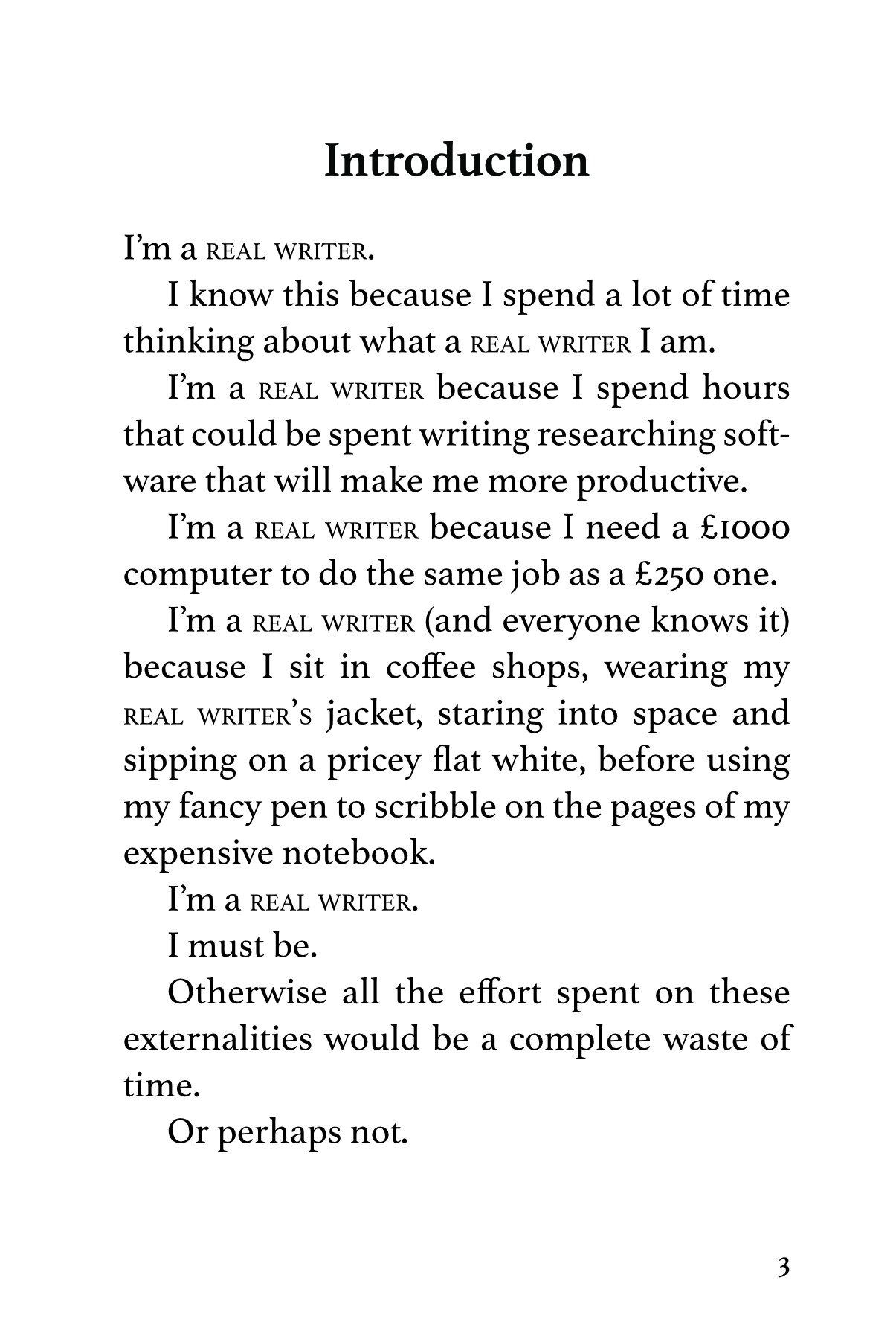
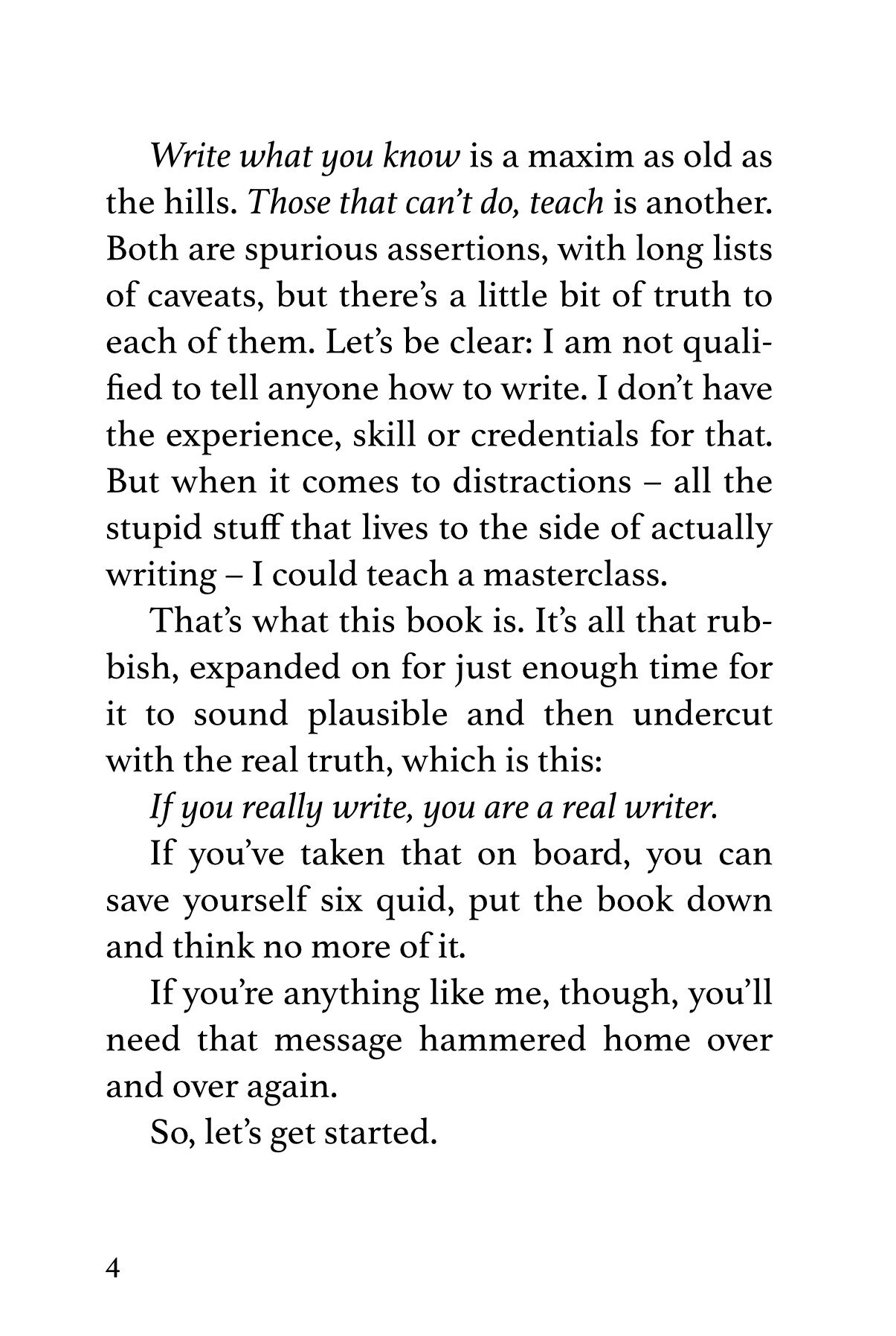
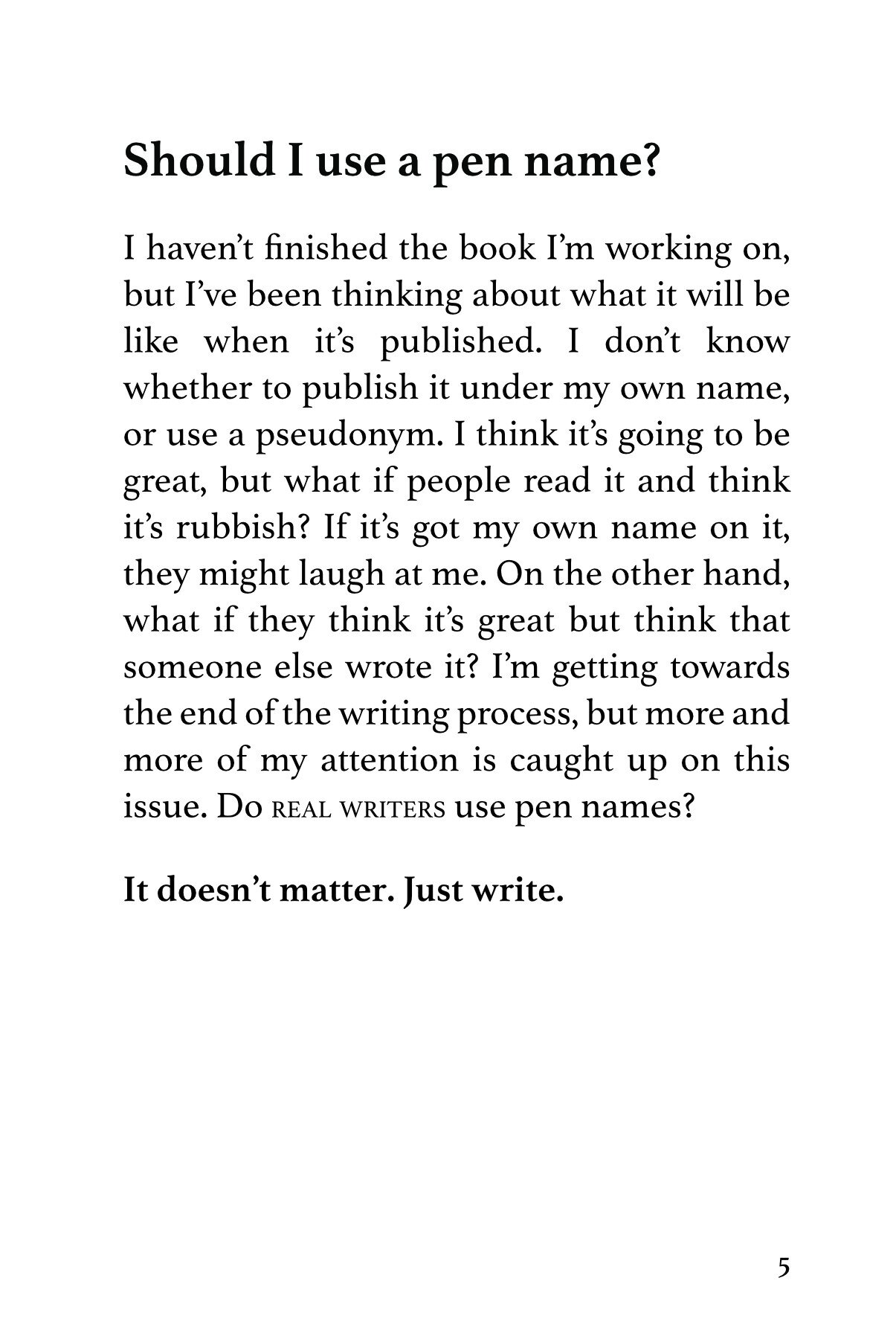
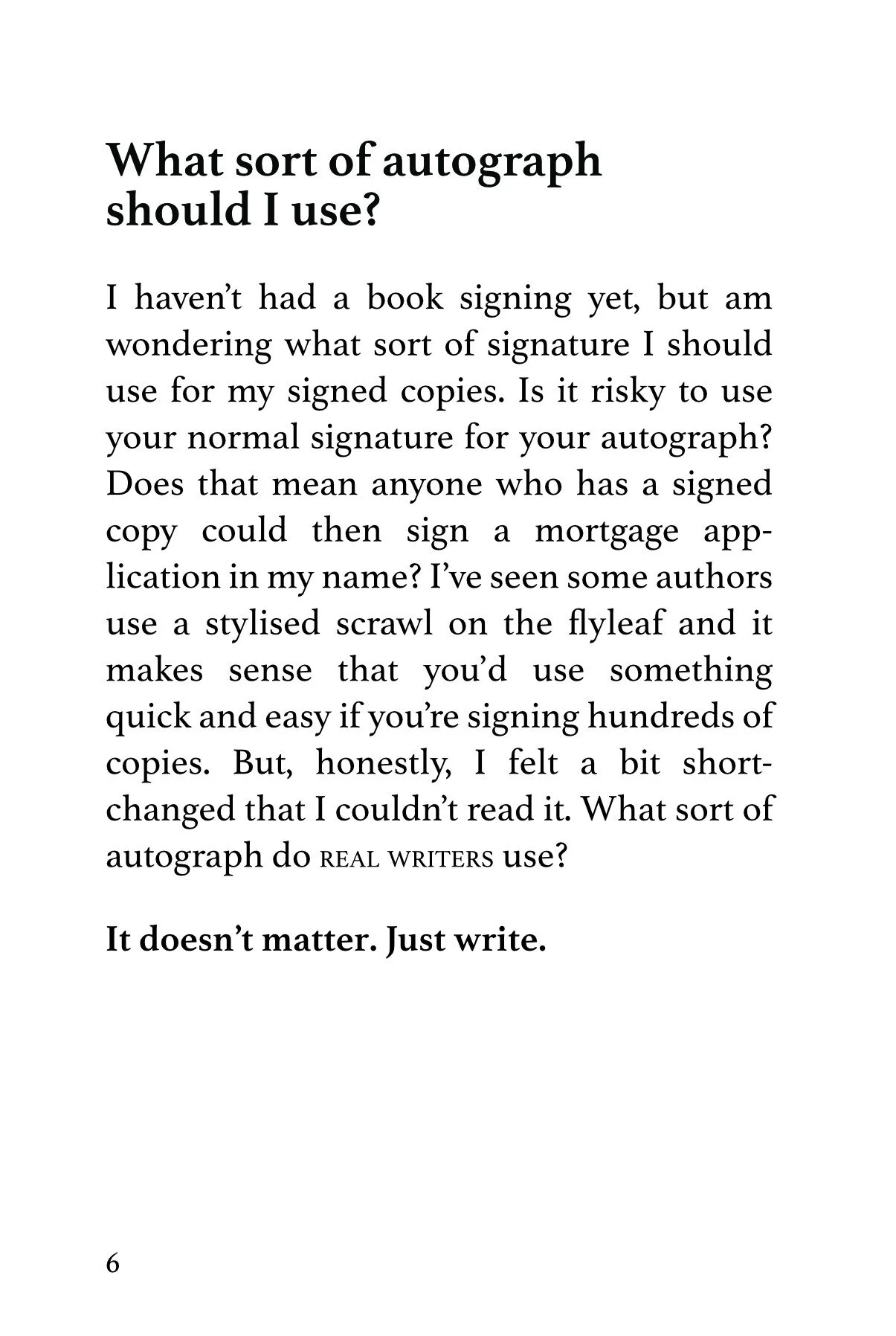
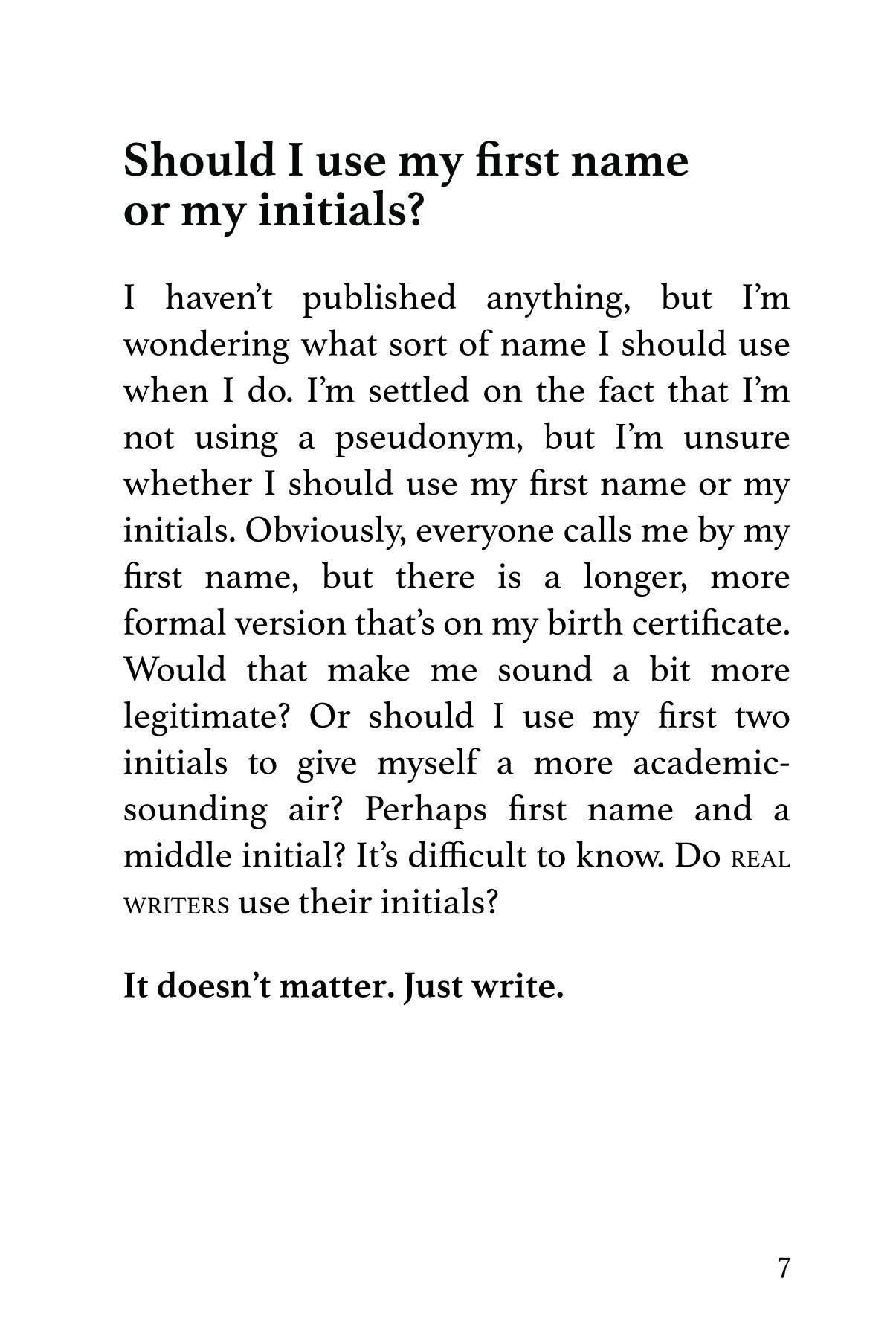
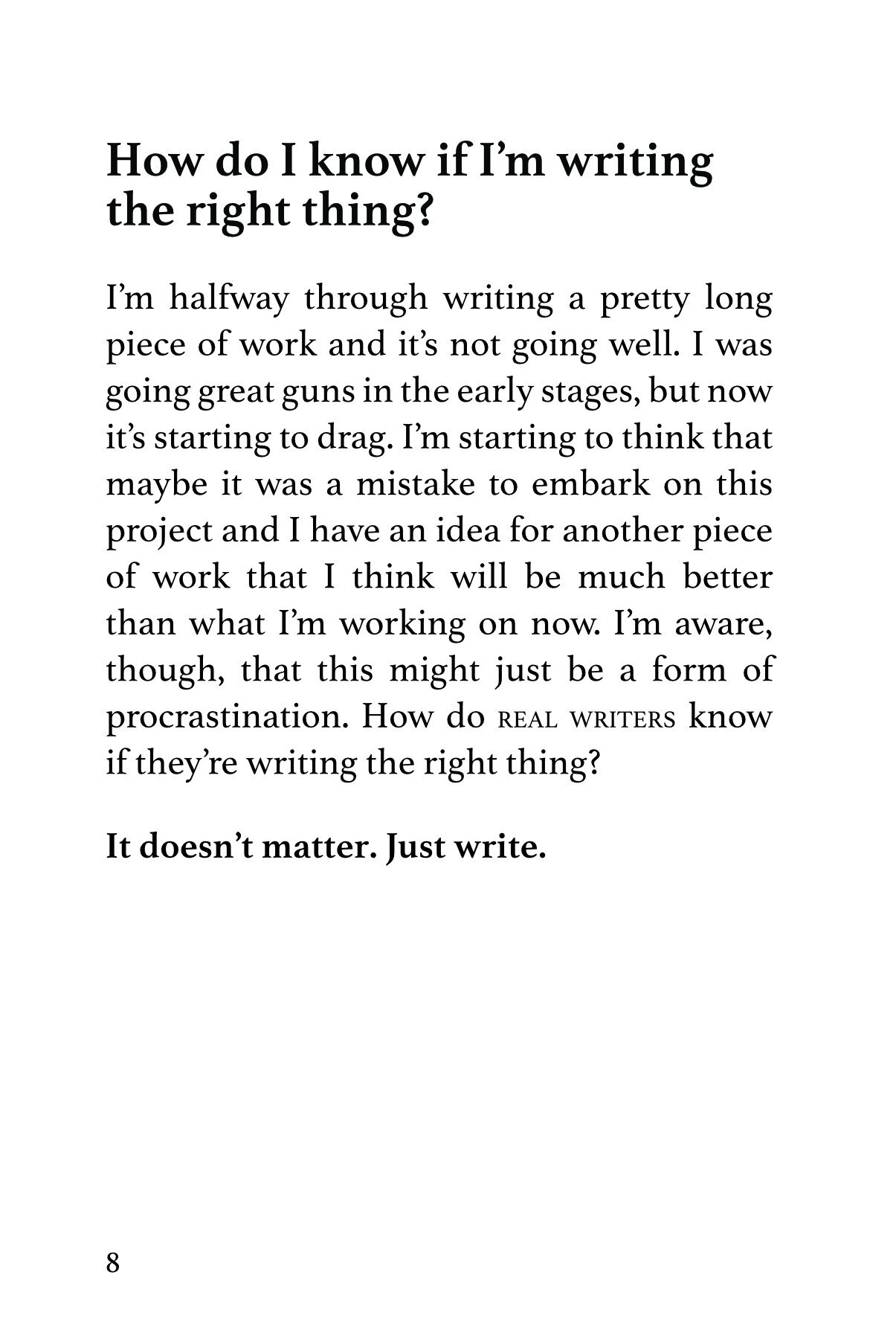
The essential guide to all the rubbish you think about to avoid writing, this pocket guide will transform you from idle dreamer to productivity powerhouse. (Not a guarantee).
Paperback, b&w, 2022, 101x152mm, 56pp
Overview
A small guide to all the things writers use as justification for not writing - notebooks, pens, sexual infidelity, that sort of thing.
Background
I’ve had a lot of long-running projects that, while not stalling exactly, have felt sometimes like they will never reach anything like an endpoint. Wanting to just get something finished, I blurted out this short How-To book, aimed at people like me who call themselves writers but often do anything but.
It’s basically a series of stupid questions, all of which have the same answer (It doesn’t matter. Just write.). Most of them are drawn from my own personal experience, when I’ve used all manner of excuses for not knuckling down and doing the work.
As the idea had been brewing for a while, I was able to put everything together quite quickly. It’s very short, so I did the first draft on Monday and had everything typeset and proofed by Friday evening. I used Ingram Spark (as I had previously on Forms) and the whole process reminded me of working in the production department at JKP. It’s the first time in a while that I’ve made an ebook and I had forgotten what a finickiy process that is.
Anyway, I think it’s a nice little book. If you know someone who writes (or claims they do) then it might make a good gift.
Writing.IE asked me to write an article about the book’s genesis. It’s almost all true. You can read it here.
Swiss Army Book
A small practical volume for the roving reader.
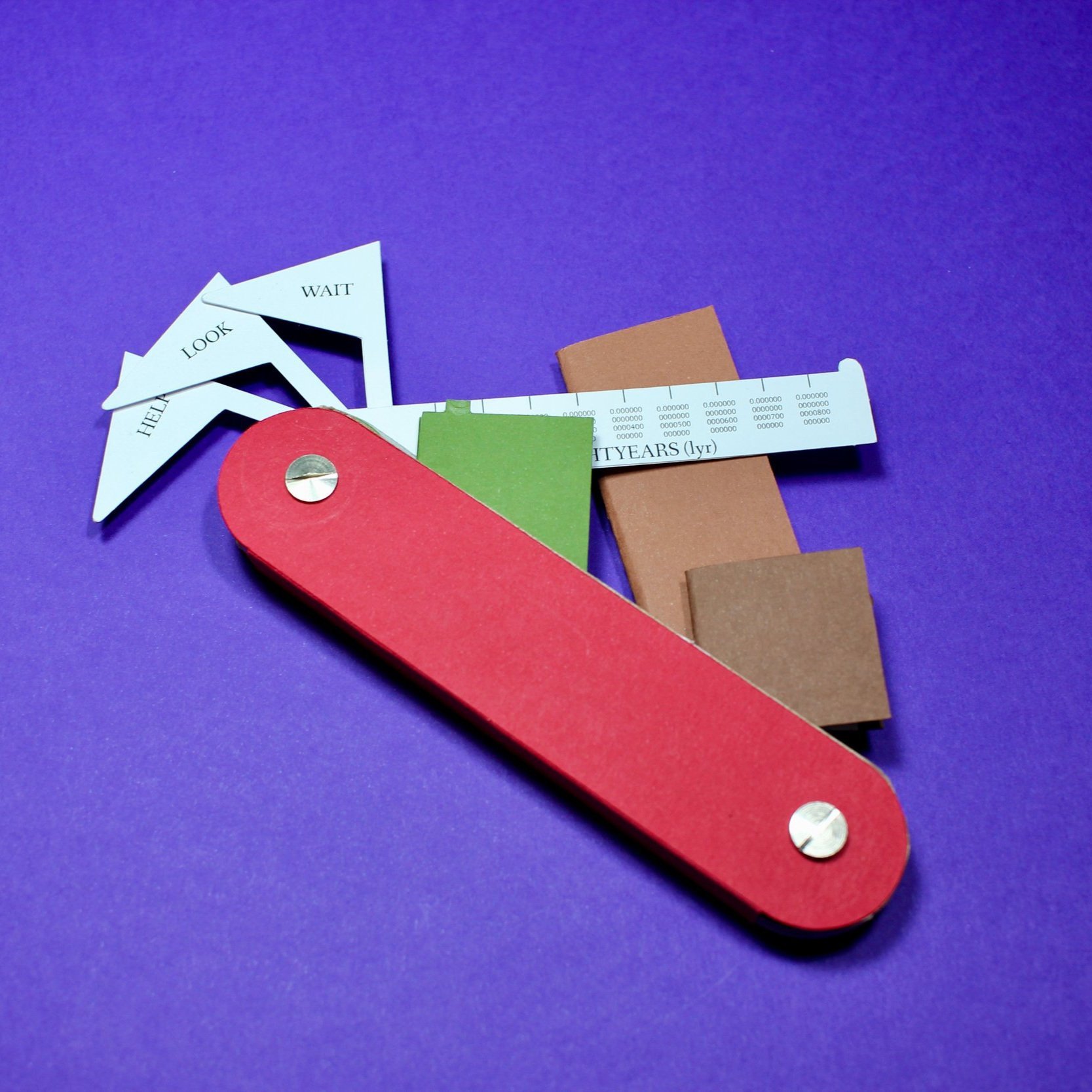
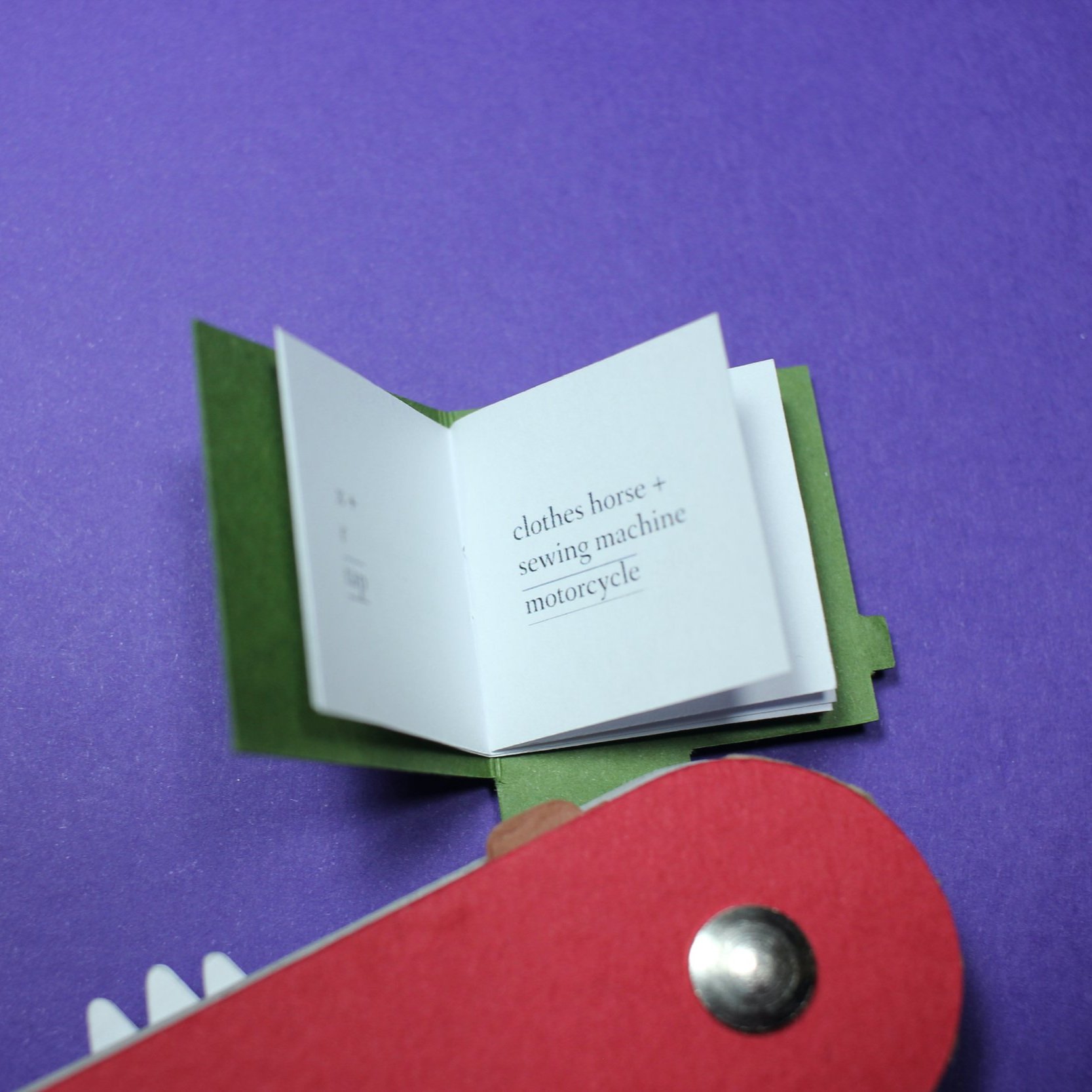
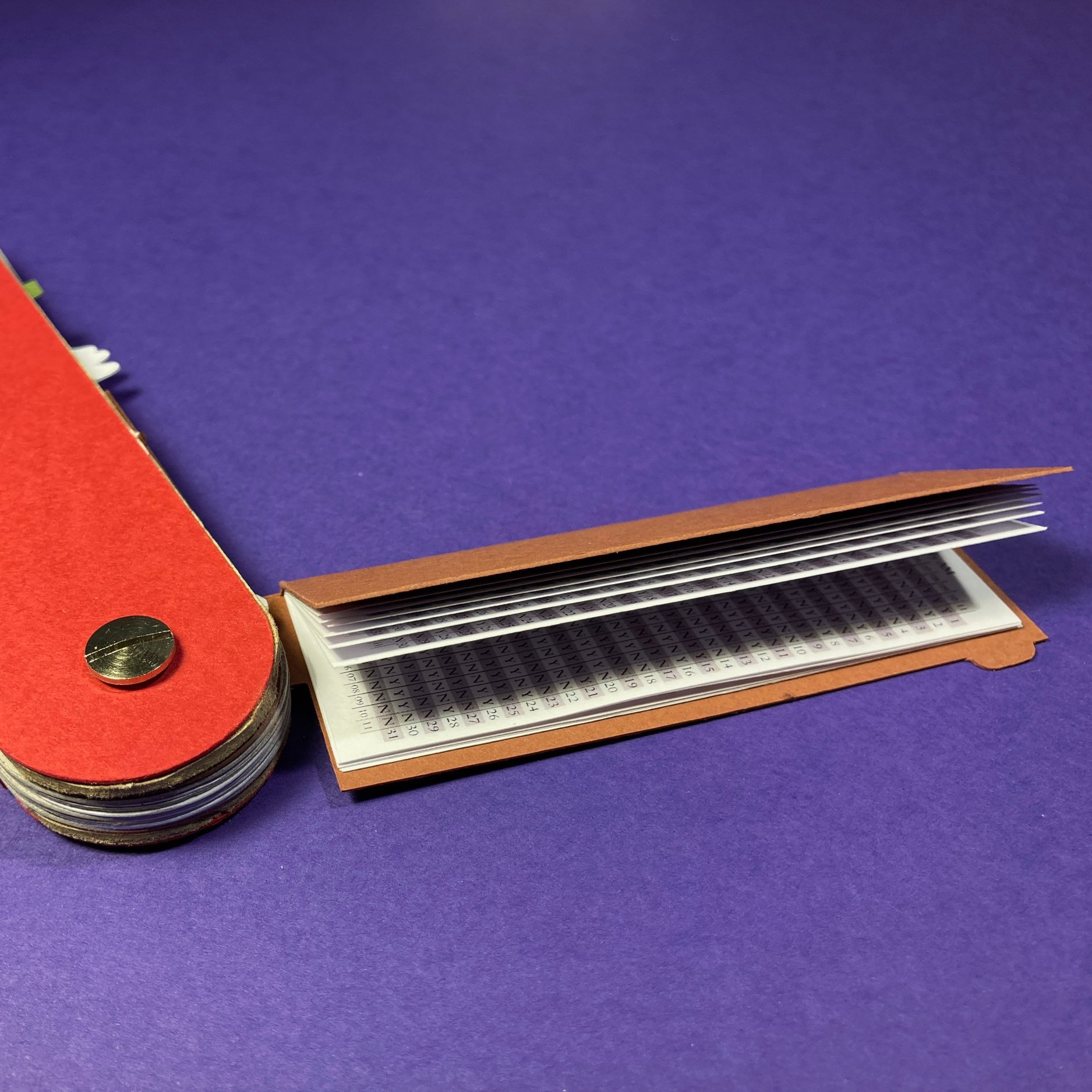
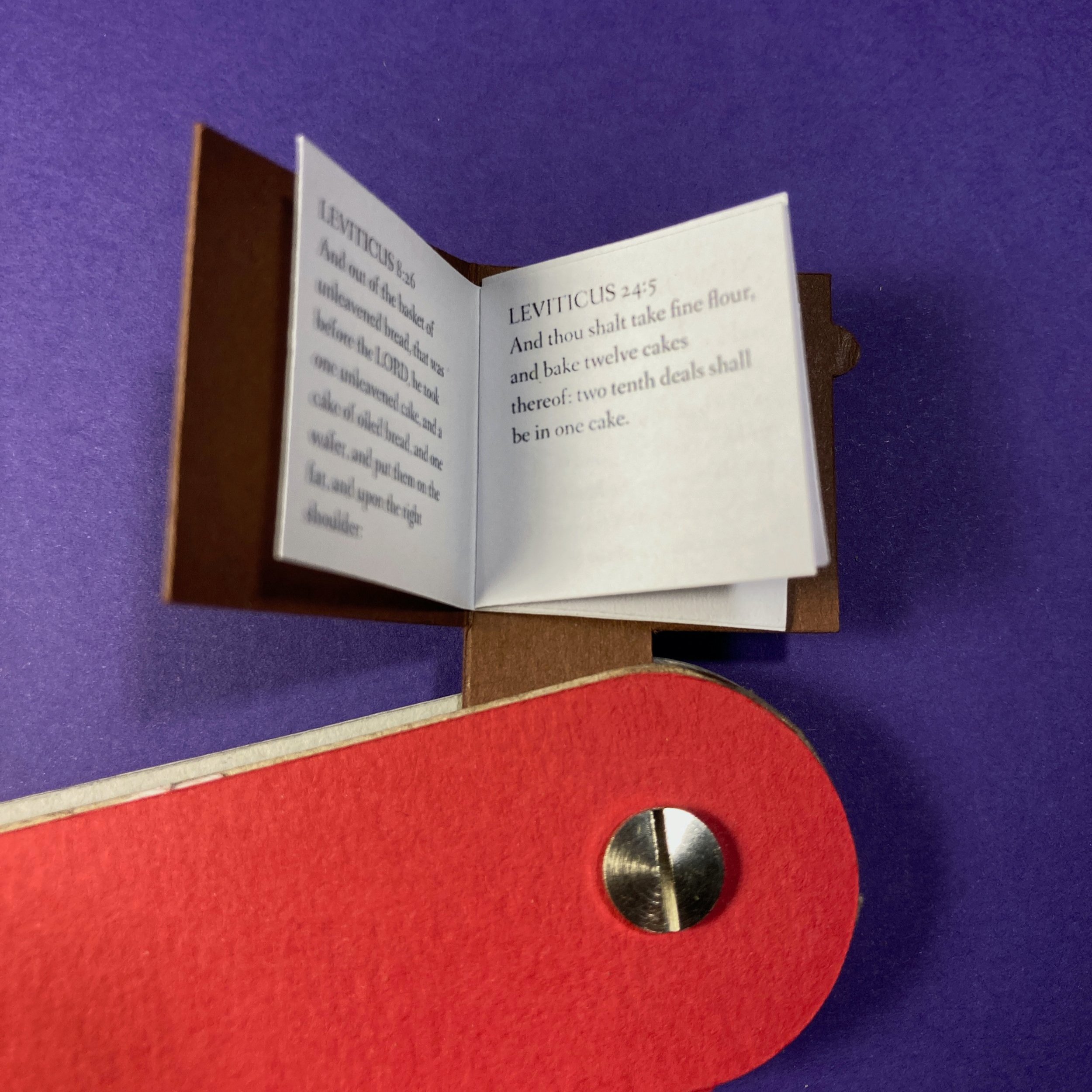
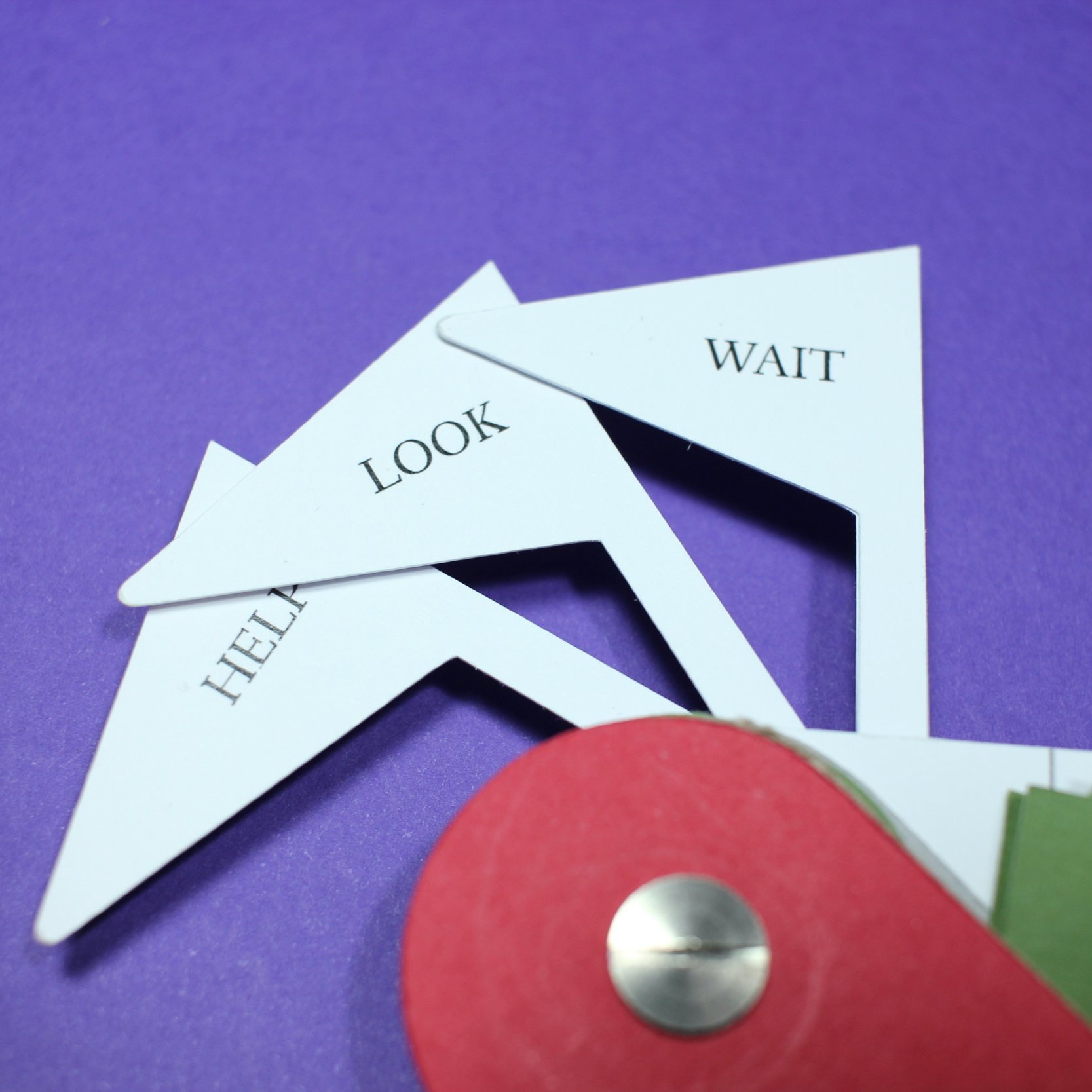
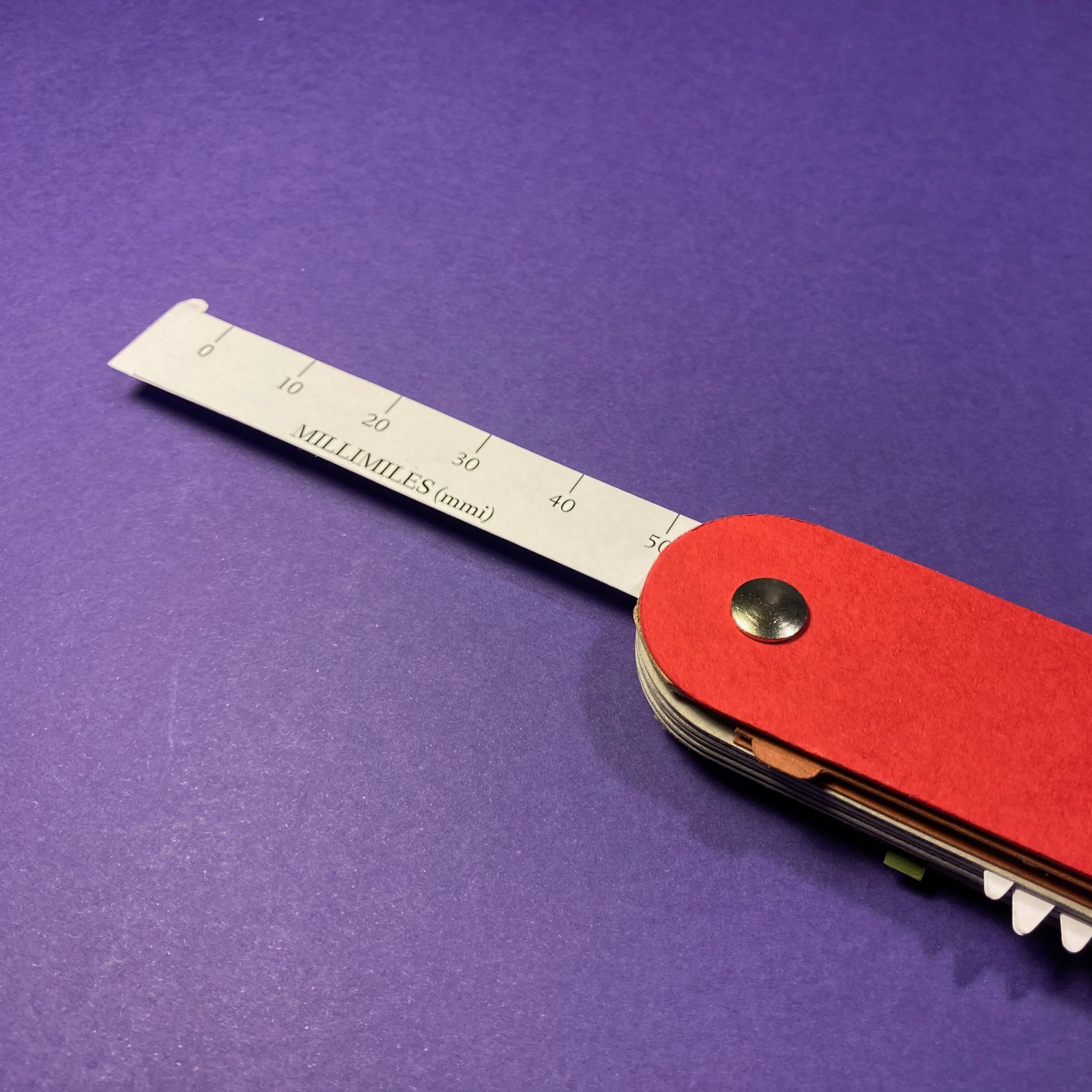
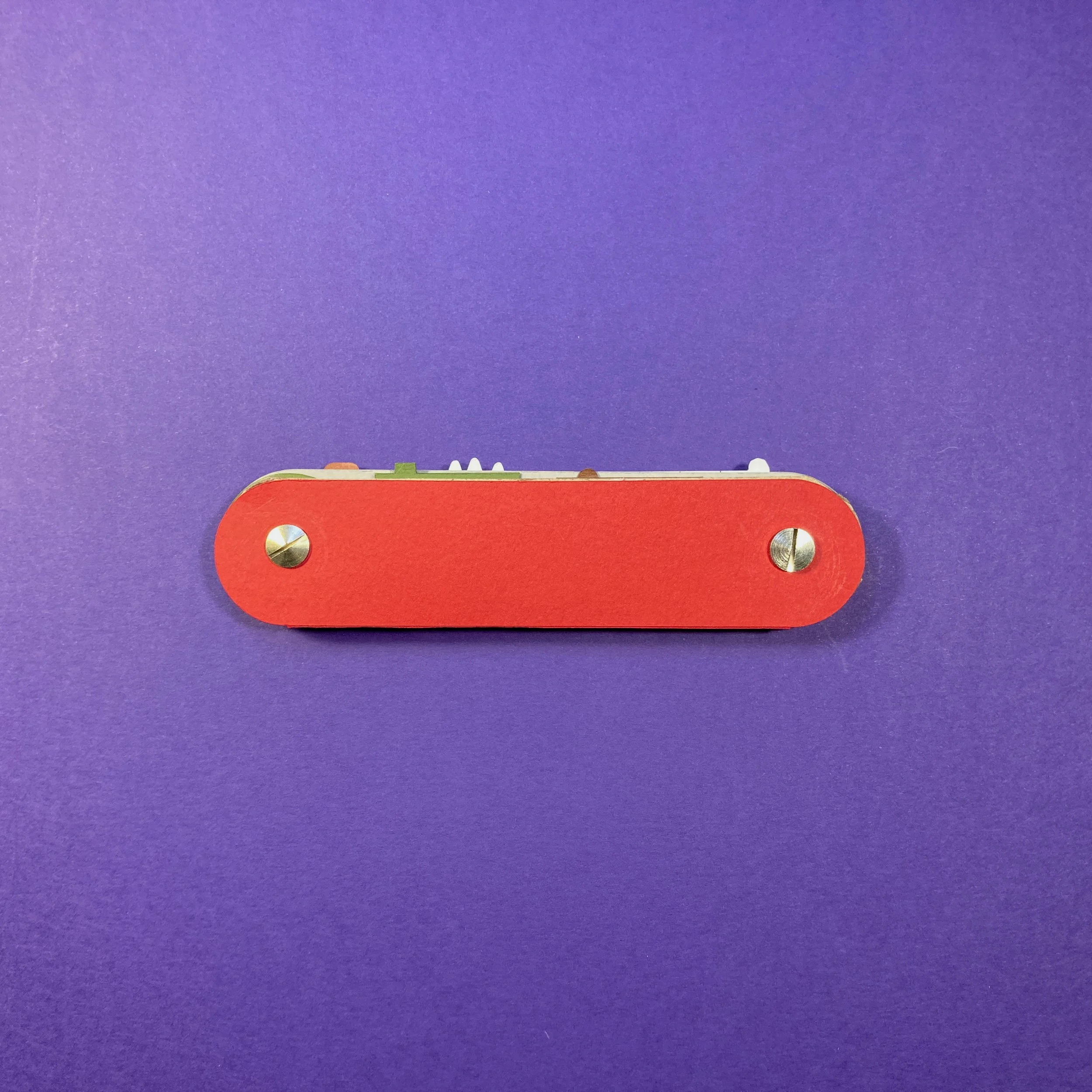
Paper/Card, 2022, 35 x 140 x 20 mm
Overview
A small practical volume for the roving reader, containing several useful texts and tools that fold out from the main body.
Contents
Yes / No Guide
Cakes of the Bible
Aggregate Objects
2-sided Ruler
Millimiles
Lightyears
Tiny Flags
Help
Look
Wait
Background
It’s rare that I remember how or when I have an idea - they just sort of appear. In the case of Swiss Army Book, however, I remember exactly how it came about. I had a period of quite intense anxiety at the end of 2021 and attempted all sorts of methods to try and ease the symptoms while working on the cause. As well as massage, shiatsu and acupuncture, I had a couple of sessions in an floatation tank. Bobbing around in salt water in the dark is… all right. I didn’t find it to be a life-changing experience, but it was quite nice. And while I was floating around in Epsom salts, I had a vision. Not of God, the future, or the interconnectedness of all living things, but a book shaped like a Swiss Army Knife. I emerged determined to make that dream a reality.
Having just made several pieces that were small and fiddly to construct, I wasn’t that keen on doing so again. Wanting to get a grasp on how the pieces would interact, I made a large version of what I had in mind, thinking that the ‘blades’ of the book would be around A6 size. It was immediately clear that this was stupidly big and, despite my misgivings, it would have to be much smaller. Not as small as a real Swiss Army Knife, but certainly of a more compact size. That first humungous version wasn’t a waste of time, as there are some things that you can only know when you have an object in your hands. As an example, that first version had the books spine-out, which made putting them away a problem as the pages would get caught up in the next compartment. Flipping it around so that the spines went into the body first made the pages close as well, making it a more pleasing motion.
(At this point I’ll be honest and admit that I did entertain the notion of a beautifully made hardback version of this book made of wood, leather and brass. After a few abortive attempts to casebind a 30x30mm book, I had to admit that such a thing was beyond my capabilities and conceded that paper and card would be the best materials for me to use.)
As I went about shrinking the size of the book, I also had to think about what would be in it. It was clear that a narrative story didn’t really fit in with the concept, so I thought about non-fiction ideas that could be implemented in a very small space. Just as the swiss army knife has an assortment of tools within its body, the swiss army book should cover a number of potential situations.
There were a false starts here, which were largely to do with issues of tone. I thought about Swiss mythology and entertained creating a history of the great gnomes of Europe, but it was a bit twee and not quite right. Thinking of books that a person might turn to when up a mountain, I thought about the bible. But, as I didn’t really want to make something that was either religious or actually practical, I tried to use it in a way that wasn’t actually useful, even to the most devout theologian. I searched the bible for passages that mention cake. (Originally it was bread, but there were too many of them.)
I also wanted something that would be a practical survival guide, but obviously not that practical. I also put together a set of ‘aggregate objects’ based around a simple 1+1=2 method, which I thought was adjacent to a survival, but not actually useful. After prototyping these, my partner suggested adding in the Yes/No Guide I had previously made as a small item for my mailing list. I also created rulers using impractical measurements and three very tiny flags. In time, I’d like to print these on rigid plastic, but I suspect I won’t get to it.
Construction was both simple and fiddly. I used the Cameo cutter to create the various pieces, but a few stupid errors here and there led to some wrongly-sized pieces, which was exasperating and led to a massive crisis of confidence until I saw where I’d gone wrong.
The final piece consists of 39 pieces, 8 different paper stocks and 7 separate volumes. The binding is two screw-and-post binders There’s a little bit of glue to make some things sit flush and nice, but for the most part it just relies on things being aligned. I think it came out all right.
Writers Write
A series of stories about writer’s block, contained in a recursively bound booklet.
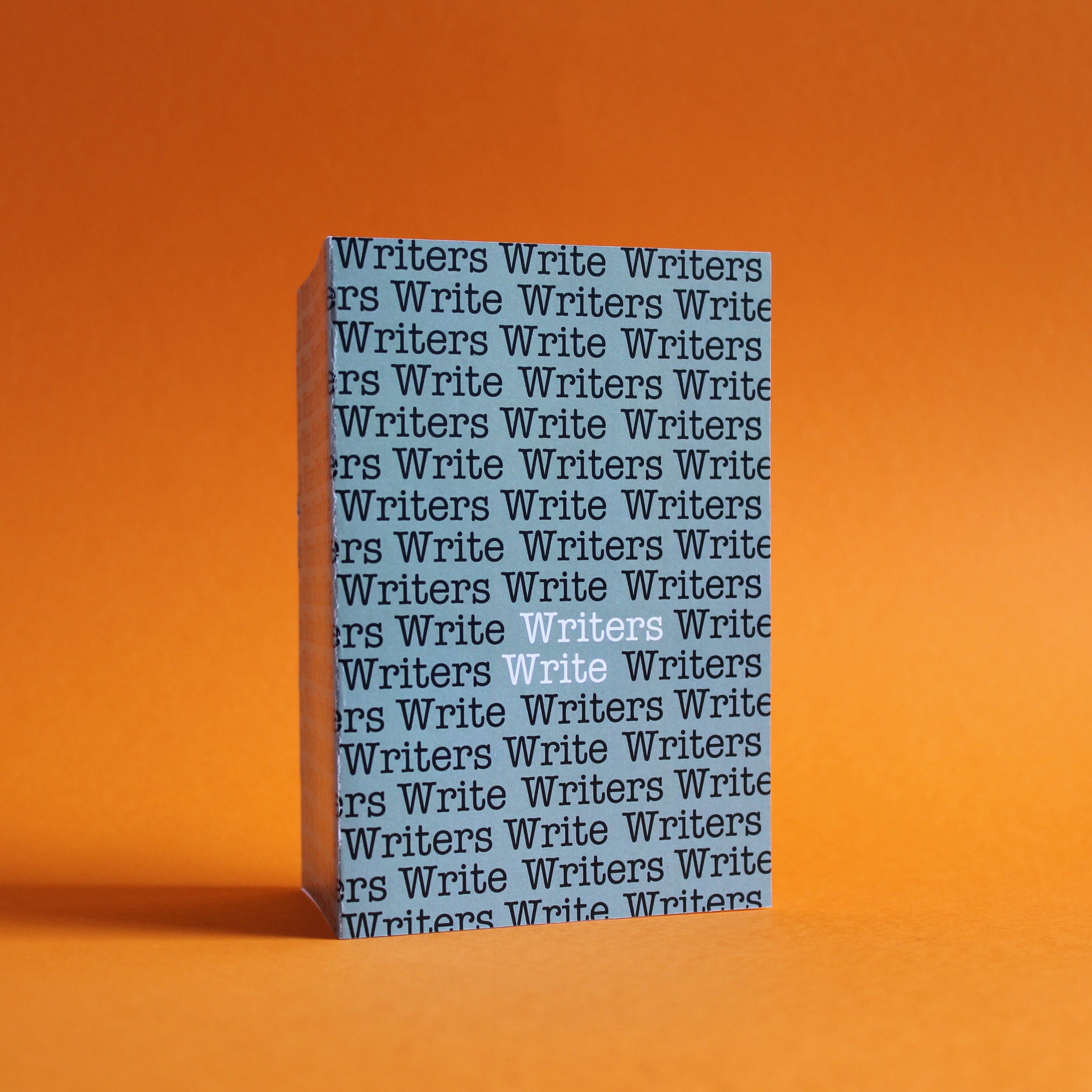
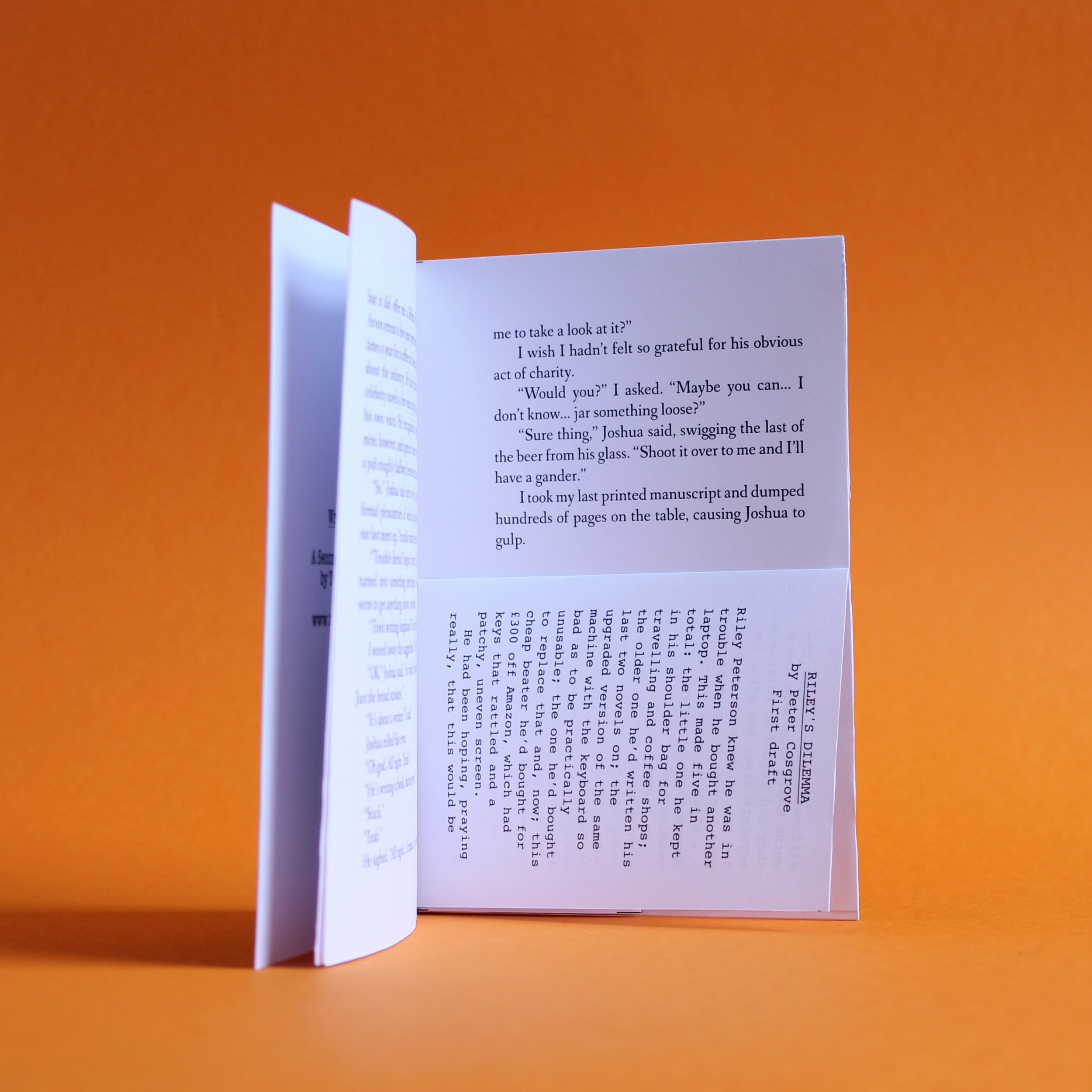
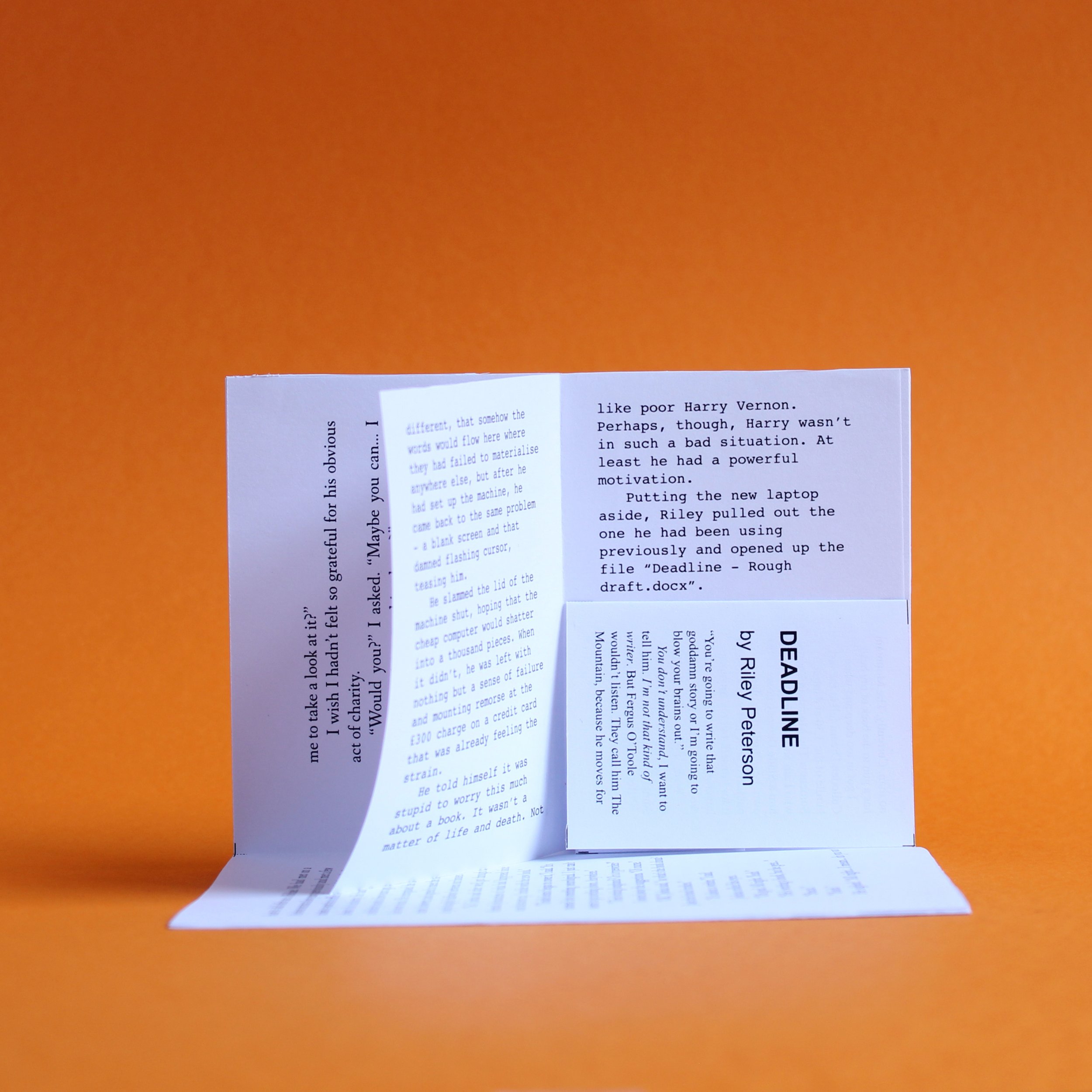
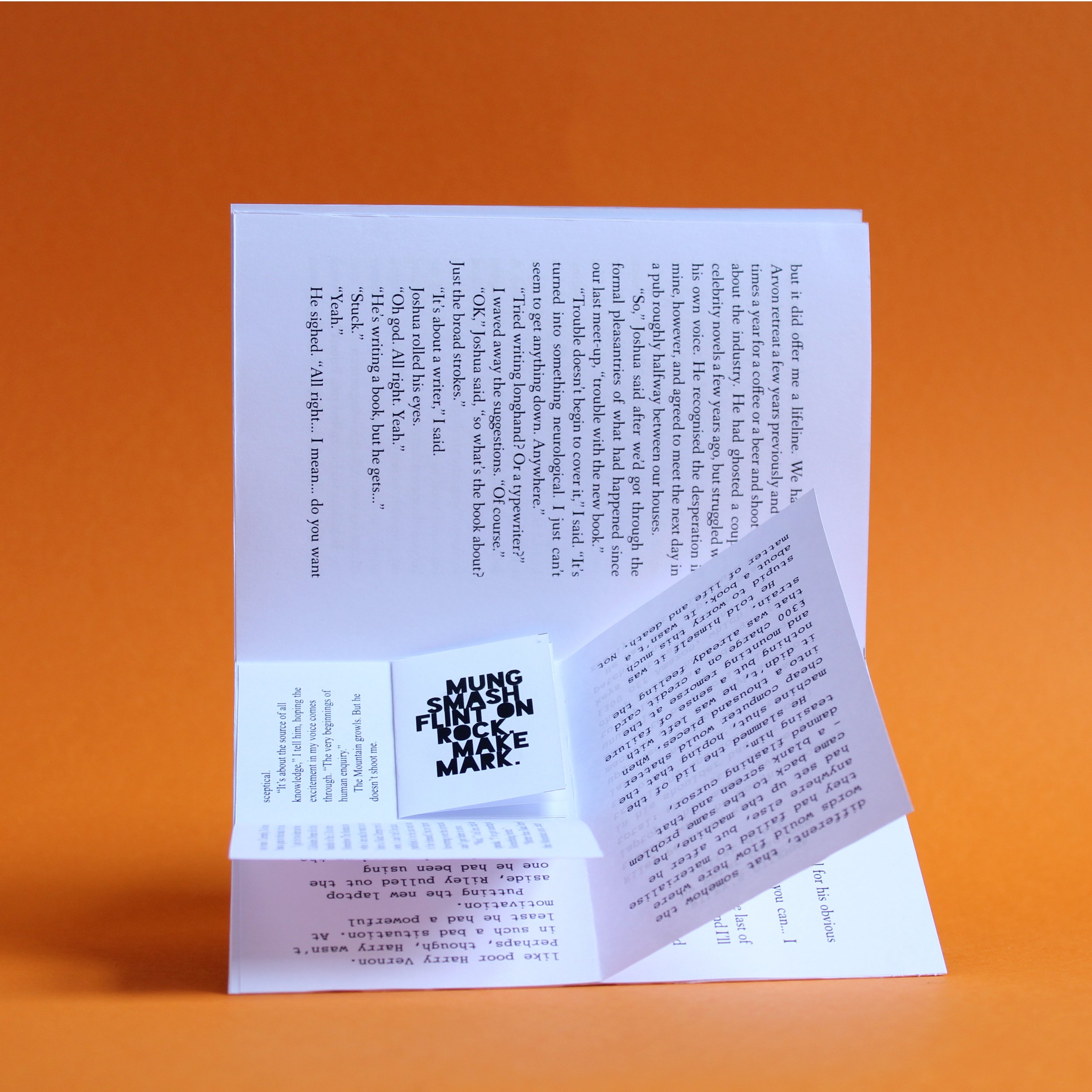
Recursive booklet, 105 x 148mm, 2022
Overview
Writers Write is a series of stories about writer’s block, contained in a recursively bound booklet.
Background
I had this idea a while ago and dismissed it because I thought it was disgustingly self-indulgent. Then I read Billy Summers and realised that some people had made entire careers basing stories on barely-disguised proxies of themselves, so figured I was joining a rich tradition. Furthermore, the edition I had in mind was just a few pages long, rather than several hundred, so I went ahead and made it.
The story is pretty much what it sounds like. One author struggling to write about another, who is, in turn, having their own difficulties writing their own story because that author is having difficulty… and so on and so on.
Praise be to the ISO paper sizing scheme, which makes this all possible. The booklet is bound by glueing the back page of the smaller booklet to bottom half of the recto in the centre spread. For someone who doesn’t like glue, I seem to be using a lot of it.
Lazy Dog
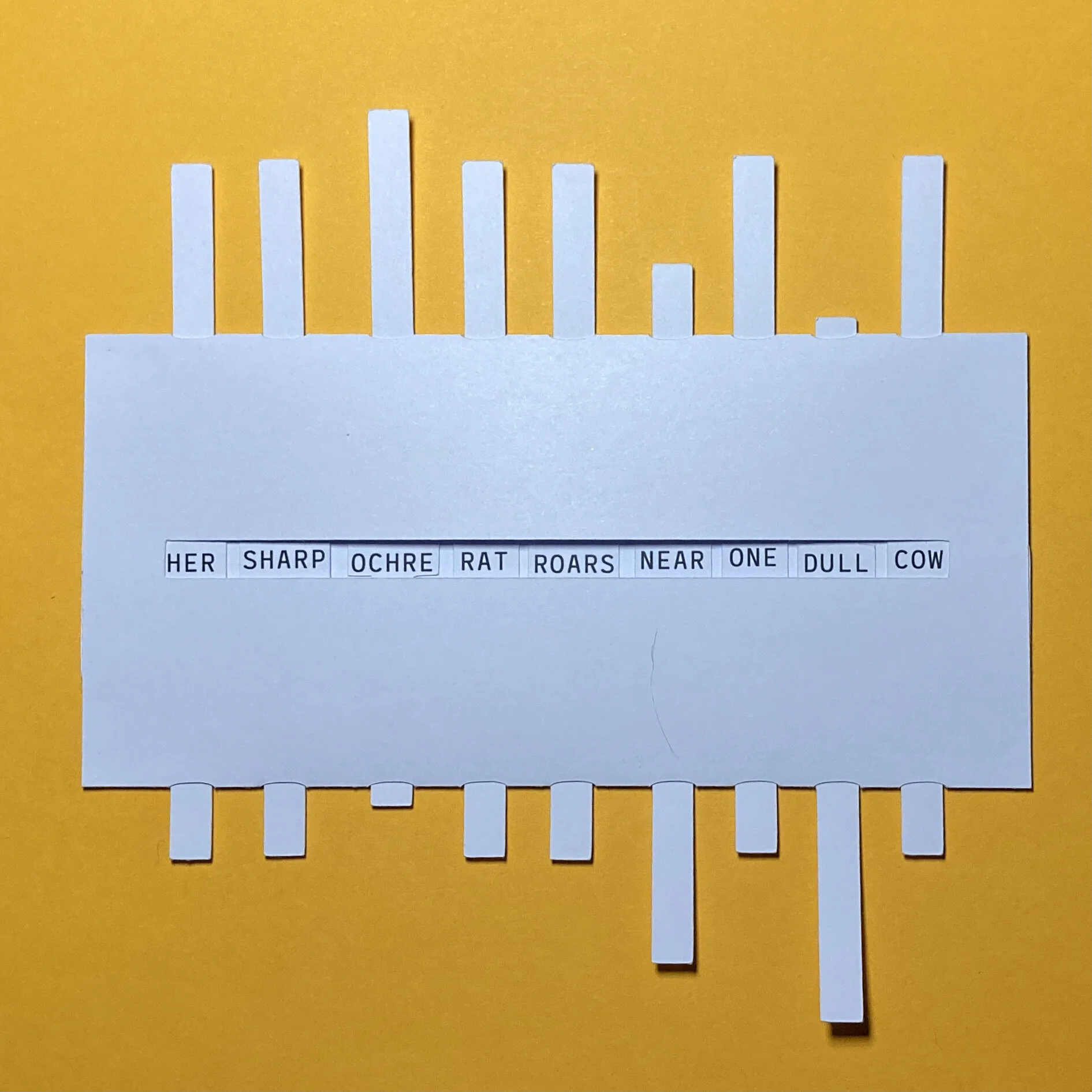
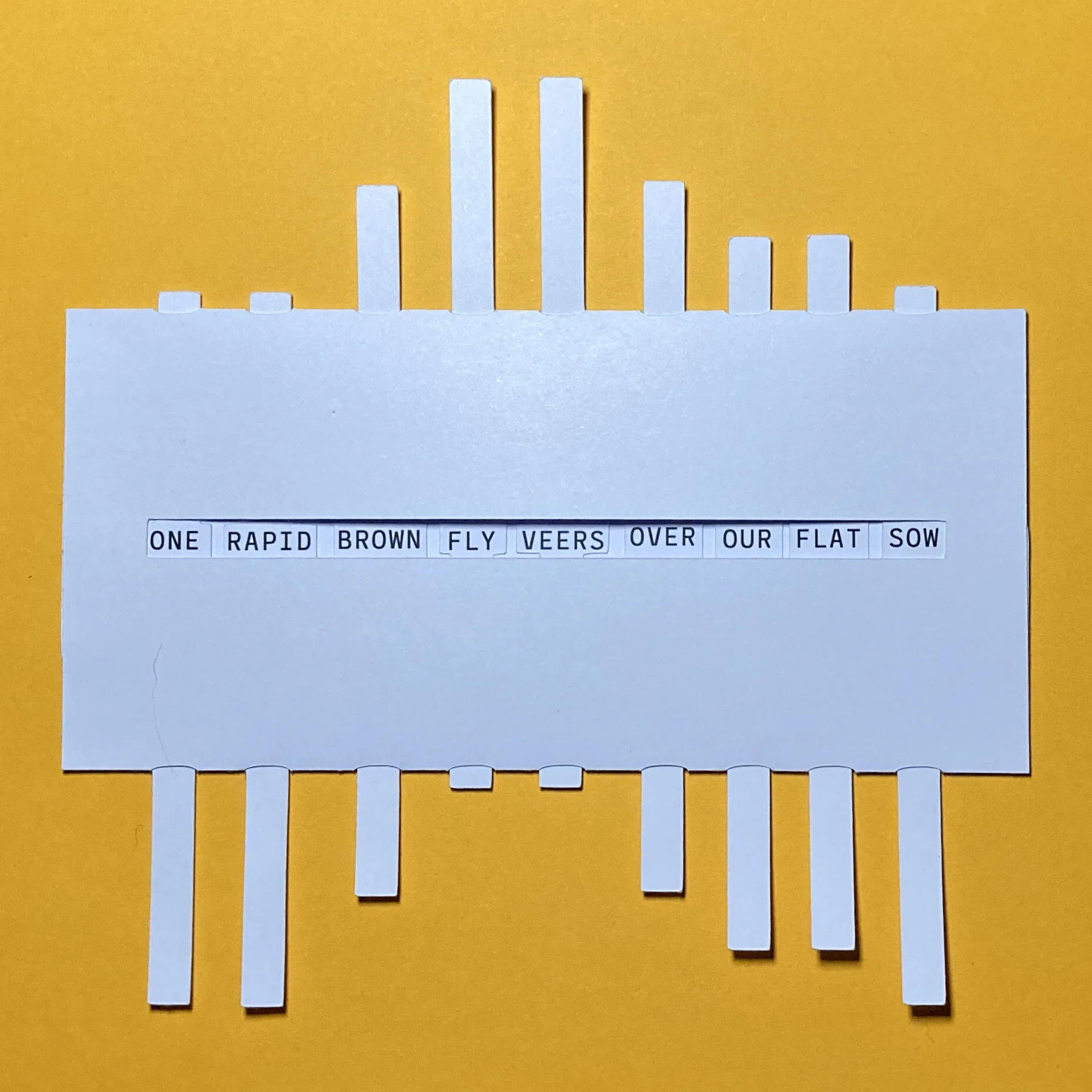
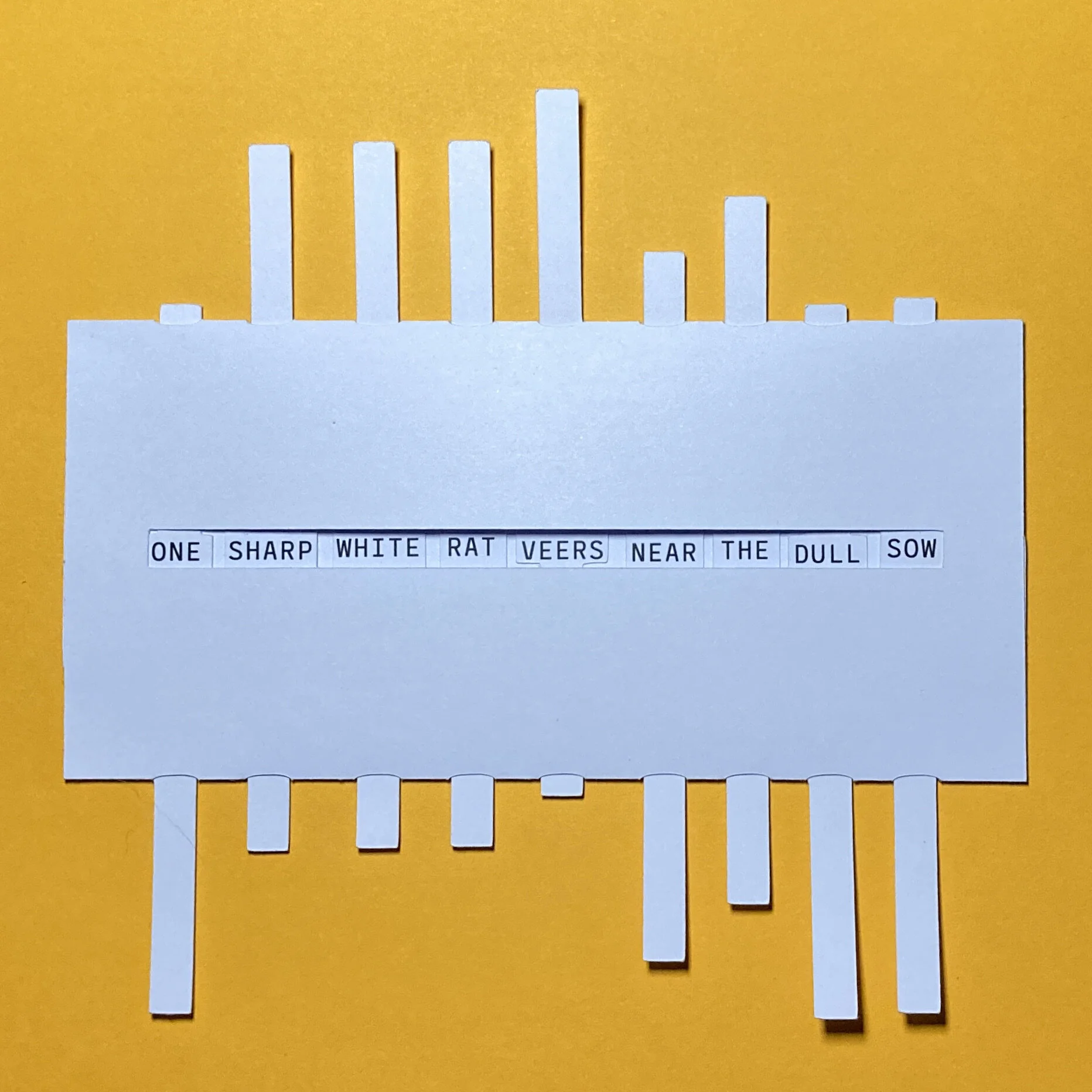
A small text toy derived from the phrase “The quick brown fox jumps over the lazy dog”.
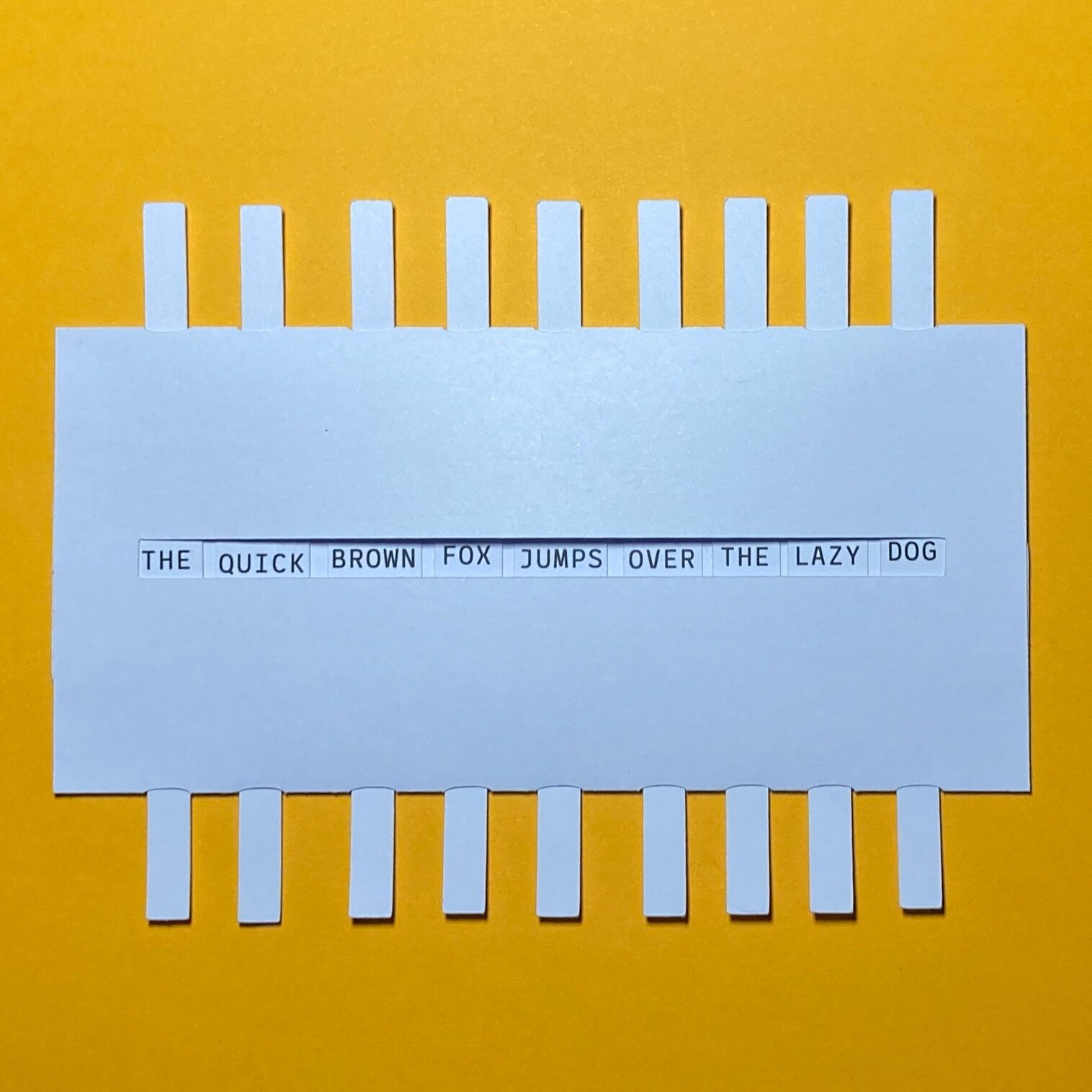
Card plaything, 115 x 150 mm, 2021
Overview
Lazy Dog is a small text toy derived from the phrase “The quick brown fox jumps over the lazy dog”. Readers push and pull the strips to create new variations.
Background
This started as a thought experiment, idly scribbling synonyms in my notebook for each words. Initially, I thought I could make it in to an interactive web thing, but then decided it would be more fun to make it out of card as physical object. Initially set in proportional type, I changed that to a monospace font so that each column could remain the same width.
Although nothing is taken from it directly, the book The Elements of Pop-Up sits on the bookshelf above my desk and probably got me thinking about push and pull strips.
Coarse
A ‘reverse Pygmalion’ on sandpaper.

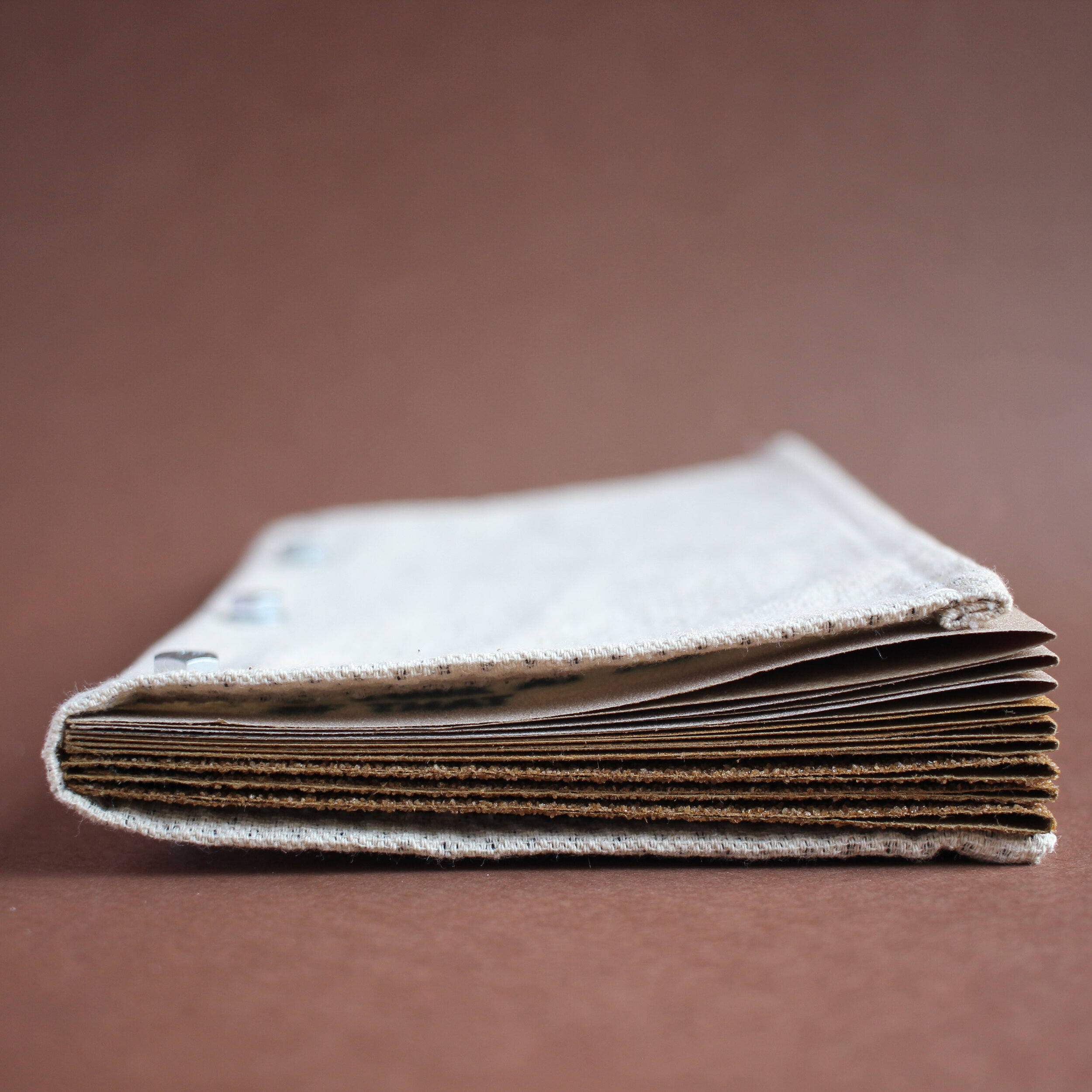
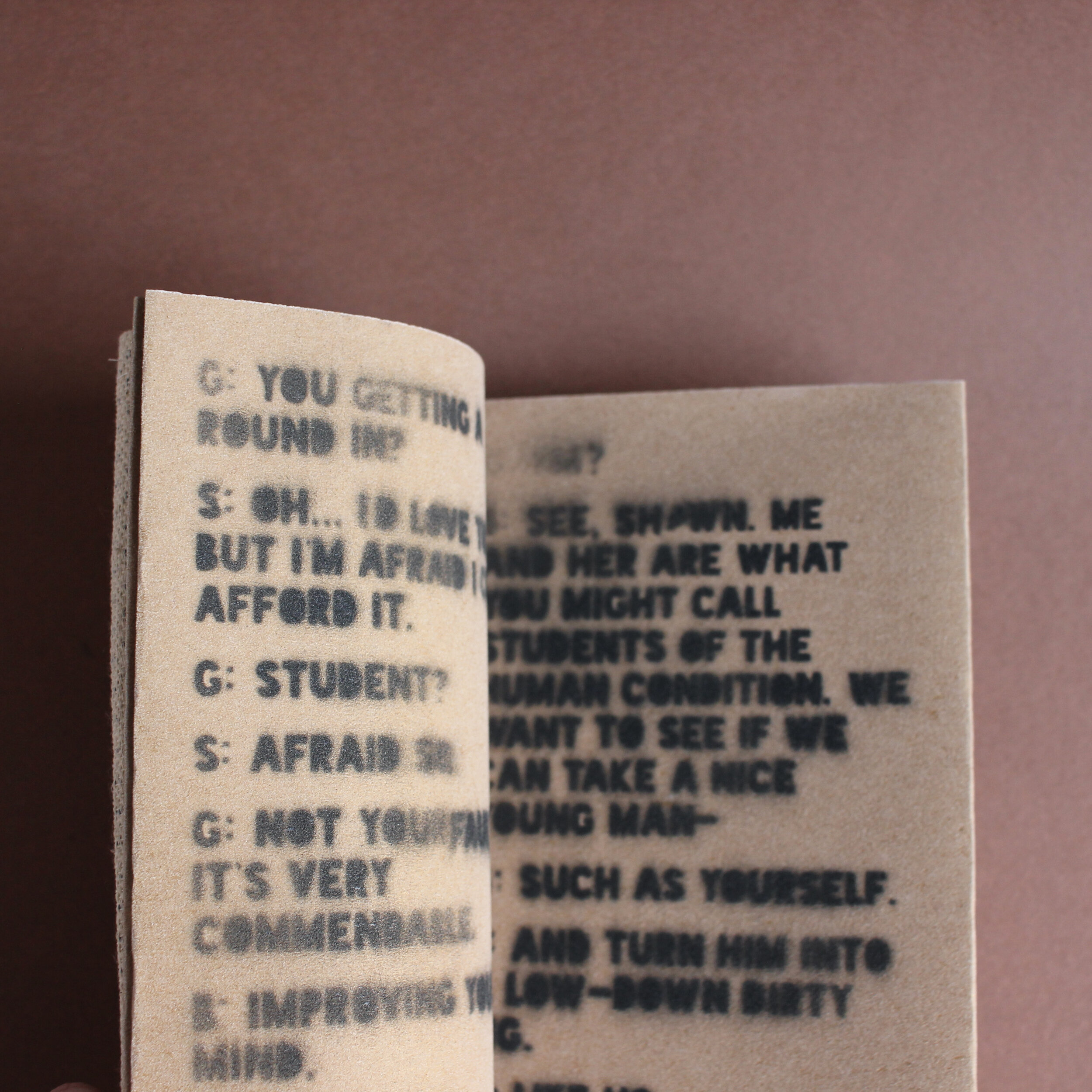
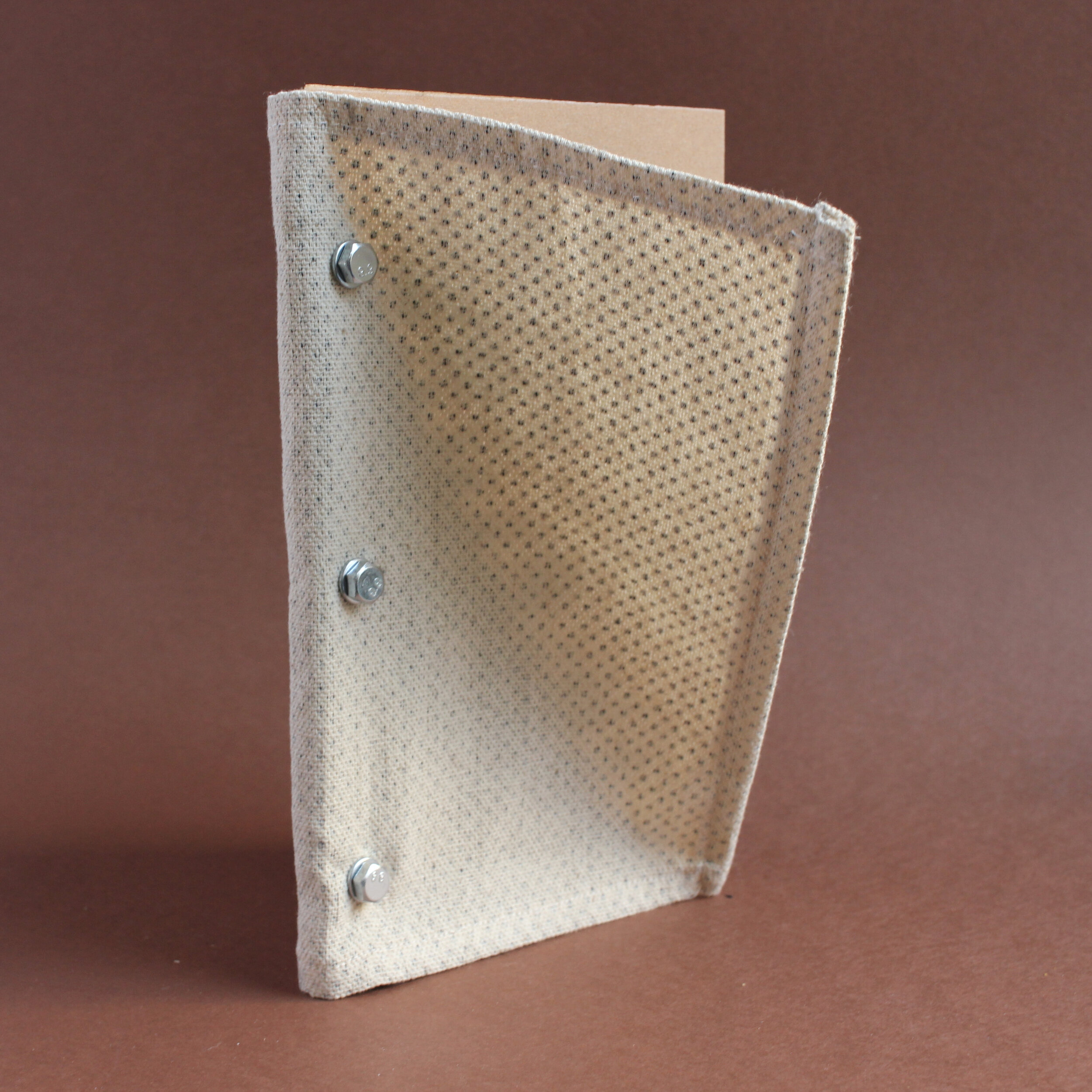
Playlet script, spraypaint on sandpaper, 18pp, one-off, 2021
Description
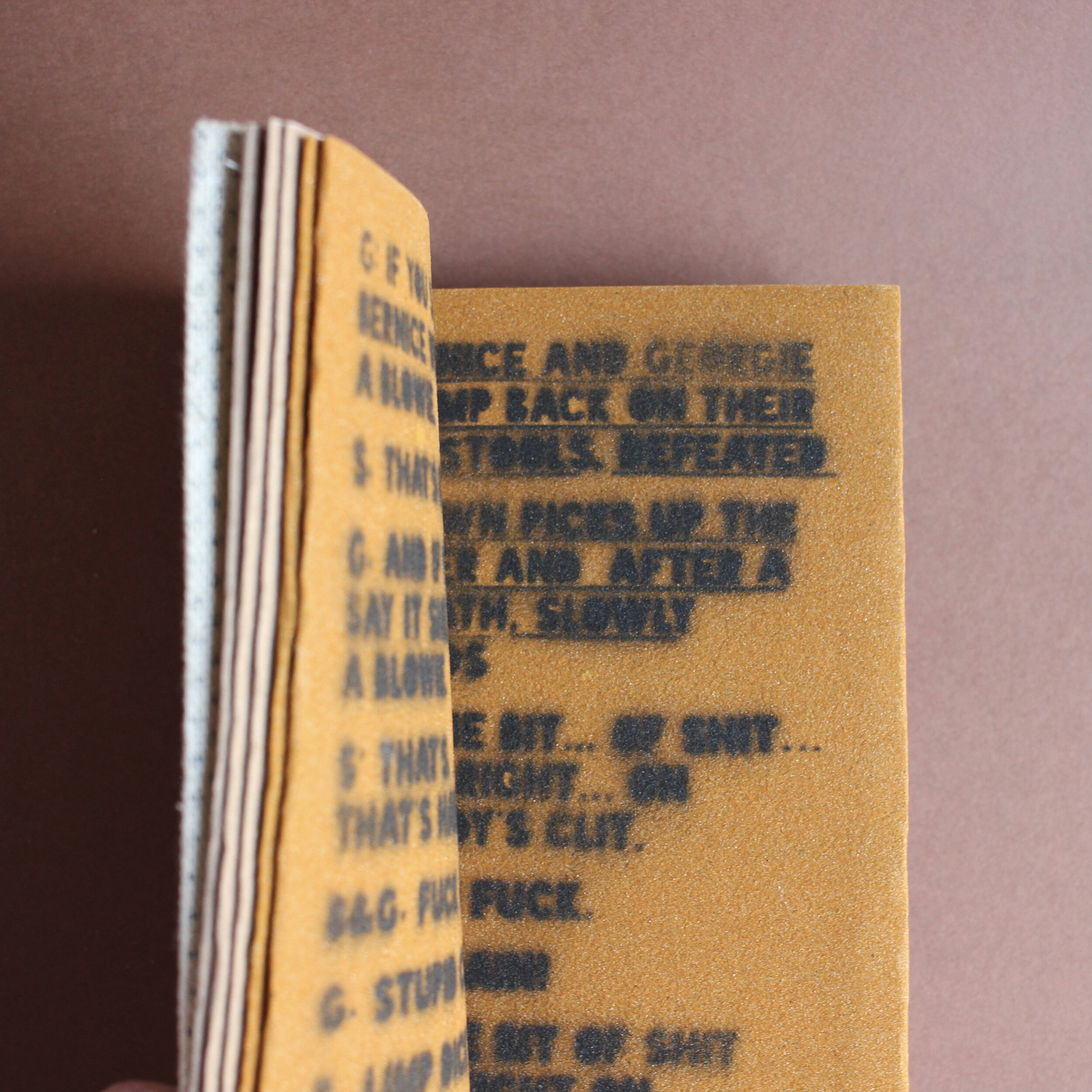
Coarse is a three-scene 'reverse Pygmalion' - a playlet about turning a nice person into a filthy animal. The pages are made of sandpaper and the text is printed via spraypaint and stencils. As the characters descend into squalour, the pages become coarser and the words are more difficult to read.
Background
This book owes a debt to 'Mémoires' by Asger Jorn and Guy Debord, which has a sandpaper cover. I sort of flipped it around, as I wanted the interior to be abrasive and harsh, but for the outside to be sort-of normal.
Part of making experimental books is playing around with form and content. I didn't really have any great desire to explore George Bernard Shaw's social experiment (or the musical version with Rex Harrison and Audrey Hepburn, for that matter), but when the idea of increasingly rough pages came to mind, it seemed to fit well enough. By necessity, a lot of the text is exceedingly vulgar and I was fine with it being rendered illegible.
The text is set in Blackout, an open source font from the League of Moveable Type. I created stencils on the Cameo cutter for each two page spread and used black spray paint to render the text on the page. Honestly, this process was a little slapdash (the flat stank of aerosols for a couple of days) but, as previously mentioned, I wasn't too concerned about the typography being sharp.
Using a modification of a Japanese stab-bind technique, the book is bound using three 25mm stainless steel bolts. Having decided to use sandpaper, I wanted to use only items I could buy from a DIY store. The cover is a section of the dust sheet I used to protect my floor as I sprayed the pages. Honestly, it may be a little too slack to effectively protect the pages and the bolts are perhaps a little too long for the book to sit comfortable on a shelf alongside other volumes. This makes it closer to Mémoires than I consciously intended.
A Book for Spiders
A commercial crime thriller, written for the arachnid reader.
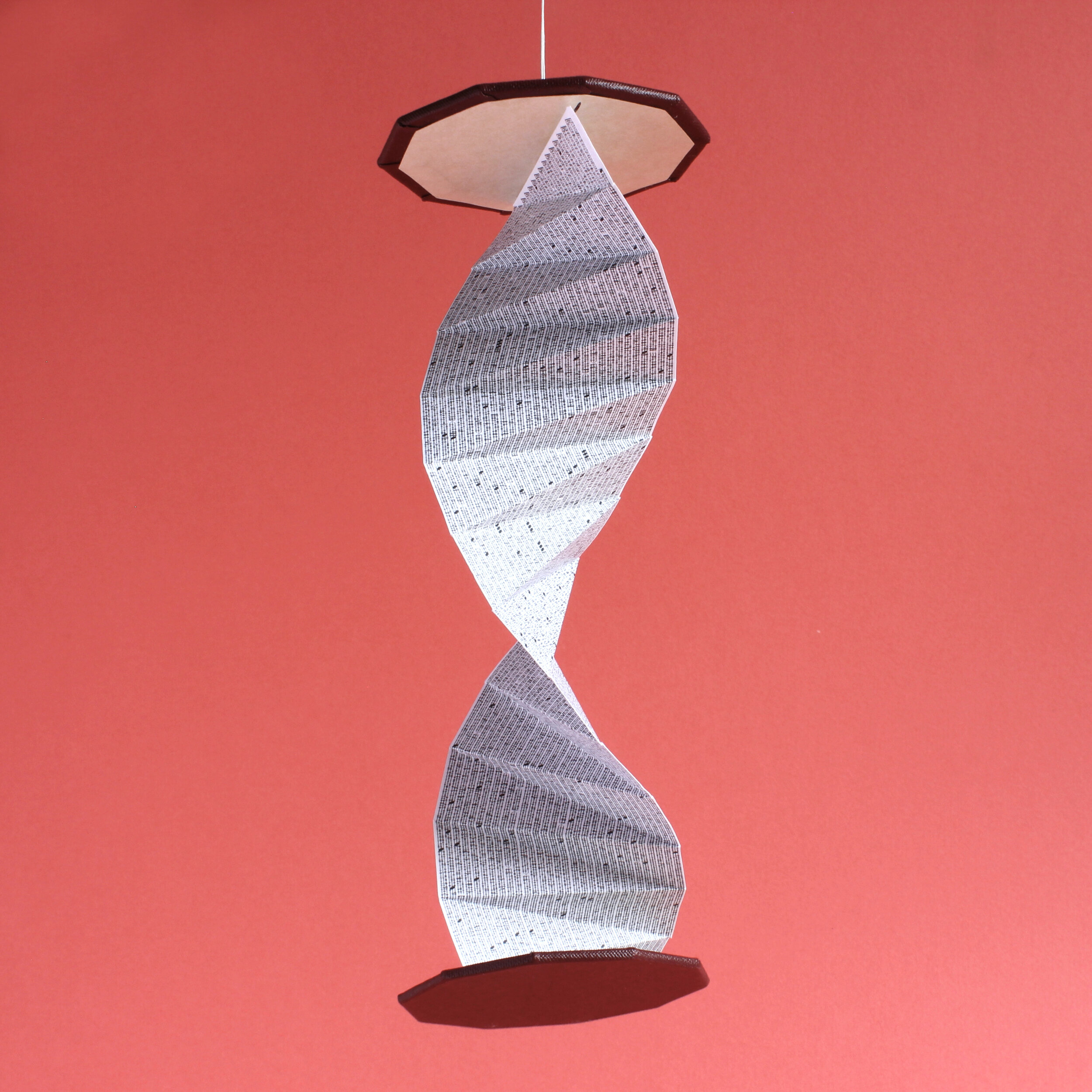
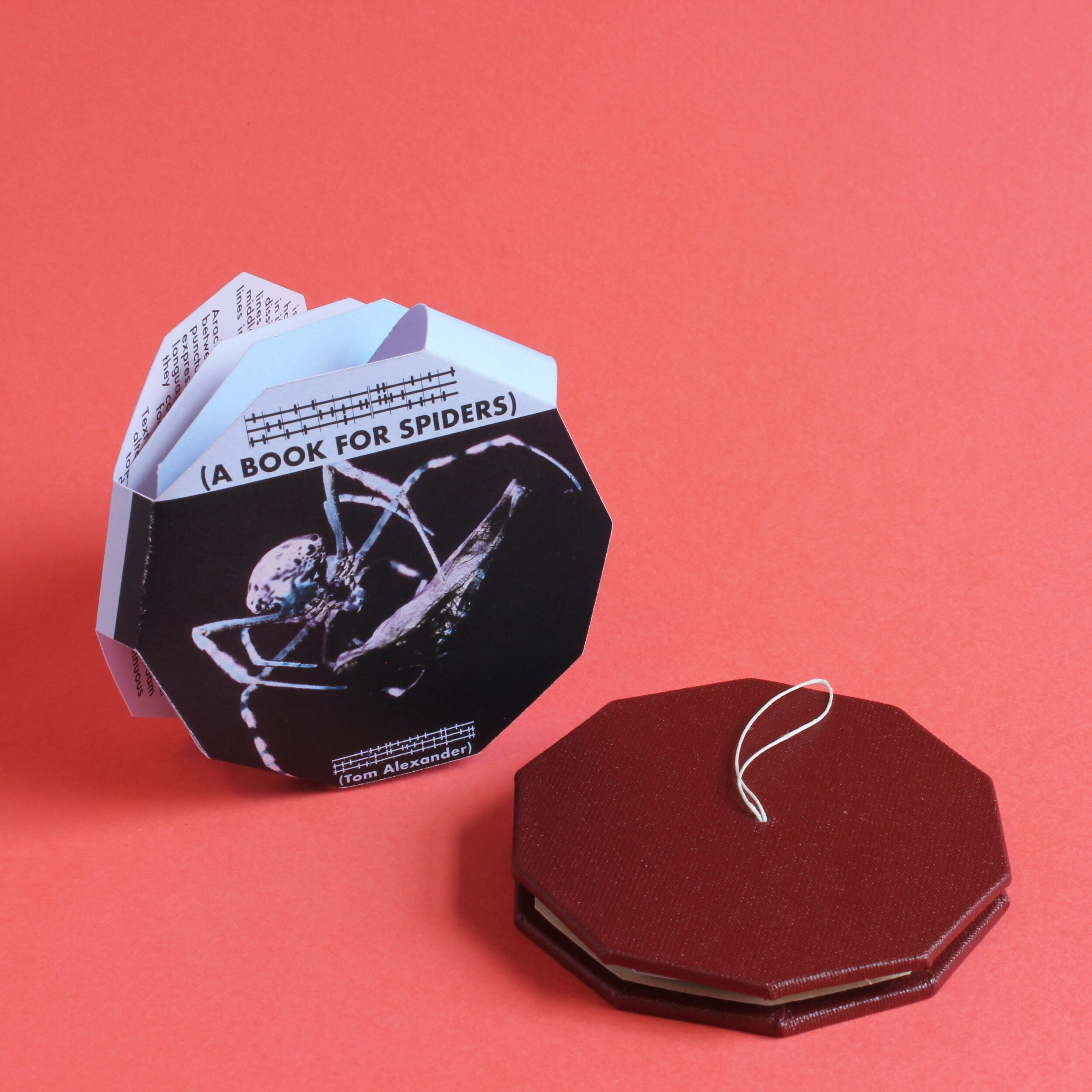
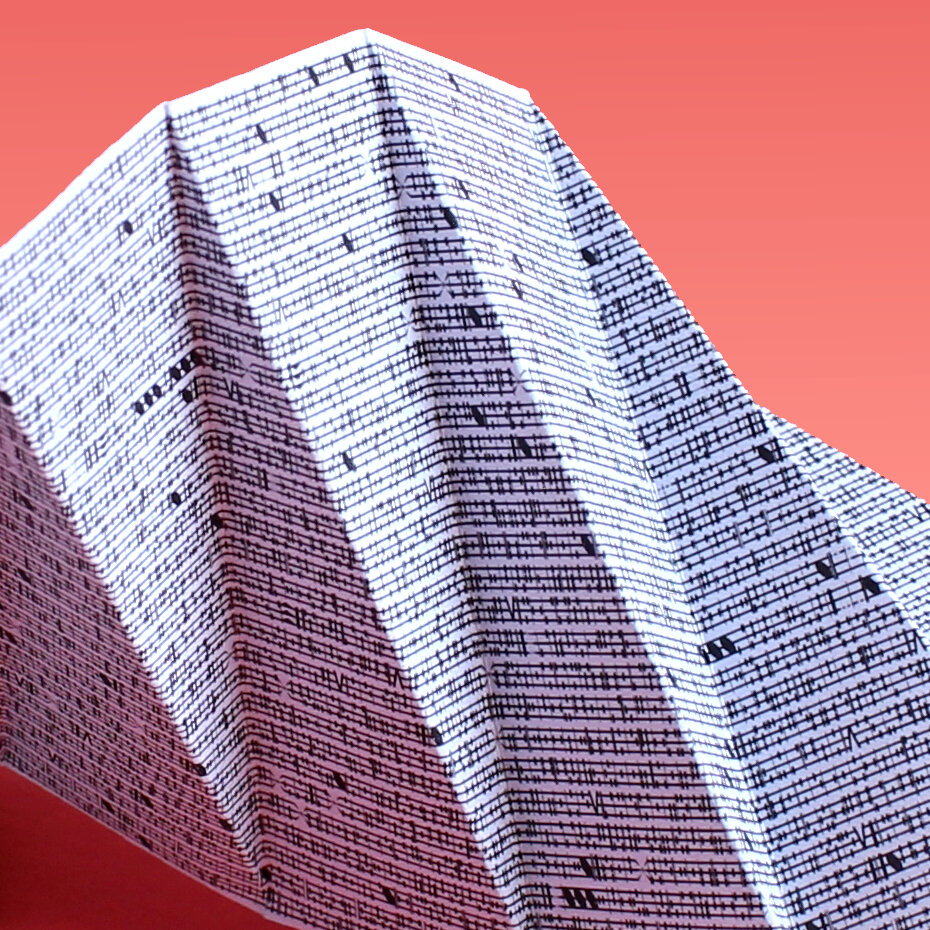
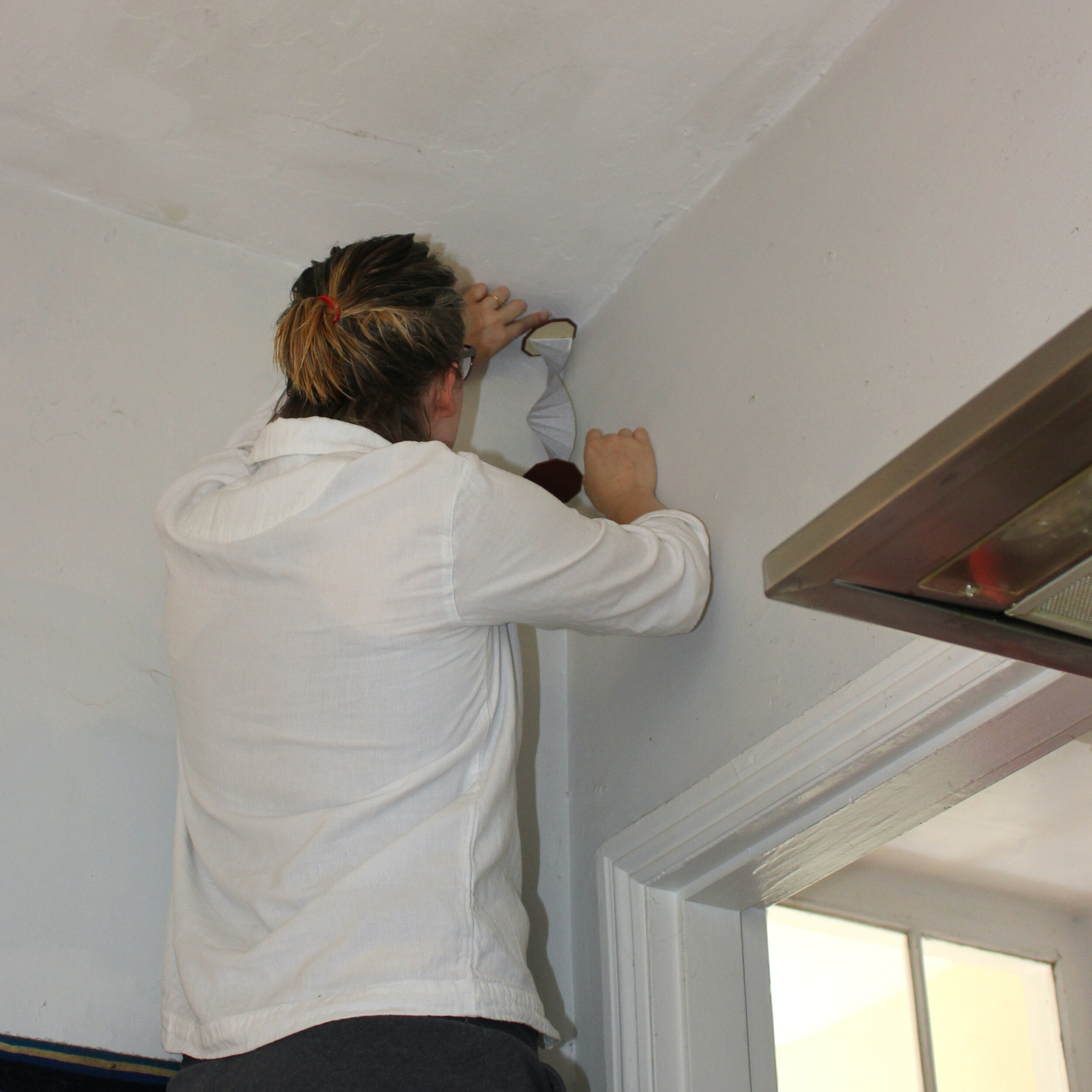
Hardback, 2021. First edition of 10 (+2 Archive copies)
Overview
A commercial crime thriller, written for the arachnid reader. The text is set in a custom typeface, running up and down the length of the single central page. An outer dust jacket explains the concept to humans, advises them as to the best place to position the book and contains a link to an English translation of Missing Limbs - the bestselling(*) arachnid thriller contained within.
Background
A Book for Spiders started as a sort-of funny idea, quickly scribbled into a notebook for a tiny pamphlet (a la Mouse Holes) which humans would stick in the high corner of a room so that spiders could read it. My partner saw my notebook lying open and told me I should definitely make it. As an inveterate people-pleaser, I set to work. I had made tiny publications before. This would be easy.
I reasoned that spiders couldn't read English, so spent some time considering what their text might look like. I had just done some font-mashing for Portrait/Landscape and mucked around with some basic ideas for spider letterforms. I figured spiders would be sensitive to vibrations on their webs and after some doodling, made an alphabet based adapted from musical notation. This formed the basis of Vox Aranae, which is the slightly pompous name I gave my spider font.
Then, of course, I had to think about content. Obviously, a typeface that couldn't be read by humans, set at a tiny size, could have any old filler in there and no-one would be any the wiser. But I would know, so obviously I was compelled to write a complete thriller about two mis-matched spiders grudgingly working together in order to take down a murderer. It wasn't an 80,000 word novel, but a genuine attempt to create the spider equivalent - smaller in size, but similar in structure and packed with as many genre tropes as possible.
With that done, I set my 30 odd chapters of clichéd crime fiction into a small pamphlet. I decided that while the book itself would be all for spiders, I also wanted an outer wrap for humans, explaining the book, offering the possibility of translation and also giving instructions on where to put it so spiders could read it. I laid out the text and wrapped it around the small volume I had created. It was exactly what I had set out to do.
But... eh. It didn't feel that different from Mouse Holes and I don't like making the same thing twice. It was, quite frankly, a bit of a bummer, because I had already spent more time on this throwaway idea than intended and I knew that there was more to come.
At this point, I had a break enforced upon me. I had signed up for the summer school at the London Centre for Book Arts - a week of hands-on instruction on various bookbinding techniques. It was a good experience and I learned a lot - namely that I am a slow learner, brutally impatient with myself and that I find group situations cripplingly stressful. I also learned how to bind books. (Seriously, if you're interested in learning book arts, LCBA is a great place to do it. The people are all really nice and knowledgable and they have a ton of cool stuff in the studio. If you can't make it there, then the book they created - Making Books - is a great overview of technique.)
With the course finished, I realised that I could actually make a Book for Spiders. So I began the process of prototyping a hardback version.
One of the issues I had with the traditional spine-bound version was the thought that spiders could get crushed between the pages. This hazard would become more dangerous with thick, heavy hardback covers, so I had to re-think the form and make it more spider-friendly. I decided that as spiders lurk up in corners, so too should the book. A paper-folding course I did at the Working Men's college (as well as this book here) had given me some ideas for alternate structures and I pretty soon hit on this dangling spiral that can fold up into a compact shape that can possibly fit on to a bookshelf.
Getting the construction right took a few goes. I'm not very adept with glue and getting the right amount of PVA in such a small space was... challenging. By the end of the project I had sworn off glue entirely, vowing only to use bindings that don’t require adhesive. We'll see how long that lasts.
The text runs up and down the length of the paper and then over to the other side. One of the problems with making small printed objects is that your margin for error is very small. This came through in both the print and construction. The paper folding was done to exact measurements, but no-one's perfect and any small deviation from the line means errors compounded on themselves and took the paper out of alignment. Trying to find a way to make the text block sit properly in the covers was annoying. Eventually, I stopped trying to find a system and took each one as an individual piece.
Overall, I’m pretty happy with them. Although I spent most of this project wondering why I couldn’t just do something simple and straightforward, I think the end product turned out real purty.
—
(*) - Show me one that’s sold more.
Portrait / Landscape
Orientation defines story in this two postcard set.

If you buy a set, please note that stands are not included.


Postcards, colour, 2021
Overview
Orientation defines story in a pair of digital mosaics.
Background
The idea for this was originally an interactive HTML piece, where the text would change depending on the shape of the browser window or the orientation of the phone/tablet. That proved too much for my rudimentary coding skills and was thrown away into a dark folder on an old hard drive. Later, it occurred to me that it would be better as pieces of paper and that led to the postcards you see now.
The intersection of pixel art, mosaic and monospace typography seemed to be a pretty straightforward one. I could just take a picture, reduce the resolution, slap a fixed-width font on top of that and wait for those sweet postcard bucks to come rolling in.
I sourced two pieces of art from the same artist, Jean-Pierre Renoir. The Portrait of Alfred Sisley and The Bay of Algiers seemed to scale well, in that they were still identifiable as a portrait and landscape when scaled down to a resolution of 37 x 44 pixels. The aspect ratios of the paintings didn’t quite match the target page size, so I had to fill in some bits of background and crop others.
The tiles are a customised version of the ‘scrabble squares’ in the Apple Symbol font. I used Font Forge to hack together a version that corresponded to their actual letters. Font Forge is a pretty frustrating piece of software to use. I’m sure it’s very powerful, but it has that inscrutable, in-depth technical sheen that a lot of open-source applications use to scare off users.
With that done, I wrote several versions of the short stories on the cards. Obviously, one was going to be about a person and the other was about a place, but it took a couple of drafts to get the right tone.
As with a lot of my pieces, writing and design process go hand-in-hand, but pull in different directions. The needs of the story are often constrained by the physical space that contains it. I don’t know if this is making me better or worse as a writer, but I find it’s an interesting way to work. It’s not so much “what’s good” as “what fits”.
Like a lot simple ideas, this one proved to be really fiddly. Trying to work out correlations of pixels to points and getting the colours balanced so they would be both readable and recognisable was a bit of a pig. It’s worth mentioning that Affinity’s ability to swap instantly between Publisher, Designer and Photo toolsets was a really handy. It’s one of the things I like most about it (as well as not having to pay a monthly fee).
Printing was outsourced to Print24, who are pretty good - fast and well priced, although they do send a ridiculous amount of emails about delivery. Most importantly, their postcards seem like they would stand up to the rigours of the postal system.
Strip
A never-ending story about not getting the hang of it.

Twisted paper
Overview
A never-ending story about not getting the hang of it.
Background
The Möbius Strip is, according to Wikipedia “a surface with only one side (when embedded in three-dimensional Euclidean space) and only one boundary curve.” I say it’s a cool shape with a cool name. For years I tried - and failed - to come up with a way of using it to tell a story. Obviously it would be a loop, with no formal beginning or ending, but apart from that I didn’t have much to go on. I bandied around some ideas, including a short treatise on time and space, based on this Worf-sampling Orbital track, a biography of French cartoonist Jean Giraud and a see-through comic about topless dancers.
None of these things worked, either because I didn’t really understand the concepts behind them (the first), because I didn’t have a strong affection for them (second) or because I was too embarrassed (third).
In the end, as with most things, I found bringing it close to personal experience was what unlocked it. I’ve never been a great one for home decorating and find the concept of wallpaper too strange to get my head around. The idea of every piece aligning perfectly made me feel stressed and this tension formed the the emotional heart of the story. As a former temp worker, I’ve had a lot of different jobs and can well remember the sinking feeling that comes with realising that no matter how hard you try, you’re just not getting it.
That understanding came with an insight sparked by the shape of the paper. What I like about the möbius strip is the twist it has in it, making it more interesting than a simple loop. That idea of the paper folding over itself put the picture in my head of wallpaper easing off one part of the wall, only to reattach itself to another.
This is one of several pieces I’ve created lately that involve loops or continuous cycles. Perhaps I just don’t like endings.
Oubliette
A free standing story about imprisonment, written in reverse text and read with a dental mirror.
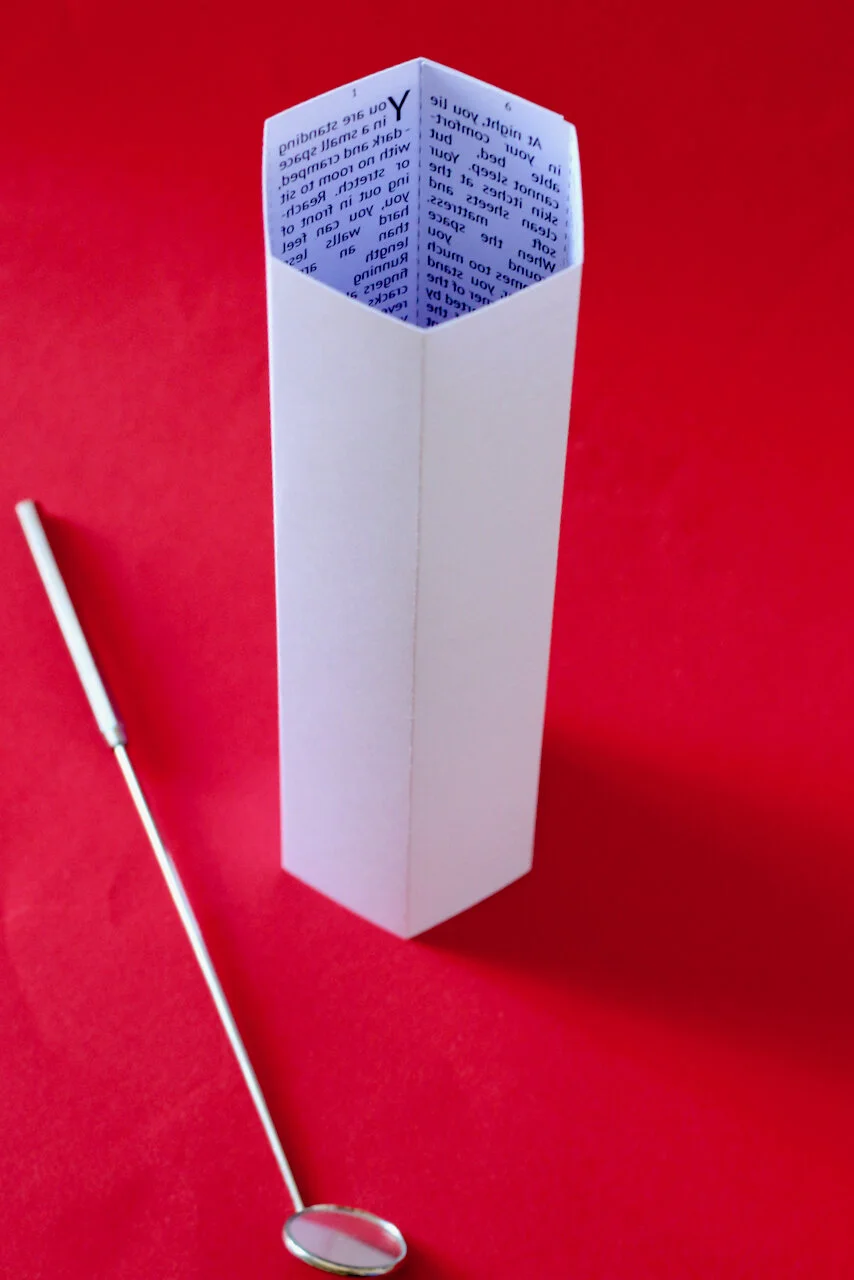
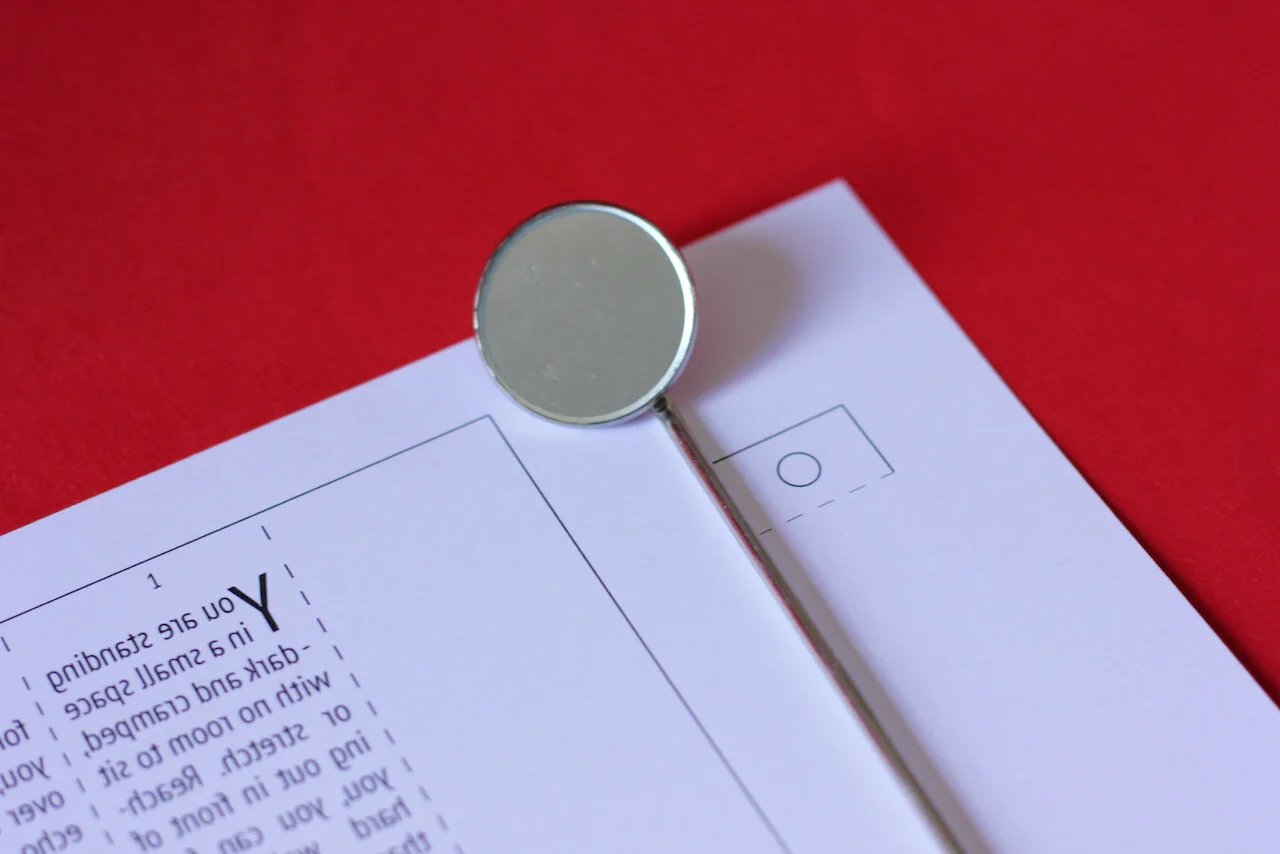
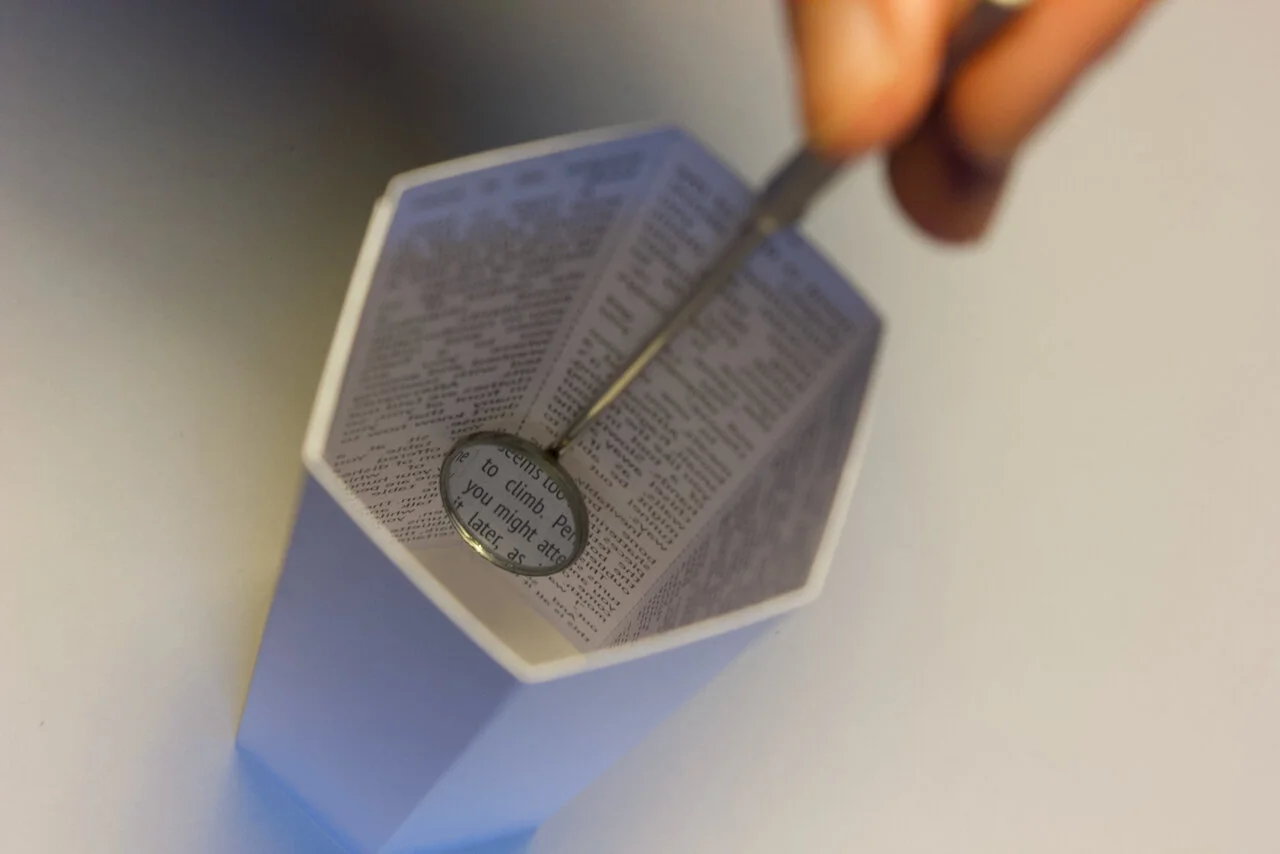
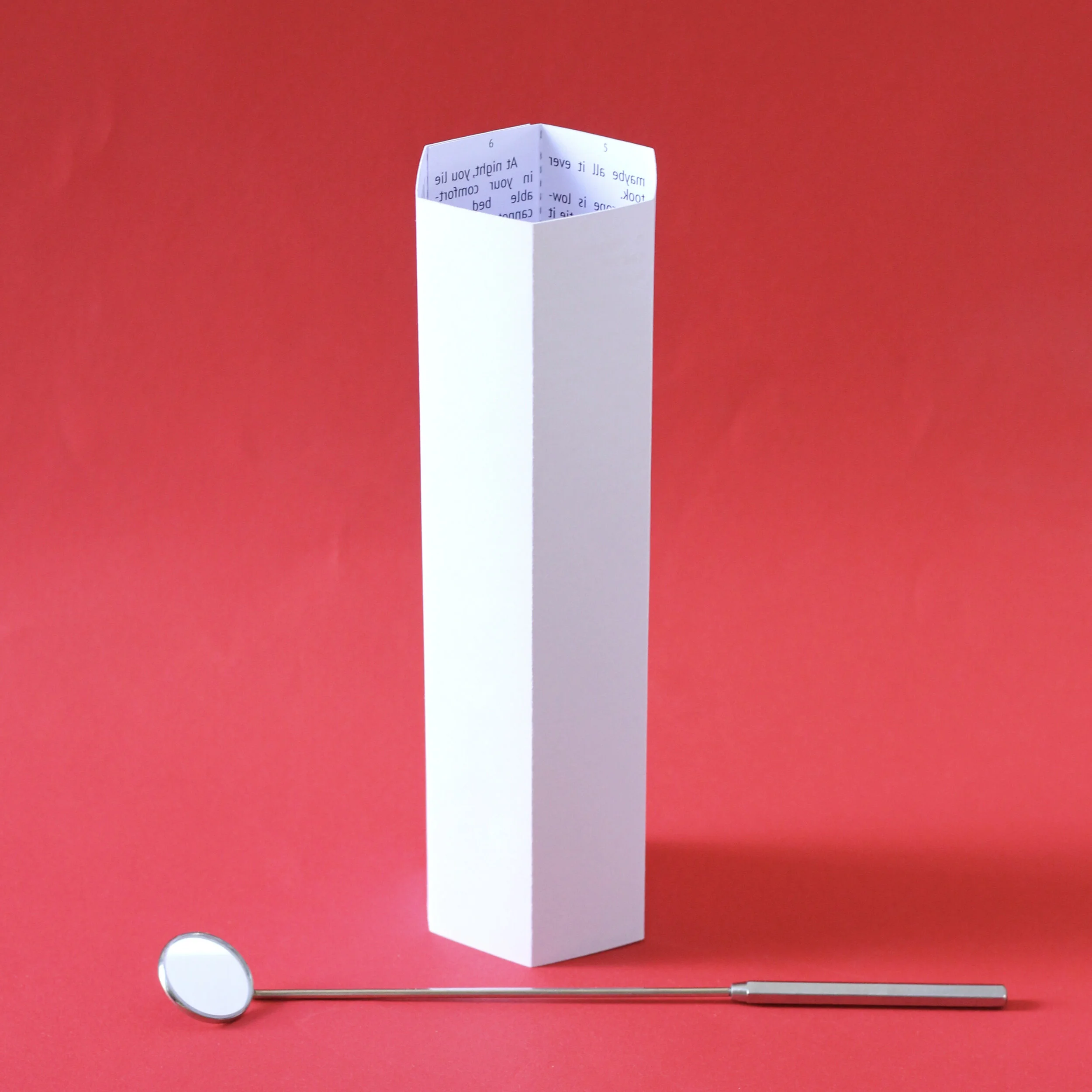
A free-standing short story about imprisonment, printed in reverse and read with a dental mirror.
This edition is pre-printed, scored and includes a professional-quality larangeyal mirror. Simple assembly required.
B&W, card
Overview
Oubliette is a story written on the walls of a free-standing vertical structure. The text is printed in reverse and must be read with a dental mirror.
Background
The first draft of Oubliette was written in 2020 as a short story exploring themes of constraint and freedom. The short (<1000 word) piece is sort of timeless and could be anyone and anywhere at any time. The use of second person perspective (“You”) is meant to put the reader directly at the bottom of the oubliette and directly understand the desire to get out and then, later, why someone might want to go back.
As I was experimenting more and more with putting text in physical forms other than flat pages, it seemed obvious to put ‘Oubliette’ in an oubliette. As reading the bottom lines would be difficult with the naked eye, I decided to print the words reversed so that they could be read with a long dental mirror.
A real oubliette has rounded walls, but mine would use a hexagonal cylinder as it would be able to lay flat. Initially, I wanted Oubliette to appear to be a thin book that would open up to reveal a pop-up structure inside. The first prototype was made from corrugated card, with text pasted on as strips of copy paper.
This prototype was documented in a short video which was uploaded to Youtube.
The first version was way too big, however, as the stem of the dental mirror wasn’t long enough to reach the bottom of the chamber. This made the text in the bottom sections unreadable.
A second version, scaled down to roughly A4 landscape, was made with grey board and coloured paper. While semi-authentic in its representation of the stone walls, the colour made it all feel a bit chintzy. I also couldn’t solve the problem of how to integrate a floor and a grille over the top. Various methods were tried, but none of them worked very well. Having them flap around, not really fitting or attaching to anything, made me hate the whole piece.
Trying to set the text took a few different approaches. I had wanted the reader to have to move the mirror both up and down the chamber walls to read the text. This proved even more confusing and although I had written the text, laid it out and constructed the piece even I couldn’t follow it. As the circular head of the mirror is only 25mm in diameter, the text was typeset as thin columns, first as one word per line, with two columns per wall.
Nothing was working very well, so I took things back to basics. I reduced the text to one column per wall, setting it in a condensed typeface that allowed for more than one word per wall. I also removed the lid and floor appendages and set the structure in simple white card of sufficient weight to stand, but also light enough to run through a printer. This one-sheet card has lines for cutting and scoring, but is a simpler and more elegant version of what came before. While this was the right move, I do sort of miss the more convoluted version. I’m sure there will be other stupidly complicated pieces in the future.
Staircase
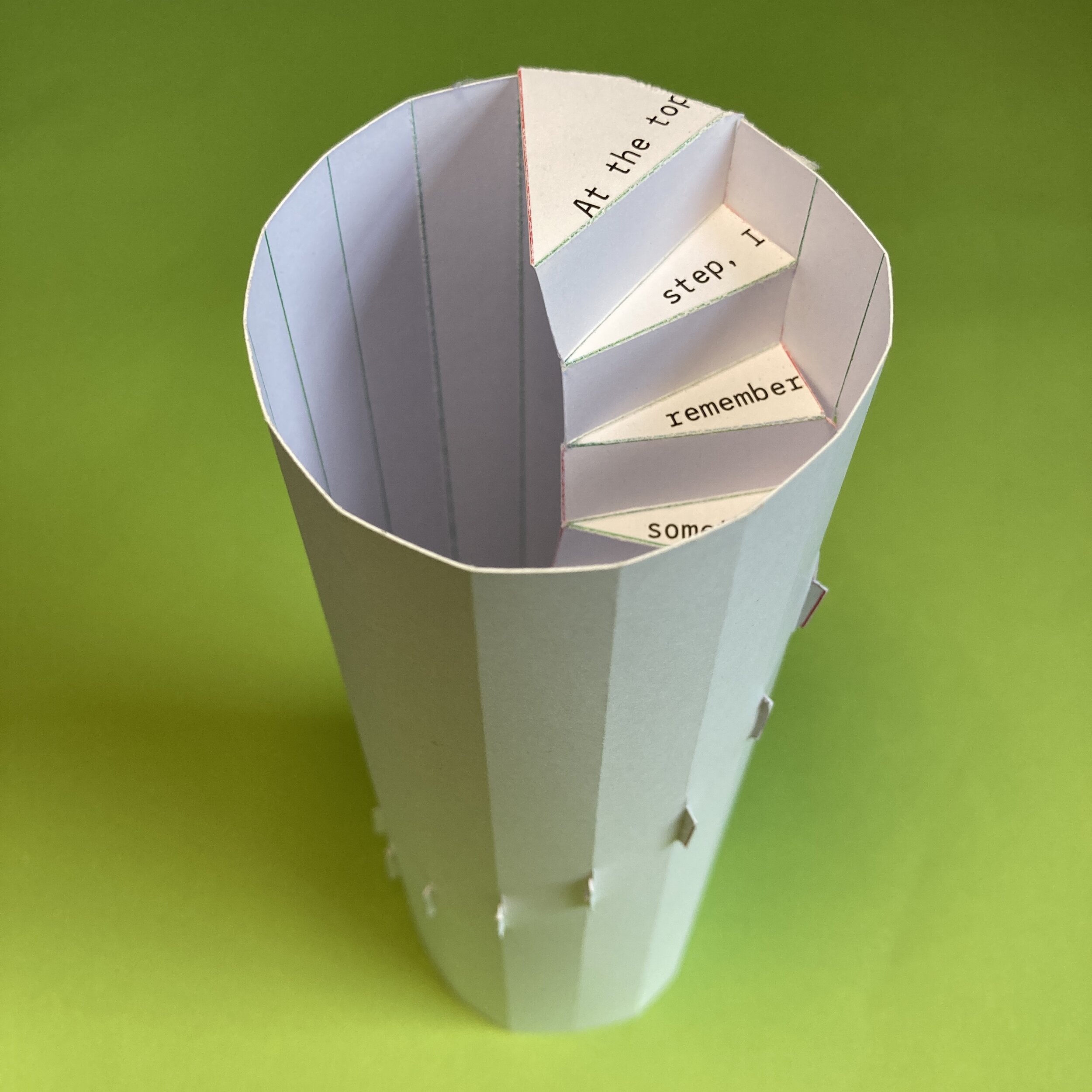
A story about going downstairs and back up again in an ever-descending/ascending spiral.
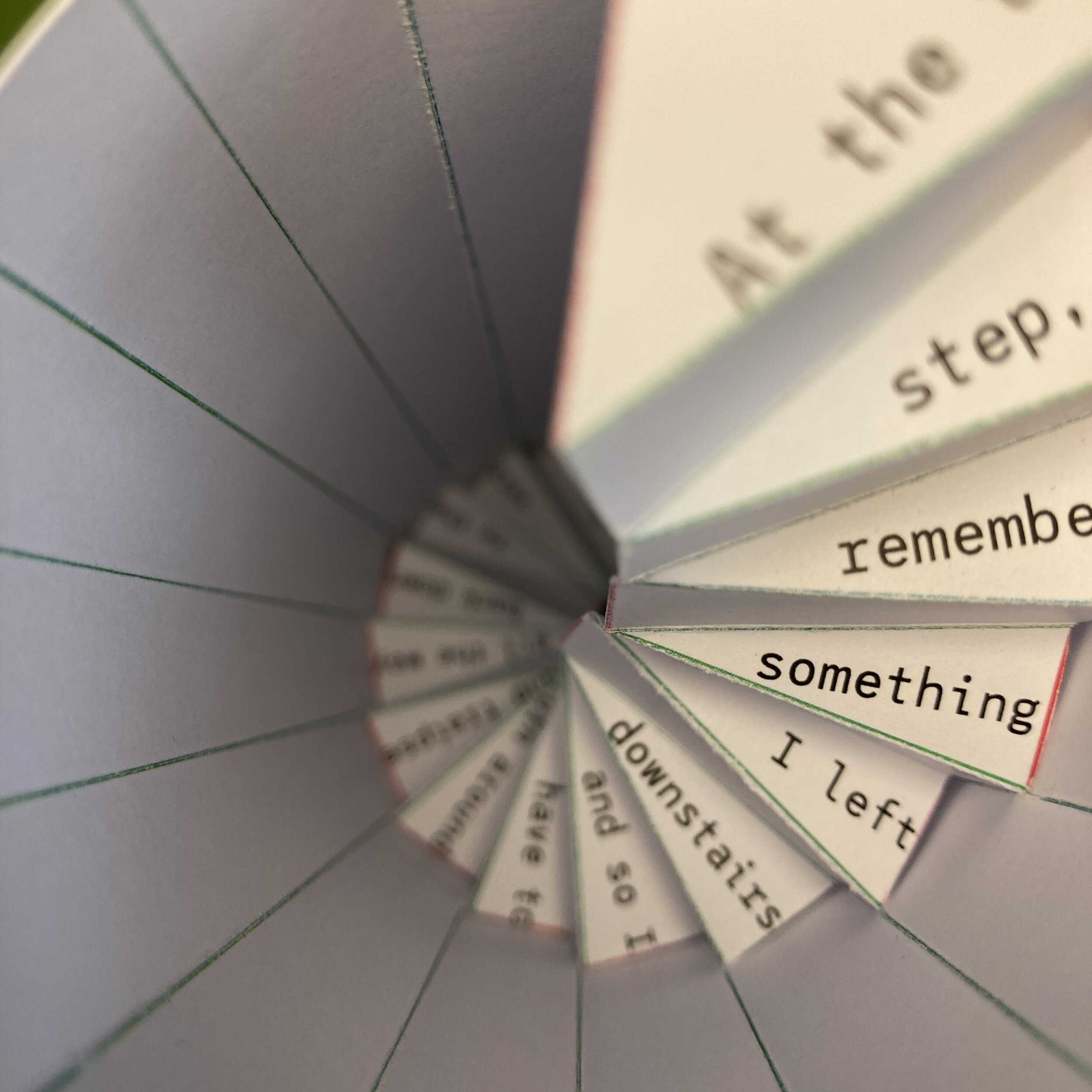
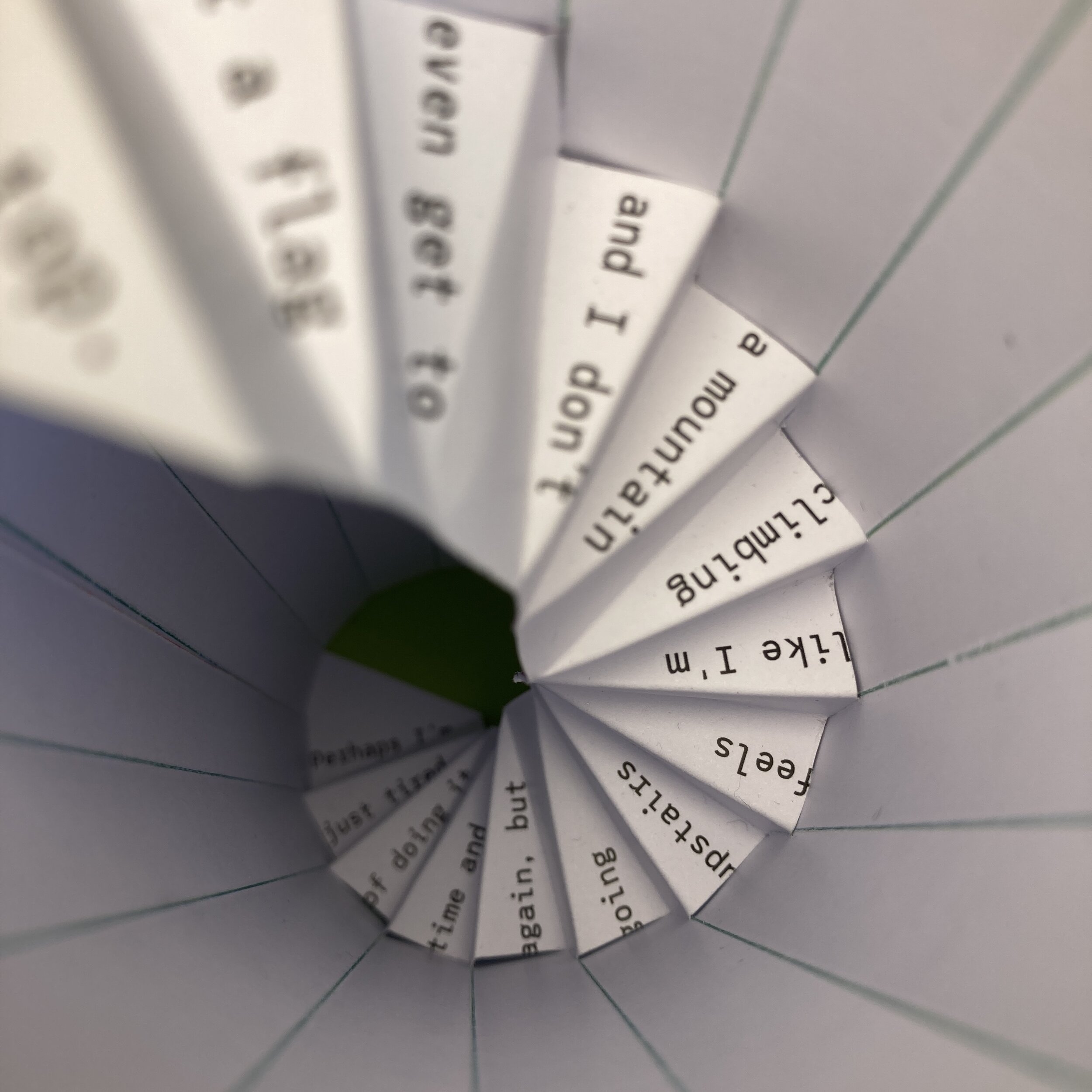
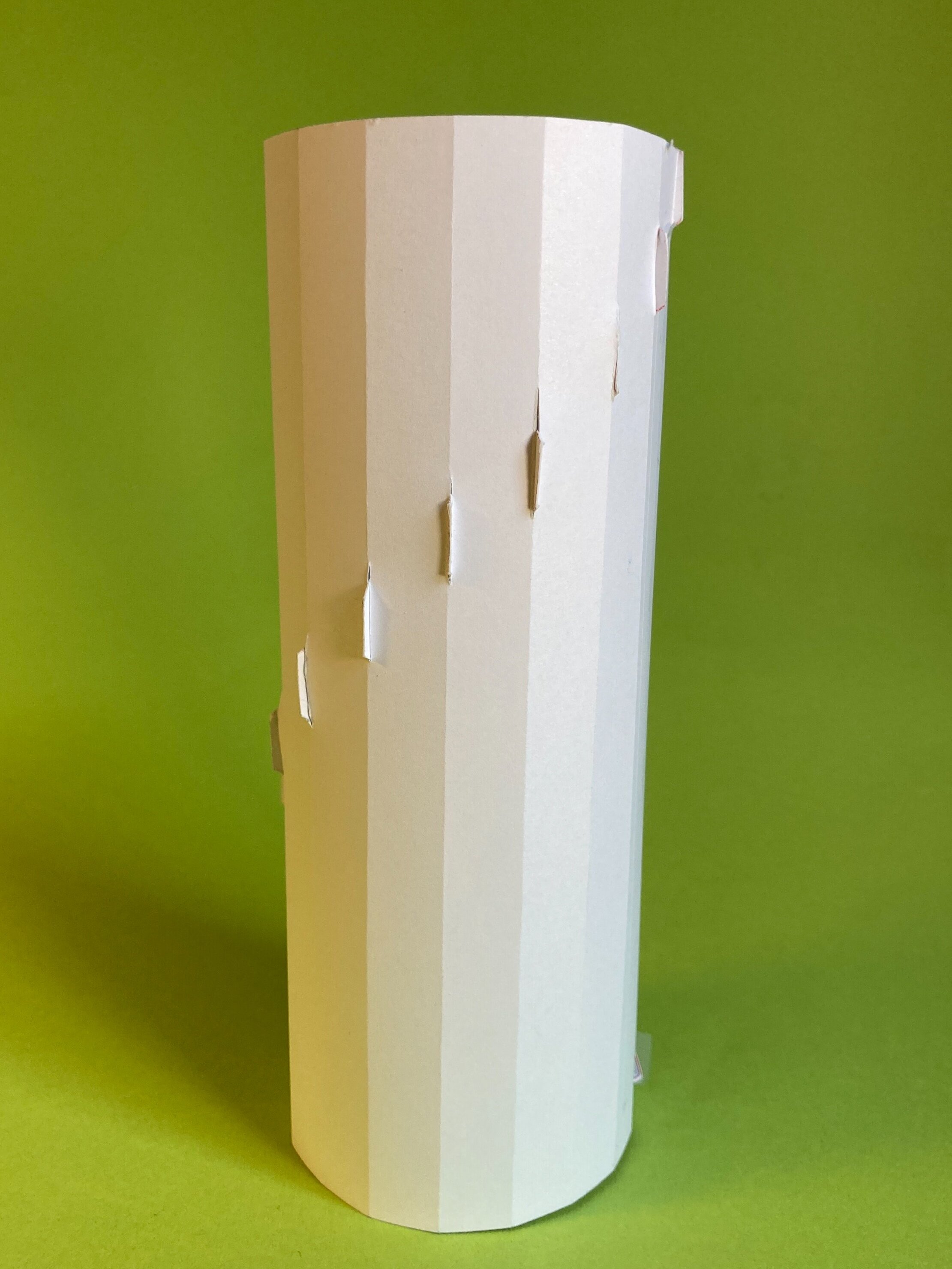
Cardboard, B&W
Overview
A story about going downstairs and back up again in an ever-descending/ascending spiral.
Background
Like a lot of people in the Coronavirus lockdowns, my usage of delivery services increased considerably. The distinct BEEP-boop of deliveries now provokes a Pavlovian response that sends me scurrying for my next treat. Our flat has a staircase down to the front door (although not a spiral one, sadly) and the process of hoofing down there to meet the postie has become all-too familiar.
It made me think about two-floor living. I grew up in maisonettes and the feeling of traversing the stairs, only to forget what you went up or down for is a very familiar one.
Building the structure was a mathematical challenge that was a bit beyond me. After several attempts to make the net by hand, I turned to Unfolder, a Mac app that transforms 3D models into 2D nets. I have dabbled with Blender and other 3D modelling programs for years now and although I wouldn’t call myself proficient in any way, they do come in handy sometimes. I managed to make a version of the staircase, unfolded it into a net and then added text manually.
Staircase is indicative of my increasing interest in looping narratives and stories contained in upright tubes.
Prismatics
A series of letters from a personality split by the colour spectrum.
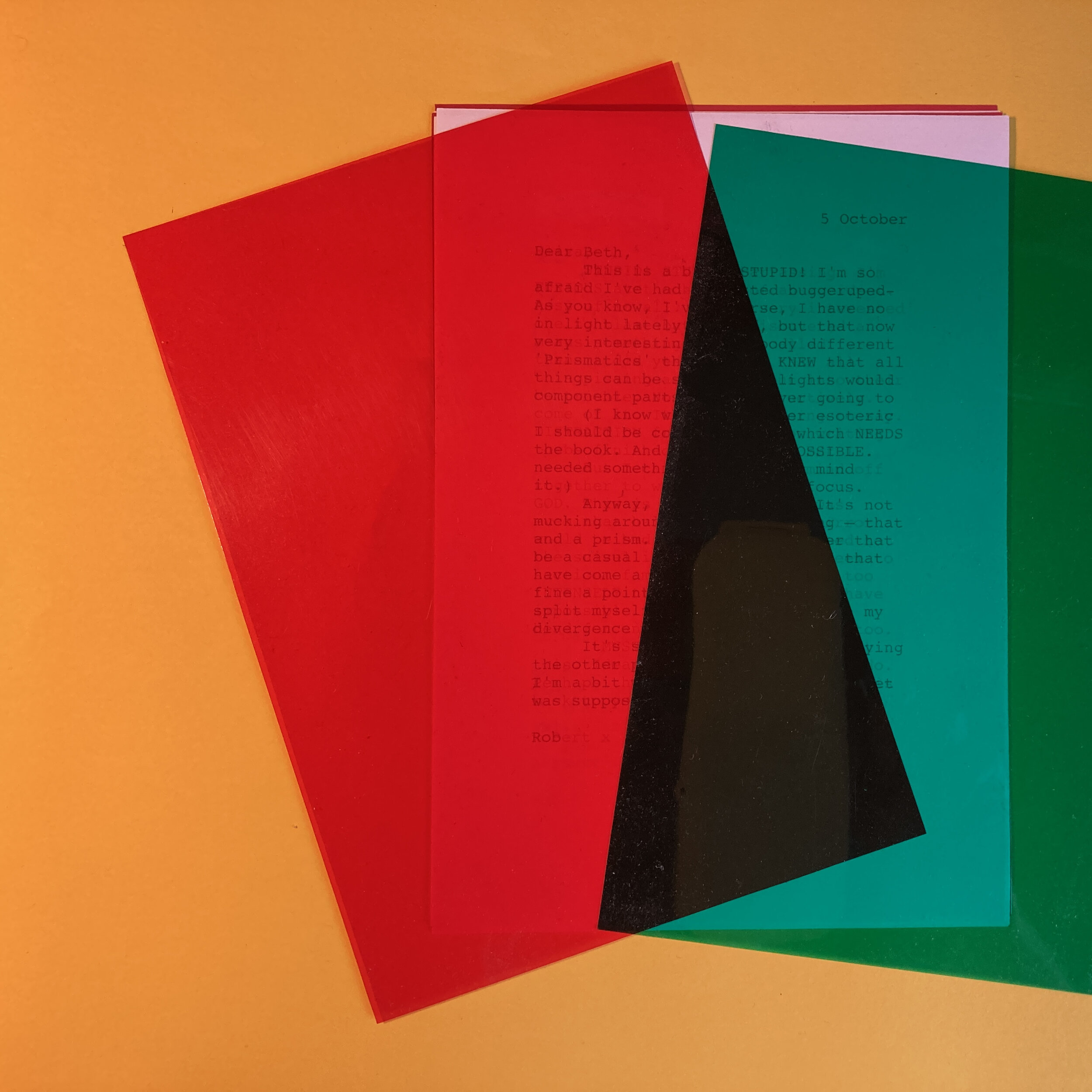
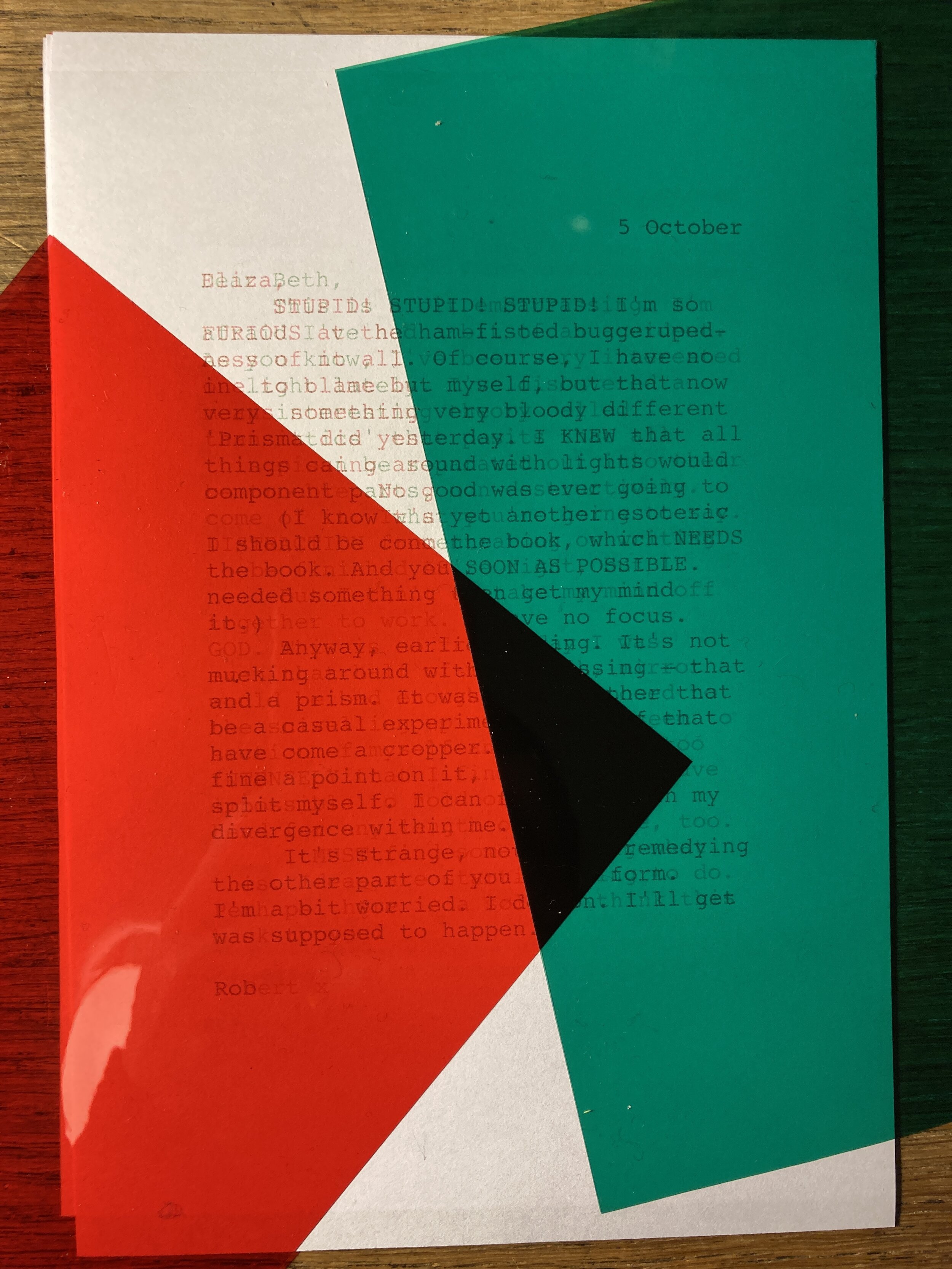
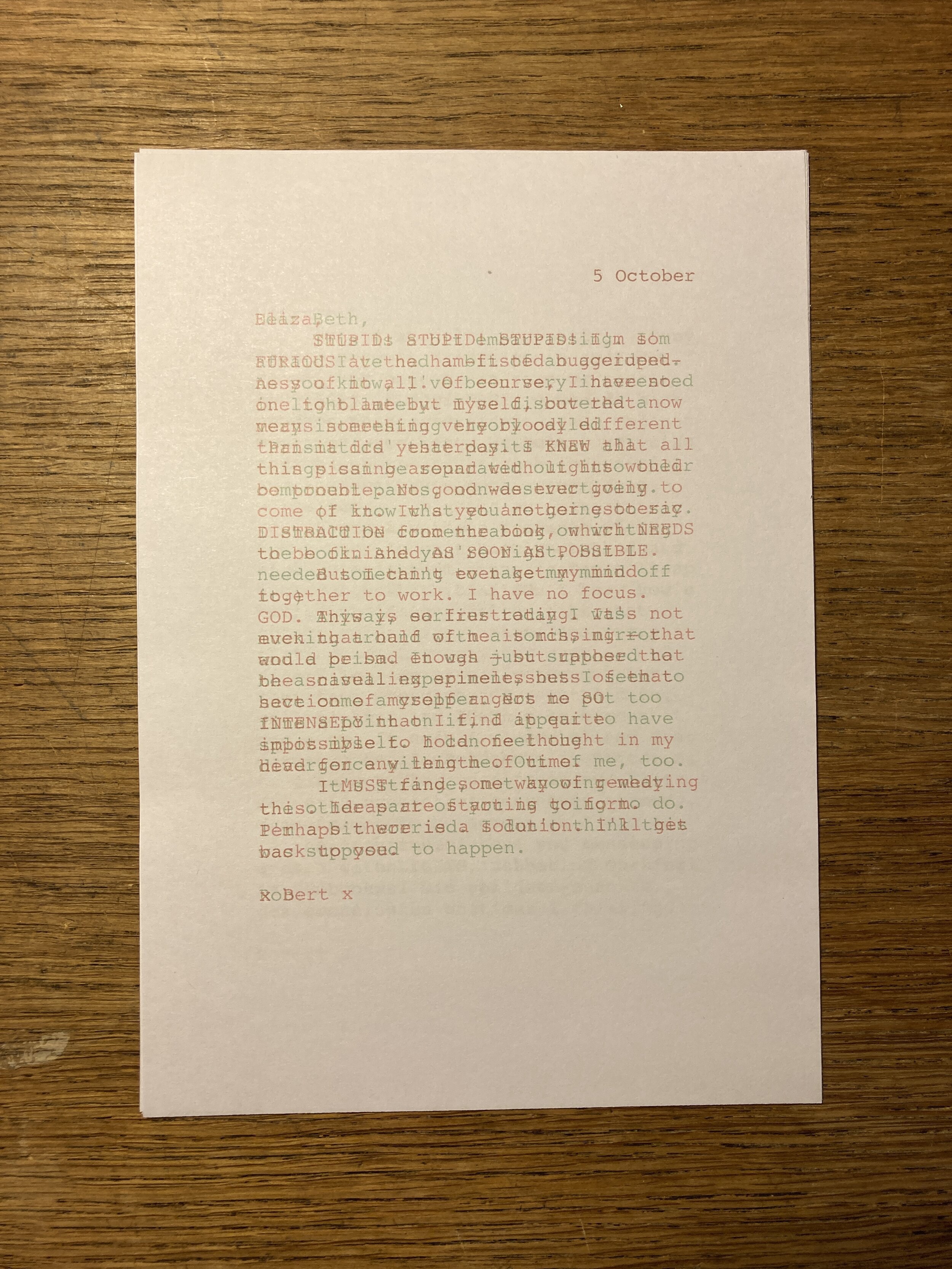
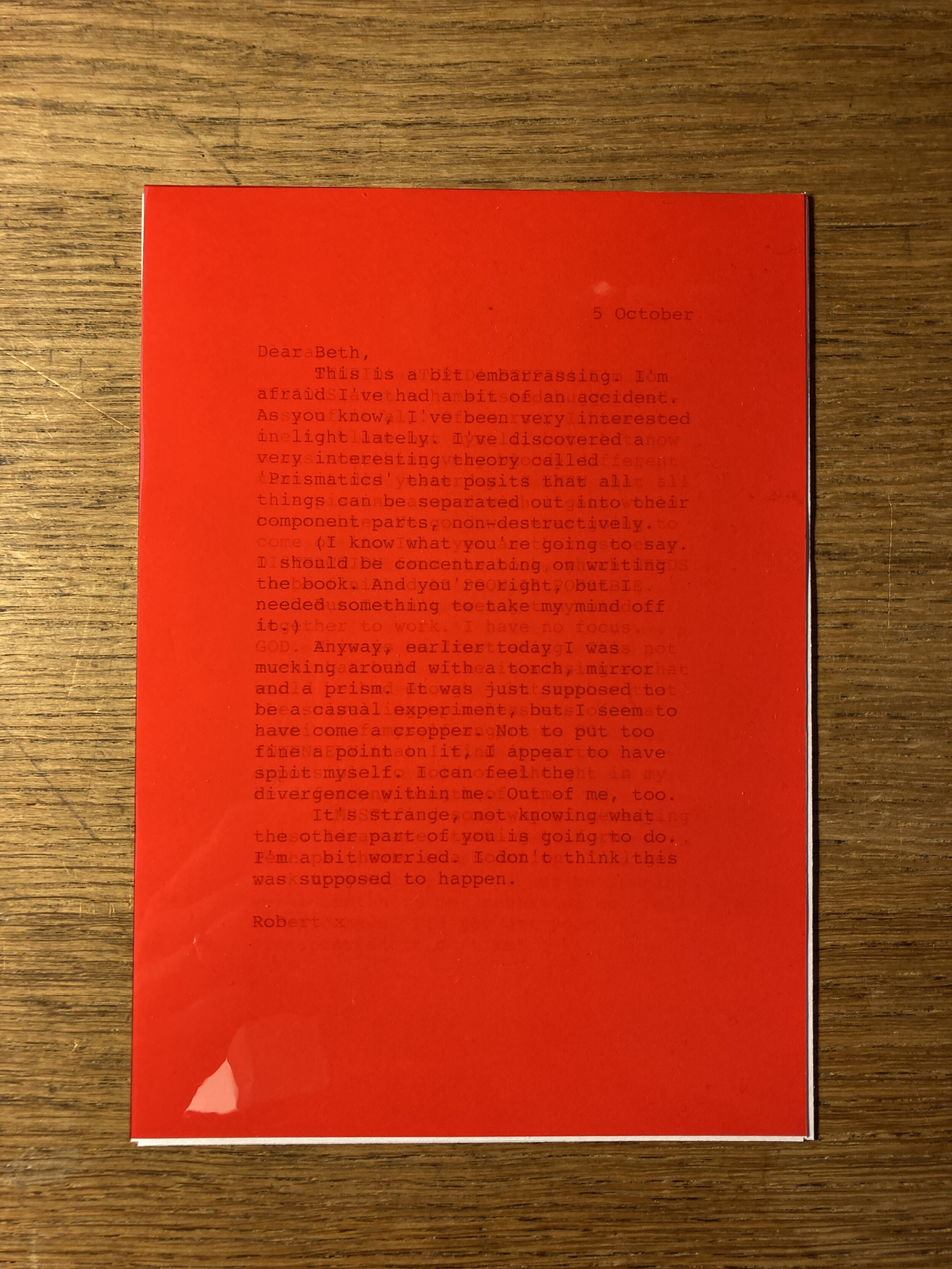
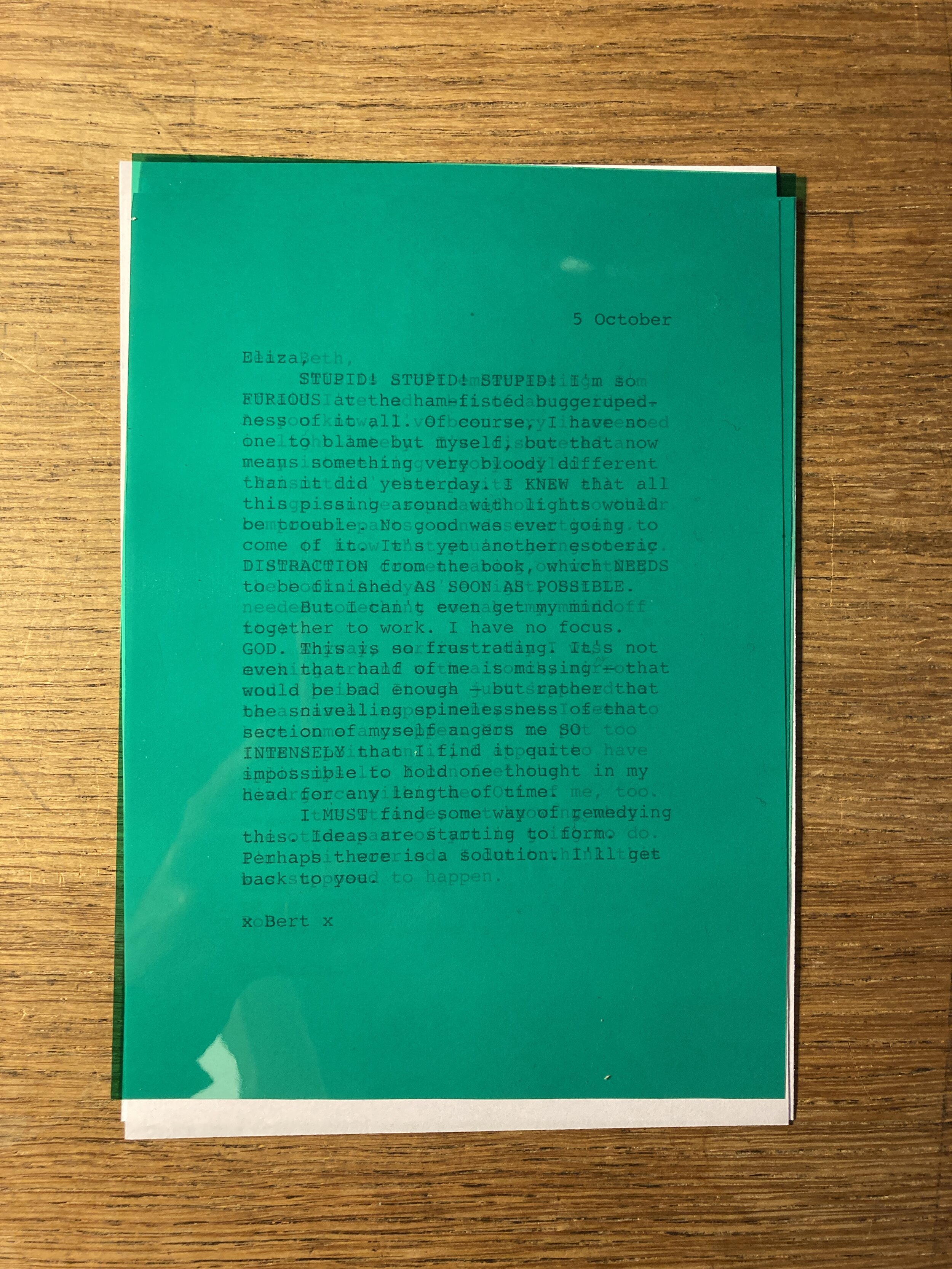
8pp, 2 colour printing, red + green coloured gels
Overview
Prismatics is an epistolary experiment. Eight letters, sent over the course of a few weeks, detail the splitting of one person into two and the conflict that brews between them. Each letter has two colour passes printed on the page, forming an unreadable jumble of letters. In order to decipher it the reader must use the enclosed coloured acetates, which filter out one of the two colours.
Background
This was not an easy piece to write. I knew what I wanted to do from a technical point of view - have two stories occupy the same space - but finding the appropriate story and tone took a while. A lot of my work is about finding the right combination of narrative and form. Often, I have one but not the other. The frustration in not being able to move forward found its way into the text - half of it, at least - and the clash between the two became the central tension running throughout the story.
Forms
Odd bits of bureaucracy to complete at your leisure.


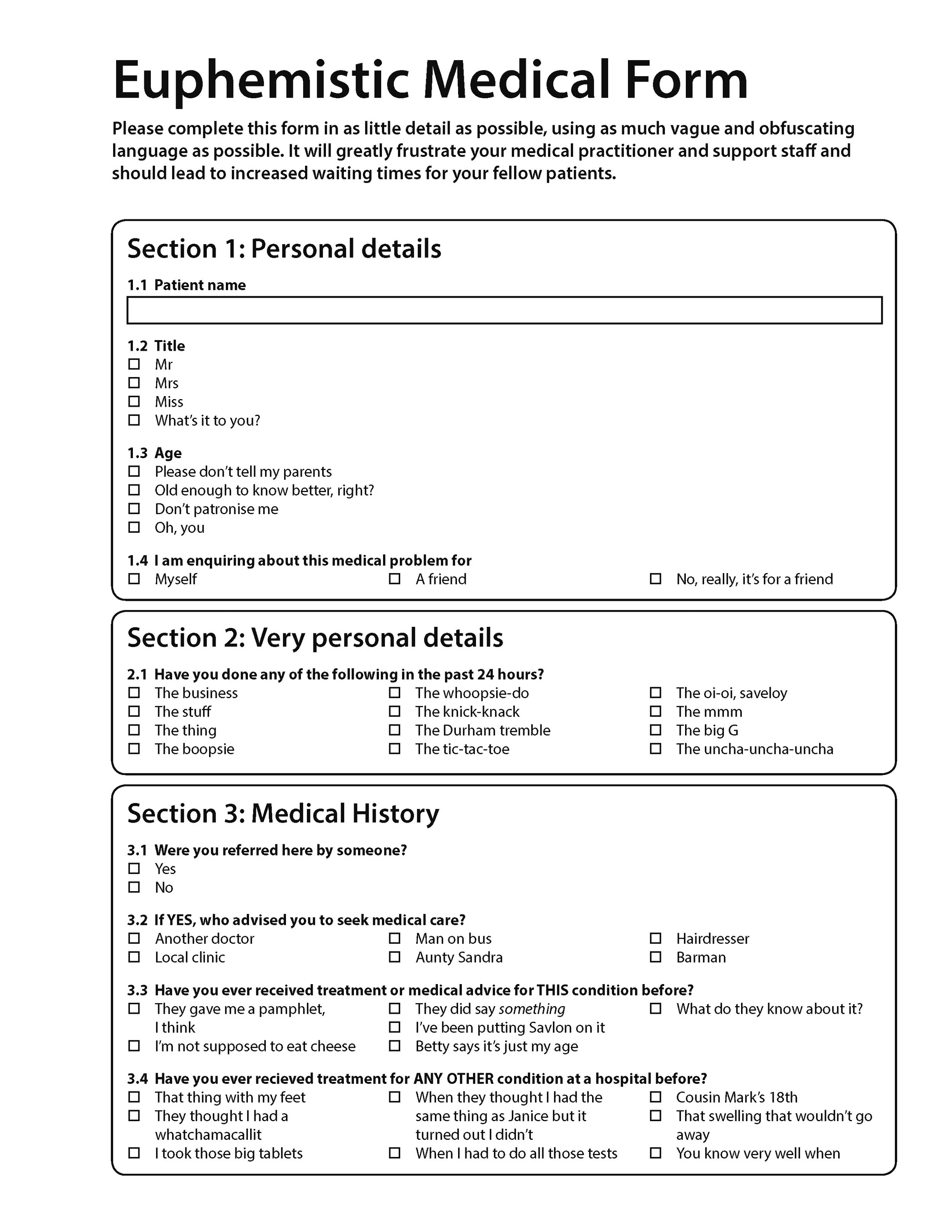
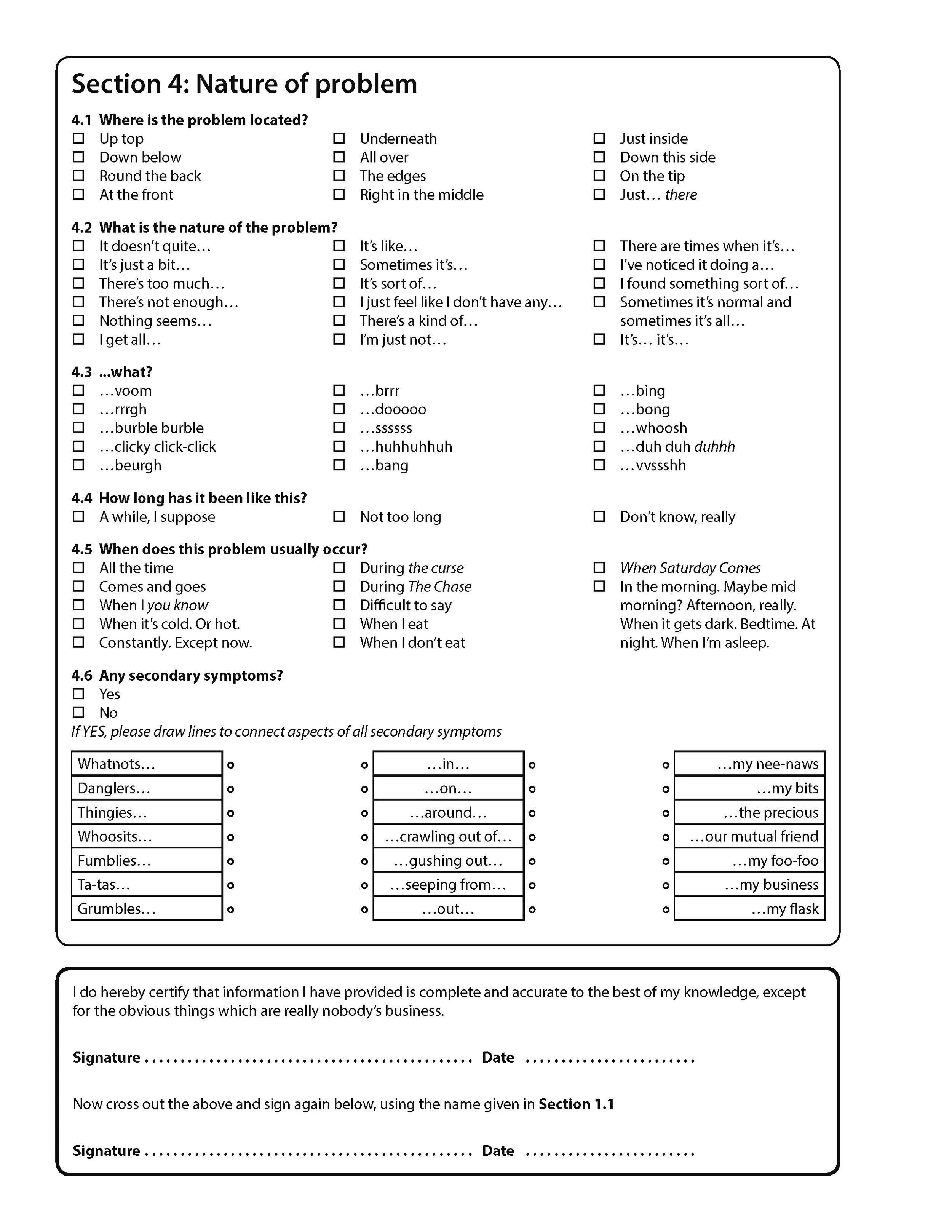


Everyone loves filling in forms. Now you can enjoy bureaucracy at home with this amazing activity book. Whether you need to communicate with the spirit plane, apply for a friend with benefits or just create a scene, 'Forms' has the proper paperwork for even the strangest situation (black ballpoint pen not included).
Paperback, 60pp
ISBN 978-1-9160373-0-4
Overview
A collection of 60 pieces of paperwork for readers to fill in themselves. Billed as “The nation’s favourite paperwork”, the book is a weird piece of novelty publishing.
Background
Forms is the realisation of a long-held dream - to publish a book that the readers write themselves. I had the idea quite a few years ago when I was focused on writing commercial gift books. My publisher at the time passed and I had the distinct impression that another publisher nearly published it, because they held on to the manuscript for 14 months before I got a full-page handwritten rejection letter from the editor. (That might not sound like much of a big deal, but publishing rejection letters – when you even get them – tend to be terse and automatically generated).
Although it hadn’t found a home in commercial publishing, I was always fond of the idea and a few years later dusted off the files, rewrote some stuff and made the layout more consistent. This was mostly catalysed by learning that IngramSpark could publish books with perforated pages. As soon as I set up the title with them, they stopped offering it. Monsters.
Anyway, it’s here. I still quite like it. It’s fun to fill in and I honestly do recommend you do that, rather than just read it in a pristine state. Filling out the stupid questions may provide you with some interesting answers.
Mouse Holes
A tiny piece of titillation for discerning rodents.
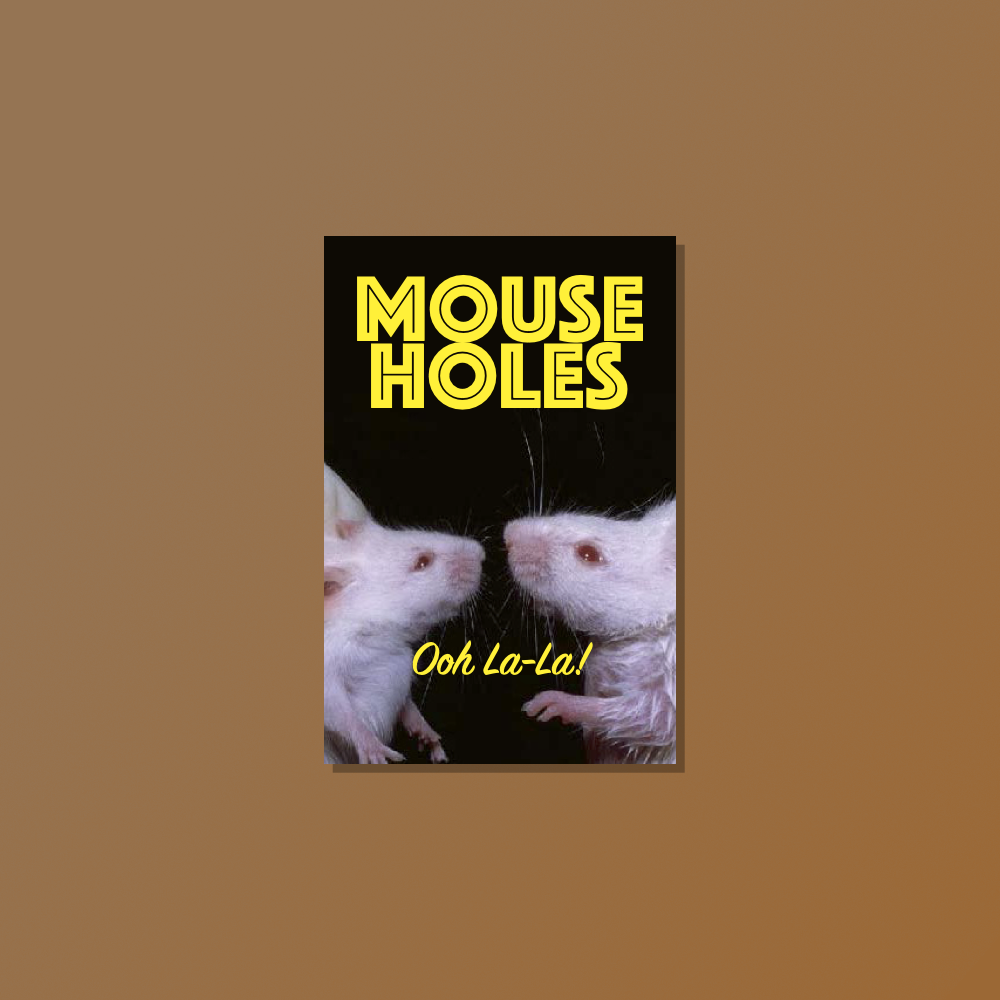
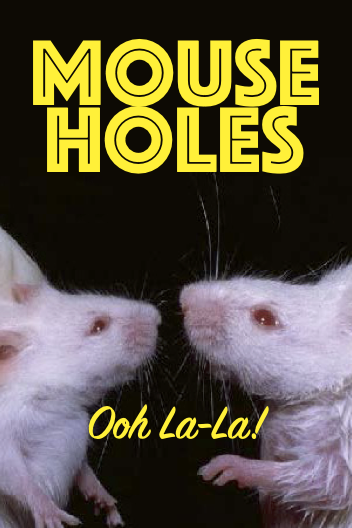
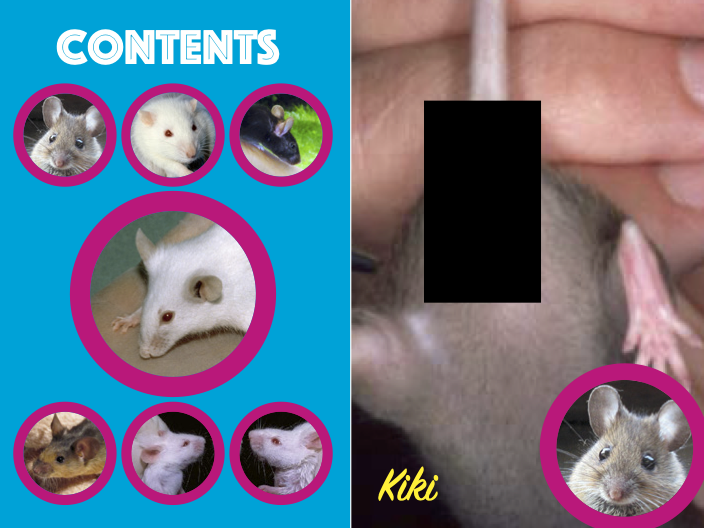
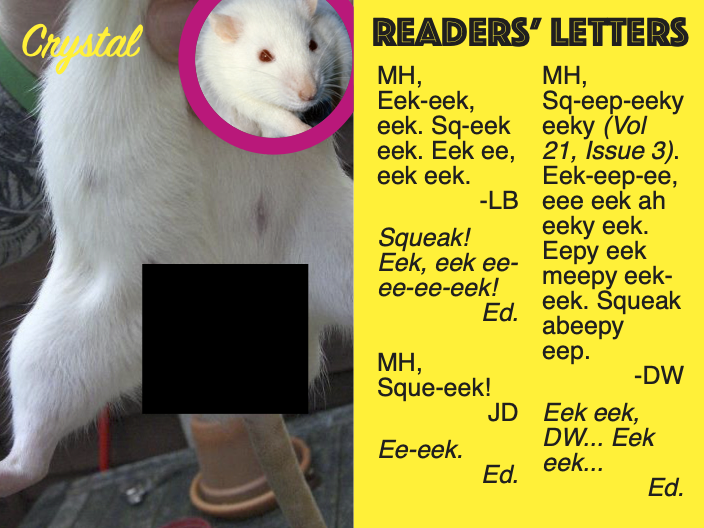
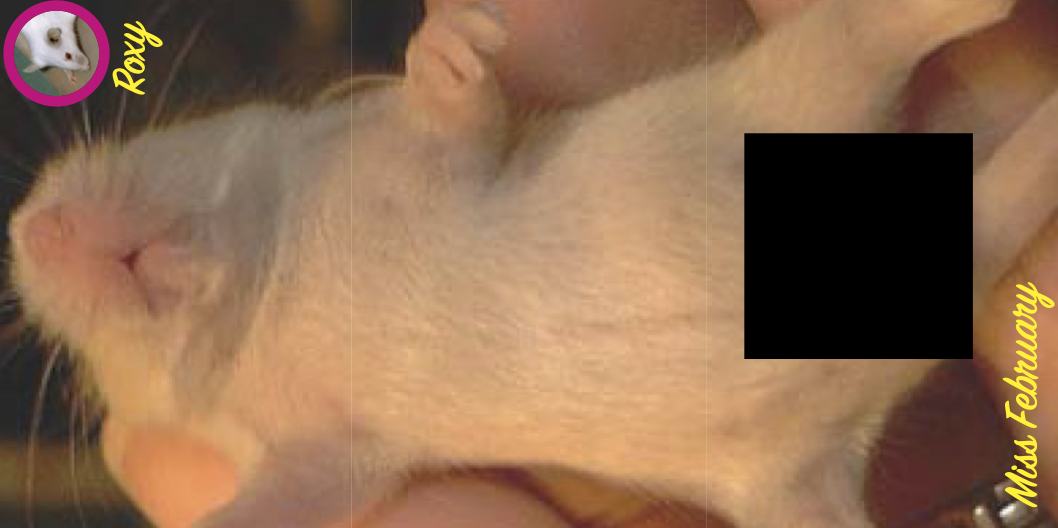
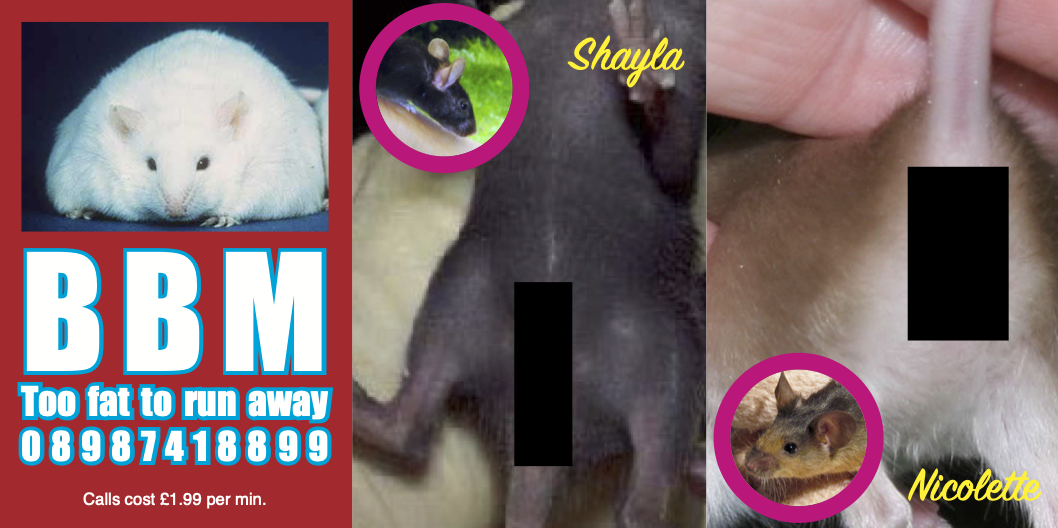
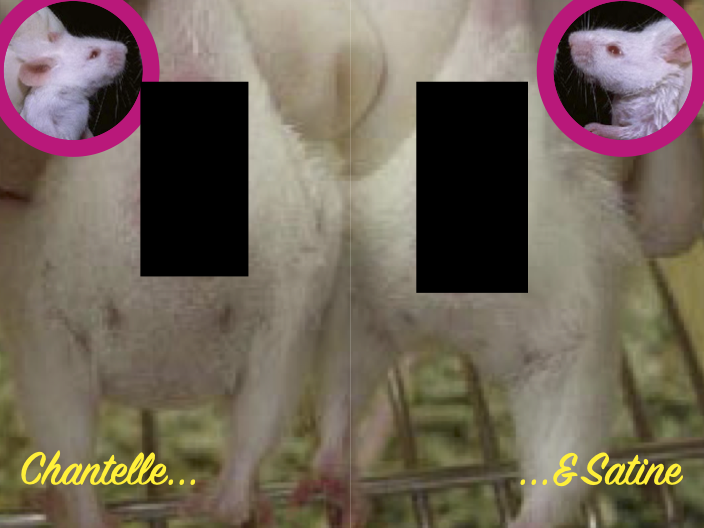
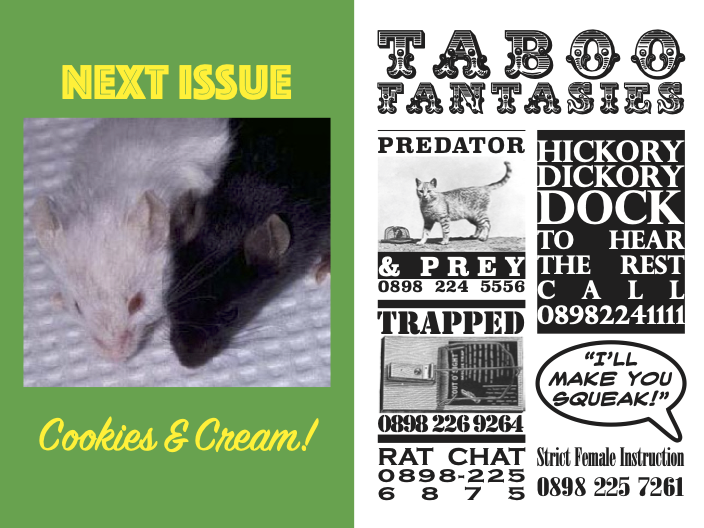
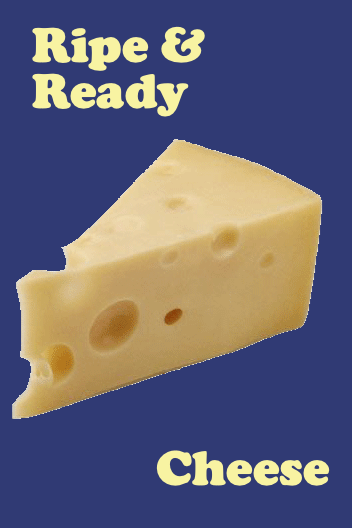
Minuscule magazine, 16pp inc centrefold, colour
Overview
A tiny piece of titillation for discerning rodents.
Background
We live in an age where if you want to look at pictures of nakedness, you can do so at the blink of an eye. A few taps on your smartphone and there they are. The idea that you once had to go to the newsagent and furtively reach up to the top shelf to get a magazine full of said pictures has become so anachronistic that it’s almost quaint. Apart, of course, from the corrosive effects of pornography on society and individual mental health and so on. But still, you know what I mean.
Mouse Holes is meant for those who don’t have access to smartphones or high speed internet, in order for them to have access to high quality nudes. I’m talking about rodents, obviously. This tiny magazine is packed with explicit-yet-tasteful pictures of ravishing rodents. In addition, there’s the other things you would expect from a top quality magazine like this, including a centrefold, reader’s letters and adverts for premium-rate dirty chat lines.
There are certain challenges inherent in making magazines and they become more difficult as the publication gets smaller. These pages had large bleeds so that elements wouldn’t get lost in trimming and registration (making sure the fronts and backs of printed pages are aligned) was a bit of a bugger, too. It was a fiddly one.