Strip
A never-ending story about not getting the hang of it.

Twisted paper
Overview
A never-ending story about not getting the hang of it.
Background
The Möbius Strip is, according to Wikipedia “a surface with only one side (when embedded in three-dimensional Euclidean space) and only one boundary curve.” I say it’s a cool shape with a cool name. For years I tried - and failed - to come up with a way of using it to tell a story. Obviously it would be a loop, with no formal beginning or ending, but apart from that I didn’t have much to go on. I bandied around some ideas, including a short treatise on time and space, based on this Worf-sampling Orbital track, a biography of French cartoonist Jean Giraud and a see-through comic about topless dancers.
None of these things worked, either because I didn’t really understand the concepts behind them (the first), because I didn’t have a strong affection for them (second) or because I was too embarrassed (third).
In the end, as with most things, I found bringing it close to personal experience was what unlocked it. I’ve never been a great one for home decorating and find the concept of wallpaper too strange to get my head around. The idea of every piece aligning perfectly made me feel stressed and this tension formed the the emotional heart of the story. As a former temp worker, I’ve had a lot of different jobs and can well remember the sinking feeling that comes with realising that no matter how hard you try, you’re just not getting it.
That understanding came with an insight sparked by the shape of the paper. What I like about the möbius strip is the twist it has in it, making it more interesting than a simple loop. That idea of the paper folding over itself put the picture in my head of wallpaper easing off one part of the wall, only to reattach itself to another.
This is one of several pieces I’ve created lately that involve loops or continuous cycles. Perhaps I just don’t like endings.
Oubliette
A free standing story about imprisonment, written in reverse text and read with a dental mirror.
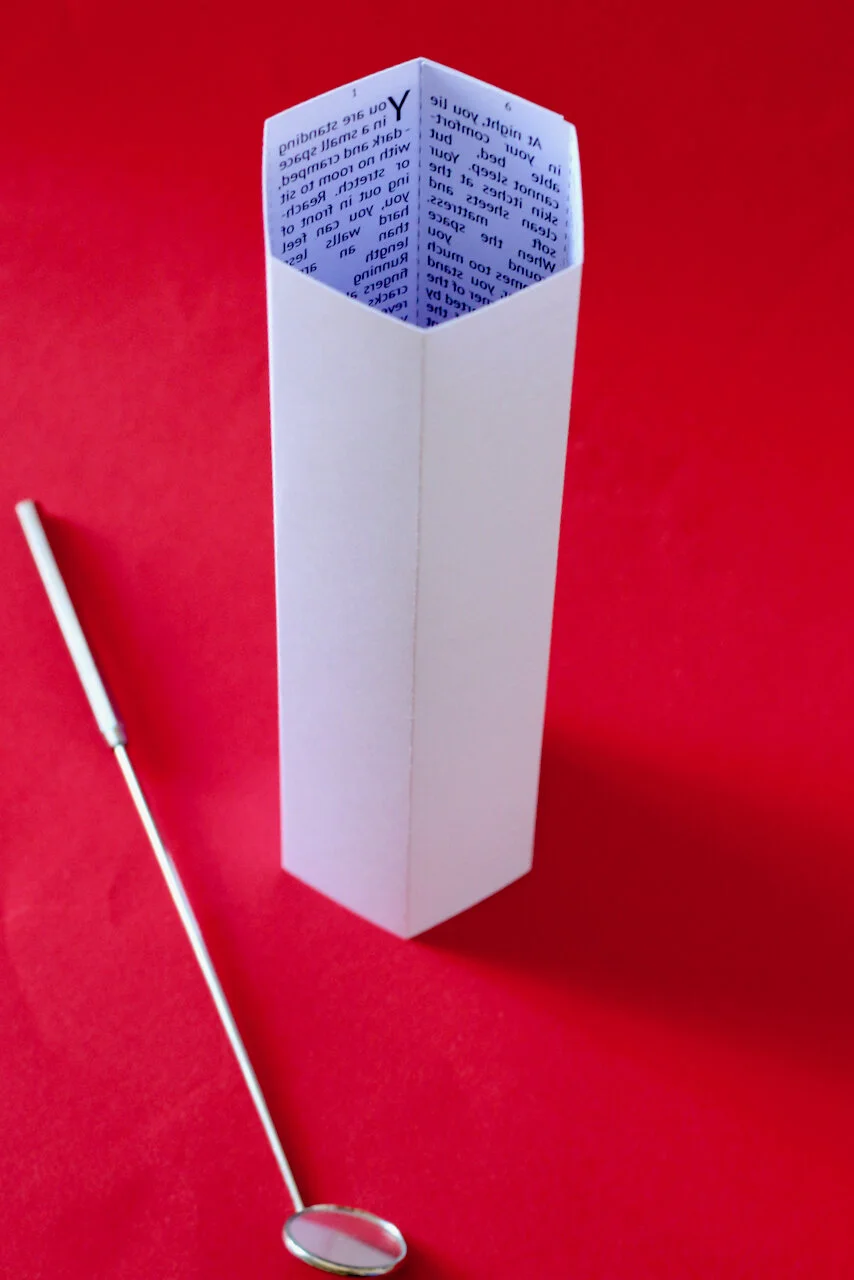
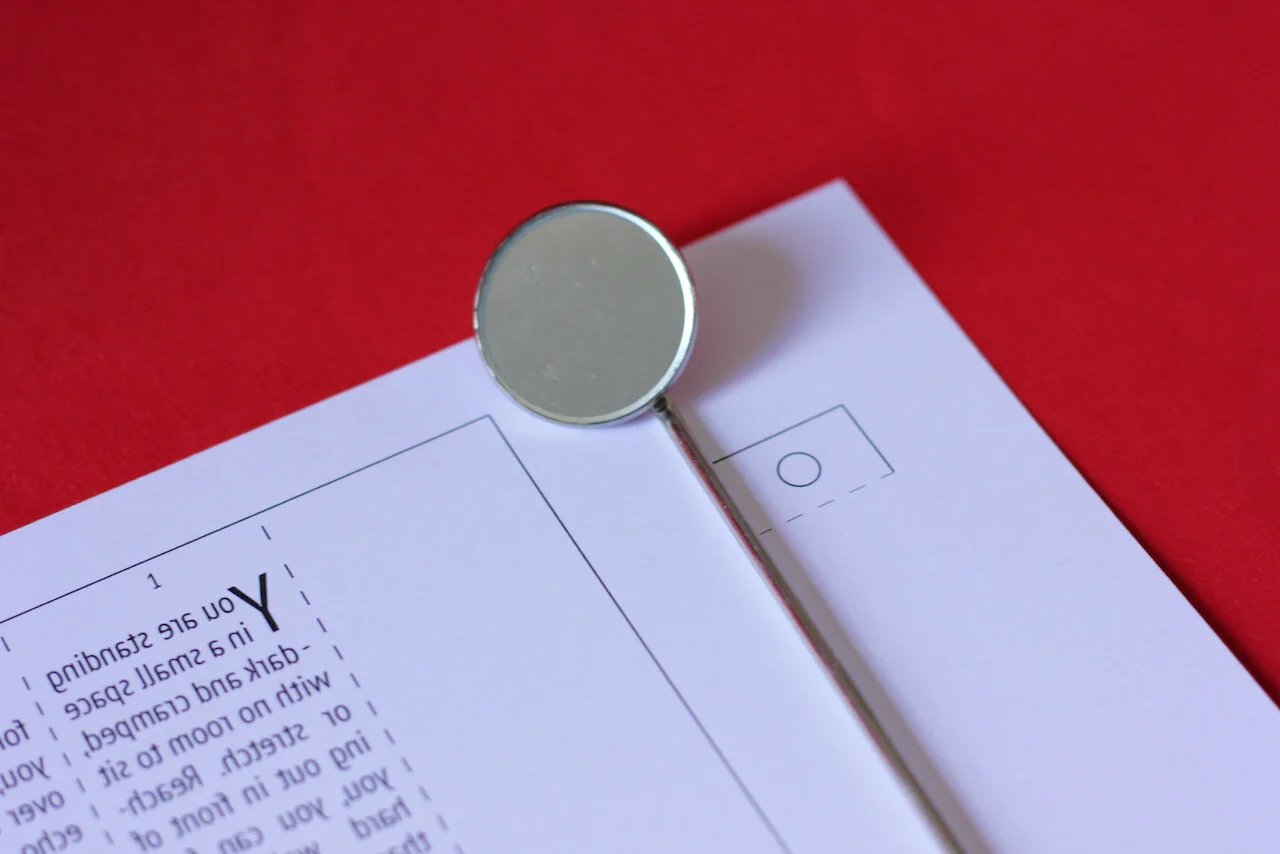
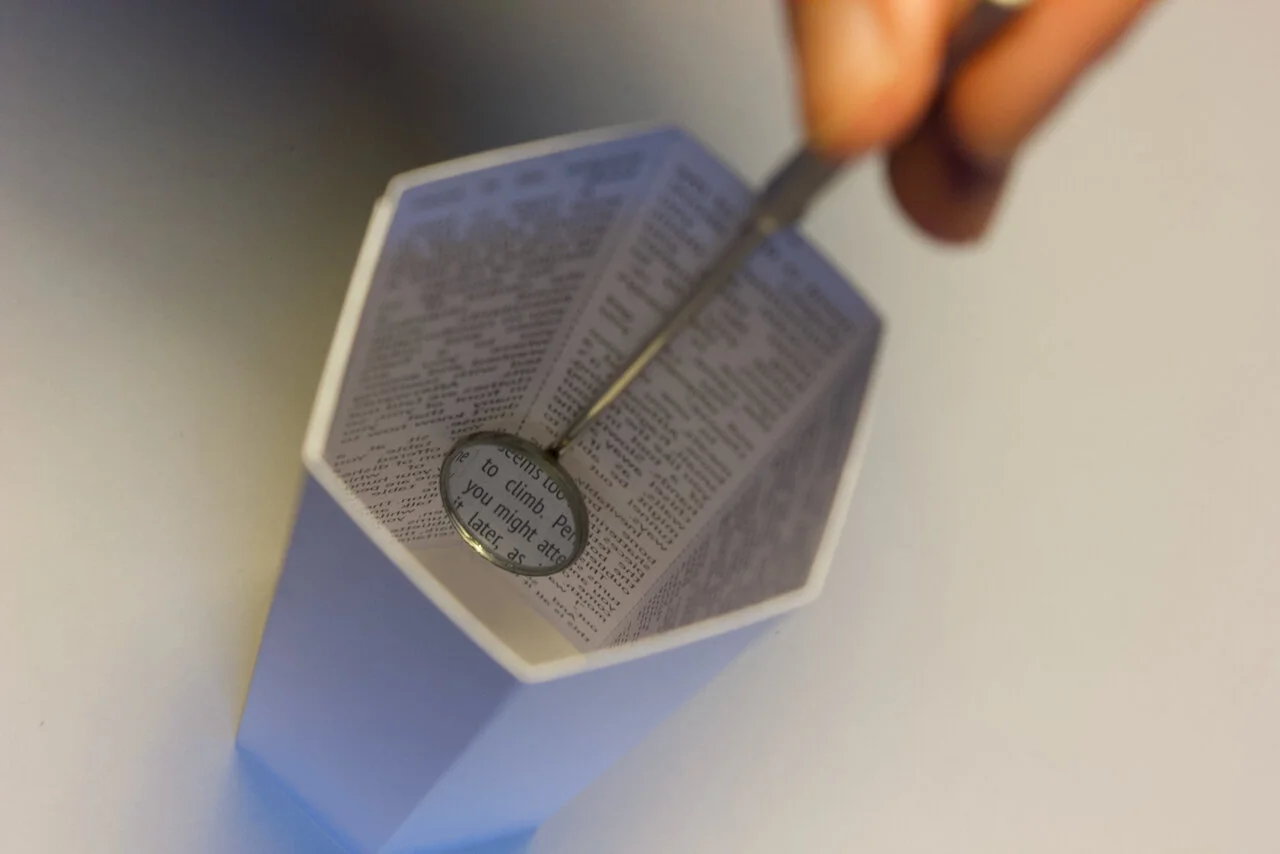
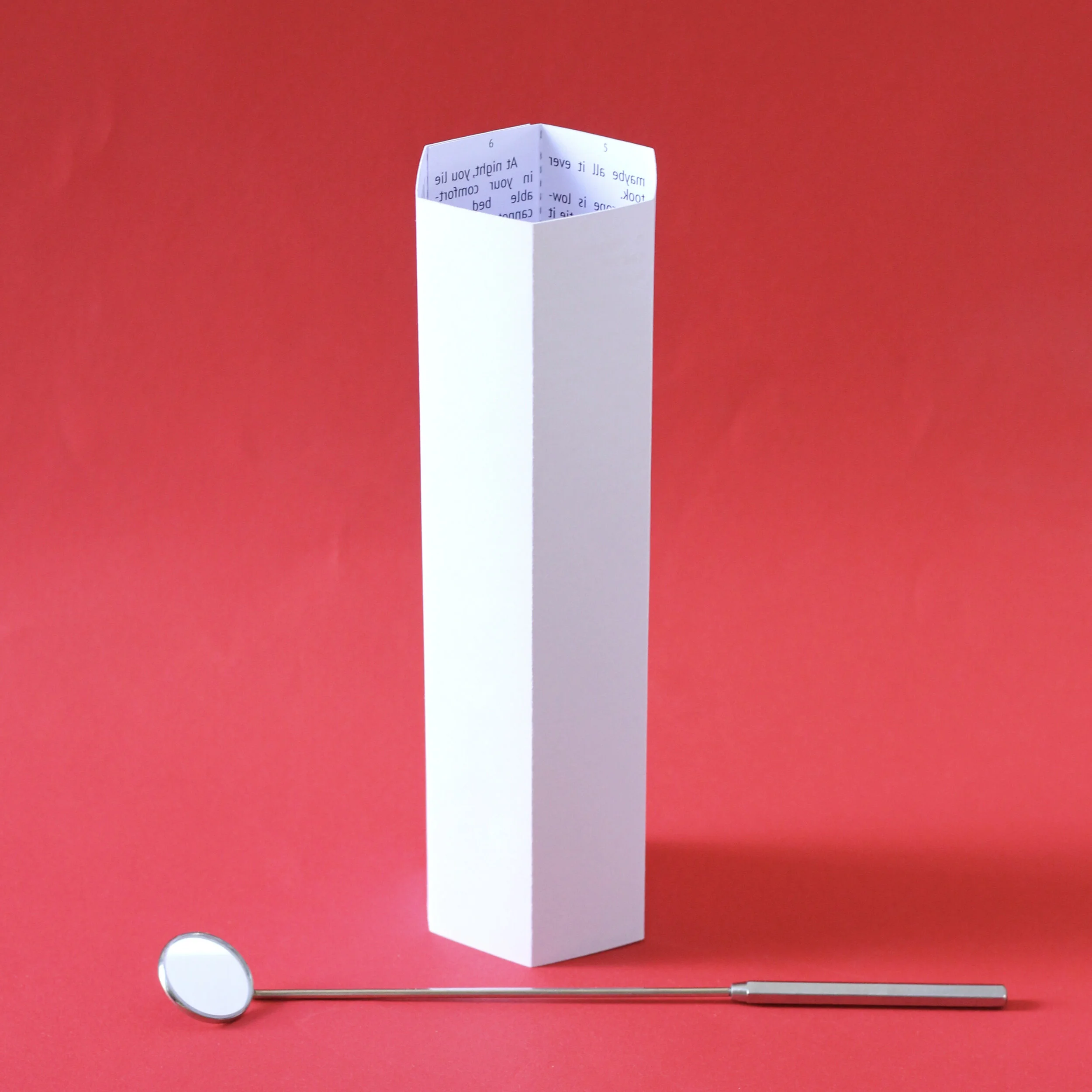
A free-standing short story about imprisonment, printed in reverse and read with a dental mirror.
This edition is pre-printed, scored and includes a professional-quality larangeyal mirror. Simple assembly required.
B&W, card
Overview
Oubliette is a story written on the walls of a free-standing vertical structure. The text is printed in reverse and must be read with a dental mirror.
Background
The first draft of Oubliette was written in 2020 as a short story exploring themes of constraint and freedom. The short (<1000 word) piece is sort of timeless and could be anyone and anywhere at any time. The use of second person perspective (“You”) is meant to put the reader directly at the bottom of the oubliette and directly understand the desire to get out and then, later, why someone might want to go back.
As I was experimenting more and more with putting text in physical forms other than flat pages, it seemed obvious to put ‘Oubliette’ in an oubliette. As reading the bottom lines would be difficult with the naked eye, I decided to print the words reversed so that they could be read with a long dental mirror.
A real oubliette has rounded walls, but mine would use a hexagonal cylinder as it would be able to lay flat. Initially, I wanted Oubliette to appear to be a thin book that would open up to reveal a pop-up structure inside. The first prototype was made from corrugated card, with text pasted on as strips of copy paper.
This prototype was documented in a short video which was uploaded to Youtube.
The first version was way too big, however, as the stem of the dental mirror wasn’t long enough to reach the bottom of the chamber. This made the text in the bottom sections unreadable.
A second version, scaled down to roughly A4 landscape, was made with grey board and coloured paper. While semi-authentic in its representation of the stone walls, the colour made it all feel a bit chintzy. I also couldn’t solve the problem of how to integrate a floor and a grille over the top. Various methods were tried, but none of them worked very well. Having them flap around, not really fitting or attaching to anything, made me hate the whole piece.
Trying to set the text took a few different approaches. I had wanted the reader to have to move the mirror both up and down the chamber walls to read the text. This proved even more confusing and although I had written the text, laid it out and constructed the piece even I couldn’t follow it. As the circular head of the mirror is only 25mm in diameter, the text was typeset as thin columns, first as one word per line, with two columns per wall.
Nothing was working very well, so I took things back to basics. I reduced the text to one column per wall, setting it in a condensed typeface that allowed for more than one word per wall. I also removed the lid and floor appendages and set the structure in simple white card of sufficient weight to stand, but also light enough to run through a printer. This one-sheet card has lines for cutting and scoring, but is a simpler and more elegant version of what came before. While this was the right move, I do sort of miss the more convoluted version. I’m sure there will be other stupidly complicated pieces in the future.
Staircase
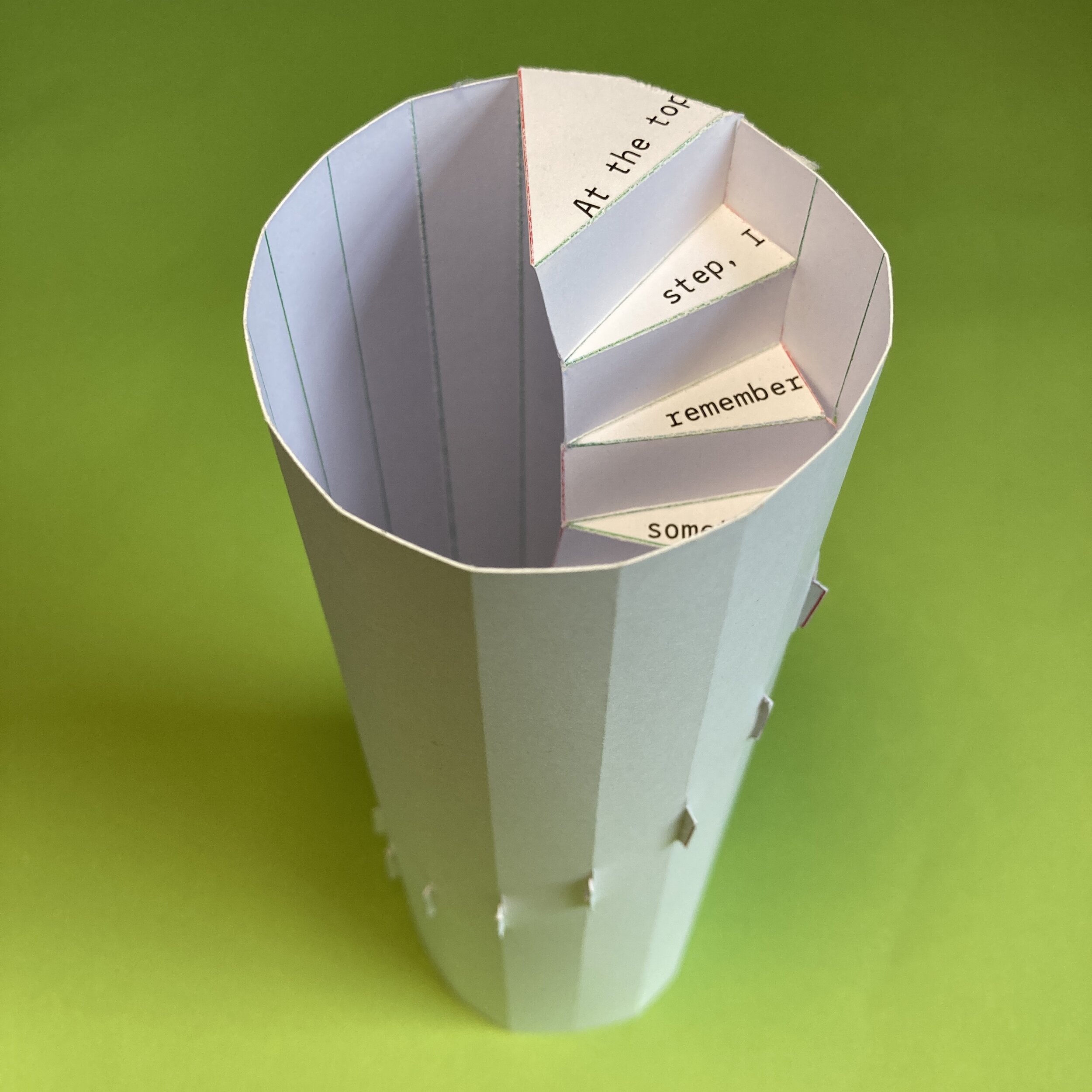
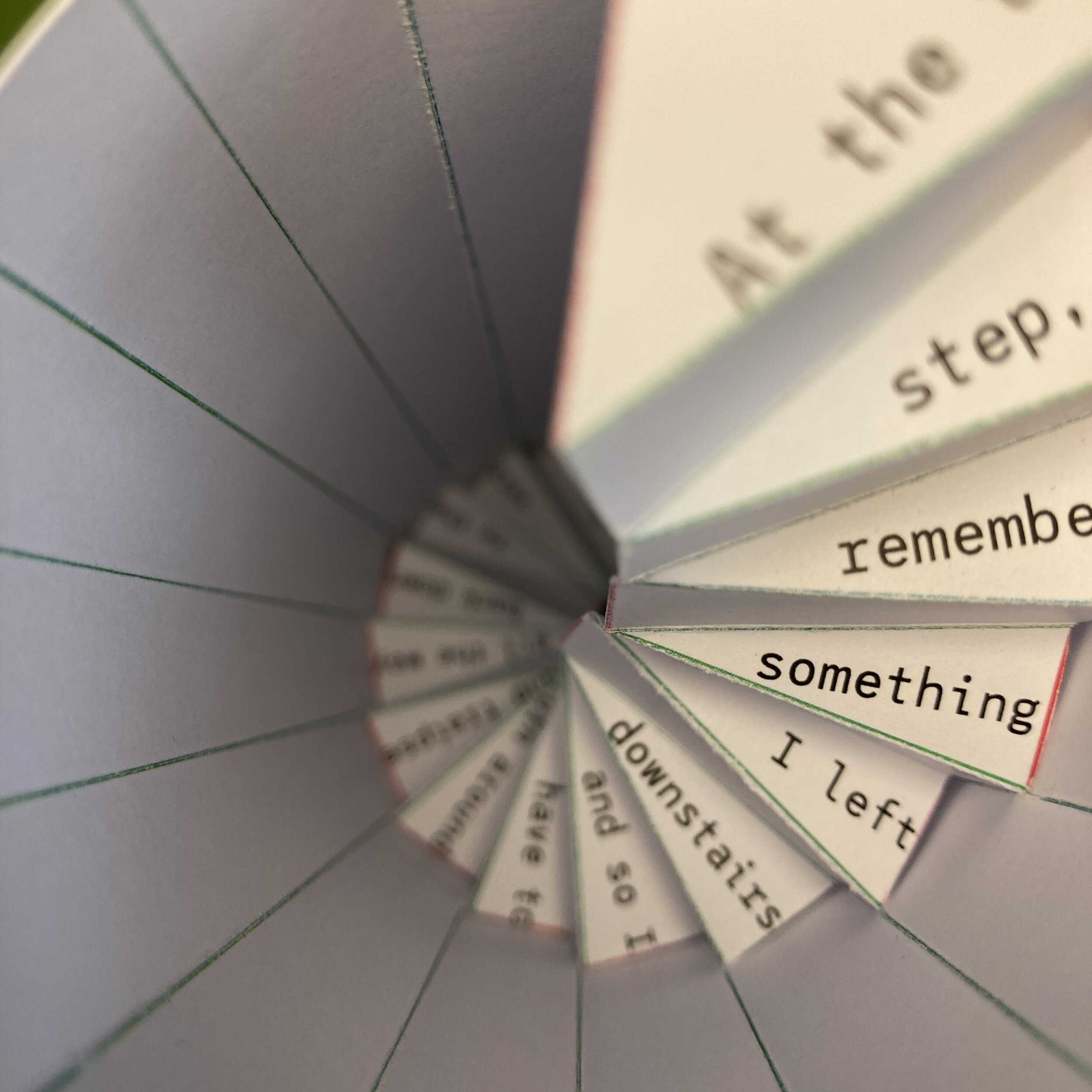
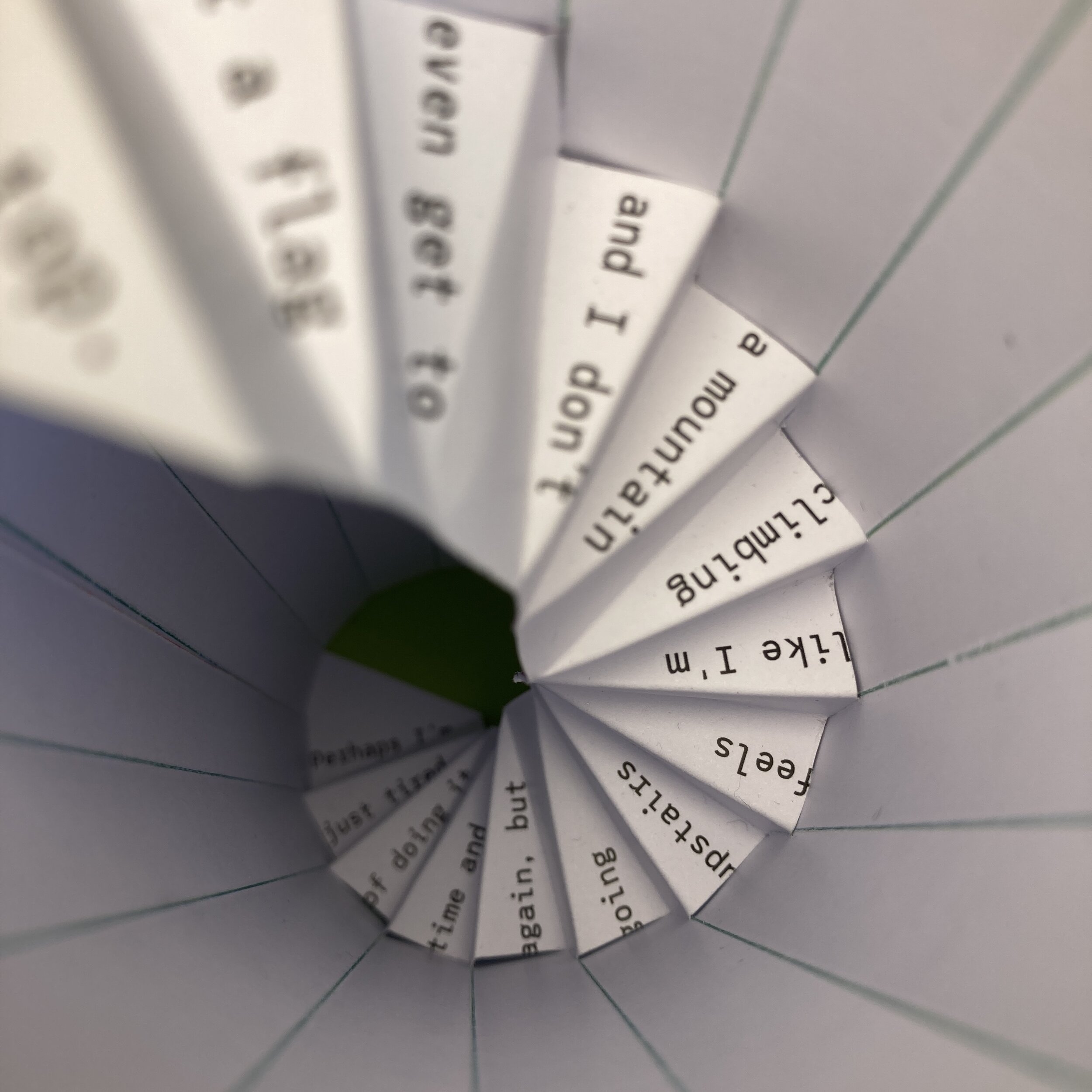
A story about going downstairs and back up again in an ever-descending/ascending spiral.
Cardboard, B&W
Overview
A story about going downstairs and back up again in an ever-descending/ascending spiral.
Background
Like a lot of people in the Coronavirus lockdowns, my usage of delivery services increased considerably. The distinct BEEP-boop of deliveries now provokes a Pavlovian response that sends me scurrying for my next treat. Our flat has a staircase down to the front door (although not a spiral one, sadly) and the process of hoofing down there to meet the postie has become all-too familiar.
It made me think about two-floor living. I grew up in maisonettes and the feeling of traversing the stairs, only to forget what you went up or down for is a very familiar one.
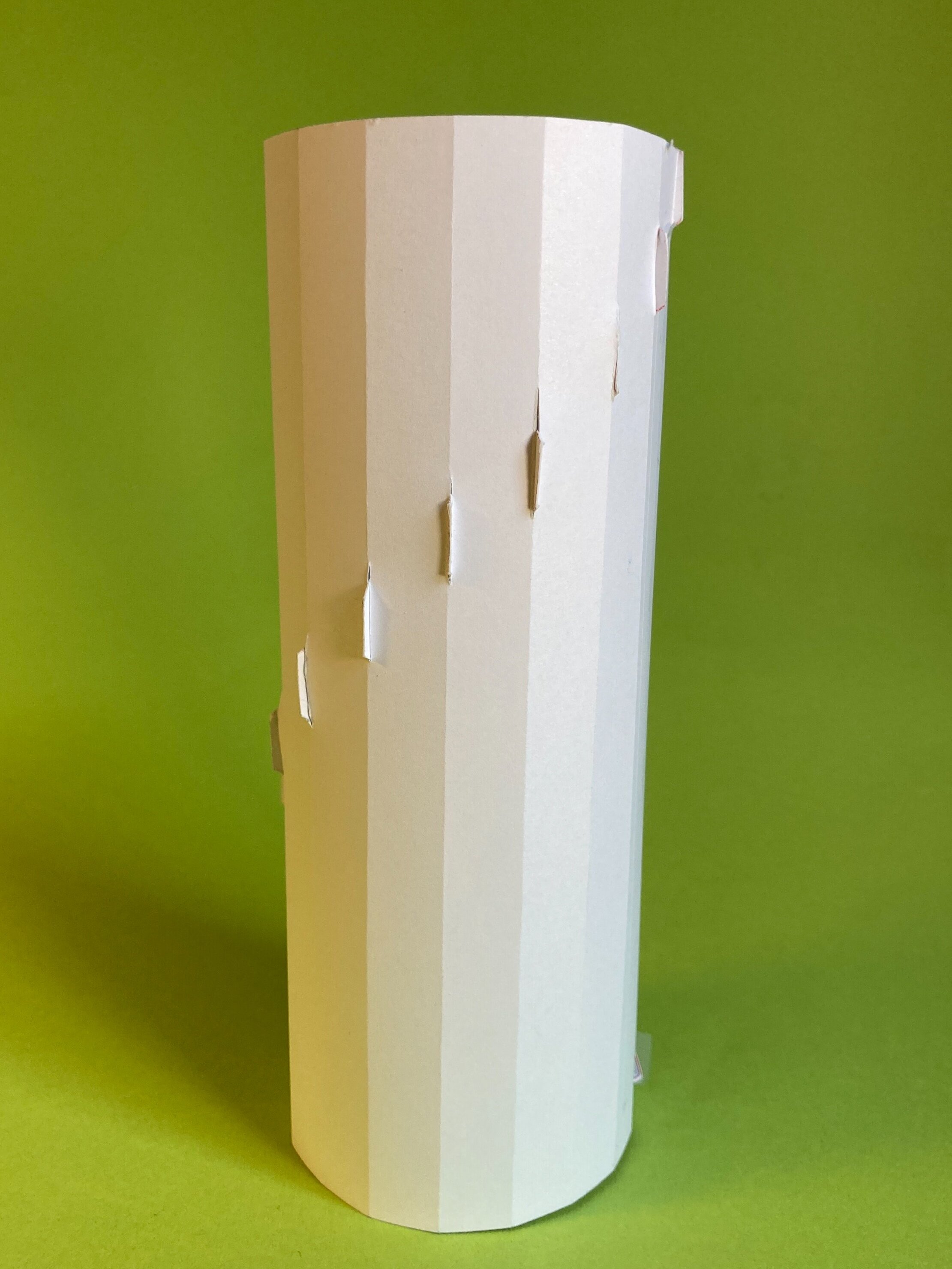
Building the structure was a mathematical challenge that was a bit beyond me. After several attempts to make the net by hand, I turned to Unfolder, a Mac app that transforms 3D models into 2D nets. I have dabbled with Blender and other 3D modelling programs for years now and although I wouldn’t call myself proficient in any way, they do come in handy sometimes. I managed to make a version of the staircase, unfolded it into a net and then added text manually.
Staircase is indicative of my increasing interest in looping narratives and stories contained in upright tubes.
Prismatics
A series of letters from a personality split by the colour spectrum.
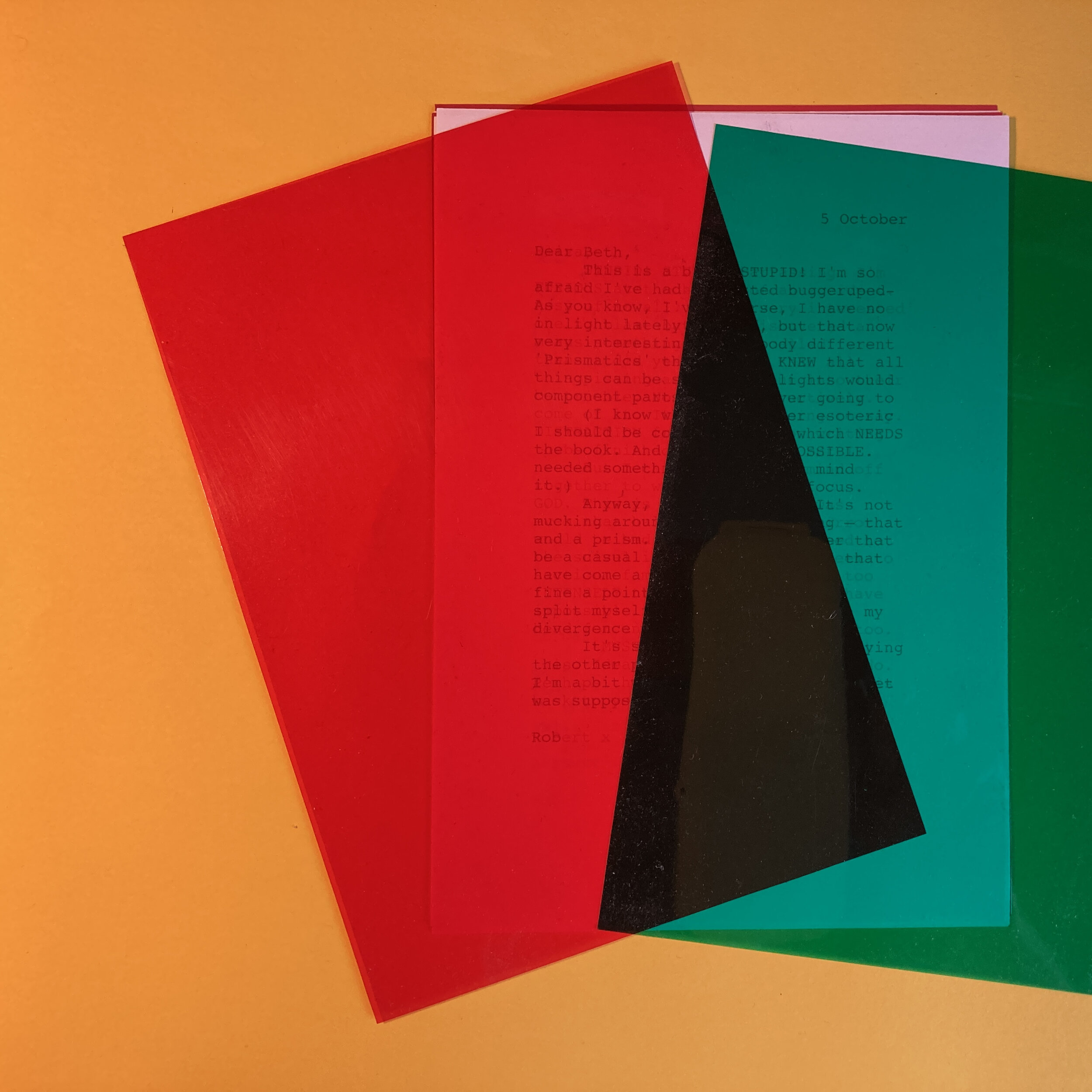
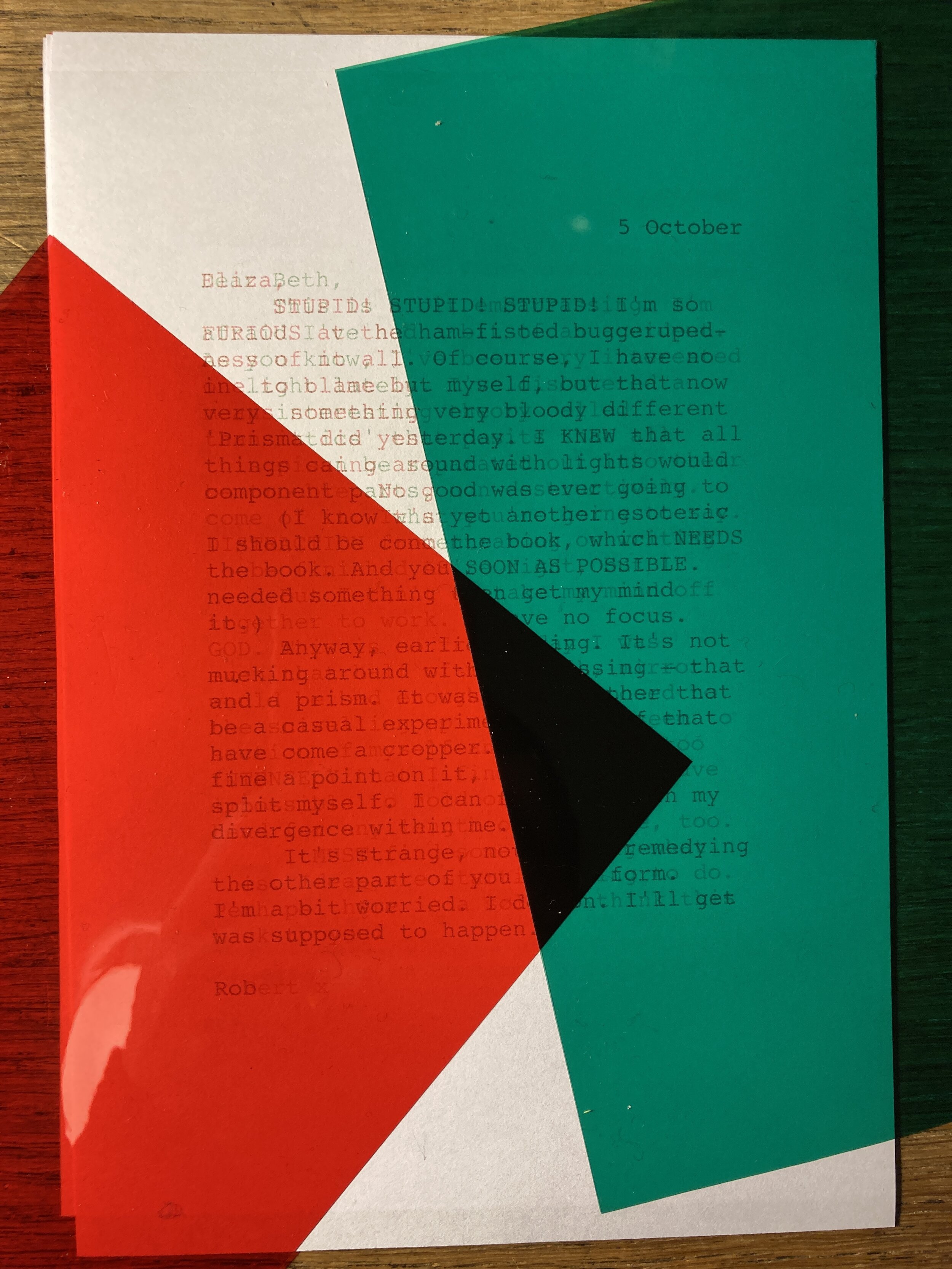
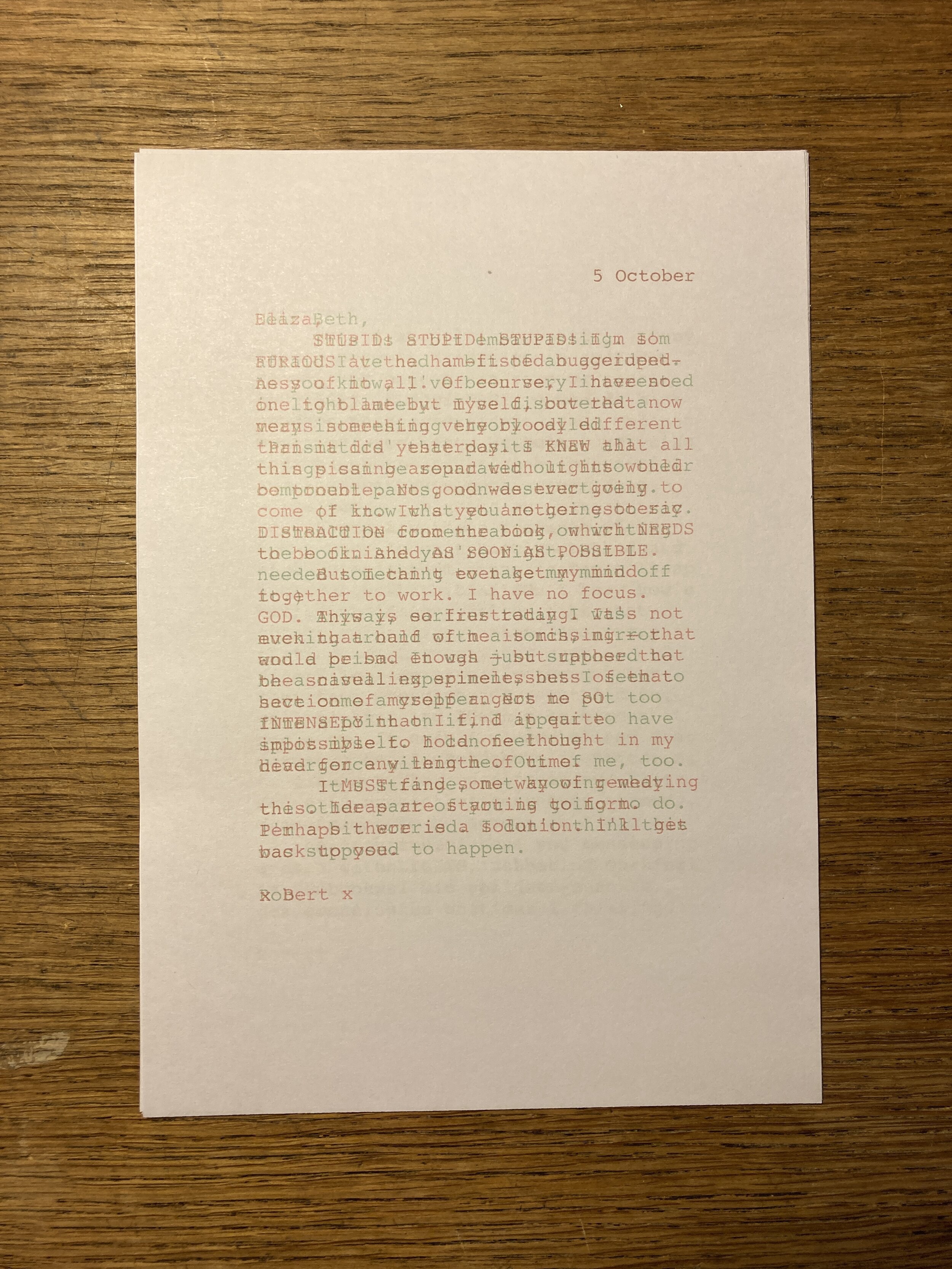
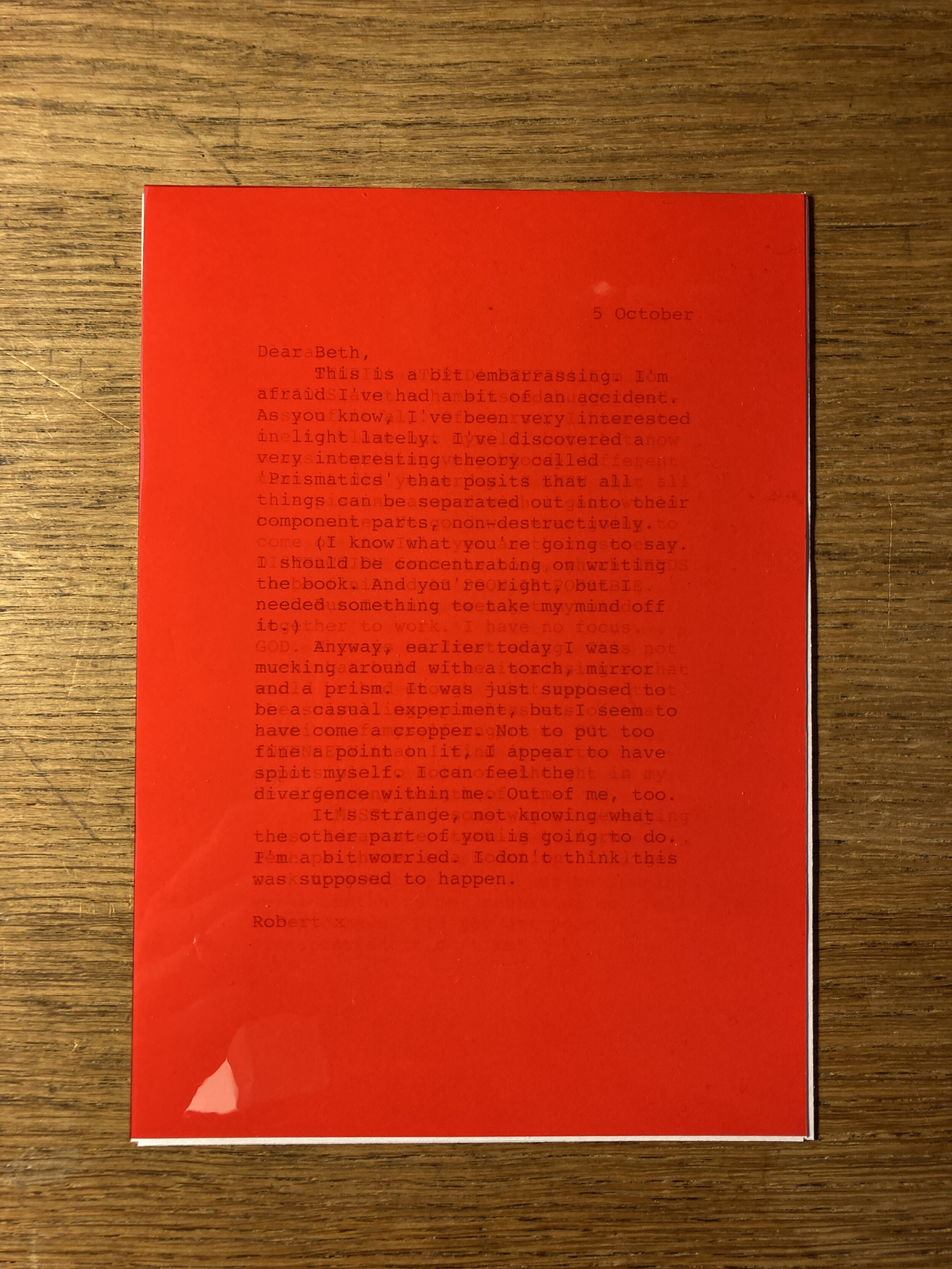
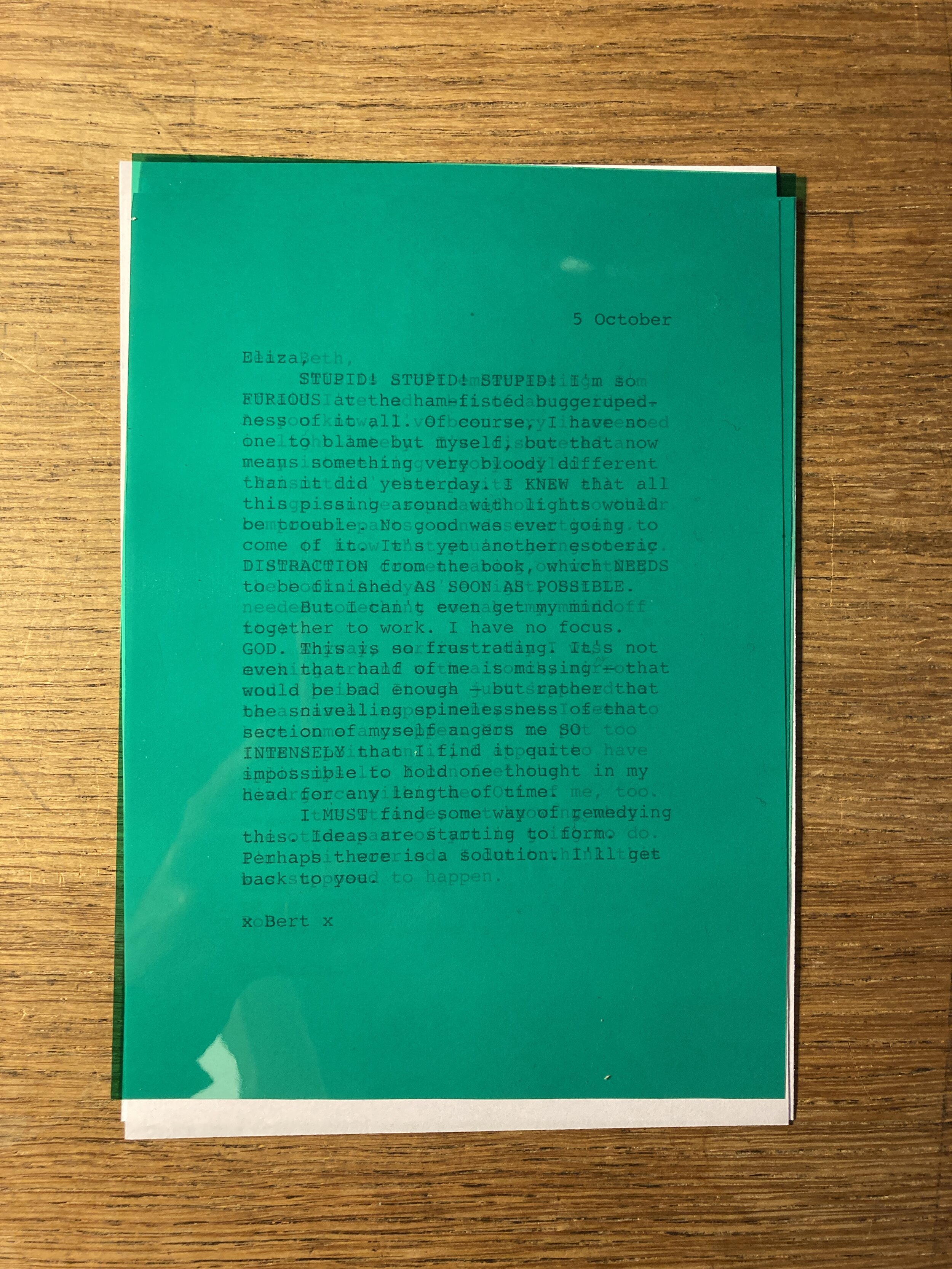
8pp, 2 colour printing, red + green coloured gels
Overview
Prismatics is an epistolary experiment. Eight letters, sent over the course of a few weeks, detail the splitting of one person into two and the conflict that brews between them. Each letter has two colour passes printed on the page, forming an unreadable jumble of letters. In order to decipher it the reader must use the enclosed coloured acetates, which filter out one of the two colours.
Background
This was not an easy piece to write. I knew what I wanted to do from a technical point of view - have two stories occupy the same space - but finding the appropriate story and tone took a while. A lot of my work is about finding the right combination of narrative and form. Often, I have one but not the other. The frustration in not being able to move forward found its way into the text - half of it, at least - and the clash between the two became the central tension running throughout the story.
Holiday Snaps
36 colour snapshots of almost every holiday ever.


A ZIP full of memories. 36 JPEGs of a holiday you may or may not have taken.
36 photographic prints, colour, 6x4”
Description
36 colour prints of text describing typical holiday photographs.
Background
I didn’t take a camera on holiday with me this year, because I didn’t want to be thinking about taking pictures. When I came back, I produced this instead. Rather than try and give an account of my holiday, I wanted to evoke a sense of all holidays. In some senses, it’s really generic, but there’s also a specificity.
As an experiment, I’m offering the first set of prints as an original artwork for sale.
I’m also offering a digital download of the JPEGs so anyone can create their own set of prints.