'The Charisma Machine: The Life, Death and Legacy of One Laptop per Child' by Morgan G. Ames
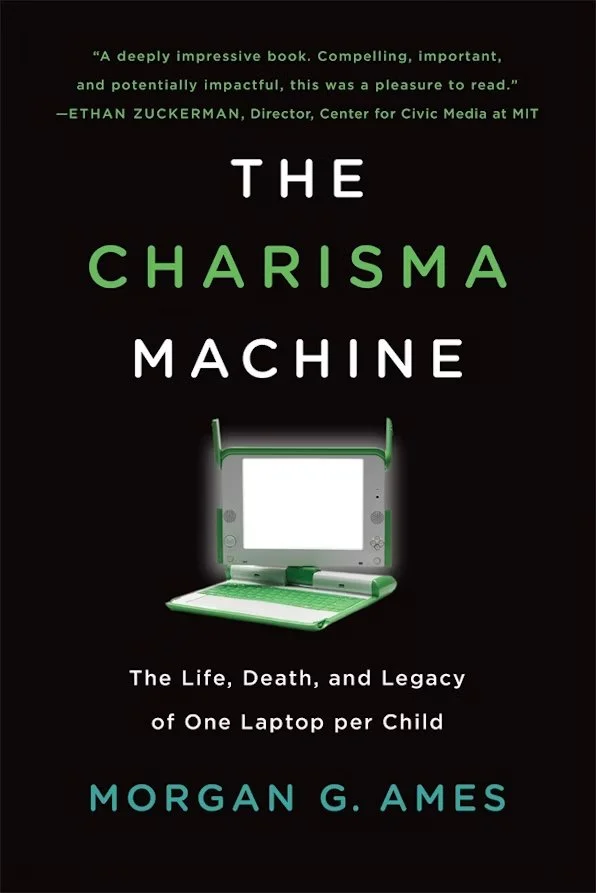
I was always fascinated by the One Laptop Per Child programme, both from an ideological point of view and as a piece of industrial design. I was never really convinced by the founders’ notion that cheap computers were the developing world’s path out of poverty, thinking that things like schools and clean drinking water were more of a priority. But the fact that it was so different a priority meant I tried to understand where they were coming from.
This study of the project takes the view that it was flawed from the outset, that the project leaders used their own, relatively privileged backgrounds, as justification for the project, without any real understanding of the actual social and economic factors at play. Put simply, they had prospered with computers, so thought that everyone else would, too. The author frames this as the archetype of the ‘technically precocious boy’ – a category I always thought I fit into when I was younger, until I met people who were actual examples. Being able to run a word processor on an Amstrad CPC wasn’t the same thing.
Anyway, this is largely an academic text, which brings with it some problems. The first of these is that it has a specific argument - that ‘charismatic’ technology is attractive and exciting, but often so much so that it blinds people to its actual utility or lack thereof - and goes about showing examples of its theory at work. If you’re studying the use of new technology in economically depressed environments, it’s useful to have case studies like these, but I honestly wanted a more general overview of the project. I’m a layperson, craving details about the organisation of the project and particularly the design process. Perhaps that’s the technically precocious boy inside me.
Adi Robertson had a good article on The Verge, giving a big-picture overview, but I would have liked more detail. I also would really still like to have a go on one. There’s an online emulator for its Sugar operating system and from the sounds it, the XO laptop had a number of recurrent hardware faults. Still, as the article says at the end, “I’ve still never seen anything like it.”
'The Charisma Machine: The Life, Death and Legacy of One Laptop per Child' by Morgan G. Ames is published by MIT Press (I got my copy off eBay, though)
‘Bitter Harvest’ by Ann Rule
I don’t read a lot of true crime. I’m not really sure why, as crime fiction makes up a reasonable proportion of my leisure reading. Perhaps I just prefer it to be made up. Still, I picked this up from the library as something to read on my week off. As I understand it, Ann Rule has a pretty good reputation for this sorry of thing - better, at least than a lot of the more salacious parts of the market and now that I’ve finished it, I can say it was… pretty good.
The thing about writing stories is that you come to understand their shape. I spent quite a lot of this book expecting a turn in the narrative. It never came, perhaps because it’s based on real life. They say that truth is stranger than fiction because fiction has to make sense. That’s sort of true, but I think it’s also worth mentioning that truth is often a lot more mundane than fiction. That, maybe, is the appeal of true crime. It’s not the glamour, it’s the mundanity.
(Also, can I just mention that the marketing on this cover is weird? “A mother’s sacrifice” is certainly one way of framing it.)
https://uk.bookshop.org/p/books/bitter-harvest-a-woman-s-fury-a-mother-s-sacrifice-ann-rule/4936811?ean=9780751579178
(It seems the iPad version of Squarespace doesn’t allow you to put links in blog posts. That can’t be true, can it?)
'Strange Houses' by Uketsu (trans. Jim Rion)
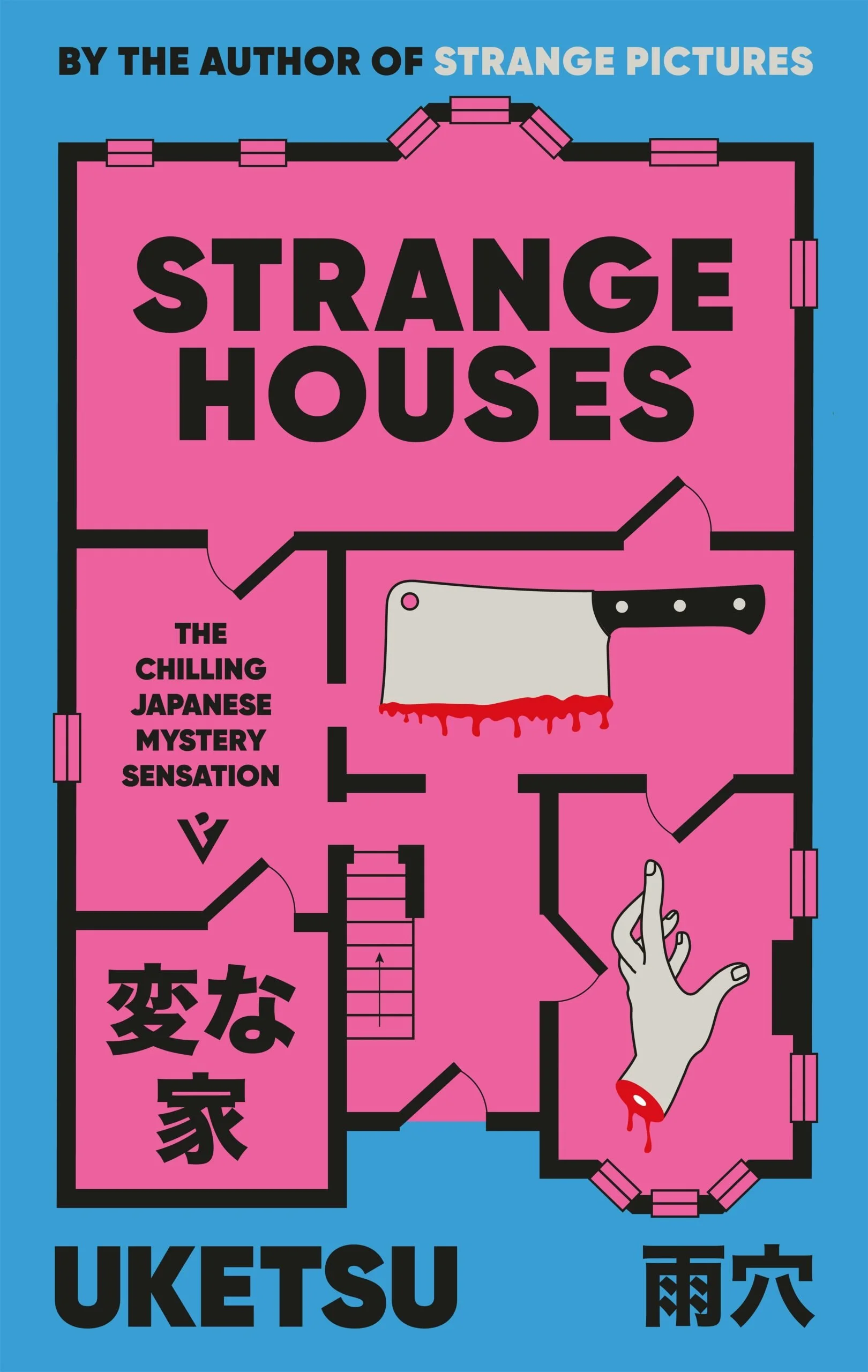
Conceptually, I love the idea of telling mystery stories through floor plans[1] and this Japanese book sets out to to exactly that. It begins by the author noticing a space between two rooms - a gap in the house that seems to serve no practical purpose - and expands from there, tracing a narrative through the arrangement of walls, windows and doors over several architectural floorplans. The design is functional and while I didn’t love the typesetting, it does manage to feel very different from a regular novel. I say that the cover design was very well done - simple and effective use of vectors by Luke Bird, although now I look at it I’m realising that actually I think I just like floorplans.
Sometimes I read a book in two sittings and somehow have managed to break at an inflection point. The first half of Strange Houses was inspired - a real story emerging from seemingly mundane details. Then the book goes into explanation of why these houses have been built this way and I kind of lost interest. There was a point at which family trees were introduced and I thought that this was going to be another kind of structure that would reveal details through odd interconnectedness, but it didn’t quite happen.
Most of the book is not told in standard prose fiction, but as scripted dialogues between participants and reportage of their movements. Later, when the story delves back in time, there are sections of regular prose, but contained within correspondence, a device that always feels somewhat inauthentic to me.
It’s a shame, because I would recommend the first half of the book without equivocation. I haven’t read the previous Strange Pictures, but skimmed it in the bookshop and it didn’t have the same appeal as the floorplans. I might get it from the library if it’s available, and hold out hope that the forthcoming Strange Buildings will concentrate more on buildings than world-building.
[1] I tried to do this with Proposal for the Elimination of Rick Burgess in my 52 Murders project, but feel that I didn’t quite nail it.
‘Invisible’ by Paul Auster
I picked this up in a closing down sale of a local independent bookshop, which was a shame. As nice as the shop was, its location meant it was probably doomed (in the basement section of a sparsely populated artisanal shopping centre, away from the high street). The fact that I can’t even remember the shop’s name is possibly significant. The fact that I also picked up a quite nice rug for my workroom there is probably less significant to anyone but me.
Anyway, I hadn’t read any Paul Auster in a long while, but remembered enjoying The New York Trilogy somewhat and The Brooklyn Follies somewhat more. There’s sometimes a satisfaction in reading a writer so established in their abilities that they can write pretty much anything and it comes out readable and moreish. I wouldn’t say this was one of his best, but I certainly didn’t expect the content of the book’s second part, which was caused a bit of a double take.
It’s also one of those books without quotation marks for dialogue. I’m trying to get to the bottom of this and decide whether it’s a contrivance or a sensible piece of efficiency. I think I might be too square to write dialogue without inverted commas.
'They' by Kay Dick / The fix-up novel

I had high hopes for this slim little novella and while it didn’t entirely live up to them, I’m still thinking about it a few days later. Set in a very English dystopia, the nameless, genderless protagonist moves between various friends of artistic bent as they resist an ill-defined but ominous presence. In this version of England’s green and pleasant lands, travel is restricted, people are disappeared and curtains are always kept close.
The ongoing sense of unease is countered by the beauty and idyl of the surroundings, making it possible to belive how the majority of the population would go along with the rise of ‘they’. It’s never described exactly who they are or what they stand for and while communication and artistic expression aren’t explicitly outlawed, there are measures in place to hinder such activities. Their mission is to create an atmosphere of oppression that is almost invisible, but which can be felt in every fibre of one’s being.
The foreword by Carmen Maria Machado uses a term I hadn’t heard before: the fix-up novel. Made up of a collection of previously published stories which share a shared world and may be connected in the very loosest sense, but are connected.
(To be clear, Machado uses the phrase to say that ‘They’ is not a fix-up novel, but the idea is interesting to me. I will say, though, that ‘They’ worked better for me as it drew to the conclusion when it felt like it was pulling in a particular direction.)
The novel was out of print for many years and has been recently re-released by Faber Editions.