‘Katabasis’ by R.F. Kuang
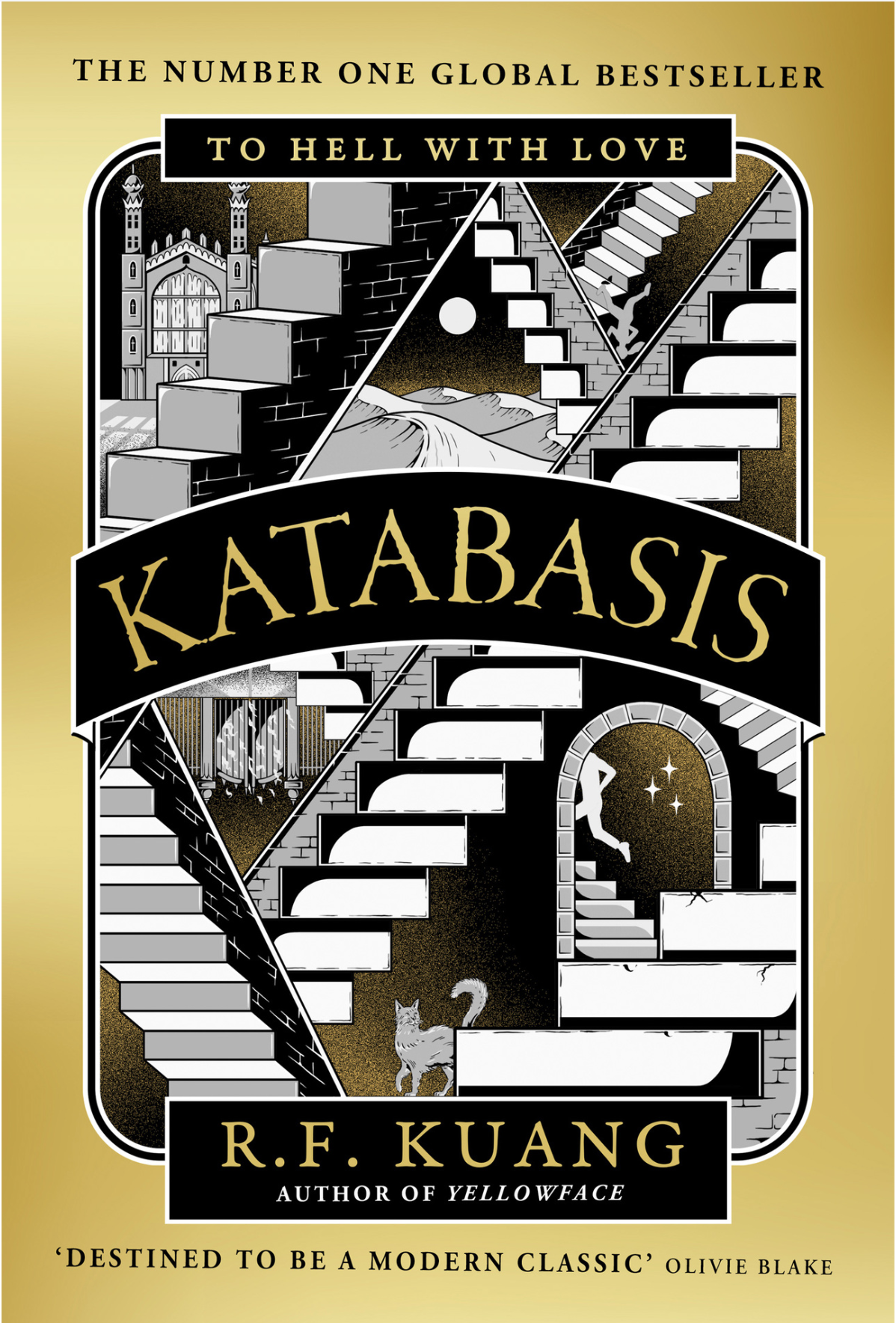
Magic is bollocks. While I appreciate that some people view it with wonder and that it can be very profitable if you do it right (cough Rowling cough) it always struck me as something of a cop out. A situation emerges and with a wave of the hand it can be solved. Cheat! Cheat!
But, I’ll admit, the system of magic used in Katabasis is elegant and appealing. It’s based around paradoxes, expressed in chalk pentagrams on the ground. A spell to compel someone to tell the truth would use a spell based on “this statement is a lie” and it all spins out from there.
The main story is about Cambridge academics going through the circles of hell to rescue their professor who they accidentally killed. I like a good Hell story, and reading this made me realise how little of the reading around the subject I did before writing Six Six Six. But, y’know, these are Cambridge academics and I drank my way to a 2:2 in Manchester, so perhaps that explains that.
(Speaking of which, I did find it… interesting that the only people they seem to find in hell are other Cambridge academics. I couldn’t tell if this myopia was deliberate or not. It reminded me of a superhero novel [which I think was Austin Grossman’s Soon I Will Be Invincible] where it just so happened that all these amazing characters went to Harvard. I have a theory that writers who went to elite universities tend to write about their amazing friends because they’re too scared to write about their families, but that’s probably just my own biases coming out.)
Anyway, I thought Katabasis was fun. It lost a bit of steam in the final third, but whatever. I’m now of the opinion that magic is mostly bollocks.
Excerpts
Magick, the most mysterious and capricious of disciplines, admired for its power, derided for its frivolity, is in brief the act of telling lies about the world. What magicians of ancient civilizations discovered through accident and ingenuity, and what the English philosopher-magicians of the eighteenth century onward codified into the Euro-American received canon, was that the natural laws of the world were set but fragile. You could cleverly reinterpret them. For brief periods of time one could even bewilder and suspend them, so long as you spun the right web of untruths. Linguistic trickery, logical conundrums, it all worked. All you had to do was find a set of premises that, even if just for a split second, made the world seem other than what it really was. The chalk, and whatever remnants of living-dead magical energy lay in the pulverized shells of those sea creatures that perished millions of years ago, did the rest. p17
(Honestly, there’s much more other stuff I could and should have extracted in the first 200 pages, but I forgot that was a thing I did, so take it from me that there’s interesting stuff about magic and hell and reincarnation there)
Alice, in turn, taught him about Chinese acrostic poems—written so as to be intelligible no matter which direction you read them in. p208
“Well, I think the biggest misconception about Buddhism is that karma functions as this grand tally that you count up at the end of the day.” Elspeth waved a hand. “But it’s not like you get five hundred good points and eight hundred bad points, so that in Hell you have to account for a net three hundred deficit. It’s nowhere so neat. Karma is more like—hm. You might say karma is like a seed. Seeds grow into fruit. Karma is a natural consequence. Badness accrues. It affects the way you live your life, how you perceive the world. When you do evil things, you see the world as petty and selfish and cruel. And what you experience in Hell is just the final ripple effect of your original evil. You get precisely what you asked for. And I think the whole point of Hell is to show you the full extent of what you wanted.” p281
Science just meant failure, as Thomas Edison had shown; science meant knowing when to cut your losses and start over and accumulate new funding, new hypotheses, new materials and ideas. You could always go to bat again, if you knew how to play the game. You could always come up with something else. p298
Body sated, mind cleared, she unfortunately began to think. p385
“The bazaar is built to distract,” said Gradus. “This is Lord Yama’s design. There’s a million things to keep a soul from writing, all in the service of making you better at it. Remember that, Alice Law. Hell is a writers’ market.” p415
“Pain is interesting, and you can bear anything as long as it’s interesting.” p427
My name is Alice Law. Sometimes I am very clever but most of the time I am not. I have been a good person sometimes, and a bad person at others. Sooner or later I will die. But before I do, I will try—I will try very hard—to make it count. p453